
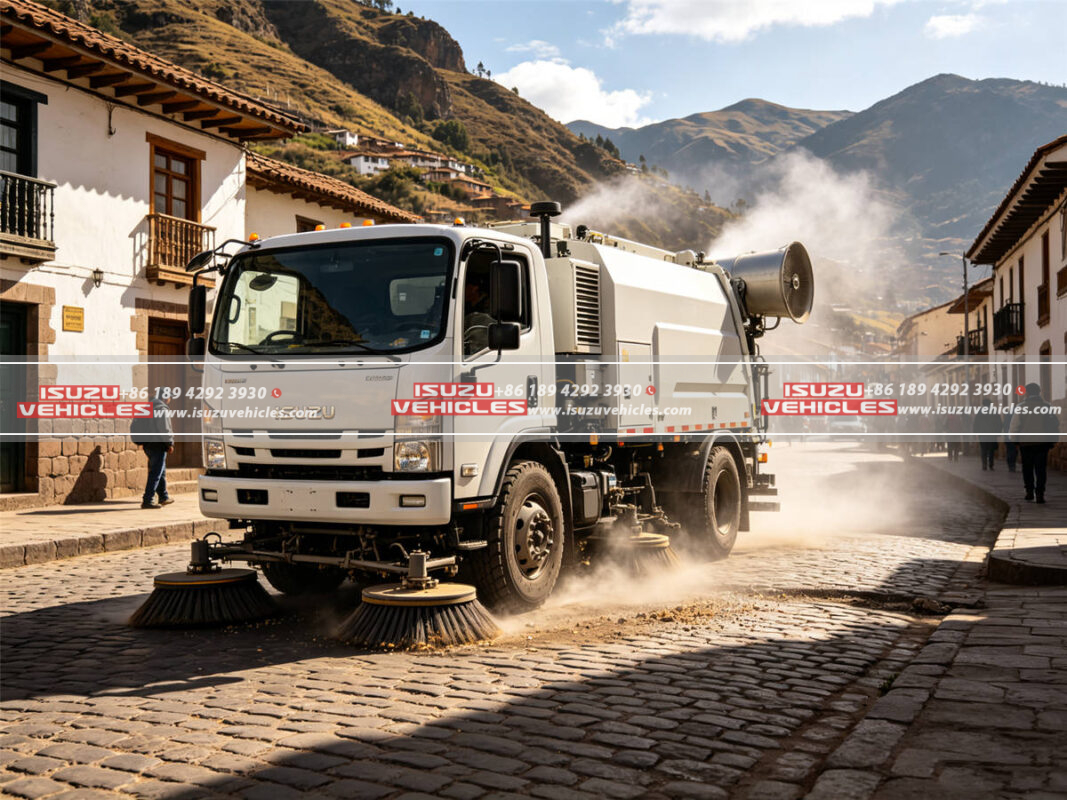
The delivery of new ISUZU Sweeper Trucks to Cusco, Peru, provides a practical sanitation solution for maintaining streets and public areas surrounding some of the world’s most valuable cultural heritage sites, where cleaning efficiency must be balanced with respect for historic architecture, tourism activity, pedestrians, and the character of the surrounding urban environment. The contract was made between ISUZU Vehicles and a major local company in Peru, with the customer selecting specialized sweeping vehicles to strengthen its municipal and environmental maintenance capabilities. With their integrated brushing, suction, and dust-control systems, the trucks are designed to support cleaner streets while their relatively controlled operating noise makes them particularly suitable for sensitive areas where excessive disturbance should be avoided.
1. Professional Street Cleaning Around Cusco’s UNESCO Heritage Environment
Cusco is internationally recognized for its exceptional cultural and architectural heritage, with the historic city and its surrounding archaeological landscape forming an important part of Peru’s identity and tourism economy. In such an environment, road and public-space maintenance requires more than simply removing visible debris, because cleaning operations must also protect the appearance of historic streets, reduce airborne dust, and maintain a pleasant environment for residents, visitors, businesses, and workers without interfering unnecessarily with the surrounding heritage atmosphere.
The ISUZU Sweeper Truck provides a dedicated solution for these requirements by combining mechanical brushing and suction into a mobile cleaning platform that can operate across urban roads, public areas, access routes, and other frequently used surfaces. ISUZU’s sweeper range is designed for urban streets, industrial zones, and municipal environments, with different configurations available for routine cleaning, dust suppression, and large-area sanitation operations.
For a city such as Cusco, where streets can experience intensive pedestrian and vehicle activity while remaining closely connected to historic buildings and tourist routes, dependable cleaning equipment can help local service providers maintain public areas without relying entirely on manual cleaning methods.
2. Low-Noise Sweeping Helps Protect the Character of Historic Areas
One of the most important considerations when operating cleaning equipment around heritage locations is the balance between productivity and environmental sensitivity. Heavy machinery can potentially create unnecessary disturbance when working close to hotels, restaurants, residential neighborhoods, archaeological attractions, museums, plazas, and historic structures, so equipment designed for controlled urban operation can provide a meaningful advantage.
Quiet Operation for Sensitive Urban Spaces
The low-noise operating concept of the delivered ISUZU Sweeper Trucks is especially valuable in locations where sanitation work takes place close to pedestrians and culturally important surroundings. An ISUZU 4 CBM road sweeper, for example, is specified with an external accelerating noise level of no more than 84 dB(A), while its compact dimensions and controlled sweeping speed make it suitable for urban cleaning environments where maneuverability and operational control are important.
Controlled Cleaning Without Compromising Productivity
Low-noise operation does not mean sacrificing cleaning capability, because the sweeping system can combine rotating brushes, suction, and dust suppression to collect road debris efficiently. Current ISUZU configurations provide sweeping widths around three meters, while larger models can achieve high cleaning capacities for roads and larger public areas. For example, the ISUZU 6000 Liter Road Sweeper is designed with a 3,000 mm sweep width and a cleaning capacity of 9,000–60,000 square meters per hour, demonstrating how specialized equipment can combine productive operation with controlled urban cleaning.
3. Integrated Sweeping and Suction for Cleaner Heritage Streets
The value of a modern road sweeper lies in its ability to perform several connected cleaning tasks within a single vehicle, which can reduce the need for separate equipment and simplify daily sanitation operations. Brushes first loosen dust, sand, leaves, and other debris from the road surface, while the suction system collects the material into the vehicle’s debris tank, allowing the cleaning process to continue without leaving loose waste behind.
This integrated approach is particularly useful in Cusco because historic streets and public areas can contain a mixture of fine dust, leaves, sand, roadside debris, and other materials generated by normal urban activity. The ISUZU 5 CBM Street Sweeper, for example, uses hydraulic-motor-driven brushes, a floating suction nozzle, dust suppression equipment, and a multi-stage vacuum filtration system, creating a comprehensive cleaning process rather than relying on brushing alone.
For larger routes, the ISUZU 12 CBM Road Sweeper combines sweeping, suction, flushing, and dust suppression functions, while its hydraulic brush system and adjustable sweeping width allow operators to adapt the vehicle to different road-cleaning requirements. This flexibility gives the local operator more options when maintaining streets with different surface conditions and traffic patterns.
4. Supporting a More Complete Urban Sanitation Fleet
The new sweeper trucks can become an important part of a broader environmental service fleet rather than functioning as isolated cleaning machines, because comprehensive urban sanitation involves several different operations that cannot always be handled by one type of vehicle. Sweeping removes surface debris and dust, waste collection handles household and commercial refuse, while specialized suction equipment addresses sewage, sludge, liquid waste, and difficult-to-remove material.
For this reason, the customer can complement its new sweepers with dedicated ISUZU garbage truck models for organized refuse collection and transportation. The current ISUZU garbage truck range includes rear-loader, side-loader, hook-loader, skip-loader, compactor, and roll-off configurations, providing different solutions for municipal and commercial waste collection requirements.
For drainage and liquid waste management, the ISUZU vacuum truck range offers specialized vehicles for sewage, sludge, sewer cleaning, and liquid waste removal. These vehicles can complement street sweepers by handling sanitation tasks that require vacuum suction rather than mechanical sweeping, helping create a more comprehensive cleaning strategy for the city and surrounding service areas.
5. ISUZU Vehicles Supports the Long-Term Protection of Cusco’s Urban Environment
The delivery of ISUZU Sweeper Trucks to Cusco demonstrates how modern commercial vehicles can contribute to the responsible maintenance of culturally significant urban environments, where cleanliness, operational efficiency, environmental awareness, and respect for heritage must work together. By providing controlled sweeping, suction, and dust suppression capabilities, the trucks give the local customer a professional tool for keeping streets and public spaces cleaner while supporting an operating approach that is better suited to sensitive urban locations.
More broadly, the project illustrates how effective sanitation depends on cooperation between different types of specialized equipment. A garbage truck can collect and transport solid waste, an ISUZU vacuum truck can support sewer and liquid-waste cleaning, and the delivered sweeper trucks can continuously remove dust and surface debris from roads and public areas. Through these complementary solutions, ISUZU Vehicles helps local operators build stronger municipal fleets that can support cleaner streets, quieter public environments, and the responsible preservation of the remarkable heritage surroundings of Cusco.