
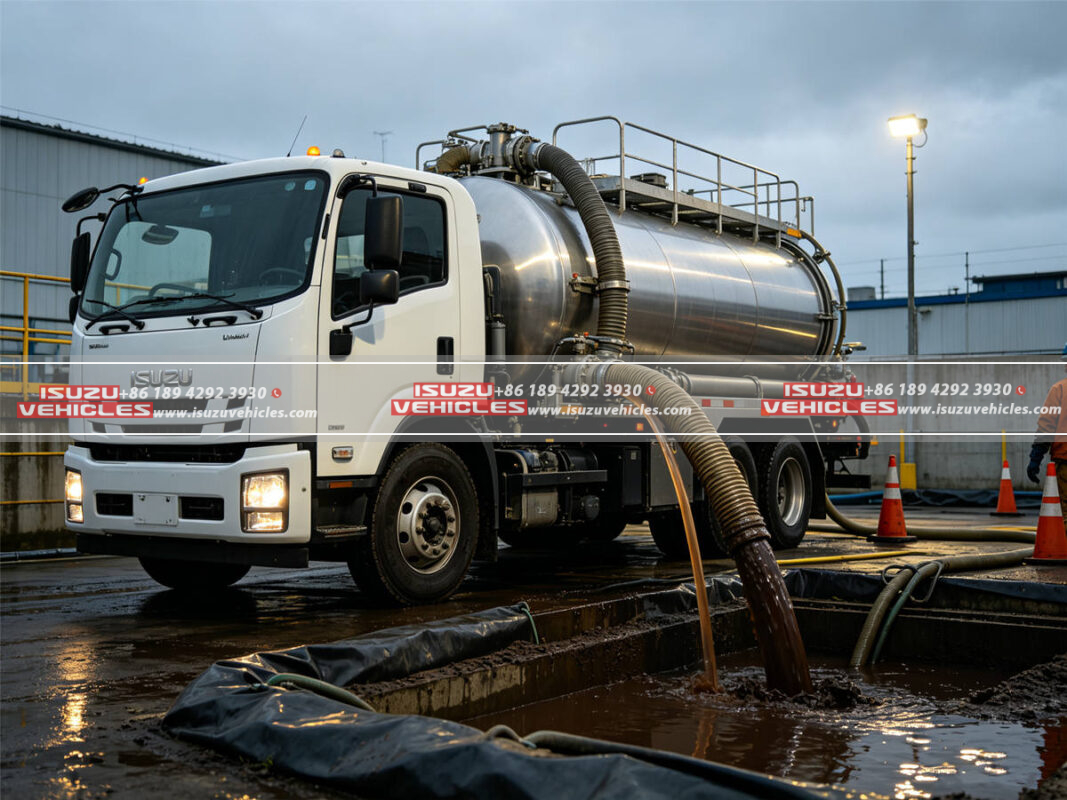
Hazardous sludge is one of the more demanding materials encountered in industrial cleaning, wastewater treatment, environmental maintenance, and emergency response operations. Unlike ordinary wastewater or septic sludge, hazardous sludge may contain toxic chemicals, heavy metals, hydrocarbons, corrosive substances, biological contaminants, or other materials that require careful containment from the moment they are collected until they reach an approved treatment or disposal facility. This naturally raises an important question for fleet operators and environmental service companies: can an ISUZU vacuum truck safely handle hazardous sludge?
The short answer is that an ISUZU vacuum truck can be configured for demanding sludge and liquid-waste applications, but the vehicle should not automatically be considered suitable for every type of hazardous material simply because it has a powerful vacuum system. The actual suitability depends on the characteristics of the sludge, the tank construction, vacuum equipment, hoses, valves, filtration and contamination-control requirements, as well as the regulations governing hazardous-waste transportation in the country where the truck will operate.
ISUZU Vehicles currently offers a broad vacuum and sewer truck range, including vacuum sewer trucks, liquid waste tankers, combined sewer jetting trucks, cesspit emptiers, and dry vacuum configurations. The product range is designed for liquid waste, sludge, sewer maintenance, industrial cleaning, and related environmental-service applications.
1. What Makes Hazardous Sludge Different from Ordinary Sludge?
Before discussing the truck itself, it is important to understand why hazardous sludge requires more attention than conventional sewage or wastewater. Sludge is essentially a mixture of liquid and solid materials, but its physical and chemical characteristics can vary enormously depending on where it comes from. Sludge collected from a municipal wastewater treatment plant may be relatively predictable, while material from a chemical factory, refinery, metal-processing facility, contaminated drainage system, or industrial spill can contain substances that create serious risks for workers, equipment, and the surrounding environment.
Potentially Dangerous Contaminants
Hazardous sludge may contain petroleum products, solvents, acids, alkalis, heavy metals, toxic organic compounds, pathogens, or other contaminants. Some materials may be corrosive, while others may release hazardous vapors when disturbed or exposed to air. Certain sludges can also contain abrasive particles that accelerate wear inside pumps, hoses, valves, and tanks.
For this reason, the first question should not simply be whether a vacuum truck has enough suction power. Operators need to determine what the material actually contains and whether the complete vehicle configuration is compatible with that material. A vacuum pump that is perfectly appropriate for sewage may require additional protection or a different configuration when used for aggressive industrial sludge.
Containment Is the First Priority
When hazardous sludge is collected, preventing leakage and uncontrolled release is more important than simply achieving high suction performance. The tank, piping, valves, hose connections, access covers, and discharge system all form part of the containment chain. A failure at any one of these points can create an environmental incident, which is why hazardous-sludge applications should always be evaluated as a complete system rather than by looking at the vacuum pump alone.
2. How Does an ISUZU Vacuum Truck Collect Sludge?
An ISUZU vacuum truck uses negative pressure generated by a vacuum pump to draw liquid, sludge, slurry, and other compatible materials through a suction hose into a dedicated tank. This approach eliminates much of the manual handling normally associated with sludge removal and allows operators to collect waste from septic tanks, drainage systems, industrial tanks, wastewater facilities, pits, and other difficult-to-access locations.
For example, one current ISUZU vacuum sewer truck specification uses a Weilong/JUROP vacuum pump with a flow rate of approximately 6,000–35,000 liters per minute and an ultimate pressure of -97,000 Pa. The truck is equipped with an 8-meter standard suction hose, dual shut-off valves, an oil-water separator, and a 5,000-liter Q235B carbon-steel tank.
High Suction Capacity Helps with Thick Sludge
Sludge is often considerably more difficult to move than clean water because of its higher viscosity and solid content. A properly selected vacuum system provides the negative pressure necessary to draw material through the hose, while the hose diameter, hose length, pump characteristics, and material consistency all influence the actual collection performance.
This is particularly important when the sludge contains settled solids. Operators may need to position the suction hose carefully and control the collection rate rather than simply operating the pump continuously at maximum capacity. Good operating practice reduces the possibility of blockages and allows the vacuum system to work more consistently.
Tank Design Matters as Much as Suction Power
The tank is the temporary containment point for the collected material, so its construction must match the intended application. The current 5,000-liter ISUZU vacuum sewer truck, for example, uses a steel tank with an 8 mm shell cover and 6 mm body according to its published specification.
However, the fact that a tank is made from carbon steel does not mean that it is automatically compatible with every hazardous chemical or corrosive sludge. For highly aggressive substances, the operator should confirm chemical compatibility, lining requirements, sealing materials, pressure and vacuum ratings, and applicable transportation regulations before placing the vehicle into service.
3. What Features Are Important When Handling Hazardous Sludge?
A vacuum truck intended for hazardous-sludge service needs more than a strong engine and vacuum pump. The entire configuration should be designed around safe containment, controlled suction, reliable discharge, and easy inspection. This is especially important when the vehicle will repeatedly operate at industrial sites where the waste composition may change from one job to another.
Sealed Connections and Shut-Off Valves
Every connection between the tank, vacuum system, suction hose, and discharge piping represents a potential leakage point. Reliable shut-off valves allow operators to isolate parts of the system and respond more quickly if abnormal conditions occur. The dual shut-off valve configuration listed on the ISUZU vacuum sewer truck is an example of the type of equipment that supports controlled waste collection.
Oil-Water Separation and Contamination Control
Vacuum systems can encounter moisture, vapor, and contaminated liquid during operation, making separation and protection of the pump important. An oil-water separator can help protect the vacuum equipment from unwanted liquid contamination, although the exact protection required depends on the characteristics of the material being collected.
For hazardous applications, operators should also consider whether additional filtration, vapor control, grounding, specialized hose materials, chemical-resistant seals, or other protective equipment is necessary. These details should be specified according to the waste itself rather than selected simply because they are available as standard truck equipment.
Easy Inspection and Cleaning
Cleaning becomes especially important after hazardous sludge collection because residues left inside the tank or hose system can contaminate subsequent loads. A vehicle used for hazardous materials should therefore have a practical maintenance and decontamination procedure, with operators following the applicable site and environmental regulations before the truck is returned to another type of service.
4. Can One Vacuum Truck Handle Every Type of Hazardous Sludge?
No, and this is one of the most important distinctions fleet operators should make. The term “hazardous sludge” describes a very broad group of materials, and two sludges can look similar while having completely different chemical properties. A truck suitable for petroleum-contaminated wastewater may not be appropriate for highly corrosive chemical sludge, while a vehicle designed for conventional sewage may require substantial modifications before it can be considered for a specialized industrial application.
For ordinary sludge, septic waste, sewage, and many municipal liquid-waste applications, an ISUZU vacuum truck can provide an efficient and practical collection solution. The current ISUZU vacuum category includes models ranging from smaller vacuum sewer trucks to larger 14 CBM, 18-ton, 10,000-liter, and combined sewer-jetting configurations, providing different capacities for different operating environments.
There are also specialized configurations for dry and semi-dry materials. For example, the published ISUZU 10 CBM Dry Vacuum Truck specification identifies fly ash, cement, sludge, and slurries among its compatible materials and describes automatic dry/wet adaptation and high particle-capture efficiency.
Even with a specialized configuration, however, chemical compatibility must be verified before hazardous substances are loaded. Operators should provide the manufacturer or body builder with accurate information about the sludge, including its chemical composition, temperature, viscosity, solid content, corrosiveness, flash point where applicable, and any known hazardous properties. This information allows the truck configuration to be selected based on the actual working conditions rather than assumptions.
5. How Does a Vacuum Truck Fit into a Complete Hazardous-Waste Cleaning Operation?
Hazardous-sludge management is rarely a single-truck operation. In many industrial and municipal projects, vacuum collection is only one stage of a larger cleaning process that may include preliminary sweeping, debris removal, water flushing, sludge suction, temporary containment, transportation, treatment, and final disposal.
This is where different types of sanitation vehicles can complement one another. A sweeper truck can be used for surface cleaning and debris collection, while a vacuum truck handles liquid waste and sludge from drains, pits, tanks, and other locations. ISUZU’s current sweeper range includes road sweepers designed for urban roads, industrial areas, and municipal sanitation work, with configurations incorporating mechanical brushes, suction systems, and water-based dust suppression.
Surface Debris and Sludge Require Different Equipment
A road sweeper should not be treated as a substitute for a hazardous-sludge vacuum truck. Sweeper trucks are designed primarily for surface cleaning, with brush systems that collect dust and debris into a hopper. For example, the ISUZU 5 CBM Street Sweeper uses hydraulic brush systems, a floating suction nozzle, a 200 mm suction port, multi-stage vacuum filtration, and a 1,000-liter water tank.
When a contaminated industrial site has both surface debris and liquid sludge, using the right vehicle for each task can make the operation safer and more efficient. The sweeper can manage suitable surface materials, while the vacuum truck remains dedicated to the collection of compatible liquid or sludge waste.
Waste Collection Should Also Be Separated by Material Type
Solid municipal refuse is normally managed through dedicated refuse collection equipment rather than a vacuum truck. ISUZU’s waste-collection range includes compactor trucks, hook loaders, skip loaders, roll-off trucks, and rubbish bin configurations. The current category, for example, includes an ISUZU 12 CBM Rubbish Bin Truck designed with a dedicated loading bunker and drainage channel for collected waste.
This separation of duties is important because hazardous sludge, general refuse, recyclable material, and street debris should not automatically be mixed simply because several types of waste are generated at the same worksite.
6. What Should Operators Check Before Using an ISUZU Vacuum Truck for Hazardous Sludge?
Before putting a vacuum truck into hazardous-sludge service, operators should perform a detailed compatibility and safety assessment. The most important step is to identify exactly what material will be collected and then select the truck configuration around that material. A vehicle that performs exceptionally well with municipal sewage may not be suitable for a corrosive or flammable industrial waste stream without additional engineering and safety measures.
Material Compatibility
Confirm that the tank, valves, hoses, gaskets, seals, pump components, and other wetted parts are compatible with the sludge. If the material is corrosive or chemically aggressive, additional protective measures or alternative materials may be necessary.
Vacuum and Pressure Ratings
Check that the vacuum system is appropriate for the required suction distance, material viscosity, hose configuration, and operating cycle. The published ISUZU vacuum sewer truck, for example, provides a high-capacity vacuum system with a stated flow rate of 6,000–35,000 LPM and an ultimate pressure of -97,000 Pa. The correct specification for a particular hazardous-sludge project should nevertheless be determined from the actual operating requirements.
Worker Protection and Operating Procedures
The vehicle itself is only one part of the safety system. Operators may need appropriate personal protective equipment, controlled access to the work area, ventilation, gas monitoring, emergency procedures, spill-response equipment, and specialized training depending on the waste characteristics. The loading and unloading process should be designed to minimize exposure and prevent accidental releases.
Transportation and Disposal Requirements
Finally, the operator must confirm the legal requirements for transporting and disposing of the specific hazardous material. Hazardous-waste transportation rules vary considerably between countries and jurisdictions, so a truck should not be declared compliant for hazardous-waste transportation solely on the basis of its chassis, tank capacity, or vacuum performance. Local certification, labeling, route restrictions, waste documentation, and disposal requirements may all apply.
For operators who need a vehicle for demanding sludge-removal work, an ISUZU vacuum truck offers a strong and flexible platform, particularly when the truck is correctly configured for the physical and chemical characteristics of the material being collected. Its vacuum technology can provide efficient removal of sludge and liquid waste, while different tank capacities and specialized configurations allow the vehicle to be adapted to municipal, industrial, and environmental-service applications. However, genuinely hazardous sludge should always be treated as a specialized application requiring material compatibility checks, appropriate containment, trained operators, and compliance with local hazardous-waste regulations rather than relying on the truck’s suction capacity alone.
For a complete sanitation fleet, operators can also combine a vacuum truck with a waste bin truck for solid waste collection and a sweeper truck for roads, industrial yards, and surface debris, creating a more comprehensive environmental-maintenance system. With the right configuration and operating procedures, ISUZU Vehicles can provide practical equipment solutions for organizations managing sludge, wastewater, refuse, and demanding municipal or industrial cleaning operations.