
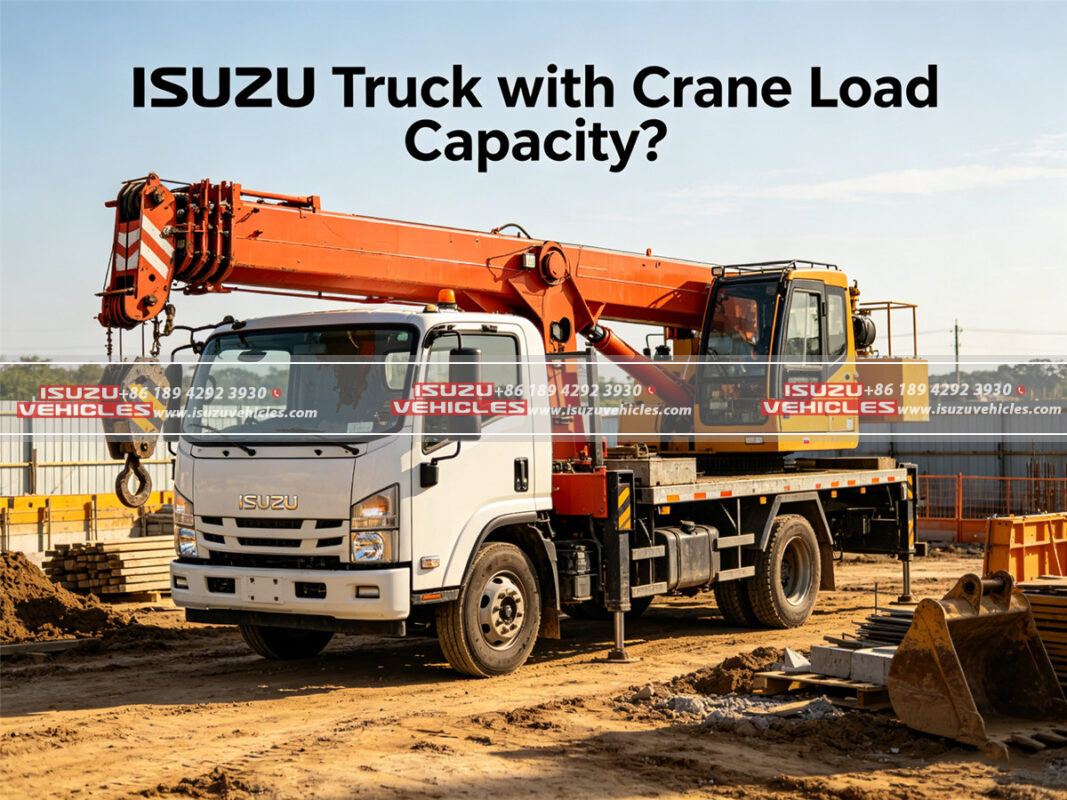
ISUZU Truck with Crane Load Capacity?
In the commercial transportation and construction industries, trucks equipped with cranes have become essential for handling heavy lifting operations while maintaining efficient mobility across job sites, warehouses, industrial facilities, and infrastructure projects. Instead of relying on separate transportation vehicles and stationary lifting equipment, many businesses now prefer integrated crane trucks because they combine hauling capability with lifting performance in a single machine. This combination improves operational flexibility, reduces labor demands, and increases efficiency during loading, unloading, installation, and material handling tasks.
Among the many options available in the commercial truck market, ISUZU crane trucks have gained strong recognition for their durability, operational reliability, and practical load-handling capabilities. Businesses involved in construction, utility services, logistics, manufacturing, telecommunications, equipment transportation, and municipal operations often choose ISUZU because the vehicles are engineered specifically for commercial workloads and demanding daily use.
One of the most important considerations when selecting a crane truck is load capacity. The lifting capability of the crane directly affects the type of jobs the truck can perform, the materials it can handle safely, and the efficiency of daily operations. Understanding how crane load capacity works on an ISUZU truck requires examining several important factors, including crane size, truck chassis strength, hydraulic performance, boom reach, weight distribution, and operational safety requirements.
Understanding ISUZU Crane Truck Load Capacity
The load capacity of an ISUZU truck with crane refers to the maximum weight the crane system can safely lift under specific operating conditions. However, crane capacity is not determined by a single number alone because lifting capability changes depending on several operational variables, including boom extension length, lifting angle, load position, and vehicle stability.
A crane may be capable of lifting several tons when the load is positioned close to the truck body, but its effective lifting capacity may decrease significantly as the boom extends farther outward. This is a normal characteristic of hydraulic crane systems because increased reach places greater leverage stress on the crane structure and truck chassis.
ISUZU crane trucks are designed to balance lifting power with vehicle stability, allowing operators to handle heavy loads safely while maintaining controlled crane movement and reliable truck performance.
Factors That Influence Crane Capacity
Several important factors determine how much weight an ISUZU crane truck can safely lift during operation.
The first factor is the crane model itself. Different crane systems are designed for different industries and lifting requirements. Smaller cranes installed on light-duty ISUZU trucks may handle compact construction materials, generators, utility equipment, or maintenance tools, while larger hydraulic cranes mounted on heavy-duty chassis can lift industrial machinery, steel structures, or construction materials weighing several tons.
The second factor is boom length and extension range. As the crane boom extends farther away from the truck, lifting capacity decreases because the load creates greater leverage against the crane structure. Operators must always follow load charts provided by the crane manufacturer to ensure safe lifting conditions.
Truck chassis strength also plays a critical role. ISUZU truck frames are engineered to support both cargo transportation and crane operation, which requires reinforced structural support to manage the combined stress of lifting loads and vehicle movement.
Hydraulic system performance is equally important because the hydraulic cylinders generate the lifting force necessary for crane operation. Stable hydraulic pressure helps ensure smooth lifting motion, controlled lowering, and accurate load positioning during operation.
Typical Load Capacity Ranges
The lifting capacity of ISUZU crane trucks varies depending on the truck class and crane configuration. Smaller light-duty models may support crane capacities ranging from approximately 1 ton to 3 tons, while medium-duty and heavy-duty configurations can handle substantially larger lifting capacities.
Some industrial ISUZU crane truck setups are capable of lifting equipment, construction materials, pipes, steel beams, generators, or heavy cargo weighing several tons under controlled conditions. However, operators must always consider lifting radius, ground stability, and load positioning when evaluating actual lifting performance.
For businesses selecting a crane truck, understanding real-world operational requirements is more important than focusing only on maximum advertised lifting numbers. A properly matched crane system improves both safety and long-term operational efficiency.
How ISUZU Truck Design Supports Heavy Lifting Operations
A crane truck requires far more structural support than a standard commercial transport vehicle because lifting operations create concentrated stress on the chassis, suspension system, and body structure. ISUZU trucks used for crane applications are engineered with commercial-grade durability to handle these demanding operating conditions.
The integration between the truck chassis and crane system is carefully designed to ensure stable lifting performance without compromising overall vehicle reliability.
Reinforced Chassis Construction
One of the major reasons businesses trust ISUZU crane trucks is the durability of the truck chassis. During crane operation, enormous force is transferred through the crane base into the truck frame. A weak chassis may flex excessively or experience structural fatigue over time, especially under continuous heavy-duty lifting conditions.
ISUZU commercial chassis systems are designed with reinforced frame structures that improve weight distribution and reduce stress concentration during lifting operations. This allows the truck to maintain better stability while supporting repeated crane use over many years.
The reinforced chassis also helps improve long-term durability in industries where crane trucks operate daily on construction sites, industrial yards, utility projects, or transportation hubs.
Hydraulic Stability and Control
Hydraulic systems are central to crane performance because they control boom movement, lifting power, and operational precision. ISUZU crane trucks are typically equipped with dependable hydraulic systems that provide smooth and stable crane operation even when handling heavy or awkwardly shaped loads.
Proper hydraulic control is especially important during delicate lifting tasks where sudden movement could create safety risks or damage expensive equipment. Controlled hydraulic performance allows operators to position loads accurately while maintaining safer working conditions.
Outrigger Systems for Safe Operation
Most crane-equipped ISUZU trucks include stabilizing outriggers that extend outward during lifting operations. These outriggers increase the vehicle’s ground support area and reduce the risk of tipping when handling heavy loads.
Outriggers are essential because crane lifting shifts weight distribution away from the truck’s centerline. Without proper stabilization, lifting heavy loads could compromise vehicle balance and create dangerous operating conditions.
The combination of reinforced chassis engineering and stabilizer systems allows ISUZU crane trucks to perform safely in demanding commercial environments.
Industries That Depend on ISUZU Crane Trucks
The versatility of crane-equipped trucks makes them valuable across many industries where lifting and transportation functions must work together efficiently. Different industries require different crane capacities depending on the size and type of materials being handled.
ISUZU crane trucks are commonly used because they offer a practical balance between mobility, lifting performance, fuel efficiency, and operational reliability.
Construction and Infrastructure Projects
Construction companies frequently use ISUZU crane trucks to transport and position heavy materials such as steel beams, concrete products, construction equipment, generators, and structural components. Having both transportation and lifting capability in a single vehicle improves job site efficiency and reduces reliance on separate cranes.
Smaller crane truck configurations are often useful in urban construction environments where maneuverability is important, while larger models handle heavier industrial lifting requirements.
Utility and Maintenance Services
Utility companies often rely on crane-equipped ISUZU trucks for handling transformers, electrical equipment, utility poles, communication devices, and maintenance tools. The lifting capability allows crews to install or repair equipment efficiently without requiring large stationary cranes.
These trucks are especially valuable for field service operations where mobility and quick setup are essential for maintaining operational efficiency.
Industrial Transportation and Equipment Delivery
Manufacturing facilities and logistics operators frequently use crane trucks for transporting machinery, loading industrial materials, and moving heavy equipment between job sites. The ability to load and unload equipment independently reduces labor requirements and improves scheduling flexibility.
Because many industrial operations involve repetitive lifting tasks throughout the day, reliable crane performance and truck durability become extremely important for maintaining productivity.
Why ISUZU Crane Trucks Remain a Preferred Commercial Solution
Businesses investing in crane trucks need equipment capable of handling demanding workloads safely, efficiently, and consistently over long operational periods. Load capacity is naturally one of the most important considerations, but true performance also depends on structural durability, hydraulic reliability, operational stability, and long-term maintenance efficiency.
ISUZU crane trucks continue to be widely trusted because they combine strong commercial engineering with dependable lifting performance suitable for a wide range of industries. Their reinforced chassis systems, stable hydraulic operation, and practical commercial design allow businesses to manage transportation and lifting operations more effectively without sacrificing reliability.
Companies evaluating heavy-duty lifting equipment often compare crane trucks with vehicles such as a bucket truck, particularly in utility and maintenance industries where elevated work platforms are also required for specialized operations. While the applications differ, both vehicle types depend heavily on hydraulic stability and commercial-grade durability to perform safely under demanding conditions.
Similarly, businesses involved in vehicle recovery or roadside assistance may recognize operational similarities between crane-equipped trucks and a tow truck, especially when handling heavy equipment movement, recovery operations, or specialized transportation tasks that require controlled lifting performance.
For many fleet operators and commercial transportation businesses, investing in dependable ISUZU Vehicles means choosing equipment designed to support long-term productivity, operational safety, and reliable heavy-duty performance across construction, industrial, utility, and logistics applications where lifting capability and transportation efficiency must work together seamlessly every day.