
Concrete is one of the most widely used construction materials in the world, serving as the foundation for residential buildings, highways, bridges, industrial facilities, airports, and countless infrastructure projects. While producing high-quality concrete at the batching plant is essential, maintaining its consistency and workability during transportation is equally important. This is where a reliable ISUZU mixer truck becomes indispensable.
Among the many specifications buyers consider when purchasing a concrete mixer truck, drum capacity is often the deciding factor. Selecting the right drum size directly affects transportation efficiency, fuel consumption, project scheduling, operating costs, and even the quality of the delivered concrete. A drum that is too small may require frequent trips between the batching plant and the construction site, while an oversized drum can increase purchase costs, reduce maneuverability, and become impractical for certain projects.
Understanding how to choose the appropriate drum capacity helps contractors, ready-mix suppliers, and construction companies maximize productivity while ensuring consistent concrete quality throughout every delivery.
Understanding Drum Capacity in an ISUZU Mixer Truck
The drum is the most recognizable component of a mixer truck, serving as both the transportation container and the mixing system. Unlike an ordinary cargo body, the rotating drum continuously agitates the concrete mixture to prevent segregation and maintain a uniform consistency until discharge.
Drum capacity generally refers to the maximum volume of fresh concrete that the truck can safely transport while maintaining proper mixing performance. It is important to distinguish between the drum’s total geometric volume and its rated concrete carrying capacity. The actual usable capacity is intentionally lower because sufficient internal space must remain available for the concrete to rotate freely during transport.
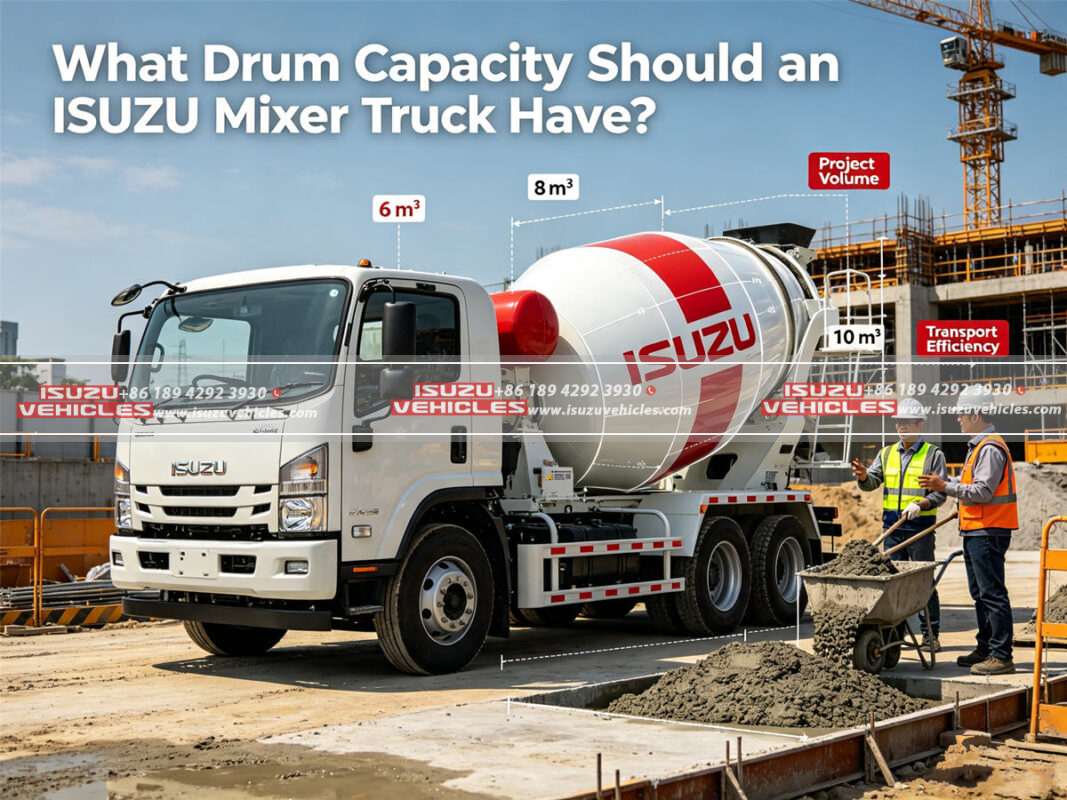
Depending on the chassis configuration and project requirements, ISUZU mixer trucks are commonly available with drum capacities ranging from 3 cubic meters to 12 cubic meters, making them suitable for a wide variety of construction applications.
Typical capacity options include:
- 3 CBM
- 4 CBM
- 5 CBM
- 6 CBM
- 8 CBM
- 10 CBM
- 12 CBM
Each capacity serves different operational needs, and choosing the correct size depends on much more than simply transporting the largest possible volume.
Matching Drum Capacity to Your Construction Projects
The most appropriate drum capacity depends primarily on the type of construction work your business performs. Every project has unique transportation requirements, site conditions, and production schedules.
Small Residential Projects
Housing developments, sidewalk construction, landscaping projects, and small commercial buildings typically require relatively modest quantities of concrete.
For these applications, 3–5 CBM mixer trucks often provide the best balance between payload, maneuverability, and operating cost.
Their advantages include:
- Easy access to narrow streets
- Lower fuel consumption
- Reduced operating expenses
- Faster loading and unloading in confined spaces
- Better maneuverability in urban environments
These compact models are particularly valuable for contractors working within densely populated cities where larger trucks may encounter access restrictions.
Medium Commercial Construction
Projects such as schools, office buildings, warehouses, shopping centers, and municipal facilities generally benefit from 6–8 CBM mixer trucks.
These trucks provide:
- Higher daily delivery capacity
- Improved batching plant efficiency
- Reduced transportation frequency
- Better balance between payload and mobility
Many ready-mix companies consider this capacity range to be the most versatile for routine commercial construction.
Large Infrastructure Projects
Major highway construction, airport development, bridge projects, dams, and industrial plants often require continuous concrete supply throughout the day.
For these demanding applications, 10–12 CBM mixer trucks maximize productivity by transporting larger concrete volumes per trip.
However, larger capacities should only be selected when road conditions, project access, and legal weight regulations allow their efficient operation.
Factors That Influence the Ideal Drum Capacity
Although project size is important, several additional considerations should influence the selection of drum capacity.
Road Conditions
Construction sites are not always located on paved highways.
If deliveries frequently involve:
- Narrow village roads
- Mountainous terrain
- Soft ground
- Steep construction entrances
- Congested urban areas
a smaller mixer truck may actually outperform a larger one due to its superior maneuverability and easier handling.
Selecting an oversized truck for difficult operating environments may increase delivery times instead of improving efficiency.
Distance from the Batching Plant
Transportation distance significantly affects productivity.
Longer travel distances generally favor larger drum capacities because each trip delivers more concrete, reducing total transportation cycles.
Conversely, projects located close to the batching plant often achieve excellent efficiency using medium-sized mixer trucks that complete multiple trips throughout the day.
Local Weight Regulations
Every country enforces legal limits regarding vehicle weight and axle loading.
A truck capable of carrying a larger drum must still comply with road regulations once fully loaded.
Buyers should verify local transportation requirements before selecting maximum-capacity models.
How Drum Capacity Affects Concrete Quality
While transporting larger concrete volumes may improve productivity, preserving concrete quality remains the highest priority. Drum capacity influences not only how much concrete can be carried but also how effectively it can be mixed during transportation.
Adequate Mixing Space
The drum should never be completely filled.
Sufficient empty space allows the internal spiral blades to:
- Continuously mix concrete
- Prevent aggregate separation
- Maintain consistent slump
- Improve discharge efficiency
Overloading the drum reduces mixing effectiveness and increases mechanical stress on hydraulic components.
Continuous Drum Rotation
Modern ISUZU mixer trucks maintain slow drum rotation during transport.
This continuous movement prevents cement paste from settling while ensuring aggregate remains evenly distributed throughout the mixture.
Proper drum capacity combined with correct rotational speed preserves concrete workability until arrival at the construction site.
Balancing Productivity, Operating Costs, and Fleet Efficiency
Choosing the largest available drum does not automatically create the most efficient fleet. Successful construction companies evaluate the entire transportation process rather than focusing solely on maximum concrete volume.
Medium-capacity mixer trucks often offer the greatest operational flexibility because they can serve a wider variety of projects while maintaining excellent fuel economy and lower maintenance costs. They also allow easier access to urban construction sites and simplify fleet scheduling when multiple deliveries are required throughout the day.
Fleet managers should also consider equipment utilization rates. A large-capacity truck operating only partially loaded represents unnecessary investment, while an undersized truck making excessive trips increases fuel consumption, labor costs, and vehicle wear. Matching drum capacity to average daily demand generally produces the best long-term financial results.
Future business growth should also influence purchasing decisions. Companies expecting to expand into larger infrastructure projects may benefit from selecting a chassis platform capable of supporting greater drum capacities or integrating advanced fleet management technologies, ensuring that today’s investment continues to meet tomorrow’s operational requirements.
Selecting the Right ISUZU Mixer Truck for Long-Term Success
Choosing the appropriate ISUZU mixer truck drum capacity requires balancing project requirements, transportation efficiency, road conditions, operating costs, and long-term fleet planning. Capacities ranging from 3 CBM to 12 CBM provide solutions for everything from residential developments to major infrastructure construction, allowing contractors to select equipment that aligns with their daily operational needs.
Beyond drum size, ISUZU mixer trucks are recognized for their durable chassis, fuel-efficient engines, reliable driveline components, and excellent long-term performance under demanding construction conditions. These qualities help reduce downtime, improve delivery reliability, and maximize return on investment throughout the truck’s service life.
For companies building a complete construction fleet, a mixer truck often works alongside a distributor truck for asphalt pavement applications and a dump truck for transporting aggregates, sand, and earthmoving materials. Combined with dependable ISUZU Vehicles, these specialized machines provide the versatility, durability, and operational efficiency required to support modern construction projects of every scale while helping businesses achieve greater productivity and sustainable long-term growth.