
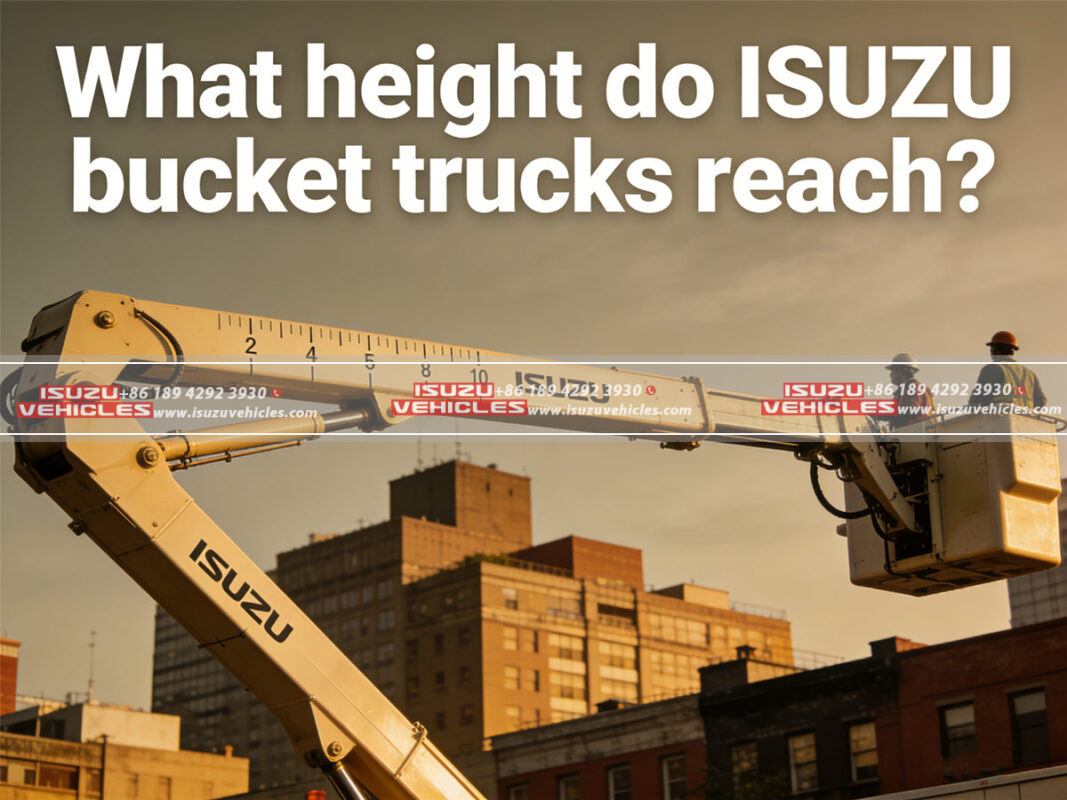
Understanding the Working Height of ISUZU Bucket Trucks
Utility maintenance, telecommunications installation, streetlight servicing, and tree trimming are all tasks that require technicians to work safely at elevated heights. In these situations, specialized aerial work vehicles are essential for providing both reach and stability. Among the most widely used aerial service vehicles in municipal and industrial fleets are ISUZU bucket trucks, which combine a reliable commercial truck chassis with a hydraulic boom and work platform designed for safe elevated operations.
One of the most common questions asked by fleet managers and contractors when selecting this type of equipment is how high these trucks can reach. The working height of a bucket truck determines the range of tasks it can perform, from servicing overhead power lines to maintaining tall urban infrastructure. Different models are designed to reach different elevations, depending on the type of boom installed, the intended industry application, and the structural capacity of the vehicle.
Understanding the typical height range of bucket trucks, as well as the engineering systems that enable them to operate safely at those elevations, can help organizations select the right equipment for their operational needs.
Typical Working Height Range of ISUZU Bucket Trucks
The maximum working height of ISUZU bucket trucks varies depending on the configuration of the boom system installed on the truck. In general, most standard bucket trucks mounted on medium-duty ISUZU chassis reach heights ranging from approximately 15 meters (about 50 feet) to more than 30 meters (around 100 feet).
These height ranges allow technicians to perform a wide variety of maintenance and installation tasks across different industries. For example, shorter boom systems in the 15 to 20 meter range are often used for municipal streetlight maintenance or traffic signal servicing, while taller units reaching 25 to 30 meters are commonly used in electrical utility work or telecommunications infrastructure installation.
In specialized cases, extended boom configurations may allow certain trucks to exceed 30 meters of vertical reach, enabling technicians to work on high transmission lines, tall communication towers, and large industrial facilities.
It is also important to distinguish between two related measurements: platform height and working height. Platform height refers to the maximum elevation of the bucket itself, while working height includes the additional reach of a technician standing in the platform. Typically, the working height is considered to be about 1 to 2 meters higher than the platform height.
Types of Boom Systems That Influence Reach
The lifting capability of ISUZU bucket trucks depends largely on the design of the boom system mounted on the vehicle. Different boom technologies allow operators to achieve varying levels of height, flexibility, and maneuverability.
Telescopic Boom Systems
Telescopic booms use extendable sections that slide out from one another to reach higher elevations. These systems provide strong vertical reach and are commonly used for jobs that require technicians to access high points directly above the truck.
Because telescopic booms extend in a straight line, they are ideal for applications such as power line maintenance where vertical height is the primary requirement.
Articulating Boom Systems
Articulating booms consist of multiple hinged sections that can bend and pivot at different angles. This design allows operators to maneuver the bucket around obstacles such as tree branches, buildings, or utility poles.
Although articulating booms may sometimes have slightly lower maximum heights compared to telescopic systems, their flexibility allows technicians to reach complex work areas that would otherwise be difficult to access.
Combination Boom Systems
Some ISUZU bucket trucks use hybrid boom designs that combine telescopic and articulating features. These systems offer both height and maneuverability, allowing technicians to reach elevated work areas while navigating around structural obstacles.
Combination booms are often used in telecommunications and electrical utility industries where both height and positioning flexibility are required.
Industry Applications for High-Reach Bucket Trucks
The height capability of ISUZU bucket trucks makes them essential tools across a wide variety of industries that require safe elevated access.
Electrical Utility Maintenance
Utility companies frequently rely on bucket trucks to maintain overhead power lines, transformers, and utility poles. Technicians working in these environments often require vehicles capable of reaching heights above 20 meters to access electrical distribution networks safely.
Insulated bucket systems are also used to protect workers from electrical hazards when performing maintenance near live power lines.
Telecommunications Infrastructure
Telecommunications companies use bucket trucks to install and maintain equipment on communication towers, fiber-optic lines, and wireless network infrastructure. As communication networks expand, technicians must regularly access elevated cable systems and antenna installations.
The reach and flexibility of bucket trucks allow workers to perform these tasks efficiently without requiring large stationary lifting equipment.
Urban Streetlight and Traffic Signal Maintenance
Municipal governments frequently deploy bucket trucks for routine maintenance of streetlights, traffic signals, and public lighting systems. These tasks usually require moderate working heights, typically between 10 and 20 meters.
The maneuverability of ISUZU trucks makes them particularly useful in busy city environments where space is limited and quick deployment is necessary.
Tree Trimming and Urban Forestry
Tree maintenance crews also use bucket trucks to trim branches that interfere with power lines, roads, or buildings. Adjustable boom systems allow operators to position the bucket precisely within dense tree canopies while maintaining safe working conditions.
Safety Systems That Support High-Altitude Operations
Working at significant heights requires strict safety standards, and ISUZU bucket trucks are equipped with multiple safety features designed to protect operators during elevated operations.
Stabilizing Outriggers
Before raising the boom, operators deploy hydraulic outriggers that extend from the sides of the truck to stabilize the vehicle. These outriggers distribute the truck’s weight evenly across the ground, preventing tipping during lifting operations.
Stabilizers are especially important when the boom is fully extended or when the truck is operating on uneven terrain.
Load Monitoring Systems
Many modern bucket trucks include load sensors that monitor the weight being supported by the boom. If the load exceeds safe limits, the system alerts the operator and prevents further extension of the boom.
This technology helps maintain safe operating conditions and protects both workers and equipment.
Insulated Work Platforms
For electrical utility applications, insulated bucket platforms protect workers from electrical currents when working near live wires. These insulation systems are designed to meet strict industry standards for electrical safety.
Together with protective harness systems and emergency lowering controls, these safety features help ensure that technicians can perform elevated tasks with confidence.
Factors That Influence Maximum Reach
Although the boom system plays the primary role in determining height, several additional factors can influence the maximum reach of ISUZU bucket trucks.
Vehicle size and chassis capacity determine how large and heavy the boom system can be. Larger trucks can support longer booms and heavier equipment, allowing them to reach higher elevations.
Ground conditions and operating angles may also affect how high the boom can safely extend. Operators must consider terrain stability and wind conditions when positioning the truck for elevated work.
Additionally, the type of work being performed may influence how the boom is positioned. Sometimes technicians must extend the boom horizontally rather than vertically to reach specific structures or equipment.
These operational considerations highlight the importance of selecting the appropriate bucket truck configuration for each industry application.
The Role of Bucket Trucks in Modern Utility and Service Fleets
As cities expand and infrastructure networks grow more complex, the demand for reliable aerial work platforms continues to increase. ISUZU bucket trucks have become essential tools for organizations responsible for maintaining electrical grids, telecommunications networks, public lighting systems, and urban vegetation management.
Their ability to reach heights ranging from moderate urban infrastructure levels to tall utility installations allows technicians to perform critical maintenance tasks safely and efficiently. The combination of durable truck engineering and advanced hydraulic boom systems ensures that these vehicles remain dependable assets in demanding working environments.
In many service fleets, bucket trucks operate alongside other specialized equipment that supports a wide range of field operations. For instance, a crane truck may assist with lifting heavy components during infrastructure repairs, while a tow truck helps transport disabled vehicles from service areas.
Together with the broader lineup of professional service vehicles available through ISUZU Vehicles, these trucks help create versatile operational fleets capable of maintaining the essential infrastructure that modern communities depend on every day.