
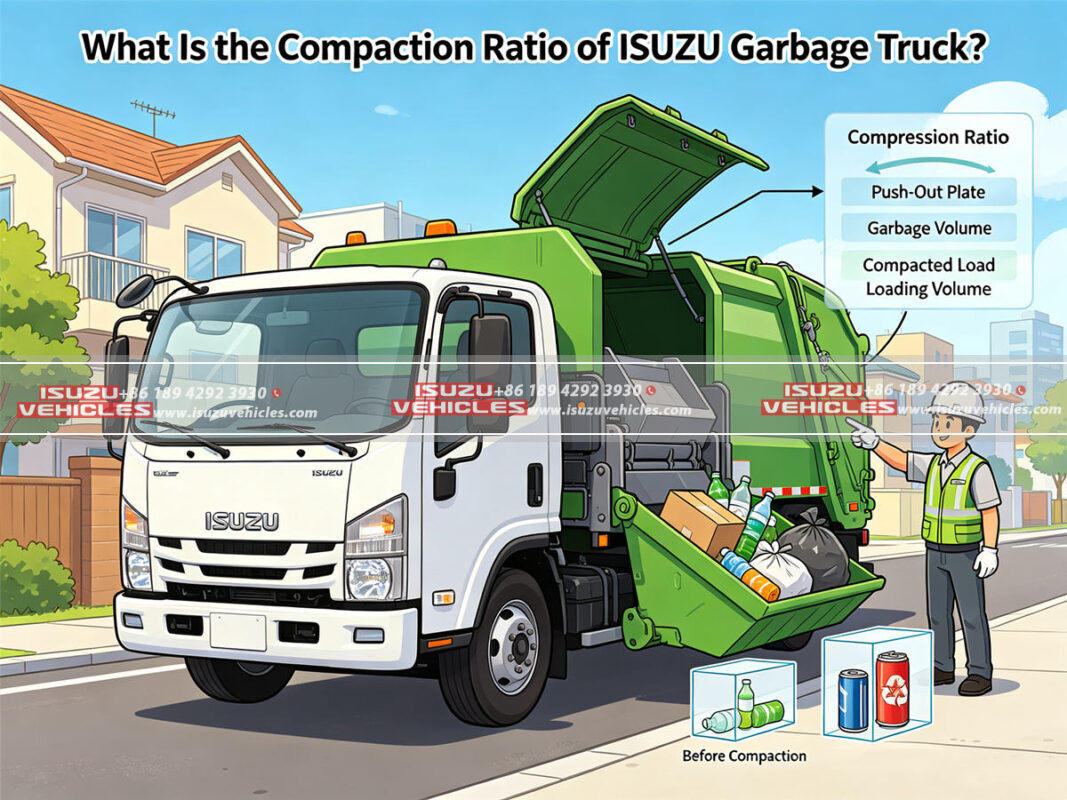
The compaction ratio is one of the most important specifications to understand when evaluating an ISUZU garbage truck because it describes how effectively the vehicle reduces the volume of loose waste before transporting it to a transfer station, treatment facility, or landfill. In simple terms, a compaction ratio of 3:1 means that approximately three cubic meters of loose waste can be compressed into about one cubic meter of space after compaction, although the actual result depends heavily on the type, moisture content, density, and composition of the waste. Current ISUZU compactor models use different hydraulic systems and body designs, so there is not one universal ratio for every vehicle; current examples include a 2.5:1 ratio on a 12 CBM compactor, a 3:1 ratio on an 8 CBM model, and adjustable systems capable of approximately 3:1 to 6:1 depending on waste density and configuration.
This distinction matters because the nominal volume of a garbage body does not tell the whole story. An 8 CBM or 12 CBM refuse body describes the physical storage volume, while the compaction ratio determines how much loose waste can potentially be consolidated into that available space. The garbage truck range from ISUZU Vehicles includes compact urban models, rear-loading compactor trucks, side loaders, large-capacity GIGA configurations, hook loaders, skip loaders, and other waste-collection vehicles, allowing buyers to select a system according to the type of waste, collection route, road environment, and required operating capacity.
It is also important to remember that a published compression ratio should not be interpreted as a guarantee that every type of waste will achieve exactly the same reduction. Household refuse containing paper, cardboard, packaging, food waste, and other relatively compressible materials can behave very differently from construction debris, metal, timber, appliances, or other rigid materials. For this reason, the compaction ratio is best understood as an engineering and operating indicator rather than a fixed conversion between body volume and actual tonnage.
How Is the Compaction Ratio Calculated?
The basic concept behind a compaction ratio is relatively simple: it compares the volume of waste before compression with the volume occupied after compression. If a garbage truck has a 3:1 compaction ratio, the theoretical relationship means that three units of loose waste can be reduced to approximately one unit of compacted volume, assuming the waste characteristics and operating conditions correspond to the conditions under which the ratio is specified.
A Simple 3:1 Example
Imagine a collection crew loads 3 cubic meters of loose household waste into the hopper, and the hydraulic compaction mechanism reduces that material to approximately 1 cubic meter inside the refuse body. This represents a 3:1 volumetric compaction ratio. If the crew continues loading and compacting similar material, the available storage space can accommodate substantially more loose waste than the physical dimensions of the body might initially suggest.
However, this does not mean that a 6 CBM garbage truck can automatically transport 18 CBM of every kind of waste. The physical body still has a fixed volume, and the vehicle also has a maximum gross vehicle weight and payload limit. Once the material becomes dense enough to approach the truck’s permitted weight, the operator cannot continue adding waste simply because there appears to be unused space in the body.
Volume and Weight Are Different Limits
This is one of the most important concepts in refuse collection. A garbage truck is constrained by both its available volume and its legal or engineering weight capacity, and which limit is reached first depends on the waste being transported. Lightweight household packaging may fill much of the body before reaching the maximum payload, while dense and heavy waste may reach the weight limit long before the body appears full.
For example, the current ISUZU 6-ton small light garbage compactor truck has a nominal body volume of 6 CBM, a gross vehicle weight of 9,400 kg, and a payload capacity of 2,500 kg, while its hydraulic system is specified with a 3:1 compaction ratio. These specifications demonstrate why body volume, compression performance, and payload capacity need to be evaluated together rather than using any one number in isolation.
What Compaction Ratios Are Available on ISUZU Garbage Trucks?
ISUZU garbage trucks are available with different compaction ratios depending on the body design, hydraulic system, application, and waste type. Current product specifications show ratios ranging from approximately 2.5:1 to higher adjustable ratios, while some specialized configurations publish considerably stronger compression figures. This variation is normal because garbage trucks are designed for different collection environments and are not all intended to handle identical waste streams.
The current ISUZU 12 CBM Compactor Garbage Truck, for example, specifies a 12 CBM refuse body, a hydraulic system pressure of 16 MPa, a loading cycle of no more than 25 seconds, and a 2.5:1 compression ratio. This type of configuration is aimed at efficient municipal collection where dependable cycle times and practical waste density are important.
The current 8 CBM Garbage Truck provides another example, with an 8 CBM compactor body and a maximum compression ratio of approximately 3:1. Its system includes a packer plate, packer cylinders, scraper cylinder, slide plate, ejection cylinder, and ejection plate, allowing waste to be compressed and transferred into the storage body during repeated collection cycles.
Some current ISUZU configurations provide a wider adjustable range. The 8 CBM rubbish compactor truck listed by ISUZU Vehicles specifies an adjustable volumetric compression ratio of approximately 3:1 to 6:1, allowing the system to adapt to different waste densities. This type of design can be particularly useful for operators who collect mixed municipal waste and encounter significant variation in material characteristics from one route or neighborhood to another.
There are also high-capacity configurations with very different published specifications. The current ISUZU GIGA 18 CBM Compactor Garbage Truck, for example, lists an 18 CBM effective container volume and a published compression ratio of 22.5:1. Because such figures depend on the manufacturer’s definition and test conditions, buyers should always compare the detailed technical specifications and ask how the ratio is measured rather than assuming that all compression-ratio figures use exactly the same testing methodology.
How Does the Hydraulic Compaction System Work?
The high compaction performance of a refuse truck comes primarily from its hydraulic packing mechanism, which converts hydraulic pressure into controlled mechanical movement. Although the exact arrangement differs between models, a typical rear-loading compactor uses a hopper where loose waste is deposited, followed by a sequence of scraper, packer, slide, and ejector movements that progressively push the material into the main body.
Loading the Waste into the Hopper
The process starts when household or commercial waste is placed into the rear hopper, either manually, from collection bins, or through a mechanical bin-lifting system. The hopper temporarily holds the material before the compaction cycle begins, allowing the truck to collect waste continuously while the hydraulic system processes previous loads.
Scraping and Packing
Hydraulic cylinders then move the scraper and packing components through a controlled sequence. The mechanism gathers waste from the hopper and pushes it toward the storage compartment, while the geometry of the packing plate and the hydraulic force compress the waste into a denser mass. This repeated action is what allows the vehicle to use its storage volume much more effectively than an ordinary open-body truck.
Moving Waste into the Main Body
Once the waste has been compressed, the mechanism transfers it farther into the refuse body, making room for the next loading cycle. This process can continue repeatedly throughout a collection route. Modern systems may use automatic PLC controls to coordinate the sequence, while manual controls are also provided on many configurations for maintenance, emergency operation, or operator preference.
The current 6-ton ISUZU compactor, for example, uses 11 hydraulic cylinders to operate the push-out plate and tailgate system, while other models use combinations of packer, scraper, skateboard, and ejection cylinders. The exact hydraulic arrangement therefore varies from one garbage truck to another, but the basic objective remains the same: convert loose waste into a more compact and manageable load.
What Factors Affect the Actual Compaction Ratio?
The advertised compaction ratio is an important specification, but the actual volume reduction achieved during everyday waste collection depends on several variables, and waste composition is one of the most significant. Household waste is not a uniform material, so two collection routes can produce very different results even when the same garbage truck is used with identical hydraulic settings.
Waste Composition
Paper, cardboard, plastic packaging, textiles, food waste, and other household materials generally offer more opportunities for volume reduction than rigid materials. Metal objects, concrete fragments, large appliances, thick timber, and certain construction wastes are much more resistant to compression and can limit the practical compaction performance of a refuse truck.
Moisture Content
Moisture can also change waste density and behavior during compaction. Food waste and other wet materials can be relatively dense even before the compaction cycle, while dry packaging materials may occupy considerable volume without weighing very much. In addition, excessive liquid can create leachate that must be managed through the truck’s drainage or sewage collection system.
Hydraulic Pressure and Mechanical Condition
The hydraulic system must generate and maintain sufficient pressure for the compaction mechanism to operate correctly. Worn cylinders, damaged seals, contaminated hydraulic oil, malfunctioning valves, or incorrect pressure settings can reduce performance and make the compression cycle less consistent. Regular maintenance is therefore directly connected to the truck’s ability to deliver the expected compaction performance.
Loading Technique
How waste enters the hopper also matters. Oversized objects, poorly distributed loads, or unsuitable materials can interfere with the packing mechanism and prevent the system from reaching its intended compression performance. Proper collection procedures and operator training help ensure that the hydraulic system is being used under the conditions for which it was designed.
Why a Higher Compaction Ratio Can Improve Collection Efficiency
The main advantage of effective compaction is that more loose waste can be collected before the truck needs to return to a disposal or transfer facility. For municipal sanitation departments and private waste-management companies, this can have a direct effect on route efficiency because every additional disposal trip requires fuel, driver time, labor, road mileage, and vehicle operating hours.
Consider a collection route dominated by lightweight household refuse. Without effective compaction, the truck’s body could become physically full while containing a relatively low mass of waste. A compactor reduces the volume occupied by that material, allowing the vehicle to continue collecting additional waste until either the body becomes full or the permissible payload is reached.
This can be particularly valuable in dense urban areas where collection vehicles make frequent stops and travel relatively short distances between collection points. A compacting system can reduce the number of times the truck needs to leave the route for disposal, helping the crew spend more of its working time collecting waste.
However, the highest possible compression ratio is not automatically the best choice for every operation. A sanitation department collecting ordinary household refuse may prioritize balanced compression, fast cycle times, reliability, and low maintenance requirements, while a specialized waste stream may require a different body design or compression system. The correct configuration should therefore be selected according to the complete collection process.
How Compaction Relates to Garbage Truck Body Capacity
Body capacity and compaction ratio work together, but they describe different aspects of a garbage truck’s performance. Body capacity tells the operator how much physical storage space is available, while compaction ratio indicates how effectively loose waste can be reduced before occupying that space.
An 8 CBM body with a 3:1 compression ratio should therefore not be interpreted as a truck that simply carries 24 CBM of waste as a fixed payload. The theoretical volume relationship is useful for understanding the potential effect of compaction, but real-world capacity is determined by waste density, loading behavior, hydraulic performance, body geometry, payload restrictions, and operating conditions.
This is also why a larger truck is not always the right answer for a particular collection route. A smaller compactor with good maneuverability and an appropriate compression system may be more productive on narrow urban streets, where a large GIGA truck could have difficulty accessing collection points. Conversely, high-volume industrial or commercial routes may justify a larger body and heavier chassis because the greater storage capacity can reduce the number of disposal trips.
How Compaction Supports a Complete Municipal Waste System
Compaction is only one part of professional waste management, because collected refuse must still be transported, transferred, treated, and disposed of properly. The garbage truck’s role is to collect and densify material efficiently while controlling leakage, odors, and unnecessary handling during transportation.
For operations dealing with liquid waste, sludge, or wastewater rather than ordinary solid refuse, a vacuum truck is generally more appropriate because its primary function is suction and containment rather than mechanical compression. Likewise, roads and collection areas may require a sweeper truck to remove scattered dust, dirt, leaves, and other surface debris after collection activities. These vehicles complement rather than replace the compactor garbage truck because each one is designed around a different waste or sanitation task.
For buyers, the most useful way to evaluate compaction performance is therefore to consider the entire operating cycle: the type of waste being collected, the required body volume, the expected density after compression, the hydraulic system, loading cycle time, unloading method, payload limit, route distance, and disposal frequency. A well-matched system can reduce unnecessary trips while improving collection productivity, but the published ratio should always be interpreted alongside the manufacturer’s complete specifications and the characteristics of the actual waste stream.
Ultimately, the compaction ratio of an ISUZU garbage truck can range from around 2.5:1 and 3:1 on many practical configurations to higher adjustable ratios on specialized systems, while actual performance depends strongly on waste composition, moisture, hydraulic pressure, body design, and operating technique. Efficient compaction allows loose refuse to occupy less space, helping collection crews make better use of the available body volume and potentially reduce disposal trips. When municipal sanitation fleets combine the right compactor with complementary equipment such as a vacuum truck for liquid waste and a sweeper truck for road cleaning, they can build a more complete waste-management operation, with ISUZU Vehicles offering a broad range of garbage and sanitation truck configurations for different collection environments.