
How Does an ISUZU Sprinkler Truck Control Dust?
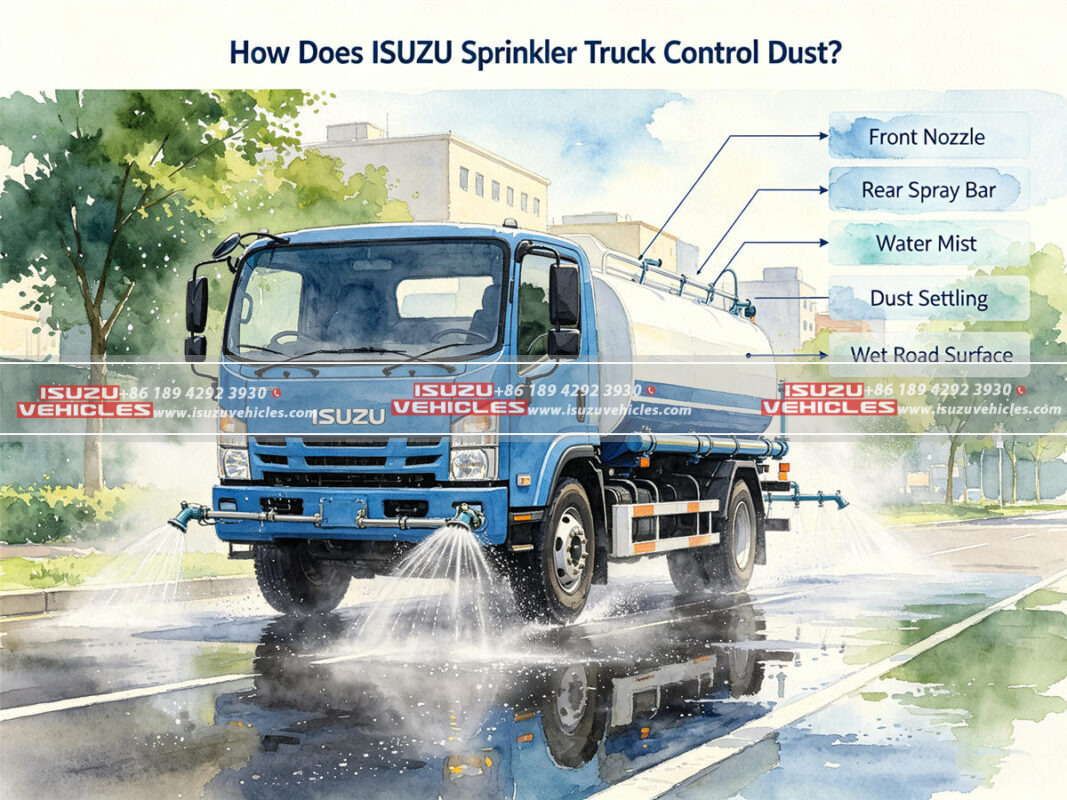
An ISUZU sprinkler truck controls dust primarily by applying a controlled layer of water to dry road surfaces, construction areas, mining roads, industrial yards, and other places where loose particles can easily become airborne, but the process is more sophisticated than simply spraying water from a tank. The vehicle combines a water storage tank, PTO-driven pump, pipelines, valves, spray nozzles, and different spraying devices so that operators can adjust the amount, pressure, direction, and coverage of water according to actual site conditions. The sprinkler truck range from ISUZU Vehicles includes compact water sprayers as well as larger 5,000-liter and 8,000-liter configurations, giving operators different choices for urban roads, construction projects, industrial areas, and large open spaces.
The basic principle is straightforward: when a dry road is disturbed by vehicle tires, wind, construction activity, or mechanical sweeping, loose dust particles can become suspended in the air, while carefully applied water increases the moisture content of the surface and helps bind those particles together. Once the surface is sufficiently damp, dust is less likely to be lifted by passing vehicles or blown away by wind. The effectiveness of the process, however, depends on using an appropriate spray pattern and water volume rather than simply applying as much water as possible, because excessive water can create unnecessary runoff and increase operating costs without providing proportional dust-control benefits.
The Water Tank Provides the Foundation for Dust Suppression
The first major component in the dust-control process is the onboard water tank, which gives the truck the ability to carry a substantial quantity of water directly to the working area. Tank capacity has an obvious influence on productivity because a larger tank allows the vehicle to cover more ground before returning to a water source, while a smaller tank can be advantageous for compact urban work where maneuverability and frequent refilling are more important.
Current ISUZU sprinkler configurations include 5,000-liter and 8,000-liter water trucks, as well as smaller water sprayer models designed for more compact working environments. One current 8,000-liter configuration uses a carbon-steel elliptical tank with a 4 mm tank thickness, internal anti-corrosion treatment, and anti-wave plates, while its pump provides a rated flow of 60 m³/h. These specifications illustrate how the tank and water-delivery system are designed as an integrated working unit rather than as separate components.
Why Tank Capacity Matters
Dust suppression often takes place over large areas, especially on construction sites, mining access roads, industrial compounds, and long municipal road sections, so the amount of water carried per trip has a direct effect on daily productivity. If the tank is too small for the working area, the truck may spend a significant amount of time traveling back and forth to refill instead of controlling dust. On the other hand, a very large tank may add unnecessary vehicle weight when the operation is limited to narrow streets or short-distance work.
The ideal capacity therefore depends on the required spray width, application rate, distance to the water source, road conditions, climate, and length of each operating cycle. In dry and dusty environments, fleet managers should also consider the frequency with which the truck needs to repeat the spraying operation, because a single application may not provide lasting surface moisture under strong sunlight, high temperatures, wind, or heavy traffic.
How the Water Pump Creates Effective Spray Pressure
The water pump is the heart of the sprinkler system because the tank only stores the water, while the pump provides the pressure and flow needed to distribute it over the working surface. In an ISUZU sprinkler truck, the pump is generally driven through the truck’s power take-off system, allowing the vehicle engine to provide mechanical power while the truck is stationary or moving during spraying operations.
For example, the current ISUZU 8,000-liter water sprinkler truck uses an 80QZB-60/90 self-priming centrifugal pump driven by the PTO, with a rated flow of 60 m³/h, a maximum lift of 90 meters, and a suction height of approximately 6–7 meters. This combination provides the water delivery capability required for road washing, dust suppression, irrigation, and other municipal applications.
The pump needs to provide enough pressure to maintain consistent water flow through the pipelines and nozzles, because an uneven spray pattern can leave some areas excessively wet while other sections receive too little water to effectively control dust. A properly selected pump therefore improves not only dust-control performance but also water-use efficiency.
How Spray Nozzles Put Water Where It Is Needed
The spray nozzles are where the stored water finally reaches the road, and their position, design, flow rate, and spray pattern have a major influence on dust-control performance. Instead of using one large outlet for every application, sprinkler trucks normally use several spraying devices positioned around the vehicle so that operators can select the most suitable method for the working environment.
Front Spraying for Road Flushing
Front-mounted nozzles are particularly useful when the goal is to wash or wet the road surface ahead of the vehicle. They can distribute water toward the pavement in a controlled pattern, helping loosen accumulated dust, dirt, and fine debris before the truck passes over the area. On busy roads or heavily contaminated surfaces, front flushing can prepare the pavement for subsequent sweeping or collection.
Rear Spraying for Wide-Area Dust Control
Rear spray nozzles can distribute water across a relatively wide section of road behind the truck, making them particularly suitable for routine dust suppression. The current 8,000-liter ISUZU sprinkler truck, for example, uses fan-shaped rear spraying and provides a total spray width of approximately 14–18 meters depending on the operating configuration.
A wide spray pattern allows the vehicle to cover more road during each pass, but the operator still needs to select an appropriate water flow because coverage width alone does not determine effectiveness. If the water is spread too thinly, the road may dry quickly and dust can return soon afterward, while excessive application can produce runoff and waste water.
Side Sprayers for Curbs and Road Edges
Dust and dirt often accumulate along curbs, road edges, sidewalks, drainage channels, and roadside vegetation, where ordinary straight-line spraying may not provide sufficient coverage. Side sprayers allow the operator to direct water toward these areas, making them useful for urban sanitation and roadside maintenance as well as dust suppression.
This flexibility is one reason sprinkler trucks can perform multiple municipal functions from the same platform. A vehicle may spend one shift controlling construction dust, another washing city roads, and another watering roadside vegetation, provided that the configuration and operating procedures are appropriate for those applications.
How Water Mist and Spray Patterns Improve Dust Control
Not every dust-control task requires the same type of water application. Large droplets can be useful for road washing and heavy surface wetting, while finer sprays or mist can be more appropriate when the objective is to capture airborne particles or provide light surface moisture without creating excessive runoff. Some ISUZU water sprinkler configurations therefore provide adjustable spray patterns to suit different operating conditions.
A current small ISUZU water sprinkler truck, for example, uses a rear water cannon capable of producing several spray patterns ranging from heavier rain-like streams to lighter rain, drizzle, and mist. This flexibility allows the operator to change the water distribution according to whether the task involves road cooling, landscaping, dust suppression, or longer-distance spraying.
In dusty environments, spray adjustment becomes particularly valuable because weather conditions can change throughout the day. A dry and windy afternoon may require a different application strategy from a relatively calm morning, while a construction site with heavy truck traffic may require more frequent surface wetting than a lightly used municipal road. The goal is not simply to make the road visibly wet, but to maintain enough moisture to reduce the generation and movement of dust.
How an ISUZU Sprinkler Truck Works with a Sweeper
Water spraying is highly effective for preventing dust from becoming airborne, but it is not always sufficient to remove the material that has already accumulated on the road. This is why many municipal and industrial cleaning programs combine sprinkler trucks with mechanical sweeping and suction equipment. Water controls the dust while the cleaning vehicle physically removes the loosened material.
A sweeper truck can use rotating brushes to gather dust, sand, leaves, and other debris toward a suction system or collection area. Modern ISUZU sweeper configurations can combine water spraying, mechanical brushes, suction, and filtration, allowing the vehicle to control secondary dust while collecting the material from the road surface.
This creates a practical two-stage approach. First, the sprinkler truck applies water to suppress airborne dust and stabilize loose particles. Then, the sweeper removes the accumulated material from the road. In some applications, a multifunctional sweeper itself can perform both operations, while separate vehicles may be preferred when the work area is particularly large or when different departments need to operate simultaneously.
The combination is especially useful on construction roads where dry soil and fine aggregate are continuously deposited by trucks. Water alone can keep the surface under control temporarily, but regular mechanical removal is necessary if the objective is to prevent a thick layer of dust and dirt from building up.
How Operators Control Water Use and Dust-Suppression Efficiency
Effective dust control depends heavily on how the vehicle is operated, because the same truck can produce very different results depending on vehicle speed, pump speed, nozzle condition, spray width, water flow, and road conditions. Operators need to adjust these variables rather than using one fixed setting for every road and weather condition.
Vehicle Speed
Vehicle speed directly affects the amount of water applied per unit of road area. If the truck travels faster while maintaining the same pump output, the water is distributed over a greater length of road and the application rate decreases. Conversely, slower operation places more water on each section of pavement. This is why spray settings and driving speed should be considered together.
Nozzle Condition
Blocked or damaged nozzles can produce uneven water distribution, leaving dry sections that remain vulnerable to dust generation while other areas receive excessive water. Regular inspection and cleaning of nozzles are therefore simple but important maintenance tasks. Calibration is also useful because correct flow and spray patterns help reduce water consumption while maintaining effective coverage.
Weather and Road Conditions
Wind, temperature, humidity, traffic volume, road material, and the amount of loose dust all influence how frequently a road needs to be sprayed. A dry, windy construction road may require repeated applications, while a lightly trafficked urban road may need less frequent treatment. Operators should therefore monitor actual conditions instead of relying only on a predetermined spraying schedule.
Why Dust Suppression Is Important for Construction and Urban Roads
Dust control is not simply a cosmetic part of road maintenance because airborne particles can reduce visibility, settle on nearby buildings and vehicles, affect working conditions, and contribute to poor local air quality. On construction and mining sites, dust can also interfere with equipment, reduce visibility for drivers, and create an uncomfortable working environment for personnel who spend long periods outdoors.
Regular water spraying helps stabilize loose surface material and reduce the amount of dust generated when tires and machinery pass through an area. The effect is particularly noticeable on unpaved roads, temporary access routes, stockyards, construction compounds, and other surfaces where fine material is easily disturbed.
However, efficient dust control should always balance environmental effectiveness with water consumption. In regions where water is scarce, operators need to avoid unnecessary overwatering and should select spray patterns, schedules, and vehicle capacities based on actual conditions. Proper nozzle calibration and controlled flow can help achieve useful dust suppression without treating water as an unlimited resource.
How Sprinkler Trucks Fit into a Complete Cleaning Fleet
A sprinkler truck is most effective when it is viewed as part of a complete environmental maintenance system rather than as an isolated piece of equipment. It can stabilize dusty surfaces, wash roads, irrigate roadside vegetation, and provide emergency water support, while other specialized vehicles handle tasks that require collection, suction, waste transportation, or heavy mechanical cleaning.
For example, a vacuum truck is designed for suction and removal of liquid waste, sludge, sewage, and certain debris rather than routine road watering, making it useful for drainage and wastewater maintenance where a sprinkler truck would not be appropriate. Similarly, a sweeper is better suited to physically collecting road debris after water has helped suppress dust. Using each vehicle according to its intended function can improve overall fleet efficiency and reduce unnecessary wear.
The most effective dust-control strategy is therefore a combination of appropriate equipment, correct water application, regular maintenance, and sensible operating practices. An ISUZU sprinkler truck uses its water tank, PTO-driven pump, pipelines, valves, and adjustable spray nozzles to place controlled amounts of water onto dusty surfaces, while complementary cleaning equipment can remove the material after it has been stabilized. For municipalities, construction companies, mining operators, and industrial contractors, combining a vacuum truck or sweeper truck with the right water-spraying equipment can create a more complete environmental maintenance solution, while ISUZU Vehicles provides a broad range of specialized trucks designed for road cleaning, dust suppression, water transportation, and other demanding field applications.