
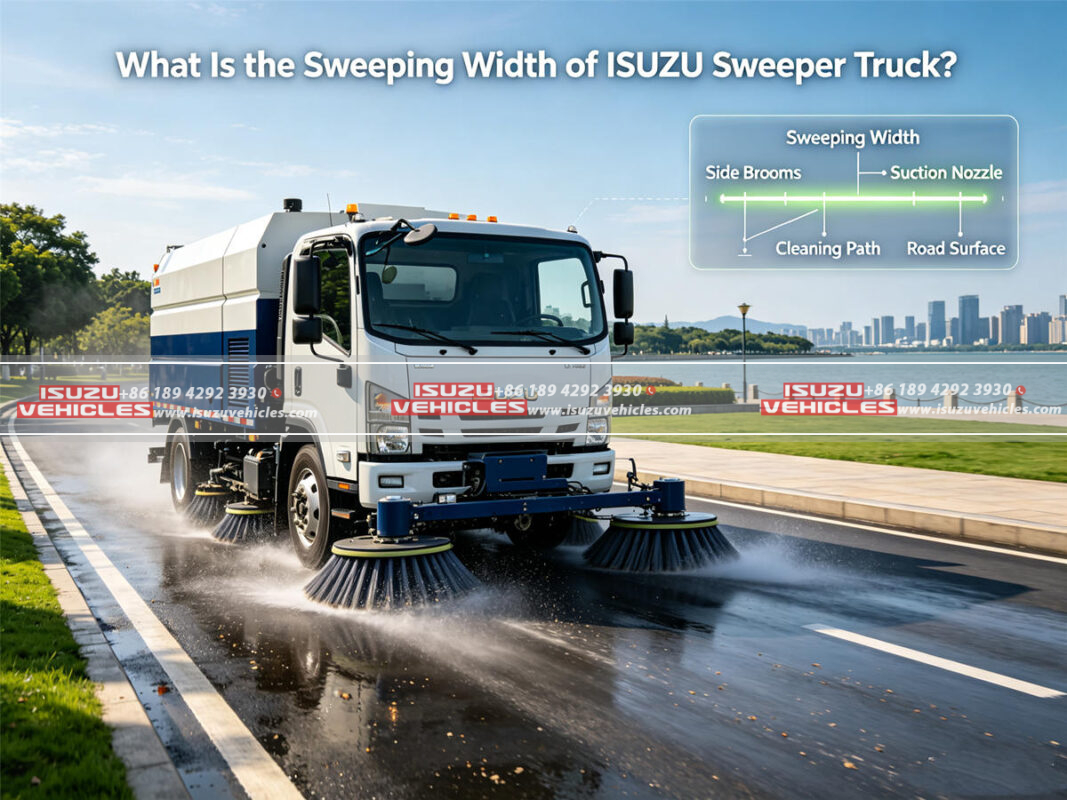
The sweeping width of an ISUZU sweeper truck refers to the maximum lateral width of road surface that the sweeping system can clean during one working pass, and it is one of the most useful specifications for understanding the vehicle’s practical cleaning productivity. Unlike the overall width of the truck, which describes the physical dimensions of the vehicle, sweeping width describes how far the brushes and suction system can effectively cover the road surface. Current ISUZU sweeper configurations offer different working widths depending on the vehicle size and sweeping mechanism, with many models providing approximately 2.6 to 3.2 meters, several models reaching 3 meters, and larger configurations offering 3.5 meters or more. For example, the current ISUZU 9 CBM Sweeper Truck has a maximum sweeping width of 3.0 meters, while the 12 CBM road sweeper provides a four-brush working width of 2.6–3.2 meters. Other configurations can reach 3.5 meters or beyond, showing that the exact width depends on the particular model rather than there being one universal specification for every ISUZU sweeper truck.
Understanding this measurement is important because sweeping width directly influences how many passes are required to clean a road, industrial yard, airport pavement, parking area, or other large surface. A wider cleaning path can cover more ground during each pass, but maximum width is only one part of the vehicle’s performance. Brush arrangement, suction capacity, vehicle speed, road conditions, debris type, water spraying, and the ability to clean close to curbs all influence the actual productivity achieved during daily operation. A well-designed sweeper truck therefore needs to balance broad coverage with effective debris collection and maneuverability.
How Is Sweeping Width Measured?
In practical terms, sweeping width describes the lateral cleaning area covered by the working brushes and suction system when the equipment is deployed in its normal operating position. The measurement may vary slightly between manufacturers because different technical specifications can refer to the effective cleaning width, brush coverage, or maximum working width, so buyers should always check the detailed specifications of the specific model rather than comparing numbers without understanding what each manufacturer means by the term.
Brush Coverage and Suction Coverage
On a modern mechanical-vacuum sweeper, the brushes loosen and move dust, sand, leaves, gravel, and other debris toward the suction area, where airflow carries the material into the collection tank. The effective sweeping width therefore depends not only on how far the brushes extend but also on whether the suction system can collect material across the same working path.
The current ISUZU 6 CBM Road Sweeper, for example, specifies a sweeping width of 2.8–3.0 meters, a sweeping speed of 3–15 km/h, and a maximum sweeping capacity of 38,000 square meters per hour, while its four hydraulic disc brushes are designed to work together with the suction system. This illustrates why sweeping width should be considered together with cleaning efficiency rather than treated as a standalone measure of performance.
Maximum Width Versus Practical Width
The maximum published width represents the largest working area under the specified configuration, but operators may not always use the full width. Narrow streets, parked vehicles, traffic lanes, road islands, curbs, pedestrians, construction barriers, and other obstacles can require the operator to reduce the working width or use only selected brushes. In some cases, a narrower pass can produce a better cleaning result because the brushes have more concentrated contact with the surface and the suction system has a more manageable amount of material to collect.
For this reason, a buyer should look beyond a single maximum-width figure and consider whether the sweeping system can adjust its working area. Current ISUZU configurations include models with adjustable brush arrangements and widths, giving operators more flexibility when moving between open roads and restricted urban environments.
What Is the Typical Sweeping Width of ISUZU Models?
There is a fairly broad range of sweeping widths across the current ISUZU sweeper lineup, reflecting the different chassis sizes, tank capacities, brush systems, and intended applications. Compact road sweepers commonly operate around the 2.6–3.0-meter range, while larger municipal and highway-oriented machines can provide approximately 3.2–3.5 meters or more. The choice between them depends largely on where the vehicle will work and how much road surface needs to be treated during each pass.
The current ISUZU 5 CBM Street Sweeper, for example, specifies a brush working width of 2.6–3.2 meters, with four hydraulic disc brushes arranged symmetrically and an adjustable brush rotation speed. This configuration provides flexibility because the operator can adapt the brush system to different road conditions instead of relying on one fixed working position.
The ISUZU 9 CBM Sweeper Truck provides a maximum sweeping width of 3.0 meters, combined with a 7,000-liter garbage tank and 2,000-liter water tank, while its sweeping speed can be adjusted from 3 to 20 km/h. This type of combination is suitable for large municipal routes, industrial parks, logistics areas, airports, and other locations where a substantial amount of debris must be collected continuously.
The larger ISUZU 12 CBM Road Sweeper uses a four-disc hydraulic brush system with a sweeping width of 2.6–3.2 meters and adjustable brush rotation speed. Its specifications also include a blower airflow capacity of 12,000–15,000 m³/h, showing how the broad mechanical sweeping path is supported by a substantial suction system.
Some larger configurations go beyond this range. The current ISUZU 12CBM Road Sweeper is specified with a sweeping width of at least 3.5 meters and a maximum sweeping capacity of 70,000 square meters per hour. Another road-flushing and vacuum sweeper configuration provides a sweeping width of at least 3,200 mm while also combining mechanical brushes with vacuum suction and a high-pressure washing system.
How Do the Brushes Create the Sweeping Width?
The sweeping width of an ISUZU sweeper truck is largely created by the arrangement and movement of its rotating brushes. Many modern models use four disc brushes positioned around the central cleaning area, with hydraulic motors controlling their rotation and hydraulic cylinders controlling lifting, lowering, and extension. When the brushes rotate against the road surface, they loosen accumulated material and direct it toward the suction opening or central collection area.
Four-Brush Sweeping Systems
A four-brush system can provide broad and flexible coverage because the brushes can work together to clean the main road surface while also reaching toward the edges. The exact arrangement differs between models, but the objective is to create overlapping cleaning paths so that material is not simply pushed from one section of the road to another.
The current ISUZU 4 CBM Road Sweeper, for example, uses four hydraulically driven 850 mm sweeping discs and a double suction plate, with a published sweeping width of 3 meters. The vehicle can operate at 3–20 km/h and has a stated cleaning efficiency of at least 95 percent. This combination shows how brush diameter, brush arrangement, suction width, and vehicle speed work together to determine the actual cleaning result.
Brush Extension and Edge Cleaning
Road debris frequently accumulates along curbs and gutters because passing traffic pushes dust and loose material toward the edges. A sweeper that only cleans the center of the lane would therefore leave an important part of the road untreated. Brush extension mechanisms allow the sweeping equipment to reach toward these areas, while the suction system collects the material after the brushes have moved it into the appropriate path.
This feature is particularly useful in urban environments, where the truck needs to alternate between wide-area sweeping and more precise edge cleaning. The operator may use a broad configuration on an open boulevard and then reduce or reposition the brushes when working alongside curbs, parked vehicles, traffic islands, or narrow streets.
How Sweeping Width Affects Cleaning Productivity
One of the clearest advantages of a wider sweeping path is that the truck can potentially clean a larger surface area during each pass. If two sweepers travel at the same speed and maintain similar cleaning performance, the vehicle with the wider effective working path can theoretically cover more square meters during the same period. This can reduce the number of passes needed to complete a long road section or large industrial area.
For example, the current ISUZU 6000 Liter Road Sweeper has a 3,000 mm sweeping width, a cleaning ability of 9,000–60,000 square meters per hour, and a cleaning speed of 3–20 km/h. The published capacity demonstrates how manufacturers connect sweeping width with operating speed and overall cleaning productivity.
However, the widest possible working path is not automatically the most productive setting. If the road is heavily contaminated, the operator may need to reduce speed so that the brushes have enough time to loosen the material and the suction system can collect it effectively. Similarly, a road with a large quantity of sand or wet debris may require a more concentrated cleaning operation than a relatively clean urban street with light dust accumulation.
In other words, practical productivity is determined by the relationship between sweeping width, operating speed, brush performance, suction airflow, debris quantity, and cleaning efficiency. A truck with a slightly narrower working width but excellent debris collection can sometimes provide better real-world results than a wider machine that leaves material behind.
How Water Spraying Supports a Wide Sweeping Path
Water is an important supporting element in many modern road sweepers because dry sweeping can disturb fine particles and cause some dust to become airborne. A controlled amount of water helps suppress this dust while the brushes loosen material, allowing the suction system to collect debris more effectively and improving the overall working environment around the vehicle.
The current ISUZU 6 CBM Pressure Wash Sweeper, for example, combines four hydraulically driven sweeping devices with a 1,500-liter water tank, a 4,000-liter garbage tank, a suction nozzle, and an auxiliary draught fan. It provides a maximum sweeping width of 3 meters and a maximum sweeping capacity of 70,000 square meters per hour.
This illustrates the difference between simply making the sweeping path wider and designing a complete cleaning system. If a wide brush system creates excessive airborne dust, the theoretical coverage advantage becomes less useful. Water suppression, suction, and filtration help ensure that material loosened by the brushes is actually captured rather than simply redistributed into the surrounding air.
For applications that require substantial road washing or dust suppression, a dedicated sprinkler truck can complement the sweeper by pre-wetting the road surface or providing additional water coverage. In other operations, an integrated washing sweeper can combine these functions on a single chassis, depending on the required cleaning process.
How Sweeping Width Should Be Matched to Different Roads
The appropriate sweeping width depends strongly on the environment in which the truck will operate, because a wide-open industrial road presents very different challenges from a narrow residential street. Fleet managers should therefore consider road width, traffic conditions, curb layout, parking, intersections, obstacles, and the amount of debris that normally accumulates before selecting a particular sweeper configuration.
Urban Streets
Urban roads often benefit from a moderate sweeping width combined with excellent maneuverability. The truck needs to work around parked cars, traffic islands, curbs, drainage channels, bicycles, pedestrians, and other obstacles, so a compact 2.6–3.0-meter working range can be highly practical. A vehicle that is too large may have difficulty reaching the areas where debris actually accumulates.
Highways and Major Roads
Highways, industrial parks, airports, and broad arterial roads provide more space for a wider cleaning path, making 3.0–3.5-meter-class systems particularly useful. On these surfaces, the operator can often maintain a consistent working line for longer periods, allowing the wider brush arrangement to deliver its productivity advantage.
Industrial and Construction Areas
Industrial yards and construction access roads can contain heavier debris such as sand, gravel, soil, packaging material, and larger particles. In these environments, suction capability and brush durability may be just as important as sweeping width. A wide path is valuable, but it must be supported by a sufficiently powerful collection system and robust brushes capable of handling demanding materials.
How to Choose the Right Sweeping Width for an ISUZU Sweeper
When selecting an ISUZU sweeper truck, the first question should not simply be, “Which model has the widest sweeping width?” Instead, buyers should ask how much road they need to clean, what kind of debris is normally present, how frequently the vehicle will operate, and what physical restrictions exist along the route. These answers help determine whether a compact 2.6–3.0-meter system, a flexible 2.6–3.2-meter system, or a larger 3.2–3.5-meter-plus configuration is more appropriate.
Tank capacity should also be considered because water-assisted sweeping requires enough water for the planned operating cycle. Similarly, the dust or garbage tank must be large enough to avoid excessive unloading interruptions. The suction blower, brush diameter, hydraulic system, auxiliary engine, filtration arrangement, and unloading mechanism all contribute to the vehicle’s overall productivity.
For buyers working in narrow city streets, a compact configuration may offer a better balance between cleaning coverage and maneuverability. For airport runways, industrial parks, highways, and large municipal roads, a wider working system may reduce the number of passes and improve route efficiency. The important point is to match the effective sweeping width to the actual road environment rather than selecting a vehicle solely because its specification sheet contains the largest number.
The sweeping width of an ISUZU sweeper truck commonly falls around 2.6–3.2 meters, with many current models providing approximately 3 meters and larger configurations reaching 3.5 meters or more, while the actual cleaning performance depends on how the brushes, suction system, water spray, vehicle speed, and collection tank work together. A wider working path can improve productivity on open roads, but adjustable brush systems and good edge-cleaning capability are equally important when operating in busy urban environments. For sanitation fleets that need different types of cleaning equipment, a vacuum truck can handle suction-oriented liquid and sludge collection while a sprinkler truck can provide dedicated water spraying and dust suppression, complementing the mechanical sweeping work performed by the sweeper. With these capabilities combined according to the specific application, ISUZU Vehicles provides a range of road-cleaning solutions for municipalities, industrial parks, highways, airports, construction areas, and other professional sanitation operations.