
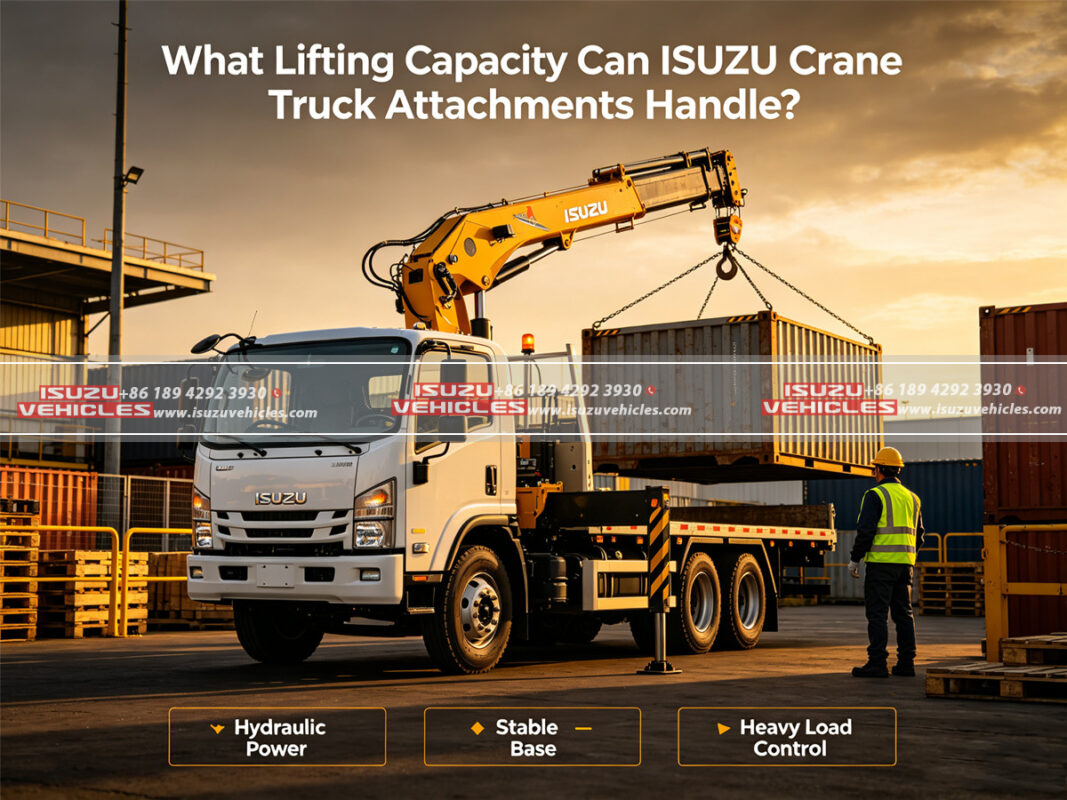
Understanding the Lifting Capability of ISUZU Crane Attachments
In construction, logistics, municipal services, and industrial operations, the ability to safely lift and move heavy materials directly affects productivity, project efficiency, and operational safety. A truck-mounted crane provides businesses with a flexible solution by combining transportation and lifting functions into a single vehicle, allowing operators to deliver materials to a job site and immediately perform loading or unloading tasks without relying on additional lifting equipment.
The ISUZU Crane Attachment is designed to provide this combination of mobility and lifting performance, offering different crane capacities depending on the vehicle configuration, boom design, hydraulic system, and application requirements. Instead of using separate trucks and cranes, companies can use an ISUZU crane truck to transport equipment, construction materials, steel structures, machinery components, and other heavy loads while maintaining the ability to perform lifting operations directly at the workplace.
Built on the reliable commercial vehicle platform of ISUZU, ISUZU crane trucks are engineered with strong chassis structures, efficient hydraulic systems, and carefully matched crane configurations to ensure stable lifting performance. The actual lifting capacity can range from several tons for light-duty applications to more than ten tons for heavy-duty operations, depending on the selected crane model and truck configuration.
Understanding lifting capacity requires more than simply looking at the maximum rated tonnage. Operators must also consider boom extension length, lifting radius, load distribution, ground conditions, and operating environment. A crane that can lift a certain weight close to the vehicle may have a lower capacity when the boom is fully extended, making proper selection and operation essential.
Main Factors That Determine ISUZU Crane Lifting Capacity
The lifting capability of an ISUZU crane attachment depends on several interconnected engineering factors. Each element influences how much weight the crane can safely handle and how efficiently it performs in real working conditions.
Crane Tonnage Rating and Hydraulic Power
The most commonly used measurement for crane capacity is ton-meter rating, which represents the crane’s lifting ability at a specific working radius. For example, a 5-ton crane does not necessarily lift 5 tons at every boom position. The actual capacity changes depending on how far the load is positioned from the crane base.
ISUZU crane trucks are commonly equipped with different crane sizes, including:
- Small cranes: approximately 2–5 ton-meter capacity for light transportation and maintenance tasks.
- Medium cranes: around 6–12 ton-meter capacity for construction materials and industrial handling.
- Heavy-duty cranes: 15 ton-meter or higher for machinery installation and large-scale lifting operations.
The hydraulic system plays a critical role in achieving these capacities. Hydraulic pumps, cylinders, and control valves work together to generate smooth and controlled lifting movements, ensuring that operators can handle loads accurately without sudden movement.
Truck Chassis Strength and Load Balance
The truck chassis is the foundation that supports the entire crane system. A crane may have excellent lifting capability, but without a properly matched chassis, the vehicle may experience instability or excessive structural stress.
ISUZU crane trucks are designed with reinforced frames and optimized weight distribution to handle the additional load created by crane installation. The chassis must support not only the crane itself but also the materials being lifted, the hydraulic equipment, and the dynamic forces created during operation.
Proper balance between the front and rear axles is essential because uneven weight distribution can reduce stability and increase operational risks.
Common ISUZU Crane Attachment Configurations and Their Applications
Different industries require different lifting solutions, which is why ISUZU crane trucks are available with various crane attachment configurations.
Light-Duty ISUZU Crane Trucks for Urban Operations
Small crane attachments are ideal for businesses that require mobility and flexibility rather than extreme lifting power. These configurations are commonly installed on compact or medium-duty ISUZU chassis and are suitable for:
- Electrical equipment installation
- Road maintenance
- Small construction projects
- Landscaping operations
- Utility service work
These cranes typically provide lifting capacities from 2 to 5 tons and are valued for their maneuverability in crowded urban areas.
For example, a small crane truck can transport building materials to a construction site and unload them directly, eliminating the need for separate forklifts or lifting machines.
Medium-Duty Crane Trucks for Construction and Industrial Transport
Medium-capacity crane attachments are among the most popular options because they provide a strong balance between lifting ability and vehicle flexibility.
These cranes are often used for:
- Steel structure installation
- Equipment transportation
- Warehouse loading operations
- Construction material handling
- Machinery maintenance
With lifting capacities commonly ranging from 5 to 10 tons, medium-duty ISUZU crane trucks are suitable for companies that need reliable performance across multiple job sites.
Heavy-Duty Crane Trucks for Specialized Lifting Tasks
Heavy-duty crane attachments are designed for more demanding applications where larger loads must be handled safely. These systems may feature longer booms, stronger hydraulic components, and reinforced truck chassis.
Typical applications include:
- Industrial machinery installation
- Large equipment transportation
- Infrastructure projects
- Heavy construction operations
Although these cranes provide greater lifting power, they require more careful planning because operating radius, ground stability, and load positioning become increasingly important factors.
How Boom Length and Working Radius Affect Lifting Capacity
One of the most misunderstood aspects of crane operation is the relationship between lifting weight and boom extension. Many users assume that a crane rated for a certain tonnage can always lift that amount, but actual performance depends heavily on working distance.
Short-Reach Lifting Performance
When the boom is positioned close to the truck body, the crane can usually achieve its maximum lifting capacity because the load creates less leverage force against the crane structure.
For example, a crane rated at 10 tons may be capable of lifting its full rated capacity when the load is positioned near the vehicle.
Extended Boom Operations
As the boom extends farther away from the truck, lifting capacity decreases because the load creates greater stress on the crane system. Operators must follow the manufacturer’s load chart to determine safe lifting limits at different boom lengths.
ISUZU crane attachments are designed with controlled hydraulic movement and safety indicators that help operators understand operating limits and prevent overloading.
Safety Features That Support ISUZU Crane Operations
Because crane operations involve heavy loads and dynamic movement, safety systems are essential for preventing accidents and protecting operators.
Hydraulic Stability and Control Systems
ISUZU crane trucks use hydraulic systems that allow smooth movement during lifting, rotation, and boom extension. Precise control reduces sudden load shifts and improves handling accuracy.
Many configurations also include safety valves that prevent uncontrolled movement if hydraulic pressure changes unexpectedly.
Outriggers and Vehicle Stabilization
Outriggers are one of the most important safety components on a crane truck. They extend outward from the vehicle chassis to increase the support area and improve stability during lifting operations.
Before lifting heavy loads, operators must ensure that:
- The vehicle is parked on stable ground.
- Outriggers are fully deployed.
- The load remains within the approved lifting range.
- The surrounding area is clear of obstacles.
These procedures help maximize the safe lifting capability of the crane attachment.
Maintenance Requirements for Maximum Crane Performance
Regular maintenance is essential for ensuring that an ISUZU crane attachment continues to deliver reliable lifting performance throughout its service life.
Hydraulic System Inspection
Hydraulic components should be inspected regularly for leaks, pressure changes, and wear. Since hydraulic systems generate the force required for lifting, maintaining proper fluid levels and component condition is critical.
Structural Inspection and Lubrication
Crane joints, pins, boom sections, and rotating mechanisms experience significant mechanical stress during operation. Regular lubrication and structural inspections help prevent premature wear and maintain smooth movement.
Proper maintenance not only improves safety but also protects the investment value of the entire vehicle.
ISUZU Crane Trucks in Modern Industrial and Emergency Operations
The versatility of ISUZU crane trucks allows them to support a wide range of industries where transportation and lifting must be combined efficiently. In construction, they provide material handling capability; in municipal services, they assist with infrastructure maintenance; and in emergency situations, they can support recovery and repair operations.
In complex field environments, ISUZU crane trucks often work alongside other specialized vehicles. For example, a bucket truck may handle elevated maintenance tasks, while a fire truck supports emergency response operations requiring rescue and firefighting capabilities. Together, these vehicles create a complete operational system for handling different challenges.
With reliable chassis engineering, flexible crane configurations, and strong lifting performance, ISUZU Vehicles continue to provide practical solutions for companies requiring efficient transport and lifting capabilities across construction, logistics, utility, and industrial applications worldwide.