
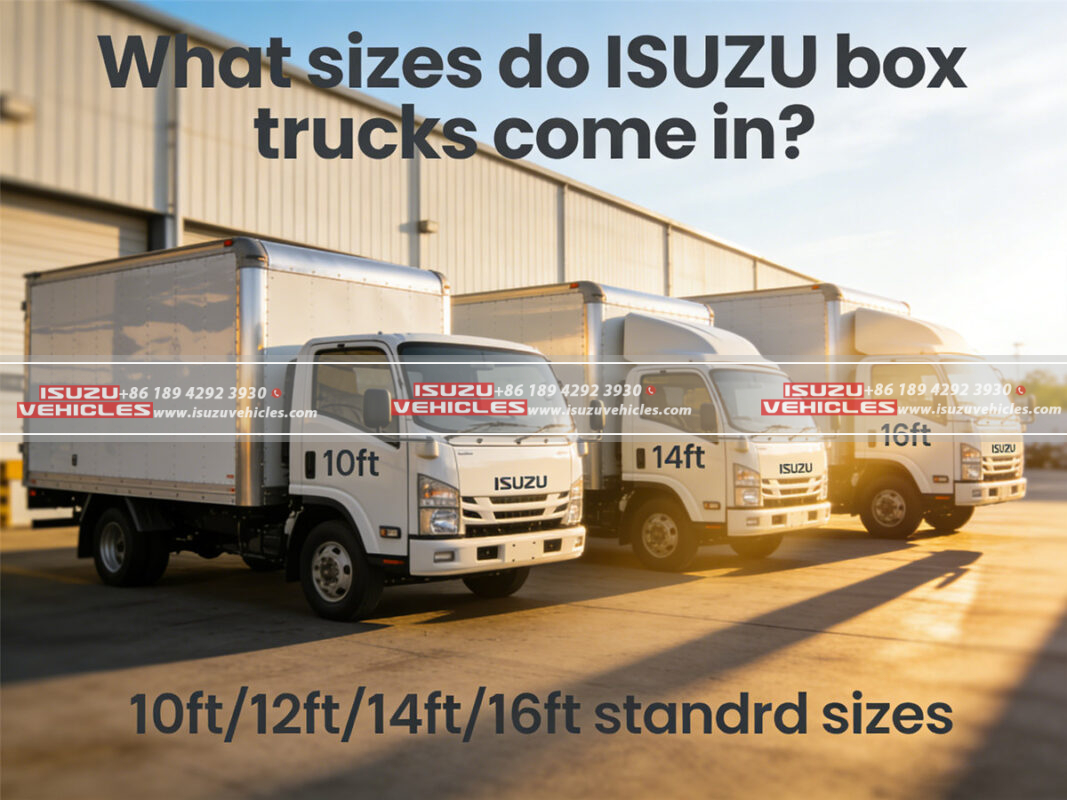
For businesses that depend on efficient goods transportation, choosing the right delivery vehicle is one of the most important operational decisions. Among the many commercial trucks used for logistics, ISUZU box trucks are widely recognized for their practicality, reliability, and flexible cargo capacity. These trucks are commonly used by delivery services, moving companies, food distributors, and retail businesses that require enclosed cargo transport.
One of the first questions many fleet managers and small business owners ask is about the available sizes of box trucks. Because transportation needs vary widely between industries, manufacturers produce box trucks in several configurations that differ in chassis size, cargo box dimensions, and payload capacity. Understanding the different size categories helps businesses select vehicles that match their delivery routes, cargo types, and operational budgets.
The range of ISUZU box truck sizes spans from compact urban delivery vehicles to medium-duty trucks designed for larger distribution operations. Each category offers a balance between cargo space, maneuverability, and weight capacity, making it possible for businesses to choose the right truck for their logistics needs.
Understanding What Defines Box Truck Size
The size of a box truck is typically determined by several technical factors rather than a single measurement. While many people focus on cargo box length, other characteristics also play a critical role in determining how much the truck can carry and where it can operate efficiently.
These factors include:
- Cargo box length and internal volume
- Vehicle wheelbase
- Gross vehicle weight rating (GVWR)
- Payload capacity
- Chassis strength and axle configuration
In most commercial vehicle specifications, manufacturers describe box truck size using both cargo box dimensions and payload capacity, which together provide a clearer understanding of the vehicle’s capabilities.
For ISUZU box trucks, these measurements are carefully balanced to ensure that the vehicle remains stable and efficient while transporting goods.
Common ISUZU Box Truck Size Categories
ISUZU produces several different truck chassis platforms that can be fitted with cargo boxes of varying sizes. These trucks generally fall into three main categories: compact, medium, and large box trucks.
Compact Box Trucks
Compact box trucks are designed primarily for city deliveries and short transportation routes. These vehicles offer moderate cargo capacity while remaining easy to maneuver through congested streets and tight loading zones.
Typical features include:
- Cargo box length: 10–14 feet (3–4.3 meters)
- Cargo volume: 10–16 cubic meters
- Payload capacity: 1.5–3 tons
Because of their smaller footprint, these trucks are often used by courier companies, local food distributors, and small retail businesses that perform daily urban deliveries.
Medium Box Trucks
Medium-sized box trucks are among the most commonly used commercial delivery vehicles. They provide significantly more cargo space while still maintaining good maneuverability and fuel efficiency.
Typical specifications include:
- Cargo box length: 16–20 feet (4.8–6 meters)
- Cargo volume: 18–30 cubic meters
- Payload capacity: 3–6 tons
These trucks are frequently used by furniture delivery services, appliance distributors, and wholesale suppliers transporting goods between warehouses and retail outlets.
Large Box Trucks
Large box trucks are designed for businesses that need to transport substantial quantities of goods in a single trip. They are often used for regional distribution or heavy commercial deliveries.
Typical characteristics include:
- Cargo box length: 22–26 feet (6.7–7.9 meters)
- Cargo volume: 30–45 cubic meters
- Payload capacity: 6–10 tons
These trucks provide the highest cargo capacity among standard box truck configurations.
ISUZU Chassis Platforms Used for Box Trucks
The size and capacity of a box truck are closely related to the chassis platform on which the cargo box is mounted. ISUZU offers several commercial truck platforms that serve as the foundation for box truck bodies.
ISUZU ELF Series
The ISUZU ELF is one of the most widely used light-duty commercial truck platforms. Trucks built on this chassis typically support compact or medium cargo boxes and are well suited for city logistics.
Key advantages include:
- Compact design for urban driving
- Good fuel efficiency
- Easy maintenance and servicing
These trucks are popular with small businesses and delivery companies operating within metropolitan areas.
ISUZU Forward Series
The ISUZU Forward platform represents the medium-duty segment of the manufacturer’s truck lineup. It supports larger cargo bodies and higher payload capacities.
Businesses that transport larger shipments or operate regional distribution networks often prefer this platform because it offers more power and structural strength than light-duty trucks.
Cargo Box Design and Interior Capacity
Although the external length of a box truck is often highlighted, the interior design of the cargo body plays a major role in determining how efficiently goods can be transported.
Internal Cargo Dimensions
The usable space inside a cargo box is defined by:
- Interior length
- Interior width
- Interior height
For many delivery businesses, interior height is particularly important because it allows taller pallets or stacked cargo to be transported without difficulty.
Cargo Securing and Storage Systems
Modern box trucks often include interior features designed to improve cargo safety and efficiency, such as:
- Tie-down rails for securing shipments
- Shelving systems for parcel delivery
- Pallet tracks for forklift loading
These features help maximize usable cargo volume and reduce the risk of product damage during transport.
Selecting the Right Box Truck Size for Your Business
Choosing the correct box truck size requires careful consideration of several operational factors. A vehicle that is too small may require multiple trips to deliver cargo, increasing fuel costs and labor expenses. On the other hand, a truck that is too large may be difficult to maneuver in tight urban environments.
When evaluating ISUZU box truck sizes, businesses typically consider the following:
- Average cargo volume per delivery
- Weight of transported goods
- Distance between warehouses and delivery points
- Road access and parking availability
- Fuel efficiency and operating costs
Companies performing frequent deliveries within city centers often prefer smaller trucks, while regional distributors benefit from larger cargo volumes that reduce the number of required trips.
Versatility of Box Trucks in Commercial Logistics
One of the reasons ISUZU box trucks remain popular across many industries is their versatility. The enclosed cargo body can be customized for a wide range of commercial applications, allowing a single chassis platform to support multiple types of transportation operations.
For example, the same vehicle platform used for standard dry freight can be modified to carry temperature-sensitive goods, delicate equipment, or retail inventory.
Businesses may add specialized features such as insulation panels, refrigeration systems, liftgates, or internal partitions depending on their cargo requirements. This adaptability makes box trucks suitable for industries ranging from food distribution to moving services and equipment transport.
In many commercial fleets, box trucks operate alongside other types of vehicles designed for different logistics tasks. For instance, companies may use a freezer truck to transport frozen foods while relying on a standard cargo truck for dry goods delivery. Within these integrated fleets, ISUZU Vehicles provide dependable transportation solutions that support diverse industries, helping businesses maintain efficient supply chains and reliable product distribution across urban and regional markets.