
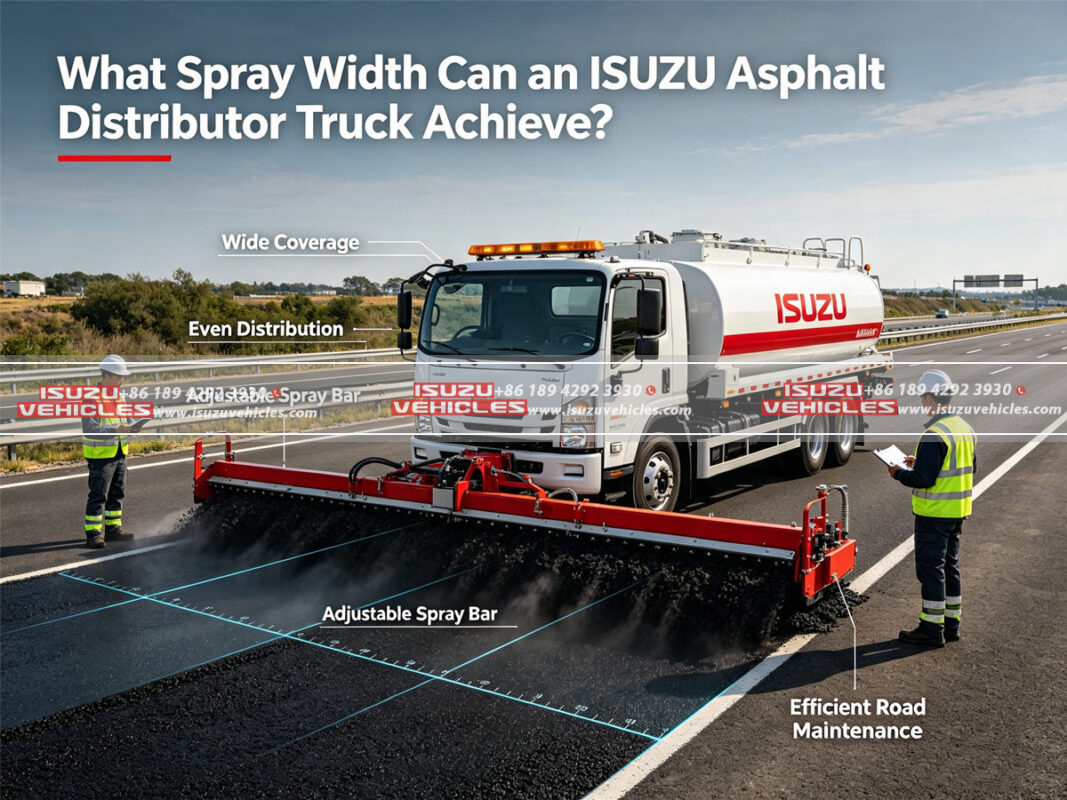
Road construction and pavement preservation demand a high level of accuracy, particularly during the application of asphalt binders and emulsions. Whether the project involves a newly constructed highway, a municipal road rehabilitation program, or preventive maintenance on an airport runway, the quality of asphalt distribution has a direct impact on pavement durability, bonding strength, and overall construction efficiency. Among the many technical specifications buyers evaluate before purchasing an asphalt distributor truck, one of the most frequently asked questions is: What spray width can an ISUZU asphalt distributor truck achieve?
The answer depends on several factors, including the truck model, spray bar design, nozzle arrangement, hydraulic control system, and the specific requirements of the road maintenance project. Modern ISUZU asphalt distributor trucks are engineered with adjustable spray systems capable of covering a wide range of widths, allowing contractors to handle everything from narrow residential streets to multi-lane highways with exceptional precision.
Understanding spray width is about more than simply measuring the distance covered. It also involves spray uniformity, application accuracy, operating efficiency, and the ability to meet engineering specifications while minimizing asphalt waste.
Typical Spray Width of an ISUZU Asphalt Distributor Truck
The spray width refers to the maximum lateral distance over which asphalt binder can be evenly distributed during a single pass of the truck. Modern ISUZU asphalt distributor trucks generally offer adjustable spray widths rather than a fixed measurement, allowing operators to adapt quickly to different project requirements.
Most commercially available models provide spray widths ranging from approximately:
- 2.5 meters for narrow urban roads and patch repairs
- 3.5–4.5 meters for municipal streets
- 5–6 meters for standard two-lane highways
- Up to 6 meters or more for large road construction projects equipped with extended spray bars
Rather than spraying at the maximum width all the time, operators typically adjust the spray bar to match the pavement dimensions. This flexibility helps ensure accurate material placement while reducing unnecessary overlap and asphalt consumption.
The hydraulic spray bar can often be folded or extended depending on transportation or working conditions, making the truck equally suitable for both confined urban environments and expansive highway construction sites.
Factors That Influence Spray Width
Although manufacturers specify a maximum spray width, several design elements determine how effectively that width can be utilized in real construction environments.
Spray Bar Design
The spray bar is the most important component affecting coverage.
Modern ISUZU distributor trucks use hydraulically controlled spray bars that can:
- Extend outward during operation
- Fold inward for transport
- Adjust working width
- Maintain stable nozzle spacing
- Deliver uniform spray pressure
A properly engineered spray bar ensures that every nozzle contributes to an even asphalt layer across the full working width.
Nozzle Configuration
Spray nozzles are carefully positioned along the spray bar at fixed intervals.
Each nozzle overlaps slightly with adjacent spray patterns to create continuous coverage without gaps or excessive material accumulation.
Proper nozzle spacing helps maintain:
- Uniform asphalt thickness
- Consistent application rates
- Reduced material waste
- Smooth pavement bonding
Replacing worn or damaged nozzles is essential for preserving spray quality throughout the equipment’s service life.
Why Adjustable Spray Width Matters
Road maintenance projects rarely involve roads of identical dimensions. Contractors may complete repairs on residential streets one day and work on wide expressways the next. An adjustable spray system provides the flexibility needed to handle this variety efficiently.
Improved Material Efficiency
Applying asphalt only where it is needed reduces waste and lowers operating costs.
A spray width that closely matches the pavement width helps avoid:
- Overspray beyond pavement edges
- Excess binder consumption
- Cleanup requirements
- Uneven pavement appearance
Because asphalt materials represent a significant portion of project costs, accurate application directly contributes to better budget control.
Higher Productivity
A wider spray width allows contractors to complete larger surface areas in fewer passes.
Benefits include:
- Faster project completion
- Lower fuel consumption
- Reduced equipment wear
- Shorter traffic disruptions
- Improved labor productivity
For highway maintenance projects covering many kilometers, wider spray capability can significantly improve daily production rates.
Maintaining Uniform Asphalt Coverage Across the Full Width
Maximum spray width alone does not guarantee high-quality results. Equally important is maintaining consistent asphalt distribution from one edge of the spray bar to the other.
Electronic Spray Control Systems
Many modern ISUZU asphalt distributor trucks incorporate computerized control systems that automatically regulate asphalt flow based on vehicle speed.
These systems ensure that:
- Spray rate remains constant
- Asphalt thickness stays uniform
- Speed variations do not affect application quality
- Material usage remains predictable
Electronic controls reduce dependence on operator experience while improving repeatability across different construction projects.
Proper Asphalt Temperature
Temperature directly influences asphalt viscosity.
If the material becomes too cool, spraying becomes uneven and nozzle blockage may occur.
If it becomes excessively hot, asphalt may flow too quickly, resulting in inconsistent application.
Integrated heating systems continuously maintain optimal spraying temperatures, allowing the full spray width to perform consistently throughout the workday.
Selecting the Right Spray Width for Different Applications
Different types of pavement preservation require different spray widths, making flexibility one of the greatest advantages of an ISUZU asphalt distributor truck.
For neighborhood streets, parking lots, and local access roads, a relatively narrow spray width allows operators to work accurately around curbs, intersections, and roadside infrastructure. Municipal maintenance departments often prefer adjustable spray bars because they can perform routine repairs without affecting adjacent surfaces.
On highways and major arterial roads, wider spray widths improve efficiency by covering larger pavement sections in fewer passes. This reduces construction time, minimizes lane closures, and lowers labor costs while maintaining excellent surface uniformity.
Airport runways, industrial parks, logistics centers, and large commercial developments also benefit from precise spray width adjustment. Since these facilities often require strict engineering tolerances, contractors rely on accurately calibrated spray systems to meet project specifications and ensure long-lasting pavement performance.
Regardless of project size, selecting the appropriate spray width always involves balancing productivity with application accuracy. Experienced operators adjust the spray bar based on pavement dimensions, environmental conditions, asphalt type, and construction requirements to achieve the best overall results.
Why ISUZU Asphalt Distributor Trucks Deliver Outstanding Road Maintenance Performance
The ISUZU asphalt distributor truck combines reliable commercial vehicle engineering with specialized asphalt application technology, making it a trusted choice for contractors and government agencies around the world. Adjustable spray widths of up to approximately six meters, advanced hydraulic spray bars, precision nozzle systems, electronic flow controls, and dependable heating technology enable operators to deliver consistent asphalt coverage across a wide range of pavement preservation projects.
Beyond spray width, ISUZU’s reputation for fuel-efficient engines, durable chassis construction, low maintenance requirements, and dependable long-term performance provides additional value throughout the equipment’s operating life. These advantages help contractors improve construction quality while controlling operating costs and reducing project downtime.
For companies building comprehensive infrastructure fleets, an asphalt distributor truck works efficiently alongside a mixer truck for concrete transport and a tow truck for vehicle recovery and equipment support. Together with reliable ISUZU Vehicles, these specialized machines provide the versatility, durability, and engineering excellence required to meet the evolving demands of modern road construction, pavement preservation, and large-scale infrastructure development.