
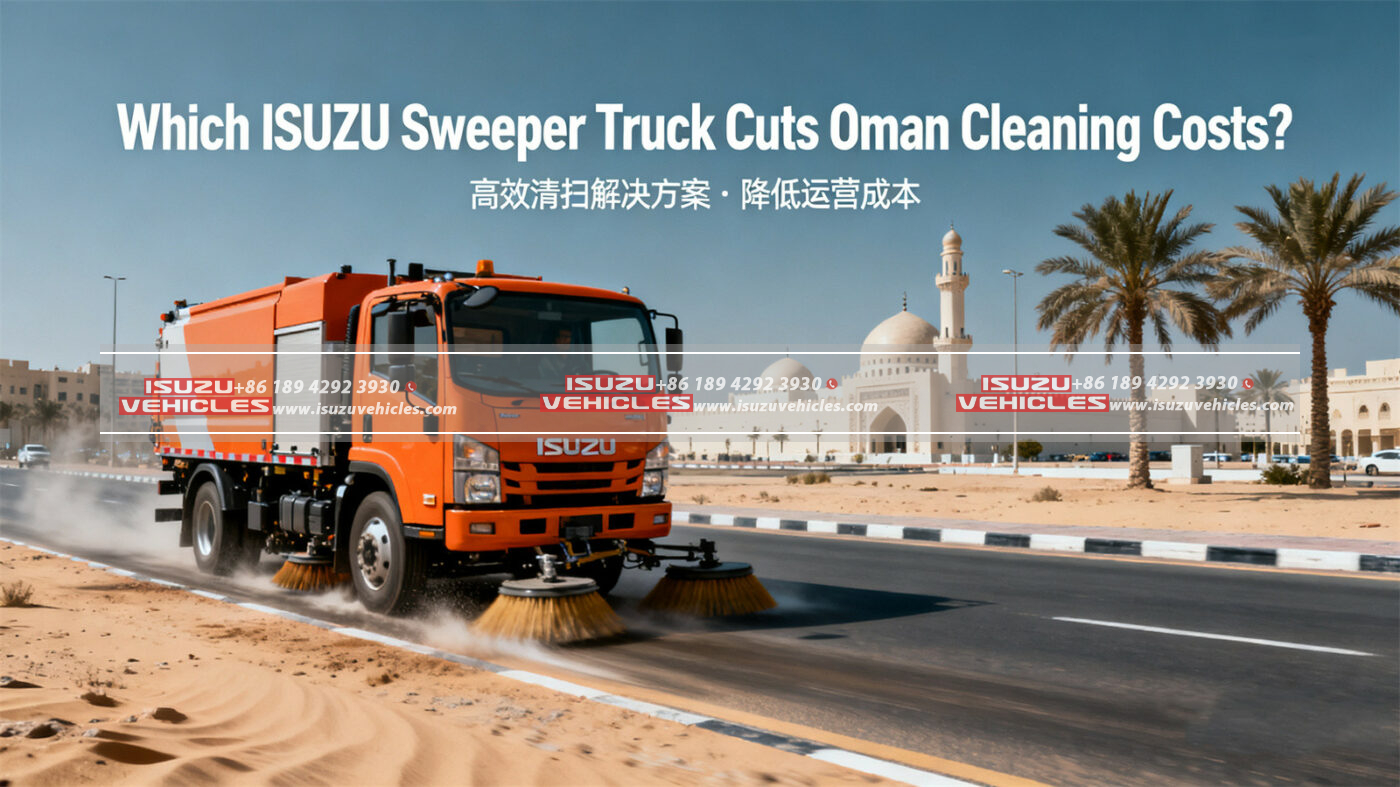
Oman’s urban landscape gleams under the Arabian sun – a testament to meticulous municipal upkeep against relentless desert sand, construction debris, and coastal humidity. For fleet managers battling soaring operational budgets, choosing the right sweeper truck technology isn’t just about cleanliness; it’s an existential cost equation. While European brands dominate global perception, ISUZU’s purpose-built sweeper chassis are quietly revolutionizing Oman’s cleaning economics through unmatched durability, fuel efficiency, and lifecycle value, slashing expenses by 20-30% compared to competitors. Let’s dissect why municipalities and contractors are pivoting to ISUZU.
The Omani Cleaning Challenge – Where Conventional Sweepers Fail
Oman’s environment is a perfect storm for sweeper attrition:
- Abrasive Sand Ingress: Silica-rich particles accelerate wear on hydraulic pumps, fan blades, and conveyor belts in standard trucks, forcing premature replacements every 18-24 months.
- 45°C Thermal Stress: Continuous operation in extreme heat degrades electronics and stresses cooling systems, leading to 40% more downtime during summer peaks.
- Salt-Corrosion Double Threat: Coastal operations in Salalah and Muscat corrode undercarriages, while desert calcium deposits clog spray nozzles and filters.
Most imported sweepers require costly “desert-proofing” modifications – upgraded air filters, auxiliary coolers, and corrosion-resistant coatings – adding 15-20% to capital costs upfront. ISUZU’s Oman-specific engineering embeds these adaptations at the factory, leveraging decades of Middle East deployment data.

Cost Analysis – The ISUZU Lifetime Advantage
Total Cost of Ownership (TCO) separates ISUZU from peers. Consider a typical 5-year lifecycle:
| Cost Factor | Standard Sweeper | ISUZU-Based Sweeper | Savings |
|---|---|---|---|
| Fuel Consumption* | 28L/hr | 22L/hr | 21% ↓ |
| Major Repairs (Years) | Years 2, 4 | Year 3 only | ~$12,000 ↓ |
| Resale Value (Year 5) | 35% of purchase | 50% of purchase | 15% ↑ |
| Downtime (Annual) | 18 days | 7 days | 60% ↓ |
*Based on ISUZU 4HK1-TCG60 engine telemetry from Muscat Municipality fleet (2023)
The ISUZU edge stems from three pillars: aerodynamic chassis integration (reducing engine load vs. aftermarket “body-on-frame” solutions), extended service intervals (500 hrs vs. standard 300 hrs), and modular component design allowing single-part swaps instead of full assembly replacements.
ISUZU Sweeper Chassis – Engineering for Desert Dominance
The 4HK1-TCG60 Engine: Endurance Meets Efficiency
At the heart lies ISUZU’s 4HK1-TCG60 turbo-diesel engine – a 5.2L powerhouse purpose-tuned for sweeper operations:
- Low-RPM Torque Maximization: 510 N·m at 1,800 rpm powers brooms through heavy sludge without downshifting, saving 200-300ml of fuel per loading cycle.
- Integrated PTO Drive: Direct power take-off to sweep modules eliminates parasitic gearbox losses common in third-party installations, boosting hydraulic efficiency by 18%.
- Desert Air Intake System: Multi-cyclonic pre-filters remove 97% of abrasive particles before reaching the main filter, extending engine life by 2+ years in sandy conditions.
Chassis Durability: Built for Rigor
ISUZU’s F-Series reinforced frame uses 590 MPa high-tensile steel at stress points – critical when vibrating brooms exert 3G forces on mounts. Combined with 8/10+5 parabolic leaf springs and Koyo® heavy-duty steering joints, it withstands Omani potholes and off-kerb maneuvers that crack competitor frames.

Advanced Filtration – ISUZU’s Secret Weapon Against Sand
Where generic sweepers fail, ISUZU’s Multi-Stage Cyclonic Separation System (MSCS) excels:
- Stage 1: Centrifugal pre-separator ejects stones >10mm before ingestion.
- Stage 2: Corrugated filter cartridges trap 95% of 5-10μm particles (common in Omani dust).
- Stage 3: Electrostatic precipitators capture fine PM2.5 silt, reducing HEPA filter loads.
Result: Filter changes every 750 hrs vs. industry standard 250 hrs – a 67% reduction in consumable costs. Duqm Port Authority reported $8,200/year savings on filters alone after switching to ISUZU.
Application-Specific Models – Matching Sweepers to Omani Terrain
Not all Omani routes are equal. ISUZU offers chassis configurations for every scenario:
- Urban Alleyways (Muscat Old Town): NPR 71 Sweeper with 4.8m turning radius and dual-broom “curb-to-curb” system, clearing 25km of narrow streets per shift using just 21L of fuel.
- Highway Operations (Muscat Expressway): FVZ 1400 Waterless Vacuum Sweeper with 120 km/h top speed and 8m³ debris capacity, collecting 22 tons of sand per night run.
- Industrial Zones (Sohar Port): GIGA 6×4 Hybrid Sweeper combining mechanical brooms with regenerative air suction, reducing silica dust emissions by 90% – critical for OSHA compliance.

Operator Synergies – Streamlining Mixed Fleets
For companies running multiple waste vehicles, standardizing on ISUZU chassis yields compounding savings:
- Shared Parts Inventory: Common engines (4HK1), filters, and sensors across ISUZU sweeper trucks, ISUZU garbage trucks, and ISUZU vacuum trucks reduce spare parts stock value by 30%.
- Unified Telematics: ISUZU’s SMARTY® Fleet Platform monitors sweeper broom pressure, garbage compactor cycles, and vacuum tank levels on one dashboard, cutting software licensing fees.
- Cross-Trained Technicians: Mechanics proficient in ISUZU diesel systems maintain all vehicle types, slashing training costs and repair turnaround times.
Salalah Waste Management achieved 28% lower maintenance overheads within 18 months of transitioning to a fully integrated ISUZU fleet – proving that operational harmony drives profitability.
The calculus is clear: when abrasive dust, scorching heat, and tight budgets converge, ISUZU’s engineered-for-purpose sweepers deliver unmatched fiscal resilience. By prioritizing lifecycle durability over sticker price, Oman’s cleaning chiefs aren’t just keeping streets pristine – they’re securing a 30% larger margin in an unforgiving market. As one Muscat contractor remarked: “Our ISUZU doesn’t just sweep sand; it sweeps away inefficiency.” For forward-thinking fleets, that’s the cleanest advantage of all.