
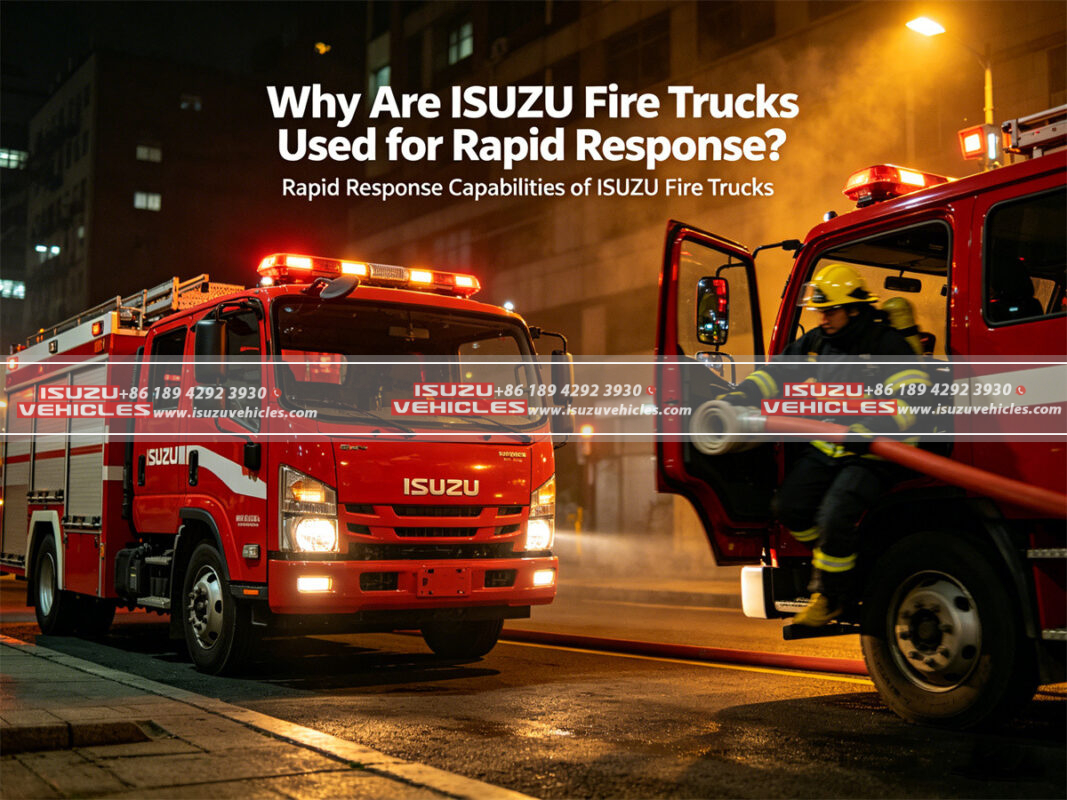
The Critical Need for Speed in Modern Fire and Emergency Response
Rapid response in fire and emergency services is one of the most decisive factors in minimizing loss of life, reducing property damage, and controlling the spread of hazardous situations, and in this high-stakes environment, vehicle performance becomes just as important as the skill of the responders themselves. Municipalities and emergency agencies increasingly rely on specialized vehicles that can combine speed, reliability, and operational readiness, which is where ISUZU fire trucks have become a widely trusted solution.
The importance of fast deployment cannot be overstated, as even a delay of a few minutes can significantly escalate fire damage or complicate rescue operations. ISUZU fire trucks are engineered with this urgency in mind, integrating mobility, power, and firefighting capability into a compact and efficient platform that allows emergency teams to reach incident sites quickly while maintaining full operational effectiveness upon arrival.
Engineering Designed for Immediate Deployment
The ability of ISUZU fire trucks to support rapid response operations begins with their underlying engineering, which prioritizes acceleration, maneuverability, and readiness under all conditions, ensuring that emergency teams are never hindered by mechanical limitations when seconds matter most.
High-Performance Engines for Fast Mobilization
ISUZU fire trucks are equipped with engines designed to deliver strong torque and rapid acceleration, allowing them to move quickly through urban traffic and reach emergency scenes without delay. This performance is particularly important in densely populated areas where congestion can slow down larger or less agile emergency vehicles.
The balance between power and fuel efficiency ensures that these trucks remain ready for repeated deployments throughout the day without excessive operational strain.
Optimized Vehicle Weight and Structural Efficiency
Another key factor in rapid response capability is the optimized weight distribution and structural design of ISUZU fire trucks. By maintaining a balance between durability and lightweight construction, these vehicles achieve faster acceleration and improved handling compared to heavier, less specialized platforms.
This structural efficiency allows fire crews to navigate tight streets, intersections, and residential areas with greater precision and control.
Advanced Transmission and Drivetrain Systems
Smooth and responsive transmission systems enable ISUZU fire trucks to shift gears efficiently under varying load conditions, which is essential when carrying water tanks, equipment, and personnel simultaneously. This ensures that the vehicle maintains consistent speed and stability during emergency deployment.
The drivetrain is also engineered to handle sudden stops and rapid directional changes, which are common in urban firefighting scenarios.
Integrated Firefighting Systems Supporting Immediate Action
Speed alone is not sufficient in emergency response; fire trucks must also be fully equipped to begin firefighting operations immediately upon arrival, and ISUZU vehicles are designed with integrated systems that support this requirement.
Onboard Water and Foam Systems
Many ISUZU fire trucks are equipped with built-in water tanks and foam systems that allow firefighters to begin suppression efforts immediately without waiting for external water sources. This is particularly important in remote or infrastructure-limited areas.
These systems are designed for rapid deployment, ensuring that firefighting operations can begin within moments of arrival.
High-Capacity Pumping Mechanisms
Pump systems in ISUZU fire trucks are engineered to deliver high-pressure water flow, enabling effective fire suppression across different types of incidents, from structural fires to vehicle and industrial emergencies. The rapid activation of these systems is essential for controlling fire spread in the early stages.
Consistent pump performance ensures that firefighters can maintain pressure throughout the operation.
Modular Equipment Storage for Quick Access
Efficient storage design allows firefighters to access hoses, tools, and safety equipment quickly, reducing setup time at the scene. ISUZU fire trucks are designed with compartmentalized storage systems that organize equipment logically and securely.
This reduces response time and allows crews to focus immediately on operational tasks.
Mobility and Urban Adaptability in Emergency Situations
One of the defining advantages of ISUZU fire trucks in rapid response scenarios is their ability to operate effectively in complex urban environments where space is limited and traffic conditions are unpredictable.
Compact Design for Narrow Streets and Tight Access
ISUZU fire trucks are often built on compact chassis platforms that allow them to navigate narrow streets, residential zones, and congested city centers where larger emergency vehicles may struggle. This accessibility is critical for reducing response times in urban emergencies.
Their smaller footprint does not compromise operational capability, making them highly efficient in dense environments.
Enhanced Steering and Maneuverability Systems
Advanced steering systems provide improved turning radius and vehicle control, enabling drivers to maneuver quickly through traffic and around obstacles. This is especially important during emergency responses where every second counts.
The ability to make precise movements in confined spaces enhances overall operational efficiency.
All-Terrain Capability for Diverse Environments
In addition to urban environments, ISUZU fire trucks are designed to operate in rural and semi-rural areas where road conditions may be uneven or less developed. Their suspension systems and drivetrain configurations allow them to maintain stability across different terrains.
This versatility ensures that emergency services are not limited by geography.
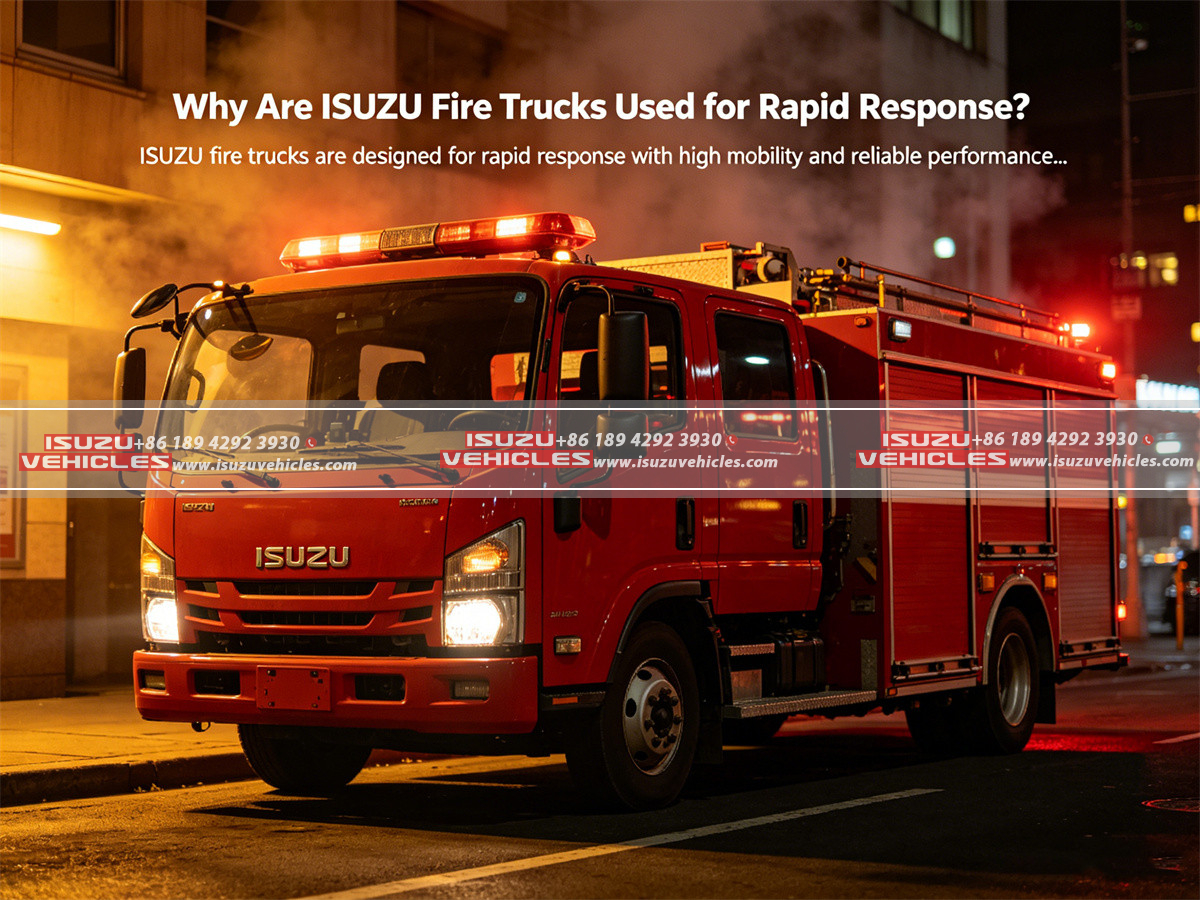
Operational Coordination and Multi-Vehicle Emergency Response
Rapid response effectiveness is also influenced by how fire trucks integrate into broader emergency response systems, where coordination between multiple vehicle types and units is essential for managing complex incidents.
Support from Auxiliary Emergency Vehicles
In many cases, ISUZU fire trucks operate alongside a pickup truck used for rapid personnel deployment or preliminary assessment of emergency scenes. This coordination allows for faster situational awareness and initial response actions before larger units arrive.
Such integration improves overall response efficiency and reduces delays in critical decision-making.
Water Supply and Logistics Support Systems
In large-scale emergencies, fire trucks may be supported by a tanker truck that provides additional water supply when hydrants are unavailable or insufficient. This ensures that firefighting operations can continue uninterrupted even in resource-limited environments.
The combination of these vehicles enhances operational sustainability during prolonged incidents.
Unified Command and Communication Systems
Modern ISUZU fire trucks are equipped with communication technologies that allow them to integrate seamlessly into emergency command networks. This ensures that all units involved in a response operation remain coordinated and informed in real time.
Effective communication reduces confusion and improves overall response speed.
Reliability, Readiness, and Continuous Operational Performance
Beyond speed and equipment, the reliability of ISUZU fire trucks plays a crucial role in their effectiveness for rapid response, as emergency services require vehicles that are always ready to operate without unexpected failures.
Continuous Readiness Through Robust Engineering
ISUZU fire trucks are built to remain in a constant state of readiness, with durable components and systems designed to withstand frequent use under high-pressure conditions. This ensures that vehicles can be deployed at any moment without concern for mechanical issues.
Reliability is a core requirement for emergency response fleets.
Reduced Downtime Through Simplified Maintenance
Efficient maintenance design allows fire departments to service ISUZU trucks quickly, minimizing downtime and ensuring that vehicles remain available for emergency deployment. Easy access to key components supports faster inspections and repairs.
This contributes directly to operational readiness and fleet efficiency.
Long-Term Durability in Demanding Conditions
Fire trucks often operate in extreme environments, including high temperatures, smoke exposure, and rough terrain. ISUZU vehicles are engineered to withstand these conditions over long service periods without significant performance degradation.
This durability ensures consistent response capability throughout the vehicle’s lifecycle.
In modern emergency response systems, ISUZU fire trucks function as the backbone of rapid deployment operations, often working in coordination with specialized support vehicles such as a pickup truck for quick response access and a tanker truck for sustained firefighting capacity, all while reflecting the reliability, engineering strength, and operational excellence associated with ISUZU Vehicles.