
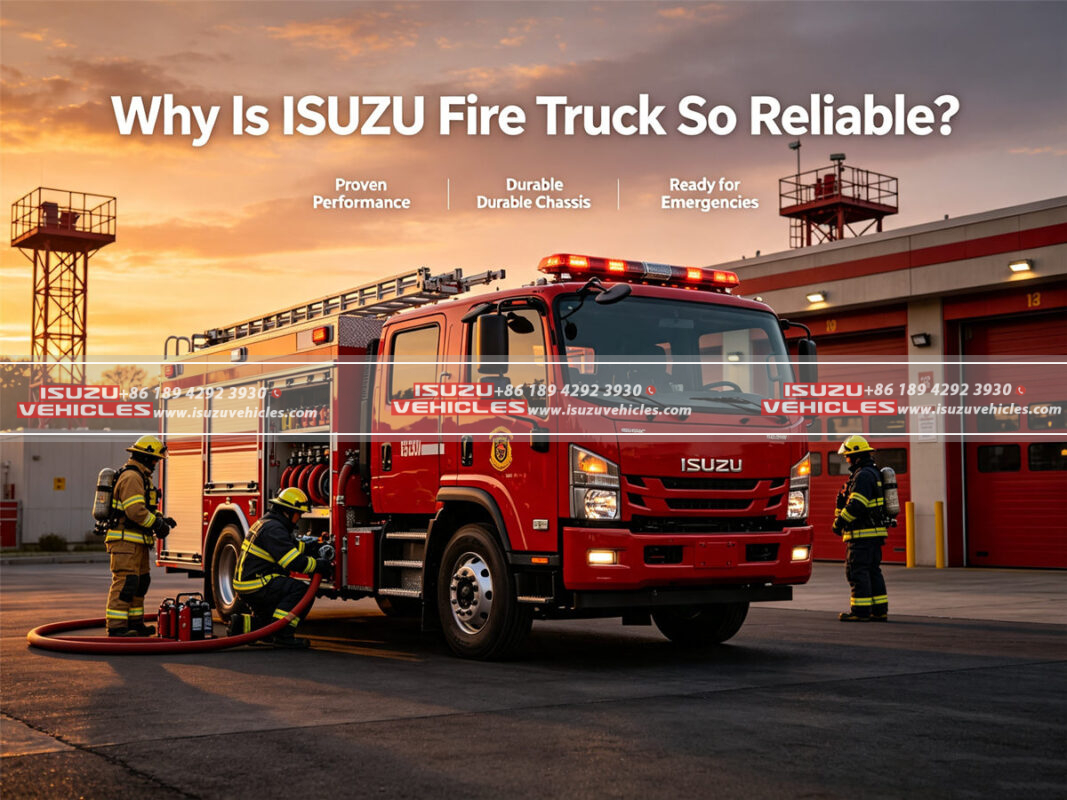
Firefighting is one of the most demanding professions in the world, requiring equipment that performs flawlessly under extreme pressure. Whether responding to urban building fires, industrial emergencies, airport incidents, or rural rescue operations, firefighters depend on vehicles that start instantly, travel safely over various road conditions, and operate continuously for extended periods without mechanical failure. In these situations, equipment reliability is not simply a matter of convenience—it directly affects emergency response efficiency and, ultimately, the protection of lives and property.
Among the many commercial firefighting vehicle manufacturers serving global markets, ISUZU fire trucks have earned a long-standing reputation for dependable performance. Municipal fire departments, industrial facilities, military organizations, airports, and emergency rescue teams across Asia, Africa, the Middle East, South America, and other regions continue to choose ISUZU-based firefighting vehicles because they consistently demonstrate excellent durability, low operating costs, and strong adaptability to a wide range of rescue missions.
So, what makes an ISUZU fire truck so reliable compared with many other commercial firefighting vehicles? The answer lies not in a single component but in decades of engineering experience, proven chassis design, advanced manufacturing standards, carefully integrated firefighting systems, and practical operating efficiency. Understanding these factors helps explain why ISUZU remains one of the most trusted names in emergency response vehicles worldwide.
The Foundation Begins with a Proven ISUZU Chassis
Every reliable fire truck starts with a dependable chassis. Regardless of how advanced the firefighting equipment may be, poor vehicle stability or mechanical reliability will eventually limit operational effectiveness. One of the greatest strengths of ISUZU fire trucks is that they are built upon commercial chassis platforms that have already proven themselves through millions of kilometers of real-world service.
Unlike vehicles developed exclusively for emergency use, ISUZU commercial truck platforms are continuously tested in logistics, construction, municipal services, mining, and long-distance transportation. These demanding industries expose vehicles to heavy payloads, rough road conditions, frequent engine operation, and varying climates, allowing engineers to refine their designs over many production generations.
Engine Reliability Built Through Decades of Development
ISUZU has long been recognized as one of the world’s leading diesel engine manufacturers. Its engines are designed with an emphasis on durability, fuel efficiency, and stable torque output, characteristics that are particularly valuable during emergency operations.
Fire trucks often spend long periods waiting in standby mode before suddenly accelerating to full power during an emergency response. The engine must respond immediately without hesitation while supporting both vehicle movement and auxiliary firefighting systems. ISUZU diesel engines are engineered to deliver consistent performance under these changing operating conditions, maintaining stable temperatures and efficient fuel consumption even during prolonged emergency deployments.
Strong Chassis Construction
The chassis must support not only the vehicle itself but also water tanks, foam tanks, pumps, hose reels, rescue tools, ladders, lighting equipment, breathing apparatus, and various specialized firefighting accessories. This additional equipment significantly increases the vehicle’s operating weight.
ISUZU chassis are designed with reinforced frame structures, optimized suspension systems, and balanced weight distribution, enabling the vehicle to maintain excellent stability while carrying heavy firefighting equipment. This structural strength contributes directly to long service life and reduced maintenance requirements.
Reliable Firefighting Systems Designed for Real Emergency Operations
While the chassis provides the foundation, the firefighting system determines how effectively a fire truck performs once it arrives at the emergency scene.
Modern ISUZU fire trucks integrate high-quality firefighting equipment supplied by experienced manufacturers, ensuring that every major component works together as a complete emergency response system.
High-Performance Water and Foam Pump Systems
One of the most critical components of any fire truck is its water pump. Firefighters depend on stable water pressure and continuous flow throughout rescue operations.
ISUZU fire trucks are commonly equipped with pumps capable of delivering high-volume water output while maintaining stable pressure under varying operating conditions. Whether drawing water from onboard tanks, hydrants, rivers, or reservoirs, the pumping system is designed to operate smoothly with minimal interruption.
Foam systems are equally important when responding to fuel fires, chemical incidents, and industrial emergencies. Integrated foam proportioning equipment ensures accurate mixing ratios, improving extinguishing performance while minimizing waste of firefighting agents.
Professional Equipment Integration
Reliability is also influenced by how well individual systems are integrated.
Instead of treating the upper body as an independent addition, professional manufacturers carefully match the firefighting equipment with the characteristics of the ISUZU chassis. Water tanks are positioned to optimize vehicle balance, pump controls are designed for quick operator access, and equipment compartments are arranged to maximize efficiency during emergency deployment.
This integrated design reduces unnecessary complexity while improving overall vehicle performance.
Excellent Durability Under Challenging Working Conditions
Fire trucks rarely operate under ideal circumstances. They may travel through flooded streets, construction sites, mountainous terrain, crowded urban areas, or remote rural roads while carrying heavy loads and responding under extreme time pressure.
The ability to withstand these demanding conditions is one of the reasons ISUZU fire trucks have gained worldwide recognition.
Resistance to Harsh Environments
Firefighting vehicles frequently encounter:
- High temperatures near active fires
- Heavy rain and flooding
- Dusty construction zones
- Coastal salt exposure
- Mountain roads
- Uneven terrain
ISUZU chassis and major mechanical systems are engineered to tolerate these environments while maintaining dependable operation. Corrosion-resistant materials, durable electrical systems, and carefully protected wiring harnesses contribute to long-term reliability even when vehicles are exposed to difficult weather and challenging operating conditions.
Long Service Life
Many municipal governments and industrial operators expect their firefighting vehicles to remain in service for well over a decade.
Because ISUZU commercial platforms are built for continuous professional use, routine maintenance can often keep these vehicles operating efficiently for many years. This extended service life significantly reduces fleet replacement costs while maximizing the return on investment.
Low Maintenance Costs and Global Service Support
Reliability is measured not only by how rarely a vehicle breaks down but also by how quickly it can return to service when maintenance becomes necessary.
One of ISUZU’s greatest advantages is its extensive global service network and mature parts supply system.
Easy Access to Replacement Parts
Since ISUZU commercial trucks are widely used around the world, replacement parts for engines, transmissions, braking systems, filters, suspension components, and electrical systems are generally easier to obtain than those for many niche emergency vehicle manufacturers.
This availability reduces vehicle downtime and simplifies long-term fleet maintenance, particularly for international customers operating in developing markets.
Simplified Maintenance Procedures
Maintenance technicians are often already familiar with ISUZU commercial vehicles because similar chassis are widely used in cargo transport, municipal services, and construction industries.
This familiarity allows maintenance personnel to diagnose issues more quickly, reducing repair times and minimizing operational interruptions for emergency response departments.
Adaptability Across Different Firefighting Applications
No two firefighting missions are identical. Urban departments, airports, industrial plants, oil fields, mining companies, and forestry agencies all require different vehicle configurations.
One reason ISUZU fire trucks remain highly regarded is their ability to support a wide variety of specialized applications.
Available configurations may include:
- Water fire trucks
- Foam fire trucks
- CAFS fire trucks
- Airport rescue vehicles
- Industrial fire trucks
- Rescue command vehicles
- Emergency lighting trucks
- Hazardous materials response vehicles
- High-reach firefighting platforms
Different wheelbases, payload capacities, tank sizes, and drivetrain options allow manufacturers to customize vehicles according to local operational requirements.
This flexibility enables customers to select equipment that matches both their budgets and specific emergency response needs without compromising the dependable performance associated with the ISUZU platform.
Engineering Partnerships Further Enhance Overall Vehicle Quality
The reliability of an ISUZU fire truck extends beyond the chassis itself. The final quality of the completed vehicle also depends on the expertise of the body builder responsible for integrating firefighting equipment.
Many professionally manufactured ISUZU fire trucks are produced through cooperation with experienced specialty vehicle manufacturers that contribute advanced tank fabrication, pump installation, hydraulic engineering, electronic control systems, aerial equipment, and rescue technologies.
Companies specializing in municipal equipment, emergency vehicles, hydraulic lifting systems, and industrial machinery help ensure that every subsystem works harmoniously with the ISUZU chassis. Through this collaborative manufacturing approach, customers receive complete firefighting solutions rather than simply modified commercial trucks.
As firefighting technologies continue to evolve, ISUZU-based platforms are also being adapted to incorporate intelligent control systems, advanced safety electronics, remote monitoring, improved lighting technologies, and environmentally friendly powertrain options, allowing fleets to modernize while retaining the proven mechanical reliability that has defined the brand for decades.
Why Professionals Continue to Choose ISUZU Fire Trucks
The long-standing reputation of ISUZU fire trucks has not been built through advertising alone but through decades of dependable service in real emergency situations around the world. Their proven commercial chassis, durable diesel engines, carefully engineered firefighting systems, long service life, and globally recognized maintenance support provide fleet operators with confidence that these vehicles will perform when every second matters. Combined with the expertise of leading specialty vehicle manufacturers that integrate pumps, tanks, rescue equipment, and aerial systems, ISUZU fire trucks continue to deliver reliable solutions for municipalities, industrial facilities, airports, and emergency organizations worldwide. For customers seeking dependable commercial equipment beyond firefighting applications, including bucket truck solutions, crane truck configurations, and a complete range of ISUZU Vehicles, the ISUZU platform remains one of the industry’s most trusted foundations for specialized transportation and rescue operations.