
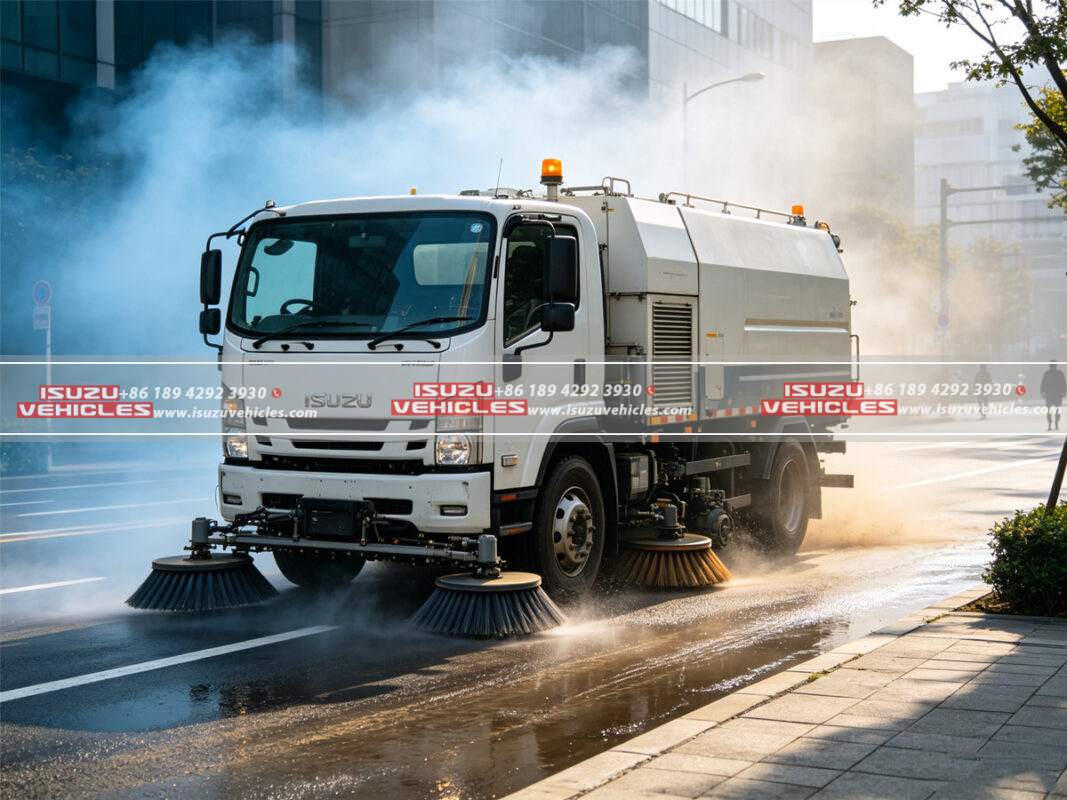
Dust is one of the most common problems affecting urban roads, industrial areas, construction zones, logistics parks, and public spaces, especially in dry weather when loose particles can easily become airborne as vehicles pass. Simply driving over a dusty road can create a cloud of fine particles, while accumulated sand, soil, gravel, leaves, and other debris can continue to generate secondary dust long after the original material has been deposited. For municipalities and professional sanitation companies, regular road cleaning is therefore not only a matter of appearance but also an important part of maintaining a cleaner and more comfortable urban environment.
An ISUZU sweeper truck is designed to address this problem through a combination of mechanical sweeping, controlled water spraying, suction, and dust collection. Instead of simply pushing debris from one part of the road to another, the vehicle uses rotating brushes to gather loose material, a suction system to collect it, and water-spraying equipment to suppress dust during the cleaning process. Depending on the configuration, an ISUZU road sweeper can therefore remove both visible debris and fine particles while significantly reducing the amount of dust released back into the atmosphere during operation.
1. Why Road Dust Is Difficult to Control
Road dust does not come from a single source, which is why ordinary manual cleaning methods are often unable to provide consistent results over large areas. Fine soil can be carried onto paved roads from construction sites, while sand and gravel may fall from trucks transporting building materials. Vehicle tires can also move loose material from unpaved shoulders onto paved surfaces, and natural sources such as dry soil, leaves, and seasonal debris can gradually accumulate along curbs and drainage areas.
Once these materials are deposited on the road, passing vehicles can repeatedly disturb them. Heavy trucks are particularly effective at generating secondary dust because their tires and airflow can move larger quantities of loose material. In busy urban areas, this cycle can continue throughout the day, meaning that a road may appear clean immediately after sweeping but quickly become dusty again if the source material has not been properly collected.
Fine particles require more than mechanical brushing
Large debris such as leaves, paper, stones, and plastic waste can usually be moved relatively easily with a mechanical brush, but fine dust behaves differently. If a brush operates on a completely dry surface, some of the smaller particles may become airborne rather than entering the collection system. This is why modern road-sweeping equipment often combines mechanical brushing with water spraying and suction.
The objective is not simply to move dust across the pavement. Instead, the complete cleaning system needs to loosen material, control airborne particles, transport the material toward the suction opening, and finally collect it inside the vehicle. This integrated process is one of the main reasons an ISUZU sweeper truck can reduce dust more effectively than basic manual sweeping.
2. Water Spraying Helps Control Airborne Dust
One of the most visible dust-control functions of a modern sweeper truck is its water-spraying system. Before or during sweeping, controlled amounts of water can be sprayed onto the road surface to increase the moisture of loose particles. This helps prevent fine dust from becoming airborne when the rotating brushes contact the pavement.
The purpose of the water system is not to flood the road. Instead, it is designed to provide controlled dust suppression while maintaining efficient sweeping performance. The amount of water used depends on the road condition, weather, cleaning speed, dust concentration, and configuration of the vehicle.
Water and sweeping work together
When the road surface is slightly damp, dust particles are less likely to remain suspended in the air. At the same time, the mechanical brushes can continue to loosen sand, dirt, and other material from the pavement so that the suction system can collect it. This creates a coordinated process in which water supports dust control while brushing and suction handle the actual removal of accumulated material.
Current ISUZU sweeper configurations demonstrate this integrated approach. For example, the ISUZU 4 CBM Road Cleaning Sweeper Truck can be equipped with a 1.0–1.5 m³ water tank and a 3.5–4.0 m³ garbage tank, while its sprinkler system uses an electric diaphragm pump, water filters, and nozzles to distribute water during cleaning.
For larger municipal operations, the ISUZU 12 CBM Road Sweeper Truck combines an 8 m³ debris tank with a 4,000-liter clean-water tank, allowing the truck to perform sweeping and dust-suppression work for longer periods before requiring refilling.
3. Mechanical Brushes Loosen and Gather Road Debris
Water alone cannot solve the road-dust problem because much of the material needs to be physically removed from the pavement. This is where the sweeping brushes become essential. Rotating brushes are positioned so that they can contact the road surface and move accumulated debris toward the suction area or collection path.
The design and positioning of the brushes have a direct influence on cleaning performance. A well-designed sweeping system needs to reach the main traffic lane while also handling material close to curbs and road edges, where sand and dust frequently accumulate. Adjustable brush rotation and hydraulic control allow the operator to adapt the system to different road conditions instead of using exactly the same brush settings for every situation.
Cleaning the areas where dust accumulates most
Road edges are often among the dirtiest parts of an urban street because wind, vehicle movement, and drainage patterns naturally push loose material toward curbs. If this material is not removed, passing vehicles can continuously pull it back into the traffic area.
Modern ISUZU sweeper trucks are designed with brush arrangements that help operators clean these difficult areas. The current 12 CBM configuration, for example, uses four hydraulic sweeping brushes arranged symmetrically on the left and right sides, with an adjustable sweeping width of approximately 2.6 to 3.2 meters. The system also uses high-strength wear-resistant steel wire brushes and hydraulic lifting and extension functions.
This combination allows the vehicle to loosen material from the road surface and guide it toward the collection system instead of merely redistributing the dust.
4. Powerful Suction Captures Dust Before It Spreads
Mechanical sweeping is only one part of dust reduction. After the brushes gather loose material, the vehicle needs an effective method of transferring that material into the collection tank. This is where the suction system becomes particularly important.
A modern ISUZU sweeper truck uses airflow and suction to pull dust, sand, leaves, gravel, and other debris through a suction nozzle and into the collection system. The suction nozzle is positioned close to the road surface, allowing the vehicle to collect material that has already been loosened by the brushes.
Floating suction nozzles improve contact with uneven roads
Urban roads are rarely perfectly flat. Manhole covers, repaired pavement, drainage channels, small depressions, and uneven surfaces can create gaps between the suction equipment and the road. If the suction nozzle remains fixed at one height, these variations can reduce collection efficiency.
For this reason, some ISUZU sweeper configurations use a full-floating suction nozzle that can follow changes in road height more effectively. The current ISUZU 12 CBM Road Sweeper Truck, for example, uses a full-floating suction nozzle with hydraulic lifting and a 200 mm suction port, while the system is designed to collect both fine dust and larger particles.
The result is a more complete cleaning process in which particles are not simply pushed forward by the brushes but are actively removed from the pavement and transferred into the truck’s collection tank.
Multi-stage filtration helps control secondary pollution
Collecting dust is only part of the challenge. If the air generated by the suction system is released without appropriate filtration, fine particles can potentially be discharged back into the surrounding environment. This is why dust filtration is an important part of the overall system.
Current ISUZU sweeper models can incorporate multi-stage filtration systems and dedicated dust-suppression equipment. The ISUZU 5 CBM Street Sweeper Truck, for example, combines a full-floating suction nozzle, a multi-stage vacuum filtration system, a dust-suppression device, and a 1,000-liter water tank.
These systems work together so that the truck is not merely collecting large visible debris but is also designed to limit the secondary release of dust during the sweeping process.
5. Different ISUZU Sweeper Configurations for Different Dust Problems
Not every road has the same dust-control requirements, which is why municipalities and contractors need to choose a sweeper configuration according to the size of the working area, road conditions, available water supply, expected debris volume, and frequency of operation.
For narrow urban streets, residential communities, commercial areas, and locations where maneuverability is particularly important, a compact sweeper can be more practical than a large vehicle. The ISUZU 6000 Liter Road Sweeper Truck, for example, uses a 4,500-liter dust tank and a 1,500-liter water tank, with a 3,000 mm sweeping width and a stated cleaning efficiency of at least 98 percent.
For larger municipal roads, industrial parks, airports, and extensive public infrastructure, a higher-capacity vehicle can reduce the number of unloading and refilling stops. The ISUZU sweeper range currently includes configurations such as 6 CBM, 8 CBM, 9 CBM, 12 CBM, and 20 CBM models, giving fleet managers several capacity options for different operating environments.
Choosing capacity according to actual working conditions
A larger sweeper is not automatically the best choice. If a vehicle spends most of its working day in narrow streets, congested urban districts, or residential communities, excessive size can make maneuvering more difficult. Conversely, a compact truck operating on a large industrial site may require too many trips for unloading and water replenishment.
The most efficient choice is therefore the vehicle that balances collection capacity, water capacity, sweeping width, maneuverability, working speed, and local road conditions. This approach allows municipalities to reduce dust consistently without unnecessarily increasing fuel consumption, labor requirements, or downtime.
6. How a Sweeper Truck Fits into a Complete Municipal Cleaning Fleet
Road sweeping is an important part of municipal sanitation, but it is only one stage of maintaining a clean public environment. Cities also need dedicated vehicles for household waste collection, sewage maintenance, sludge removal, drainage cleaning, and other specialized services. The best results are often achieved when these vehicles operate as a coordinated fleet rather than expecting one type of truck to handle every task.
For example, an ISUZU garbage truck can collect household and commercial refuse from residential areas and public facilities, while the sweeper truck handles dust, sand, leaves, and road debris. ISUZU’s current garbage truck range includes rear-loading, hook-loader, skip-loader, compactor, rubbish-bin, and roll-off configurations, allowing waste-collection departments to select equipment according to their local collection system. Explore the ISUZU Garbage Truck category.
At the same time, sewer and drainage work requires equipment with completely different capabilities. A vacuum truck can be used to remove liquid waste, sludge, and accumulated material from septic systems, stormwater catch basins, sewer lines, and industrial facilities. ISUZU’s current vacuum truck range includes 14 CBM vacuum sewer trucks, 6,000-liter vacuum sewer trucks, 11 CBM vacuum tank trucks, combined sewer jetting trucks, and other specialized configurations. View the ISUZU Vacuum Truck range.
This division of work makes municipal operations more efficient because each vehicle performs the task it was specifically designed for. The sweeper removes road dust and solid debris, the garbage truck handles collected refuse, and the vacuum truck manages liquid waste and drainage-related material. Together, these specialized vehicles can provide much more comprehensive urban sanitation than a single multipurpose platform.
An ISUZU sweeper truck reduces dust through a coordinated combination of water spraying, mechanical brushing, suction, filtration, and controlled collection rather than relying on one cleaning method alone. Water helps prevent fine particles from becoming airborne, rotating brushes loosen and gather accumulated material, suction transfers dust and debris into the collection tank, and filtration helps reduce secondary particle release. When the vehicle is properly selected and operated for the road conditions, this integrated approach can make daily municipal cleaning more consistent and productive. By combining an ISUZU garbage truck for refuse collection with a vacuum truck for sewage and liquid-waste maintenance, municipalities can build a more complete sanitation fleet, while the sweeper remains the key tool for keeping roads cleaner and controlling recurring dust. For cities, industrial parks, contractors, and public-service departments seeking dependable equipment for everyday environmental maintenance, ISUZU Vehicles provide a practical platform for developing an integrated and efficient road-cleaning operation.