
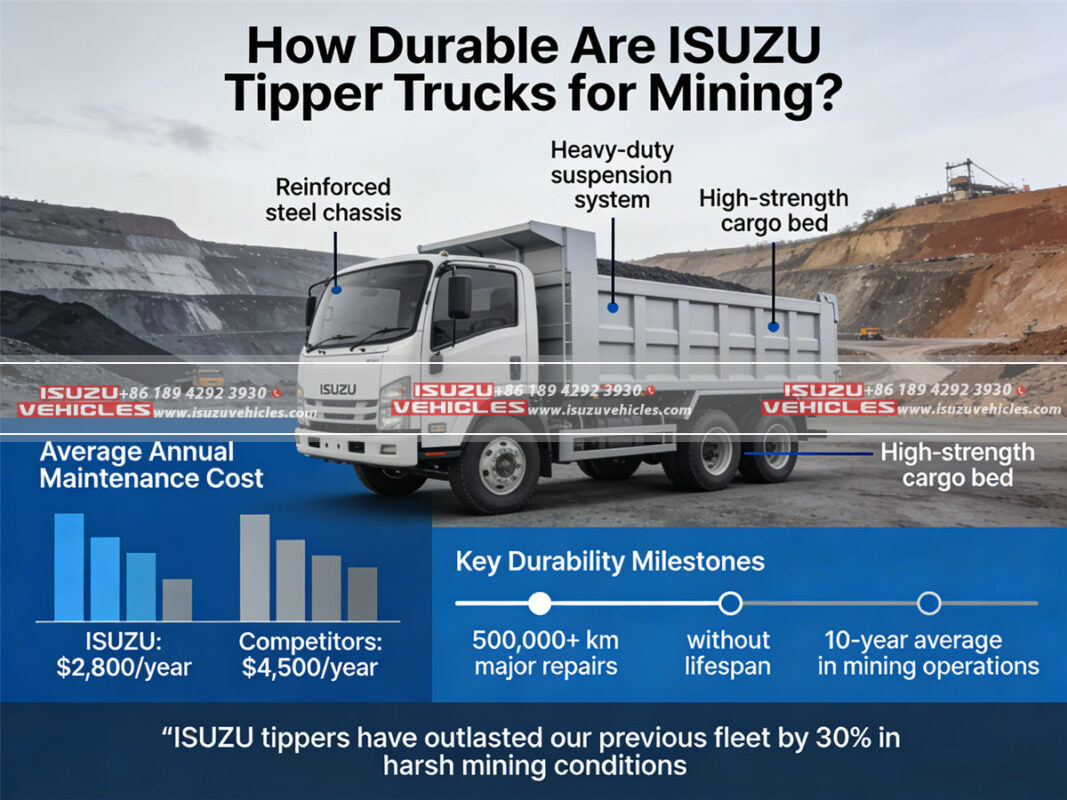
Understanding the Demands of Mining Operations
Mining environments are among the most punishing operational settings for any commercial vehicle, where steep gradients, abrasive materials, overloaded haul cycles, unpredictable weather conditions, and extended operating hours combine to create a relentless test of structural integrity and mechanical endurance, making durability not simply a desirable feature but an absolute operational necessity. Within this demanding context, the question arises: how durable are ISUZU tipper trucks when deployed in mining applications that require consistent hauling of ore, overburden, aggregate, or mineral concentrates?
Mining sites are characterized by rough haul roads, loose gravel surfaces, mud during rainy seasons, and intense dust exposure that penetrates every mechanical joint and electrical connection, placing extraordinary strain on engines, transmissions, suspension systems, and chassis frames, and therefore only trucks engineered with industrial-grade materials and carefully tested structural components can realistically maintain productivity without excessive downtime.
The durability of a mining truck is not determined solely by its ability to carry heavy loads, but rather by how effectively it withstands repeated stress cycles over months and years of operation, how well it resists corrosion and fatigue, and how reliably it performs in remote locations where maintenance resources may be limited, and this is precisely where ISUZU’s long-standing engineering philosophy begins to reveal its strength.
Chassis Strength and Structural Integrity
One of the most critical determinants of durability in mining operations lies in the chassis and frame construction, since the chassis forms the backbone of any tipper truck and absorbs the dynamic loads generated during hauling, dumping, braking, and cornering on uneven terrain.
Reinforced Ladder Frame Construction
ISUZU tipper trucks are built on reinforced ladder-type frames manufactured from high-tensile steel, which are engineered to distribute stress evenly across the structure while resisting torsional flexing when traveling over uneven mining surfaces, thereby reducing the risk of frame cracking or long-term deformation that can compromise vehicle stability and payload performance.
In mining applications where repeated loading and unloading cycles generate constant impact forces, this type of frame construction plays a pivotal role in maintaining structural stability over time, especially when combined with cross-member reinforcements that enhance rigidity and minimize vibration transmission.
Heavy-Duty Suspension Systems
Durability in mining is not solely a matter of rigid structure but also of controlled flexibility, and ISUZU tipper trucks typically incorporate heavy-duty leaf spring or multi-leaf suspension systems designed to handle concentrated axle loads while absorbing shock from rough haul roads, ensuring that impact forces are dissipated before they reach critical components such as the transmission and differential assemblies.
The combination of reinforced frame design and robust suspension contributes significantly to long-term operational durability, particularly in environments where uneven ground conditions are unavoidable and constant.
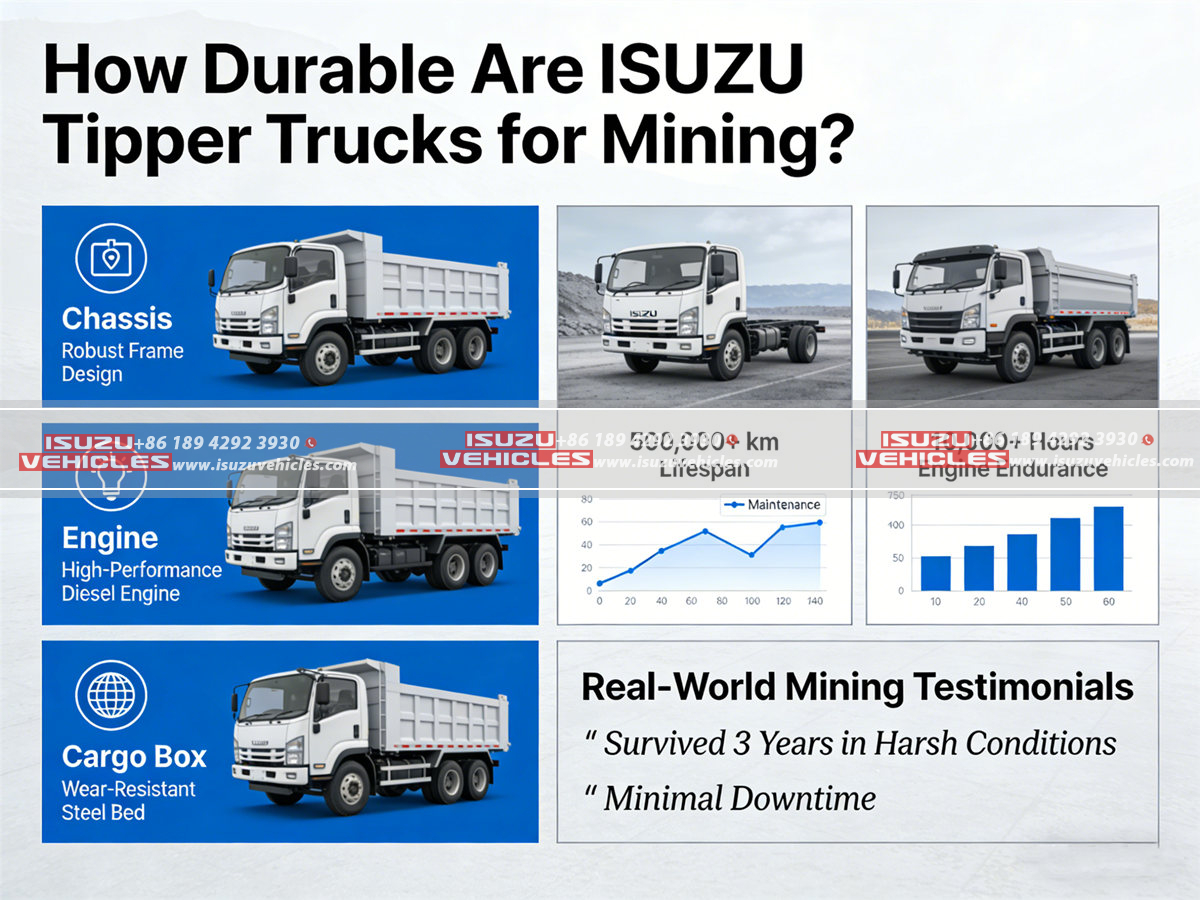
Engine Reliability Under High-Stress Conditions
Mining trucks often operate continuously for extended shifts, sometimes exceeding ten to twelve hours per day, under conditions of high ambient temperature, heavy payload demand, and constant gear changes, which means that engine durability becomes a defining factor in overall vehicle longevity.
ISUZU diesel engines are widely recognized for their fuel efficiency and torque delivery characteristics, but more importantly for mining applications, they are engineered with robust cooling systems, durable cylinder block construction, and optimized combustion efficiency that minimizes internal stress and heat accumulation, ensuring stable performance even when hauling dense materials uphill or maneuvering through steep mine access roads.
Cooling and Filtration Systems
Dust and fine particulate matter are persistent threats within mining environments, and ISUZU’s enhanced air filtration systems are designed to reduce particulate intrusion into the combustion chamber, thereby preventing premature engine wear and preserving performance over time, while high-capacity radiators and cooling fans maintain optimal temperature control even during low-speed heavy-load operations.
This attention to thermal management and contamination control plays a crucial role in ensuring that engines retain reliability throughout prolonged service cycles, thereby enhancing the durability profile of ISUZU tipper trucks in mining scenarios.
Body Construction and Tipping Mechanism Durability
The durability of a tipper truck in mining is also heavily influenced by the construction of its cargo body and the reliability of its hydraulic tipping system, as both components are subjected to repeated impact loads when transporting rocks, ore, sand, and gravel.
High-Strength Steel Cargo Beds
ISUZU tipper trucks used in mining applications often feature cargo beds constructed from wear-resistant steel plates that are specifically engineered to resist abrasion from sharp mineral fragments and heavy bulk materials, thereby preventing premature thinning, cracking, or structural compromise.
The reinforced sidewalls and floor panels are designed to withstand impact during loading by excavators or loaders, while strategic ribbing beneath the bed provides additional support against deformation caused by concentrated weight distribution.
Hydraulic Tipping Stability
The hydraulic system responsible for raising and lowering the cargo bed must operate smoothly and consistently under heavy load, and ISUZU integrates durable hydraulic cylinders with stable lifting geometry that minimizes lateral stress during dumping, ensuring controlled discharge of material without destabilizing the vehicle on uneven surfaces.
Reliable hydraulic components are essential for maintaining productivity in mining operations, as failures in tipping mechanisms can lead to costly downtime and safety hazards.
Resistance to Environmental and Operational Stress
Mining sites frequently expose vehicles to corrosive materials, moisture accumulation, extreme heat during summer, and occasionally freezing temperatures in colder regions, all of which can accelerate component degradation if protective measures are inadequate.
ISUZU tipper trucks incorporate anti-corrosion coatings, sealed electrical systems, and durable underbody protection that help shield critical components from environmental exposure, while robust braking systems are engineered to maintain effectiveness even when subjected to continuous heavy-load descents along steep mining roads.
In addition, durable axles and reinforced drivetrains are configured to transmit torque efficiently without excessive wear, allowing the truck to maintain performance consistency even under demanding haul cycles.
Durability in mining is therefore not simply a function of heavy materials, but rather the result of thoughtful integration of structural strength, mechanical reliability, environmental resistance, and service-friendly design.
Maintenance Efficiency and Lifecycle Value
Long-term durability is closely tied to maintenance accessibility and component serviceability, particularly in mining environments where repair facilities may be remote and downtime directly impacts production output.
ISUZU tipper trucks are designed with accessible engine compartments, straightforward mechanical layouts, and widely available parts networks, making preventive maintenance easier to perform and reducing the time required for inspection, replacement, or servicing of key components such as filters, belts, and brake assemblies.
When vehicles are easier to maintain, they are more likely to receive timely servicing, which in turn extends operational life and protects investment value, reinforcing the practical durability of the truck beyond its raw material strength.
From a total cost of ownership perspective, durability in mining is not only about surviving harsh conditions, but also about minimizing unscheduled repairs and maximizing uptime across multiple years of service.
Comparative Perspective Within Heavy-Duty Segments
Within the broader landscape of commercial vehicles operating in heavy industries, ISUZU tipper trucks hold a strategic position between medium-duty urban transport vehicles and ultra-heavy off-road mining haulers, offering a balance of maneuverability, fuel efficiency, and structural strength that makes them particularly suitable for small to mid-scale mining operations, quarry activities, and aggregate transport projects.
While extremely large mining operations may require specialized rigid-frame haul trucks, many mining contractors rely on versatile tipper platforms that can travel on public roads as well as site roads, and this flexibility enhances operational efficiency in projects where transport between quarry and processing plant is required.
In this context, the durability of ISUZU tipper trucks reflects a combination of practical engineering, adaptable configuration options, and proven reliability across construction and mining sectors worldwide.
As fleet managers evaluate equipment choices, they often consider how well a vehicle integrates into broader operations that may also include a dump truck, a tanker truck, or other specialized units designed for fuel delivery and material handling, all operating under the umbrella of dependable commercial solutions associated with ISUZU Vehicles, where durability is not treated as a marketing slogan but as a measurable performance standard validated by years of demanding field experience.