
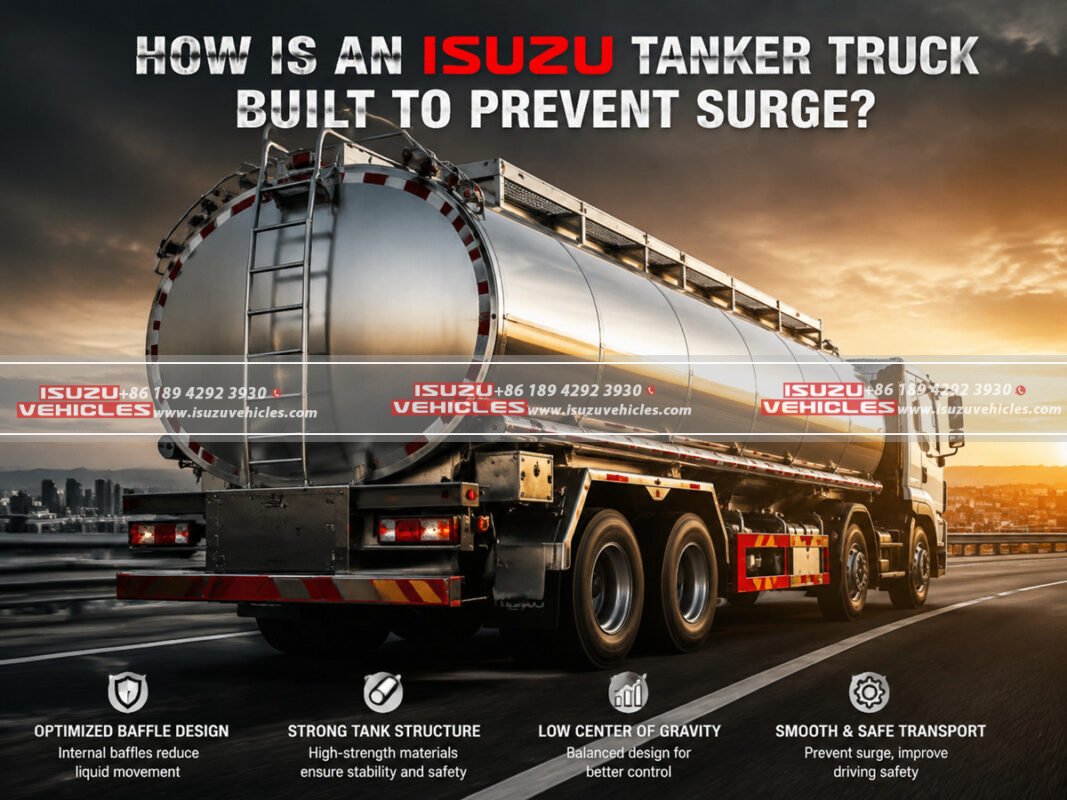
Transporting liquids by road presents challenges that ordinary cargo vehicles do not face. Unlike solid materials that remain relatively stable once loaded, liquids constantly move inside a tank as the vehicle accelerates, brakes, turns, or travels across uneven roads. This movement, commonly known as liquid surge or sloshing, can significantly affect vehicle stability, braking performance, and driver control if not properly managed.
For companies transporting fuel, water, chemicals, food-grade liquids, or other fluids, controlling this internal movement is a critical safety requirement. This is why the design of an ISUZU tanker truck focuses not only on tank capacity but also on structural engineering, internal tank systems, chassis stability, and advanced safety considerations.
Through carefully designed tanks, internal baffles, optimized weight distribution, and reliable vehicle systems, ISUZU tanker trucks are built to minimize surge effects and provide safer transportation performance. Understanding how these features work helps fleet operators select the right equipment for demanding liquid transportation tasks.
Understanding Liquid Surge in Tanker Transportation
Liquid surge occurs when the fluid inside a tank continues moving after the truck changes speed or direction. When a tanker truck accelerates, the liquid pushes toward the rear of the tank. During braking, the liquid force moves forward. When turning, the liquid shifts sideways and creates additional pressure against the tank walls.
This movement creates several potential challenges:
- Reduced vehicle stability
- Longer braking distances
- Increased stress on suspension components
- Difficulty maintaining steering control
- Higher risk during emergency maneuvers
The impact of surge becomes more noticeable when the tank is only partially filled. A completely full tank leaves little room for liquid movement, but partially filled tanks allow larger waves to form inside the compartment.
Because tanker trucks frequently operate with changing load levels throughout the day, controlling partial-load movement is one of the most important engineering considerations.
An ISUZU tanker truck addresses this challenge through a combination of tank design, internal structures, and vehicle stability systems that work together to improve handling performance.
Internal Baffles: The Key Technology for Reducing Surge
One of the most important components used to control liquid movement inside a tanker body is the internal baffle system.
How Baffles Work
Baffles are reinforced plates installed inside the tank compartment. Instead of allowing the entire volume of liquid to move freely from one end of the tank to another, baffles divide the tank into smaller sections.
When the vehicle accelerates or brakes, these barriers slow down liquid movement by:
- Breaking large waves into smaller movements
- Reducing forward and backward fluid force
- Limiting sideways liquid displacement
- Improving vehicle balance
This allows the truck to respond more predictably during driving, especially when carrying partially filled tanks.
Compartment Design
Many tanker trucks use multi-compartment designs depending on the application.
For example, a fuel tanker may require separate chambers for transporting different products, while a water tanker may prioritize maximum capacity and stability.
By carefully calculating compartment sizes, engineers can reduce surge without unnecessarily reducing usable tank volume.
Optimized Tank Shape and Structural Engineering
The tank itself plays an important role in controlling liquid behavior. A poorly designed tank can increase fluid movement, while a properly engineered tank improves stability and durability.
The ISUZU tanker truck uses carefully designed tank structures to balance capacity, strength, and transportation safety.
Tank Shape Considerations
Common tanker bodies use elliptical or rounded designs because these shapes provide several advantages:
- Better pressure distribution
- Improved structural strength
- Lower center of gravity
- Reduced stress concentration
A lower center of gravity helps improve vehicle handling by reducing body roll during cornering and sudden direction changes.
Strong Tank Materials
Tank construction materials are selected according to the transported liquid.
Common materials include:
- Carbon steel for general applications
- Stainless steel for corrosive or food-grade liquids
- Aluminum alloy for weight reduction
A strong tank structure not only improves safety but also helps maintain long-term performance under repeated loading and unloading cycles.
Chassis Stability and Weight Distribution
Preventing surge is not only about controlling liquid movement inside the tank. The truck chassis must also be designed to handle changing dynamic forces during transportation.
A reliable ISUZU tanker truck combines a durable commercial chassis with carefully matched tank dimensions to maintain overall balance.
Proper Load Distribution
Incorrect weight distribution can increase the effects of liquid movement.
Engineers consider:
- Tank position on the chassis
- Axle load limits
- Wheelbase length
- Suspension capacity
- Center of gravity
A properly balanced tanker reduces stress on individual components while improving steering response and braking stability.
Suspension and Braking Performance
Suspension systems absorb road impacts and help maintain tire contact with the road surface.
Meanwhile, efficient braking systems are essential because liquid surge can increase forward momentum during sudden stops.
ISUZU trucks are designed with dependable braking systems and suspension components suitable for commercial operation, helping drivers maintain better control under different load conditions.
Safety Features for Different Liquid Transportation Applications
Different liquids create different transportation challenges, which means tanker trucks must be customized according to their intended purpose.
Fuel and Chemical Transportation
Fuel and chemical tanker applications require strict safety standards because the transported materials may be flammable, corrosive, or hazardous.
Important considerations include:
- Anti-static protection
- Emergency shutoff systems
- Pressure control devices
- Secure tank sealing
- Corrosion-resistant materials
Reducing surge is especially important because sudden liquid movement can create additional stress on tanks and fittings.
Water and Municipal Applications
Water transportation has different requirements, but stability remains equally important.
Municipal departments often use tanker trucks for:
- Road cleaning
- Emergency water supply
- Dust suppression
- Landscape irrigation
In these applications, the truck must frequently accelerate, stop, and maneuver in urban environments. Effective surge control helps operators maintain smooth and predictable handling.
Reliable Liquid Transportation with ISUZU Engineering
The ability to control liquid surge is one of the reasons professional operators rely on the ISUZU tanker truck for demanding transportation tasks. Through internal baffle systems, optimized tank structures, balanced chassis design, and dependable vehicle components, ISUZU provides a safer and more stable solution for carrying liquids over different road conditions.
Whether transporting fuel across highways, delivering industrial liquids to factories, or supporting municipal operations, a well-designed tanker truck must do more than simply carry volume—it must maintain control throughout every journey. Surge prevention technology improves driver confidence, reduces vehicle stress, and helps protect both cargo and surrounding road users.
For companies managing specialized vehicle fleets, tanker trucks often operate alongside other purpose-built units such as a sewer truck for waste and drainage services or a sprinkler truck for urban cleaning and water distribution. Combined with dependable ISUZU Vehicles, these professional solutions provide the durability, safety, and operational flexibility required for modern transportation, municipal services, and industrial applications worldwide.