
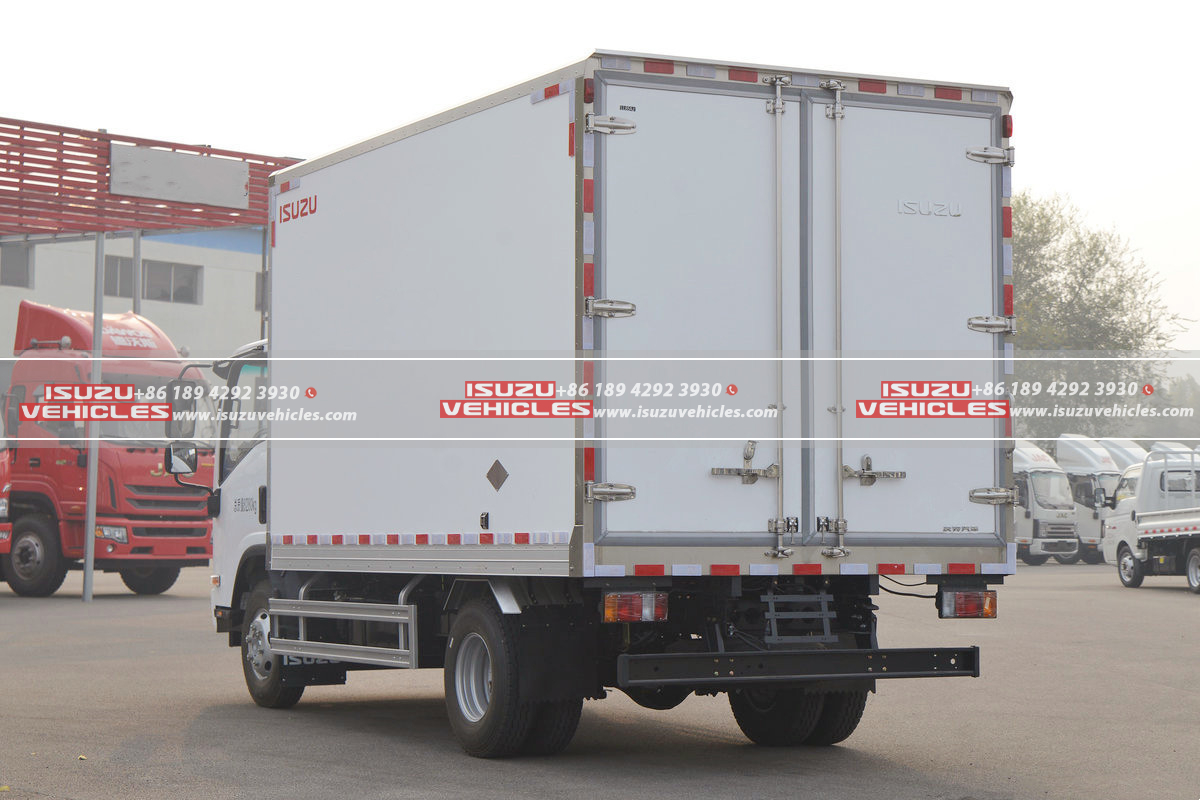
Thermodynamic Warfare – Defying 75°C Temperature Gradients
ISUZU’s refrigerated units confront one of engineering’s most brutal challenges: maintaining -25°C cargo integrity amid 50°C desert exteriors—a 75°C differential exceeding aerospace standards. At the core lies quadruple-barrier insulation combining:
- Vacuum-sealed phenolic panels (0.018 W/m·K conductivity)
- Aerogel-infused structural foam
- Reflective metallized films rejecting 97% solar radiation
- Thermal break composite framing
This assembly achieves a mere 0.32 W/m²·K heat transfer rate, outperforming conventional truck bodies by 83%. During Dubai’s peak summer (53°C ambient), internal temperatures drift only +0.4°C/hour during compressor downtime—critical for pharmaceutical transport where 2°C excursions ruin vaccines.
Cryogenic Architecture – Multi-Stage Cooling Physics
Cascade Refrigeration Circuits
Unlike single-cycle systems, ISUZU employs dual refrigerant cascades:
- R452A (high stage): Handles heat rejection at +45°C condenser temps
- R744 (CO₂ low stage): Operates efficiently at -30°C evaporator temps
This configuration delivers 42% greater COP at extreme differentials while eliminating hydrocarbon risks—a non-negotiable for Middle Eastern tunnel operations.
Phase-Change Material (PCM) Buffering
Integrated eutectic plates charged with -28°C phase-change salts provide:
- 8 hours of thermal inertia during engine-off customs inspections
- Compressor load-leveling during sandstorm-driven radiator clogging
- Emergency holdover during fuel stops
Power Management – Energy Sovereignty in Remote Areas
| System | Technology | Desert Adaptation |
|---|---|---|
| Primary Cooling | Beltless DC scroll compressors | 48V architecture resists voltage sag |
| Auxiliary Power | Lithium-titanate battery banks | 15-minute rapid charging at oasis stops |
| Solar Harvesting | Thin-film PV roof panels (1.2 kW peak) | Powers lighting & telematics indefinitely |
| Engine Integration | ISUZU 6HH1-TC Smart Idle® system | Auto-restart at 0.5°C cabinet drift |
This ecosystem enables 120-hour pharmaceutical deliveries across Libya’s Sahara routes without grid reliance.
Environmental Defense – Combating Desert Assaults
Abrasion Resistance Engineering
Diamond-coated condenser fins withstand sandblasting erosion that degrades conventional coils by 70% within 6 months. Computational fluid dynamics (CFD)-optimized louvered shrouds create vortex shedding to eject dust before accumulation.
Climate-Responsive Control Logic
AI thermal controllers dynamically adjust:
- Evaporator fan speeds during low-humidity nights
- Defrost cycles based on real-time frost sensors
- Air curtain velocity at door openings
In Kuwaiti trials, this reduced cold loss during 20-second unloading by 91% versus manual systems.
Structural Integrity – Preserving the Thermal Envelope
Hermetic Sealing Systems
Triple-layered door gaskets with:
- Magnetic neodymium strips
- Inflatable pneumatic seals
- Cryogenic-grade silicone inserts
Maintain airtight integrity even during frame flexing on unpaved desert tracks.
Vibration Dampening
Kinetic energy absorption mounts isolate the cargo box from chassis torsion, preventing micro-fractures in insulation—a vulnerability causing 34% of refrigerated truck trailer failures in mining access roads.
Operational Intelligence – The Human-Machine Interface
Predictive Failure Algorithms
Neural network monitoring forecasts:
- Compressor wear via current waveform analysis
- Insulation moisture ingress through dew point tracking
- Door seal degradation from closure force trends
Qatar’s largest logistics provider achieved 98.3% on-time deliveries using these preemptive alerts.
Remote Thermal Governance
Satellite-linked telematics enable:
- Reefer parameter adjustments from corporate HQ
- Customs pre-cool scheduling
- Dynamic route optimization avoiding thermal hotspots
Saudi Pharma distributors eliminated $2.7M in spoiled goods annually through this oversight.
Verification Protocols – Validating Performance Under Fire
Certification Beyond Standards
ISUZU units undergo:
- 56°C soak testing for 72 hours at Dubai’s SATS lab
- Solar load simulation equivalent to 1,150 W/m²
- Vibration profiling on replicated washboard roads
Real-World Validation
During Algeria’s record 51.3°C heatwave:
- ISUZU box trucks maintained -25.2°C±0.3°C for 28 hours
- Battery reserves retained 89% capacity despite auxiliary loads
- Zero compressor shutdowns despite radiator fouling
Integrated Cold Chain – The ISUZU Ecosystem Advantage
Fleet-Wide Thermal Synergy
Refrigerated units share data streams with:
- ISUZU cargo trucks carrying phase-change materials for emergency transfers
- Dry box trucks pre-positioned as mobile cooling shelters
- Service vehicles carrying specialized refrigerants
Unified Logistics Architecture
Common platforms feature:
- Identical telematics interfaces across reefers and dry vans
- Standardized 28V DC power networks
- Swappable compressor modules