
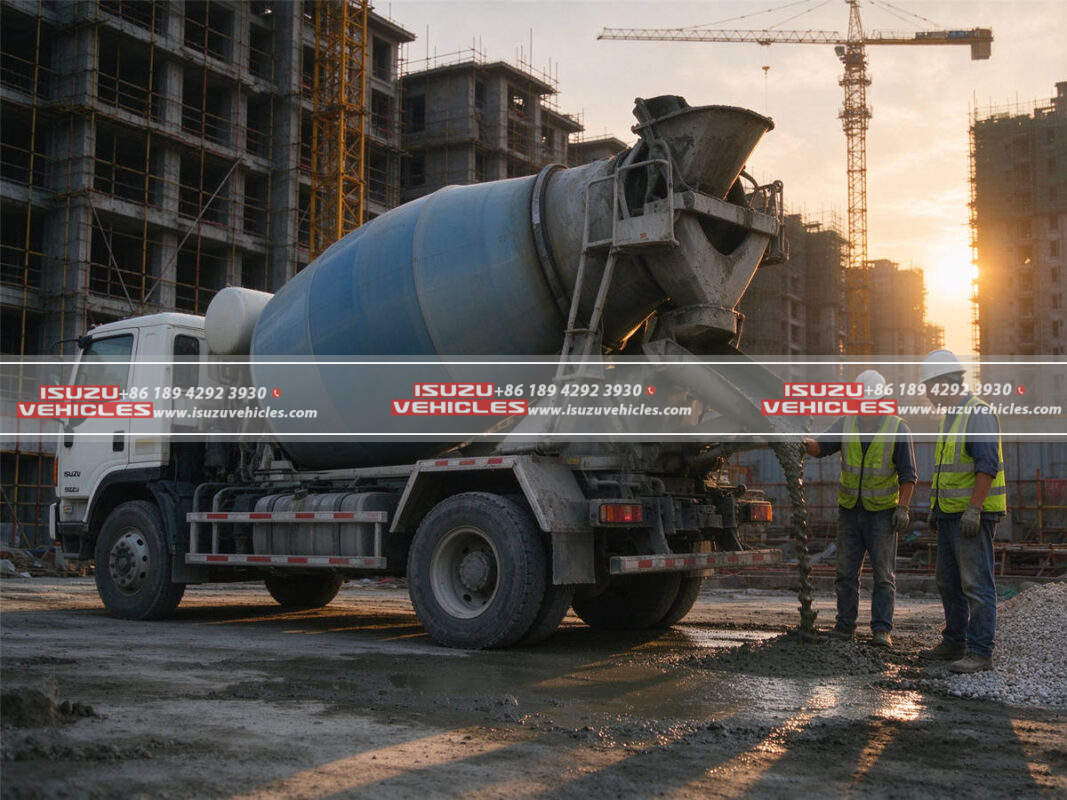
Fresh concrete is one of the most time-sensitive materials used in modern construction, because once cement and water are combined, hydration begins immediately and the material gradually changes from a workable mixture into a hardened structural material. For contractors, engineers, and fleet managers, this naturally raises an important question: how long can an ISUZU mixer truck keep concrete fresh while transporting it from a batching plant to a construction site?
The answer is not simply a fixed number of hours because concrete does not suddenly become unusable at a single moment. The practical delivery window depends on the mix design, cement type, admixtures, ambient temperature, transportation distance, traffic conditions, drum operation, and project specifications. In many conventional ready-mix operations, delivery is commonly planned within approximately 60 to 90 minutes from batching, but the actual allowable period should always follow the applicable concrete standard, project specification, and instructions from the concrete producer.
What an ISUZU mixer truck does particularly well is maintain the uniformity of fresh concrete during transportation through continuous drum agitation. Instead of allowing the aggregate, cement paste, and water to separate while the vehicle is moving, the rotating drum keeps the mixture moving and helps preserve its consistency until the truck reaches the construction site. ISUZU Vehicles offers mixer configurations for different project requirements, from compact models for smaller construction projects to large-capacity mixers for major infrastructure work.
1. What Determines How Long Concrete Stays Fresh?
Several factors influence the freshness and workability of concrete, and the mixer truck is only one part of the overall delivery process. The concrete mix itself has a major influence because different proportions of cement, water, aggregates, supplementary materials, and chemical admixtures produce different setting and workability characteristics. A mix designed for rapid strength development may behave differently from one specifically formulated to maintain workability during extended transportation.
Temperature is another important factor. In hot weather, hydration can proceed more rapidly, while high temperatures and evaporation may contribute to faster slump loss. In cooler conditions, hydration generally progresses more slowly, although cold weather creates its own requirements for concrete temperature control and curing. This means that the same concrete mix can have different practical transportation requirements depending on the environment in which it is produced, transported, and placed.
The distance between the batching plant and the construction site also matters, but distance alone does not determine delivery time. A 20-kilometer journey through an open industrial area may take considerably less time than a much shorter journey through congested urban roads. Traffic congestion, road construction, accidents, restricted access, and waiting at the jobsite can all increase the elapsed time between batching and placement.
Workability and Setting Are Different
It is important to distinguish between the loss of workability and the actual setting of concrete. Concrete can remain technically plastic while becoming progressively more difficult to pump, place, compact, and finish. A load that has not yet hardened may nevertheless be unsuitable for a particular application if its slump and workability have fallen outside the specified range.
This is particularly important for reinforced concrete structures and projects using concrete pumps, because the mixture needs to maintain suitable flow characteristics as it moves through the delivery system. For this reason, contractors should not judge concrete quality simply by checking whether the material still looks liquid. Testing and project specifications provide a much more reliable basis for determining whether the concrete remains suitable for placement.
2. How Does an ISUZU Mixer Truck Keep Concrete Fresh?
The main function of an ISUZU concrete mixer truck is to transport fresh concrete while continuously agitating it inside the rotating drum. This movement helps keep the different components of the concrete mixture distributed more evenly and reduces the possibility of excessive segregation during transportation.
A mixer truck does not stop the hydration process, and it cannot make concrete remain fresh indefinitely. Instead, it helps preserve the concrete’s physical uniformity and workability during the transportation period. This distinction is important because the truck should be considered part of a complete concrete-delivery system rather than a machine capable of extending concrete life without limits.
The design of the mixer drum is also important. The drum, blades, hydraulic drive system, chassis, and control system work together to ensure that concrete can be mixed or agitated efficiently while the vehicle is traveling. A properly operated drum keeps the mixture moving while avoiding unnecessary mechanical stress.
Continuous Agitation Prevents Excessive Separation
Concrete contains materials with different particle sizes and densities, so without appropriate agitation, heavier aggregates can gradually settle while the cement paste and water behave differently. Continuous drum rotation helps maintain a more uniform mixture and ensures that the material arriving at the construction site is closer to the condition intended by the concrete producer.
However, drum rotation cannot compensate for excessive transportation delays, an unsuitable mix design, poor batching practices, or prolonged waiting at the construction site. The vehicle is an important part of the process, but good concrete logistics require every stage to work together.
3. What Is a Typical Concrete Delivery Time?
There is no universal delivery time that applies to every concrete mixture and every construction project. Many conventional ready-mix operations use a target delivery window of approximately 60 to 90 minutes from batching, but the appropriate limit can vary according to the applicable standard, mix design, environmental conditions, admixtures, and project requirements.
For example, a concrete mixture containing an appropriate setting-control admixture may be designed to retain workability for a longer period than a conventional mixture, while a hot-weather mix may require more careful transportation and placement planning. Similarly, concrete intended for a large foundation may have different requirements from concrete used for a small residential structure.
This is why it would be inaccurate to say that every ISUZU mixer truck can keep concrete fresh for exactly one hour, two hours, or another fixed period. The mixer truck can maintain agitation throughout transportation, but the acceptable delivery period ultimately depends on the concrete itself and the specifications established for the project.
Jobsite Waiting Time Can Reduce the Available Window
Transportation is not necessarily the only source of delay. A mixer truck can arrive at the construction site on schedule and still lose valuable time if the pumping equipment is not ready, workers are unavailable, the access route is blocked, or the previous load has not yet been discharged.
This is particularly problematic on large construction projects where multiple mixer trucks are dispatched from the same batching plant. If several vehicles arrive together but the placement operation can only accept one load at a time, the following trucks may be forced to wait. Efficient scheduling is therefore essential for maintaining a steady supply of fresh concrete.
Before dispatching a mixer truck, the site should ideally have the concrete pump or discharge location prepared, workers positioned, reinforcement and formwork inspected, and access routes cleared. Reducing unnecessary waiting can provide a valuable margin for maintaining concrete quality.
4. What Happens When Concrete Is Transported Too Long?
As transportation and waiting time increase, concrete gradually loses workability, and this effect can become more pronounced in hot or dry conditions. One of the most noticeable changes is slump loss, which means that the concrete becomes stiffer and more difficult to place. A reduction in workability can make pumping, vibration, consolidation, and surface finishing more difficult, particularly when the concrete must be delivered through long pipelines or into heavily reinforced structures.
Another concern is segregation, where the different components of the mixture become unevenly distributed. Proper drum agitation helps reduce this risk, but it cannot completely overcome poor handling or excessive delays. If concrete is allowed to remain stationary for too long or is transported outside its specified working period, its quality and placement characteristics can become increasingly difficult to control.
One common mistake is attempting to solve excessive slump loss by adding unauthorized water at the construction site. Although additional water may make the concrete appear easier to work with, it can change the designed water-cement ratio and potentially affect strength, durability, shrinkage, and other important properties. Any adjustment should therefore follow the concrete supplier’s approved procedure and the project’s quality-control requirements.
Quality Control Matters More Than Appearance
Experienced construction teams understand that concrete should not be judged solely by its appearance when it arrives. A load may still look wet and workable while no longer meeting the project’s specified requirements. Slump testing, temperature measurement, batch records, delivery documentation, and other quality-control procedures provide a more reliable way to determine whether the material remains suitable for placement.
When a load falls outside the required specification, the responsible concrete supplier, engineer, or quality-control team should determine the appropriate action instead of relying on an improvised adjustment by the driver or construction workers.
5. How Can Contractors Keep Concrete Fresh for Longer?
Although an ISUZU mixer truck cannot stop the natural hydration of concrete, contractors can significantly improve the practical delivery window by reducing unnecessary delays and selecting equipment and materials appropriate for the project. The first step is to coordinate the batching plant and construction site so that trucks are dispatched according to the actual placement rate rather than simply sending as many vehicles as possible.
Route planning is equally important. When the expected delivery route includes congested intersections, narrow roads, construction zones, or other predictable obstacles, the logistics team should account for these conditions when establishing the dispatch schedule. A route that is slightly longer but more predictable may sometimes be preferable to a shorter route with highly variable traffic.
Choose the Concrete Mix According to the Project
When a project requires longer transportation distances, the concrete should be designed with those conditions in mind. Depending on the application, approved admixtures can be used to control setting behavior or improve workability retention. These decisions should be made by qualified concrete professionals because the mix must still meet the required strength, durability, and performance characteristics.
Weather should also be considered during planning. In hot conditions, controlling concrete temperature and reducing unnecessary exposure can become particularly important. In colder environments, the concrete temperature and curing strategy require careful management for different reasons.
Prepare the Site Before the Truck Arrives
One of the simplest ways to protect the available delivery window is to make sure the construction site is ready before the mixer arrives. The concrete pump should be positioned, the discharge area should be clear, the workers should be prepared, and the formwork and reinforcement should already have passed the necessary inspections.
On larger projects, several mixer trucks can be scheduled in sequence so that concrete arrives at a steady rate. This approach can help prevent both gaps in the concrete supply and excessive waiting times for individual trucks.
6. How Do Mixer Trucks Work With Other Construction Vehicles?
Concrete transportation is normally only one stage of a much larger construction process, so an efficient project often requires several types of specialized vehicles working together. The mixer truck transports and continuously agitates fresh concrete, while other equipment handles placement, aggregate transportation, excavation, and material handling.
A concrete mixer truck is designed specifically for fresh concrete, while a concrete pump truck can transfer the material from the mixer into locations that are difficult to reach directly with the discharge chute. This is particularly useful for multi-story buildings, bridges, foundations, tunnels, and large infrastructure projects where concrete needs to be placed at considerable height or distance.
A dump truck performs a different role, transporting materials such as sand, gravel, aggregate, soil, and construction debris rather than fresh concrete. Keeping these applications separate is important because the rotating drum of a mixer truck is designed around the unique handling requirements of concrete, while the tipping body of a dump truck is intended for bulk solid materials.
ISUZU Vehicles provides different mixer configurations for different construction requirements, allowing buyers to select equipment according to project scale, road conditions, required capacity, and operating environment. Smaller mixer trucks can be useful for urban construction sites where maneuverability is important, while larger-capacity models can support major infrastructure projects requiring substantial quantities of concrete.
For larger operations, the combination of several mixer trucks and one or more concrete pump trucks can create a continuous concrete supply chain, with mixer vehicles traveling between the batching plant and project site while the pump maintains a steady placement operation. This coordinated approach can reduce waiting time and make better use of the available delivery window.
Ultimately, an ISUZU mixer truck helps keep concrete fresh and uniform during transportation primarily through continuous drum agitation, but it cannot preserve concrete indefinitely or eliminate the natural hydration process. The practical delivery period depends on the mix design, temperature, admixtures, transportation distance, traffic, waiting time, and project specifications.
The most effective strategy is therefore to combine a properly specified mixer truck with an appropriate concrete mix, efficient route planning, accurate dispatch scheduling, and a construction site that is ready to receive each load. With these factors working together, ISUZU Vehicles mixer trucks can provide a dependable connection between the batching plant and construction site, while complementary equipment such as a concrete pump truck supports precise placement and a dump truck handles the bulk materials required for other stages of construction.