
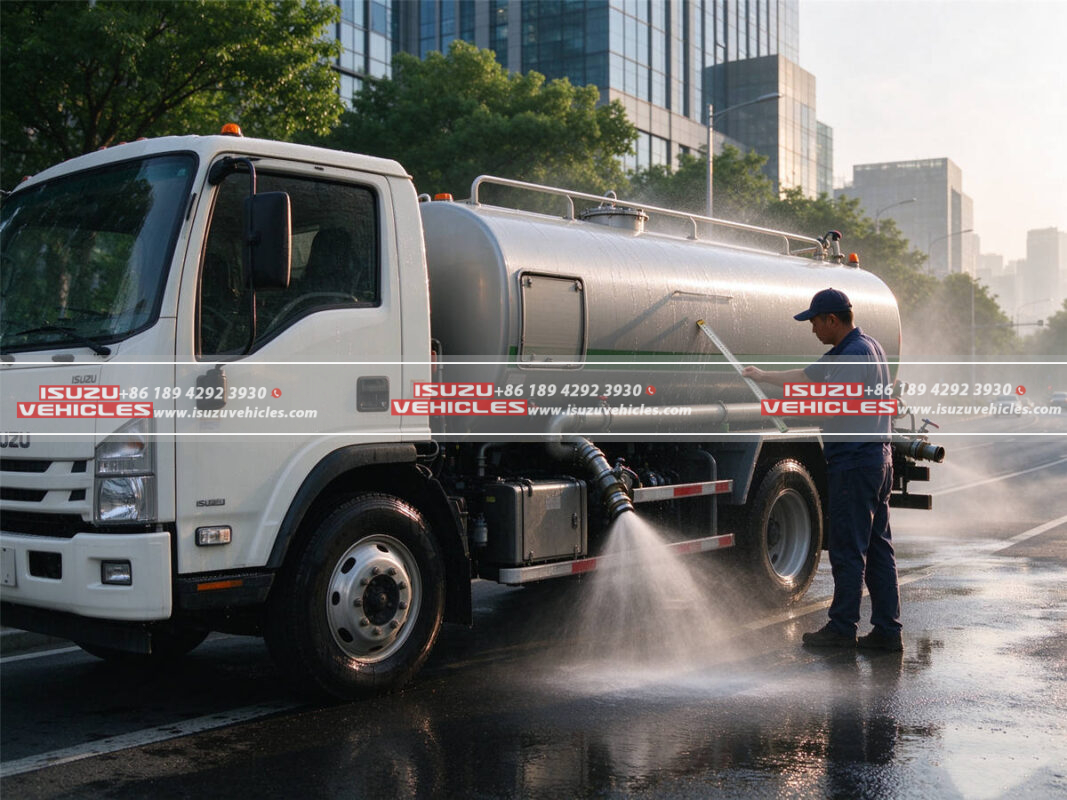
Choosing the right tank size is one of the most important decisions when purchasing an ISUZU sprinkler truck, because water capacity directly affects how long the vehicle can work between refilling points, how much area it can cover during each operating cycle, how much water it can distribute, and what type of chassis is required to carry the loaded vehicle safely. A larger tank may appear attractive because it reduces the number of trips back to a water source, but maximum capacity is not automatically the best capacity, particularly when the truck must operate on narrow urban roads, travel through areas with weight restrictions, or perform frequent stopping and turning during municipal maintenance work.
Current ISUZU Vehicles configurations demonstrate this range clearly, with 5,000-liter and 8,000-liter sprinkler trucks available for different operating requirements, while smaller configurations can also be selected where maneuverability and compact dimensions are more important than maximum water volume. A 5,000-liter truck carries approximately 5 cubic meters of water, while an 8,000-liter model carries approximately 8 cubic meters, but the actual suitability of either configuration depends on payload, chassis design, route conditions, water consumption, refill availability, and the specific work the vehicle is expected to perform. :contentReference[oaicite:0]{index=0}
For fleet managers, contractors, municipalities, and construction companies, the better question is therefore not simply, “How large should the tank be?” but rather, “How much water does the truck need to carry during one practical working cycle?” Once that question is answered, the appropriate tank size becomes much easier to determine.
1. Why Tank Capacity Matters So Much
The tank is the central working component of a sprinkler truck, but its capacity must be considered as part of the complete vehicle rather than as an isolated specification. Water weighs approximately one kilogram per liter under normal conditions, meaning that 5,000 liters of water represents roughly 5 metric tons of liquid, while 8,000 liters represents approximately 8 metric tons before the weight of the tank, pump, piping, spray equipment, chassis, fuel, passengers, and other equipment is added. This simple relationship explains why increasing tank capacity has a direct impact on the truck’s payload requirements and overall configuration.
A 5,000-liter tank therefore does not mean that every 5,000-liter vehicle can legally carry 5,000 kilograms of additional water under every operating condition. The truck’s gross vehicle weight, curb weight, rated payload, axle ratings, suspension, braking system, and applicable road regulations must all be checked before the tank is filled to its nominal capacity. For example, one current ISUZU 5,000L sprinkler truck is listed with a 7,300 kg curb weight and a 3,810 kg payload capacity, illustrating why the buyer must evaluate the complete vehicle specification instead of looking only at the tank label. :contentReference[oaicite:1]{index=1}
This is particularly important when a buyer considers upgrading from a medium tank to a much larger one, because the additional water may require a heavier chassis and different axle configuration rather than simply a larger tank body. A correctly matched vehicle should remain stable, controllable, and mechanically suitable when fully loaded, while an oversized tank installed on an unsuitable chassis can create unnecessary stress and compromise both operational efficiency and vehicle safety.
Tank Size Should Follow the Working Cycle
The most useful way to think about tank capacity is in terms of a complete working cycle: fill the tank, travel to the work area, perform the required spraying or washing, return for another water supply, and repeat the process. If the filling station is close to the worksite and water consumption is moderate, a smaller tank can provide excellent productivity because the truck spends little time traveling for refills. Conversely, if the truck works many kilometers away from a water source, every additional trip can consume significant fuel, labor hours, and productive working time, making a larger tank much more valuable.
This is why the ideal tank size can vary considerably between two companies performing apparently similar jobs. A municipal department operating within a compact city may find 5,000 liters highly practical, while a road construction contractor working across a large project area may prefer 8,000 liters because the vehicle needs to remain productive for longer periods before returning to its filling point.
2. Is a 5,000-Liter ISUZU Sprinkler Truck a Good Choice?
For many general-purpose municipal and commercial applications, a 5,000-liter sprinkler truck provides a very useful balance between water capacity, maneuverability, operating cost, and vehicle size. It is large enough to carry a meaningful quantity of water for road washing, dust suppression, landscaping, irrigation, construction-site maintenance, and other routine applications, while remaining more compact than many heavy-duty water carriers.
Current ISUZU specifications include a 5,000L water sprinkler truck with a 5 CBM tank, approximately 6.0 × 2.0 × 2.5 meter overall dimensions, 15-meter sprinkling width, and a listed water cannon range of 30 meters. This combination demonstrates an important point: the usefulness of a sprinkler truck is determined not only by how much water it stores but also by how effectively its pumping and spraying equipment distributes that water. :contentReference[oaicite:2]{index=2}
A 5,000-liter configuration is particularly appropriate for urban roads where the truck needs to maneuver around intersections, parked vehicles, traffic, buildings, and other obstacles. It can also be a practical choice for residential communities, industrial parks, small and medium-sized construction sites, landscaping contractors, and municipal departments that have relatively convenient access to hydrants, reservoirs, water stations, or other approved filling locations.
Typical Applications for 5,000 Liters
- Urban road washing and routine street maintenance
- Construction-site dust suppression
- Roadside tree and landscape irrigation
- Industrial yard cleaning
- Residential community maintenance
- Public-area watering
- Emergency water transportation and support
Another advantage is that a medium-capacity truck can often provide a good compromise between working range and maneuverability, particularly when the vehicle is expected to spend much of its working day inside built-up areas. For operations where water consumption is moderate and refill points are readily accessible, paying for substantially greater tank capacity may not produce a proportional improvement in productivity.
3. When Does an 8,000-Liter Tank Make More Sense?
An 8,000-liter sprinkler truck becomes increasingly attractive when the distance between the worksite and water source is significant, when the vehicle must cover a large service area, or when the application requires continuous water distribution for extended periods. Carrying approximately 3,000 liters more water than a 5,000-liter model means that, under comparable spraying conditions, the larger truck can potentially complete a longer working cycle before returning for another load.
This advantage can be particularly valuable for highway maintenance, large-scale road construction, mining operations, industrial facilities, extensive landscaping projects, and remote areas where suitable water sources are limited. In such environments, the time required to drive back to a filling point may be much more significant than it would be in a city, so carrying additional water can translate directly into greater productive working time.
ISUZU Vehicles currently lists an 8,000-liter sprinkler configuration based on a heavier F-series 4×2 chassis, with a listed gross vehicle weight of 16,000 kg, curb weight of 7,200 kg, and rated payload of 8,600 kg. Its carbon-steel tank incorporates internal anti-wave plates, while the larger chassis is designed around the greater load requirement. :contentReference[oaicite:3]{index=3}
That difference illustrates an important purchasing principle: moving from 5,000 liters to 8,000 liters is not merely a tank upgrade; it is a decision about the entire vehicle platform. The heavier configuration needs to be matched with suitable chassis capacity, axle loading, suspension, braking performance, tire specifications, and road conditions.
Large Tanks Are Not Always Better
A larger tank can reduce refill frequency, but it can also make the vehicle physically larger and heavier, potentially increasing fuel consumption and making maneuvering more difficult. If the truck operates primarily on narrow streets or in congested urban districts, the additional water may provide less practical value than expected because the vehicle spends much of its time maneuvering rather than traveling long distances between filling points.
For this reason, an 8,000-liter truck should normally be selected because the operating conditions justify the additional capacity, rather than simply because the specification appears more impressive. The most efficient fleet is usually the one in which the tank size matches the route and working cycle rather than the one with the largest possible tank.
4. How Should Tank Size Match Different Jobs?
The best tank capacity depends heavily on the job, because different applications consume water at very different rates and operate under very different logistical conditions. A contractor should therefore examine the actual daily workflow before deciding whether a compact, medium, or large sprinkler truck is appropriate.
Urban Road Cleaning
For city road washing and general municipal maintenance, a 5,000-liter truck is often a practical option because it provides enough water for meaningful working cycles while retaining relatively compact dimensions. Urban operators may also have frequent access to water sources, reducing the need to carry an exceptionally large volume.
Construction Dust Suppression
Construction projects can consume large amounts of water, especially during dry weather when exposed soil, sand, aggregate, and traffic generate airborne dust. A 5,000-liter model may be suitable for smaller sites, while an 8,000-liter truck can become more productive on extensive projects where the water source is far from the active work zone.
Highway and Road Maintenance
Long-distance road maintenance usually benefits from greater capacity because the vehicle may need to travel considerable distances between filling locations. In this situation, an 8,000-liter truck can reduce the frequency of water-supply trips and allow the crew to spend more time treating the road surface.
Landscaping and Irrigation
Landscaping operations can require either small or large tanks depending on the service area. A compact vehicle may be ideal for parks and city gardens with nearby filling points, while a larger vehicle can be more efficient for roadside vegetation, large industrial landscapes, and extensive public areas.
The important consideration in every case is the relationship between water consumption, working distance, and refill availability. If the truck consumes its entire tank before completing even half of its planned route, a larger capacity is justified; if it regularly returns to the filling point with substantial water remaining, increasing the tank size may simply add unnecessary weight.
5. Tank Capacity Is Only One Part of the Sprinkler System
Buyers sometimes focus so heavily on tank volume that they overlook the pumping and spraying equipment, even though these components determine how effectively the stored water is converted into useful work. Two trucks with identical tank capacities can perform differently if their pump flow rates, spray widths, nozzle arrangements, water cannons, pipelines, and control systems are different.
A current ISUZU 5,000-liter configuration, for example, lists a 20 m³/hour water pump flow rate, 90-meter pump lift, 15-meter sprinkling width, and 30-meter water cannon range. These figures provide a better understanding of the vehicle’s working capability than tank capacity alone because they describe how the available water can actually be collected and distributed. :contentReference[oaicite:4]{index=4}
Recent ISUZU information also illustrates that the 5,000-liter and 8,000-liter models can use similar pump-performance concepts while differing substantially in stored water volume, reinforcing the distinction between water capacity and water-delivery capability. The tank determines how much water the vehicle carries, whereas the pump and spray system determine how quickly and effectively that water reaches the road, construction area, vegetation, or other target surface. :contentReference[oaicite:5]{index=5}
For dust suppression, uniform distribution can be more important than simply spraying the greatest possible quantity of water, because excessive water in one location may waste resources while leaving another section insufficiently treated. A properly designed spray bar, suitable nozzles, adjustable controls, and an appropriately selected pump can therefore make a medium-capacity truck surprisingly productive.
6. How to Select the Right Tank Size for Your ISUZU Fleet
The most reliable approach is to evaluate the complete operating environment before placing an order. Start by estimating how much water the truck consumes during one normal working cycle, then determine the average distance to the nearest reliable water source, the number of refill opportunities available during a shift, the expected road conditions, and the amount of maneuvering required at the worksite. These factors will usually indicate whether a compact or medium-capacity vehicle is more appropriate than a larger model.
For general urban maintenance, a 5,000-liter configuration is often a strong starting point because it provides meaningful capacity without unnecessarily increasing vehicle size. For large construction projects, highway maintenance, industrial sites, and remote operations, an 8,000-liter model can offer a clear productivity advantage by extending the distance between refilling cycles. Current ISUZU Vehicles information similarly identifies 5,000-liter configurations as practical for urban road maintenance and larger 8,000-liter vehicles as suitable where longer operating cycles and greater coverage are required. :contentReference[oaicite:6]{index=6}
It is also worth considering whether a sprinkler truck is actually the correct specialized vehicle for the complete job. If the primary requirement is collecting household or commercial refuse, a garbage truck is more appropriate because its body and loading system are designed around solid-waste collection. ISUZU Vehicles offers configurations ranging from compact 4 CBM and 5 CBM models to 6 CBM, 7 CBM, 8 CBM, 12 CBM, and larger waste-handling systems, giving fleet managers different options according to collection volume and operating environment. :contentReference[oaicite:7]{index=7}
When the work involves sewage, sludge, septic tanks, blocked drains, or other liquid waste, a vacuum truck is the more suitable solution because its suction equipment is designed to collect and transport liquid waste rather than distribute clean water. The current ISUZU range includes 4 CBM vacuum cleaners, 6 CBM vacuum jetting trucks, 12 CBM high-pressure vacuum cleaners, 14 CBM vacuum sewer trucks, and combined jetting-vacuum configurations, demonstrating how different tank capacities can be matched with specialized wastewater applications. :contentReference[oaicite:8]{index=8}
For road washing and water distribution itself, the ISUZU sprinkler truck range provides the appropriate equipment, with current configurations including 5,000-liter and 8,000-liter vehicles as well as smaller options. :contentReference[oaicite:9]{index=9} The best choice is therefore the vehicle whose tank, chassis, pump, spray equipment, payload, dimensions, and operating range all match the real working conditions.
Ultimately, there is no universally perfect tank size for every ISUZU sprinkler truck. A 5,000-liter tank can be highly effective for urban road maintenance, dust suppression, landscaping, and construction work where refill points are reasonably accessible, while an 8,000-liter tank becomes increasingly valuable when the truck must cover larger areas or operate farther from water sources. By evaluating water consumption, route distance, refill infrastructure, payload requirements, road conditions, and spray-system performance together, fleet operators can choose a vehicle that carries enough water to remain productive without paying the operational penalty of unnecessary weight and size. With the right configuration, ISUZU Vehicles can provide a practical foundation for road maintenance, environmental services, construction support, and municipal operations, while complementary equipment such as garbage trucks and vacuum trucks can handle the solid-waste and wastewater tasks that a sprinkler truck is not designed to perform.