
Understanding ISUZU Bucket Truck Height Capacity for Elevated Work Operations
Modern infrastructure depends heavily on reliable equipment that can safely perform tasks at elevated positions. From maintaining electrical networks and repairing communication systems to managing street lighting and inspecting industrial facilities, working at height requires specialized vehicles that provide both accessibility and stability. A bucket truck is one of the most widely used solutions because it combines vehicle mobility with an aerial platform, allowing workers to reach elevated areas without relying on temporary scaffolding or separate lifting equipment.
The ISUZU Bucket Truck is designed to provide a practical and efficient solution for companies and public service organizations that require safe aerial access. One of the most important specifications when selecting a bucket truck is its height capacity, which determines how high workers can safely reach during operation. However, the maximum working height is not only determined by the boom length; it also depends on the truck chassis, boom design, basket capacity, operating angle, and overall equipment configuration.
ISUZU bucket trucks are available in different configurations to meet various working requirements. Some models are designed for urban maintenance tasks with moderate height requirements, while others feature longer telescopic or articulated booms for large-scale infrastructure projects. Understanding these height capabilities helps buyers select the right vehicle for their specific application.
Built on the reliable commercial vehicle platform of ISUZU, ISUZU bucket trucks combine durable chassis performance, stable lifting systems, and flexible aerial equipment options. Whether used for utility maintenance, telecommunications, municipal services, or industrial operations, these vehicles provide a balanced combination of mobility, safety, and working height capability.
What Determines the Height Capacity of an ISUZU Bucket Truck?
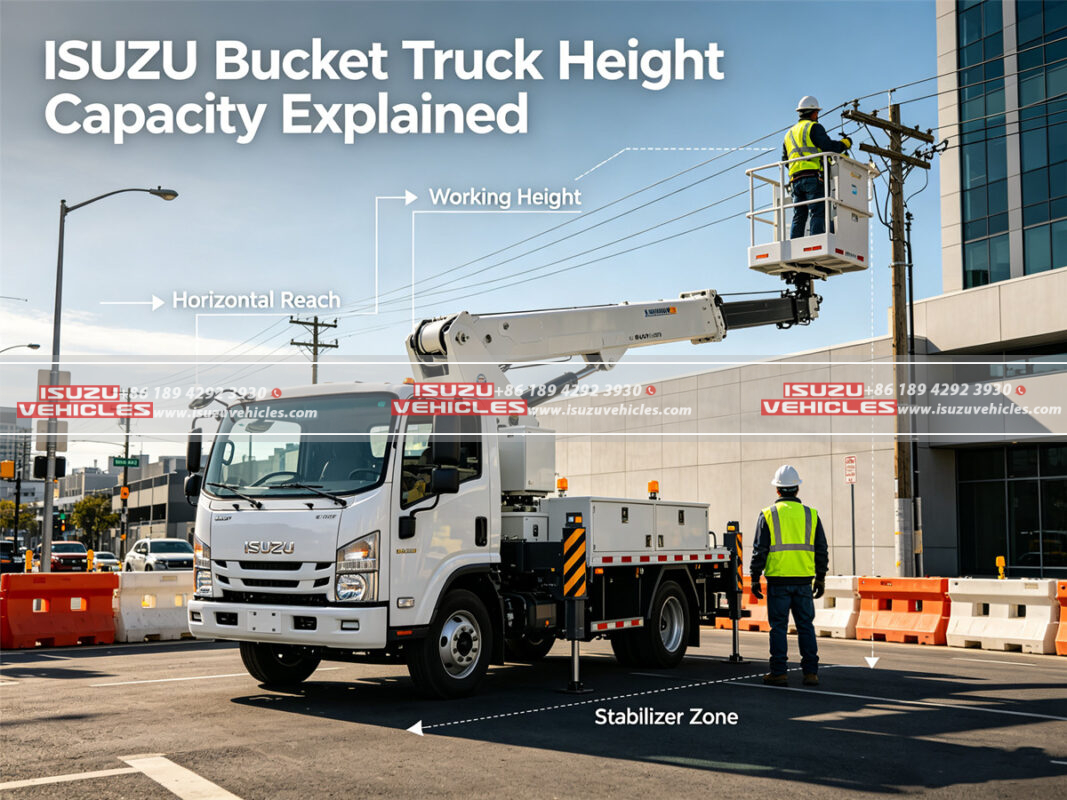
The working height of a bucket truck refers to the maximum vertical distance that the platform can reach when the boom is fully extended under safe operating conditions. Several engineering factors influence this capability.
Boom Type and Extension Length
The boom is the primary component responsible for determining aerial reach. ISUZU bucket trucks may use different boom designs depending on the required working height and application.
Common boom configurations include:
- Telescopic boom systems, which extend in straight sections to provide long vertical reach.
- Articulated boom systems, which use multiple joints to provide greater flexibility around obstacles.
- Combination boom systems, which combine telescopic and articulated movements for complex work environments.
A compact ISUZU bucket truck may provide a working height of around 10–16 meters, making it suitable for streetlights, utility lines, and urban maintenance. Larger models can reach approximately 18–30 meters or more, depending on the boom structure and vehicle configuration.
The choice of boom type depends on the working environment. For example, a telecommunications company may need a truck that can reach tall communication towers, while a city maintenance department may require better maneuverability rather than maximum height.
Truck Chassis and Stability Design
Aerial work requires a strong foundation because the vehicle must remain stable while the boom is extended. The truck chassis supports the entire lifting system, including the boom, hydraulic components, outriggers, and worker platform.
ISUZU bucket trucks are designed with matched chassis and aerial equipment configurations to ensure proper weight distribution. A stronger chassis allows the vehicle to support larger booms while maintaining safe operation.
The stability system is equally important because even a long boom cannot perform effectively without proper balance. Hydraulic outriggers extend from the vehicle sides to create a wider support base, reducing movement and improving safety during elevated work.
Common ISUZU Bucket Truck Height Capacity Categories
Different industries require different working heights, so ISUZU bucket trucks are available in multiple height ranges.
Low and Medium Height Bucket Trucks: 10–16 Meters
Small and medium bucket trucks are commonly used for everyday maintenance tasks where extreme height is unnecessary.
Typical applications include:
- Street lamp maintenance
- Traffic signal repair
- Small electrical line servicing
- Tree trimming
- Building maintenance
These trucks offer excellent maneuverability and can operate effectively in crowded urban environments where larger vehicles may have difficulty accessing.
Their compact design makes them popular among municipalities, utility companies, and maintenance contractors.
High Reach Bucket Trucks: 18–25 Meters
Medium-to-high reach bucket trucks are designed for more demanding aerial operations. They provide additional working height while maintaining relatively good mobility.
These models are suitable for:
- Power distribution maintenance
- Communication tower servicing
- Industrial facility inspection
- Large-scale lighting projects
The increased boom length allows operators to reach higher structures while keeping workers safely positioned inside the insulated platform.
Ultra-High Reach Bucket Trucks: 26 Meters and Above
Large bucket trucks are designed for specialized applications where maximum aerial access is required.
They are commonly used for:
- High-voltage power maintenance
- Large infrastructure projects
- Airport facility maintenance
- Tall building service operations
These vehicles typically require heavier chassis systems and more advanced stability features because greater height creates additional operational forces.
How ISUZU Bucket Trucks Ensure Safe High-Altitude Operations
Working at height involves significant safety requirements, which is why professional bucket trucks include multiple systems designed to protect operators and equipment.
Hydraulic Control Systems
Hydraulic systems provide the power required for boom extension, rotation, and basket positioning. A reliable hydraulic system allows smooth and controlled movement, reducing sudden changes that could affect worker safety.
ISUZU bucket trucks use hydraulic technology to provide accurate positioning, allowing operators to place the platform precisely where work is needed.
Safety Platforms and Load Management
The worker basket is designed to safely support operators and tools during elevated operations. Basket capacity is determined according to equipment design and safety regulations.
Operators must consider:
- Number of workers in the basket
- Weight of tools and equipment
- Wind conditions
- Boom extension position
Overloading the platform can affect stability and reduce operational safety.
Outrigger Stabilization Systems
Outriggers are essential for high-reach bucket truck operations. Before extending the boom, operators must deploy outriggers properly to stabilize the vehicle.
The effectiveness of a bucket truck’s height capability depends not only on the boom but also on correct setup procedures. Even a high-capacity aerial platform requires stable ground conditions and proper operation techniques.
Applications of ISUZU Bucket Trucks at Different Working Heights
The ideal bucket truck height depends on the specific industry and working environment.
Electrical and Utility Maintenance
Utility companies often require bucket trucks for power line installation, inspection, and repair. Medium and high-reach models allow workers to safely access electrical infrastructure while reducing the need for temporary climbing equipment.
For electrical applications, insulation features and stable operation are especially important because workers often operate near sensitive equipment.
Telecommunication and Network Installation
Communication networks require regular maintenance of towers, cables, and signal equipment. High-reach bucket trucks provide technicians with efficient access to elevated communication systems.
Their mobility allows companies to move quickly between different service locations.
Municipal and Public Infrastructure Services
Cities use bucket trucks for maintaining streetlights, traffic signals, public signs, and trees. Compact ISUZU bucket trucks are particularly useful because they can operate in busy urban environments while occupying limited road space.
ISUZU Bucket Truck Height Capacity Compared with Other Specialized Vehicles
Different aerial and lifting vehicles serve different purposes, and understanding these differences helps businesses select the right equipment.
Bucket Truck vs Crane Truck
A crane truck is primarily designed for lifting and moving heavy materials, such as construction equipment, steel components, and machinery. Its main function is load handling rather than carrying workers to elevated positions.
A bucket truck, on the other hand, is designed specifically for personnel access and maintenance work at height. It provides a safe working platform where technicians can perform repairs and inspections.
While both vehicles use hydraulic lifting technology, their applications are fundamentally different.
Bucket Truck vs Fire Truck
A fire truck is designed for emergency response, firefighting, and rescue operations. Some specialized fire trucks may include aerial ladders or platforms for reaching high buildings, but their primary purpose is emergency protection.
Bucket trucks focus on routine maintenance and industrial access, providing a stable working environment for long-duration tasks.
Maintenance Tips for Maximizing ISUZU Bucket Truck Working Height Performance
Regular maintenance is essential for keeping a bucket truck safe and reliable throughout its service life.
Inspecting Hydraulic Components
Hydraulic cylinders, hoses, valves, and pumps should be checked regularly for leaks, pressure issues, or wear. Since the hydraulic system controls the boom movement, maintaining these components is critical.
Checking Structural Components
The boom, basket, pins, and support structures should be inspected regularly to identify signs of fatigue or damage.
Proper lubrication and scheduled inspections help extend equipment life and maintain safe working performance.
Future Development of High-Reach Bucket Truck Technology
As industries continue to improve safety standards and operational efficiency, bucket trucks are becoming more advanced. Future models are expected to include smarter control systems, improved stability monitoring, and more efficient energy solutions.
Intelligent sensors may help operators monitor load conditions, boom position, and safety limits in real time, making elevated operations safer and more efficient.
With flexible height configurations, durable chassis systems, and reliable aerial performance, ISUZU Vehicles continue to provide effective solutions for professional height-access operations. Whether supporting utility maintenance with a bucket truck, handling heavy lifting tasks with a crane truck, or assisting emergency response alongside a fire truck, ISUZU specialized vehicles help businesses and public organizations complete challenging tasks safely and efficiently across global markets.