
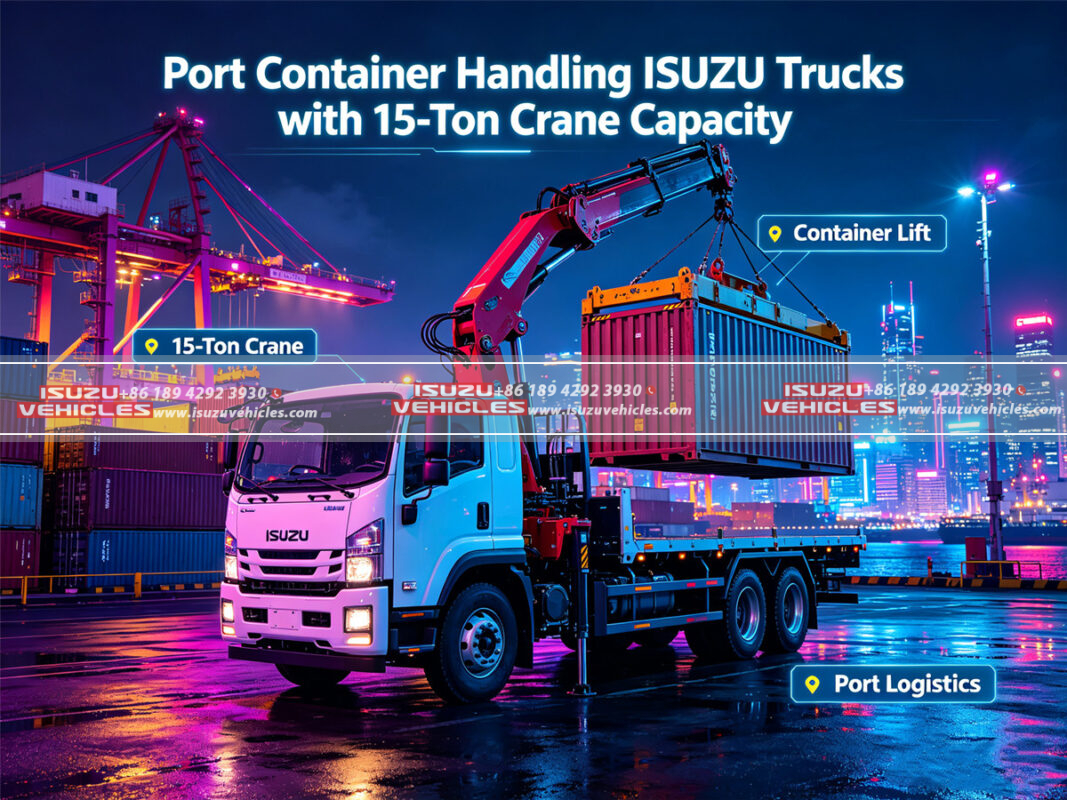
The Growing Need for Efficient Container Handling Equipment at Ports
Global trade depends heavily on efficient port operations, where thousands of containers must be loaded, unloaded, transferred, and delivered every day. As international supply chains become more complex, ports require equipment that can provide fast handling speed, strong lifting performance, and reliable operation under demanding working conditions. Traditional container handling equipment such as large cranes and dedicated lifting machines remain essential, but flexible truck-mounted solutions are becoming increasingly valuable for smaller terminals, logistics yards, industrial facilities, and transportation companies.
The ISUZU Truck with 15-Ton Crane Capacity represents a practical solution for businesses that need both transportation capability and independent lifting performance. By combining a heavy-duty truck chassis with a powerful hydraulic crane system, this type of vehicle can transport containers, machinery, construction materials, and other heavy cargo while also completing loading and unloading operations without requiring additional lifting equipment.
Unlike standard cargo vehicles that depend entirely on external cranes or forklifts, an ISUZU crane truck provides greater operational flexibility. The vehicle can arrive at different locations, position itself near the cargo, and use its integrated crane attachment to perform lifting tasks directly. This reduces waiting time, improves transportation efficiency, and helps companies lower equipment coordination costs.
Built on the reliable commercial vehicle foundation of ISUZU, these crane-equipped trucks combine strong chassis engineering, efficient hydraulic systems, and practical operating design. For port-related logistics, where time efficiency and cargo safety are critical, a 15-ton crane configuration provides a strong balance between lifting capability and vehicle mobility.
How a 15-Ton Crane Capacity ISUZU Truck Supports Container Handling
The main advantage of a 15-Ton Crane Capacity ISUZU Truck is its ability to perform heavy lifting tasks while maintaining the mobility of a road-going commercial vehicle. The system is designed around several key components that work together to safely handle large and heavy cargo.
Heavy-Duty Hydraulic Crane System
The hydraulic crane is the core component responsible for lifting containers and other heavy materials. Unlike mechanical lifting systems, hydraulic cranes use pressurized fluid to generate smooth and controlled movement, allowing operators to extend the boom, rotate the crane, and position loads with precision.
A 15-ton crane rating means the crane is capable of handling substantial loads under specific operating conditions. However, the actual lifting capacity depends on factors such as boom length, working radius, load position, and ground stability.
For example, the crane may achieve its maximum lifting capacity when operating close to the truck body, while the available lifting force decreases as the boom extends farther. Professional operators use load charts and safety indicators to determine the correct operating range.
Reinforced Truck Chassis for Stable Operation
A powerful crane requires a strong foundation. The truck chassis must support not only the crane equipment but also the weight of transported cargo and the forces generated during lifting operations.
ISUZU crane trucks are designed with reinforced frames and optimized weight distribution to improve stability. Heavy-duty suspension systems and reliable braking components help maintain control when the vehicle is carrying large loads or operating on uneven surfaces.
For port environments where trucks frequently move between container yards, warehouses, and loading areas, chassis durability directly affects productivity and operating reliability.
Advantages of Using ISUZU Crane Trucks for Port and Container Logistics
Modern logistics companies increasingly focus on reducing handling time and improving operational flexibility. A truck-mounted crane provides several advantages compared with using separate transportation and lifting equipment.
Reduced Dependence on External Equipment
One of the biggest benefits of an ISUZU crane truck is operational independence. A conventional cargo truck may arrive at a location but still require a separate crane or forklift before unloading can begin.
With a 15-ton crane attachment, the truck can complete many loading and unloading tasks independently. This reduces scheduling problems, eliminates unnecessary waiting periods, and improves overall logistics efficiency.
For small and medium-sized ports, industrial parks, and remote logistics areas, this flexibility can significantly improve daily operations.
Faster Container Transfer and Material Handling
Time is a critical factor in port operations. Delays during loading and unloading can affect transportation schedules and increase operating costs.
An ISUZU crane truck allows operators to complete lifting tasks immediately after arrival. Whether handling container components, machinery parts, steel structures, or industrial equipment, the integrated crane system provides a faster workflow compared with relying on multiple machines.
This efficiency is especially valuable in locations where space is limited or where large fixed cranes are not always available.
Key Safety Features for Heavy Lifting Operations
Handling containers and heavy industrial materials requires strict attention to safety. A 15-ton crane system must provide reliable control mechanisms to prevent accidents and protect both operators and surrounding equipment.
Hydraulic Stability and Load Control Systems
Modern ISUZU crane trucks use advanced hydraulic control technology to provide smooth lifting and lowering movements. Precise hydraulic control helps prevent sudden load shifts, which can create dangerous situations during heavy lifting operations.
Many crane systems include overload protection devices, hydraulic safety valves, and monitoring indicators that help operators stay within safe working limits.
These systems are particularly important in port environments where lifting operations often occur near workers, vehicles, and valuable cargo.
Outriggers for Improved Vehicle Stability
Before lifting heavy loads, operators deploy hydraulic outriggers that extend from the sides of the truck chassis. These supports increase the vehicle’s contact area with the ground and improve stability during crane operation.
Proper outrigger deployment helps prevent excessive movement and reduces the risk of vehicle imbalance when handling heavy containers.
The effectiveness of a 15-ton crane depends not only on the crane itself but also on correct setup procedures, including ground assessment and proper load positioning.
Applications Beyond Container Handling
Although container transportation is one of the major applications for crane-equipped ISUZU trucks, their versatility allows them to support many other industries.
Industrial Equipment Transportation
Manufacturing facilities often require heavy machinery to be moved between production areas, warehouses, and installation locations. A crane truck can transport equipment and complete lifting tasks at the destination without requiring additional machinery.
This makes it an efficient choice for factories, construction companies, and industrial service providers.
Construction and Infrastructure Projects
Construction sites frequently require materials such as steel beams, pipes, generators, and prefabricated components to be lifted into position. An ISUZU crane truck provides a mobile lifting solution that can support various project stages.
Compared with fixed cranes, truck-mounted cranes offer greater mobility and can move between different job sites as project requirements change.
Maintenance and Operation Considerations for Long-Term Performance
To ensure reliable performance, regular maintenance is essential for both the truck chassis and crane system. Heavy lifting operations place significant stress on hydraulic components, structural parts, and mechanical connections.
Hydraulic System Maintenance
The hydraulic system should be inspected regularly for oil quality, pressure stability, and possible leakage. Proper hydraulic maintenance ensures smooth crane movement and prevents unexpected failures during operation.
Crane Structure Inspection
Boom sections, lifting hooks, cables, and connection points should be checked regularly for wear or damage. Since these components handle heavy loads, even small structural issues can affect operational safety.
Routine maintenance not only improves safety but also extends the service life of the entire vehicle.
The Role of ISUZU Crane Trucks in Integrated Logistics and Emergency Operations
The flexibility of an ISUZU crane truck allows it to work alongside many other specialized vehicles in modern industrial environments. In port logistics, it can support container movement, equipment installation, and cargo transfer operations. In construction and municipal projects, it can complement other vehicles that handle different tasks.
For example, a cherry picker truck may be used for elevated maintenance work involving lighting systems, communication equipment, or infrastructure inspection, while a tow truck may support vehicle recovery and transportation when equipment failures occur. Together, these specialized vehicles create a more complete operational network for logistics, maintenance, and emergency services.
With strong lifting capability, durable chassis engineering, and flexible application options, ISUZU Vehicles continue to provide reliable solutions for container handling, industrial transportation, and heavy-duty logistics operations, helping businesses improve efficiency and maintain dependable performance in demanding working environments worldwide.