
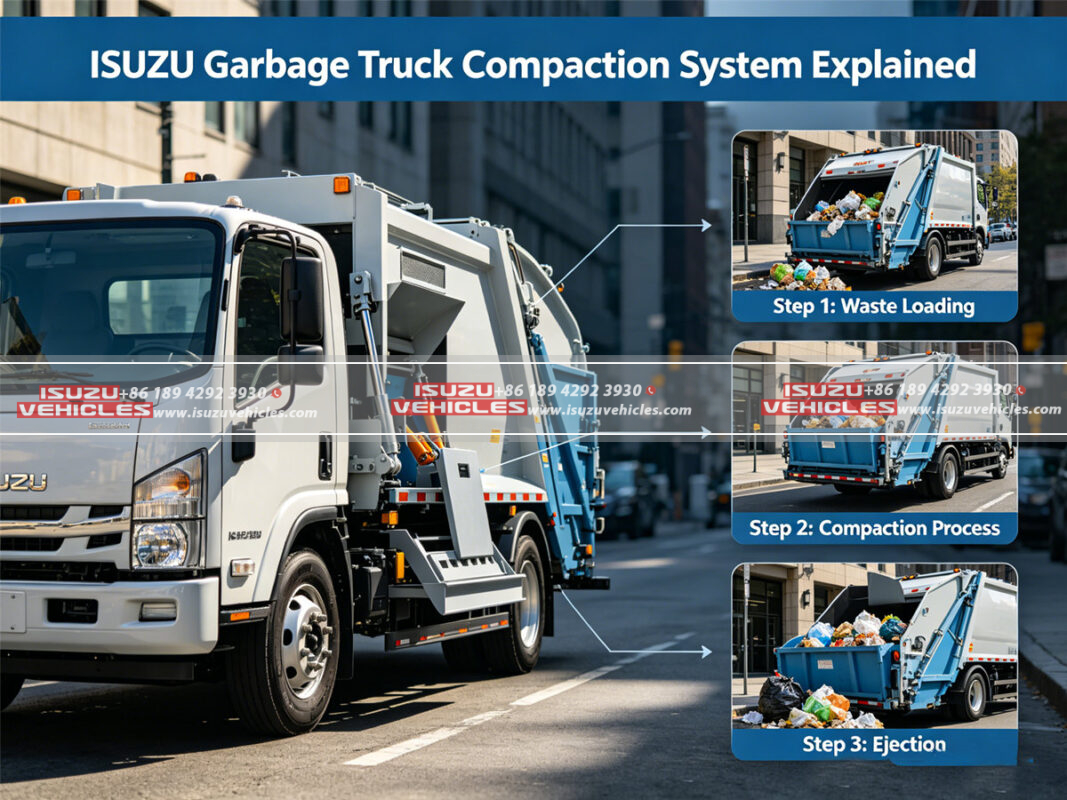
Understanding the Importance of Garbage Truck Compaction Systems
Modern waste management operations depend heavily on efficiency, because municipalities, sanitation companies, and environmental service providers must collect and transport increasingly large volumes of waste while controlling labor costs, fuel consumption, landfill transportation frequency, and vehicle maintenance expenses. As urban populations continue expanding and industrial activities generate more waste materials, sanitation fleets require advanced collection equipment capable of maximizing carrying capacity without sacrificing operational reliability. This is one of the main reasons why ISUZU garbage trucks equipped with advanced compaction systems have become highly valuable in modern sanitation operations worldwide.
A garbage truck compaction system is designed to compress waste materials inside the truck body, allowing the vehicle to transport significantly larger volumes of refuse than standard non-compacting collection vehicles. By reducing the physical space occupied by waste, the compaction mechanism improves transportation efficiency, decreases unloading frequency, and helps sanitation fleets complete collection routes more productively.
The effectiveness of a garbage truck is not determined only by engine power or body size, because the compaction system itself plays a central role in route performance, fuel economy, labor productivity, and long-term operating efficiency. ISUZU garbage trucks are widely recognized for integrating durable commercial truck engineering with efficient hydraulic compaction technology, allowing operators to maintain reliable waste collection performance under demanding urban and industrial conditions.
How the ISUZU Garbage Truck Compaction System Works
Hydraulic Compression Mechanism
At the core of every modern ISUZU garbage truck is the hydraulic compaction system, which uses high-pressure hydraulic cylinders and mechanical compression plates to compress waste materials after they are loaded into the hopper area. Once waste enters the rear loading compartment, the hydraulic system activates a compression blade or packing panel that pushes the waste deeper into the truck body while compacting it into a denser form.
This process is repeated continuously during collection operations, allowing the truck to maximize available storage capacity throughout the route. Hydraulic systems are preferred because they provide strong and consistent compression force while maintaining smooth and controlled operation during repeated waste loading cycles.
The hydraulic compaction process significantly reduces the volume of loose waste materials, which means operators can collect larger amounts of refuse before needing to unload at disposal facilities or transfer stations.
Loading Hopper and Waste Transfer Process
The loading hopper serves as the entry point for collected waste and is carefully designed to support efficient waste transfer into the compaction chamber. During collection operations, sanitation crews place waste into the hopper either manually or through automated lifting systems depending on the truck configuration.
Once the hopper reaches a certain capacity, the hydraulic packing mechanism pushes the waste into the main storage body while simultaneously compressing the material to create additional storage space. This continuous loading and compression cycle allows garbage trucks to maintain steady collection performance throughout long operational shifts.
Efficient hopper design also helps improve loading speed and reduce collection delays, particularly in busy urban environments where sanitation crews must complete demanding collection schedules.
High-Density Waste Storage
The primary purpose of the compaction system is to increase waste density inside the truck body, which directly improves hauling efficiency. Without compaction technology, loose household waste, packaging materials, cardboard, and lightweight debris would quickly fill the available storage area even though the actual weight may remain relatively low.
By compressing these materials into a denser form, ISUZU garbage trucks can transport larger waste quantities in a single trip, reducing the number of disposal runs required during daily operations.
Benefits of the ISUZU Garbage Truck Compaction System
Improved Route Efficiency
One of the biggest operational advantages of the ISUZU garbage truck compaction system is improved route efficiency, because higher waste density allows trucks to remain operational longer before reaching maximum storage capacity. Fewer unloading trips mean collection crews can service larger areas during the same work period, improving overall fleet productivity.
This advantage is especially important in densely populated cities where waste collection demands are high and disposal facilities may be located far from collection zones. Reducing travel frequency between routes and landfill sites helps sanitation departments optimize schedules while minimizing unnecessary transportation delays.
Reduced Fuel Consumption
Fuel expenses are one of the largest operational costs in municipal sanitation fleets, particularly for garbage trucks operating continuously throughout the day under stop-and-go traffic conditions. Compaction systems help reduce fuel consumption indirectly by decreasing the number of trips required to transport collected waste to disposal facilities.
By maximizing carrying efficiency, ISUZU garbage trucks can complete more collection work while consuming less fuel overall, helping municipalities and private waste management companies lower long-term operating expenses.
Lower Labor Costs and Increased Productivity
Efficient compaction systems also improve labor productivity because collection crews spend less time traveling to disposal locations and more time completing active waste collection tasks. Faster route completion allows sanitation operators to optimize workforce allocation and improve service coverage across larger operational areas.
In addition, many modern ISUZU garbage truck configurations incorporate semi-automated or fully automated loading systems that further reduce manual labor requirements while improving collection speed and worker safety.
Enhanced Environmental Performance
Reducing the number of disposal trips not only lowers fuel costs but also decreases vehicle emissions and overall environmental impact. More efficient waste transportation contributes to cleaner urban operations while supporting broader sustainability goals within modern sanitation systems.
This environmental benefit is increasingly important as cities and governments implement stricter environmental regulations and seek cleaner waste management solutions.
Why ISUZU Compaction Systems Are Trusted Worldwide
Durable Hydraulic Engineering
The long-term reliability of a garbage truck depends heavily on the durability of its hydraulic compaction system because these components operate continuously under heavy pressure throughout daily collection routes. ISUZU garbage trucks are designed with robust hydraulic systems capable of handling demanding waste collection workloads while maintaining stable performance over many years of operation.
Durable hydraulic components help reduce maintenance frequency and minimize operational downtime caused by equipment failure, which is critical for sanitation fleets operating on strict collection schedules.
Strong Chassis Support for Heavy Loads
Compacted waste creates higher payload density, meaning the truck chassis must support heavier and more concentrated loads during transportation. ISUZU commercial truck platforms are engineered with reinforced chassis structures that maintain vehicle stability and durability under demanding waste hauling conditions.
This strong structural support allows garbage trucks to handle intensive collection operations safely while maintaining long-term mechanical reliability.
Adaptability for Different Waste Collection Applications
ISUZU compaction systems are also valued for their versatility because they can be integrated into multiple garbage truck configurations designed for residential collection, industrial waste handling, recycling operations, and commercial refuse transportation.
This flexibility allows municipalities and waste management companies to customize truck configurations according to operational needs while maintaining the efficiency advantages provided by hydraulic compaction technology.
The Future of Waste Collection Efficiency with ISUZU Garbage Trucks
As urban populations continue growing and waste management systems become increasingly sophisticated, the demand for highly efficient sanitation equipment will continue expanding across global markets. ISUZU garbage trucks equipped with advanced compaction systems are well positioned to support this evolution because they combine durable commercial engineering, efficient hydraulic performance, fuel economy, and operational reliability in a way that directly addresses modern sanitation challenges.
Future developments in garbage truck technology are expected to include smarter hydraulic controls, automated route optimization systems, enhanced safety features, improved waste monitoring technologies, and more environmentally sustainable operational designs that help municipalities improve collection performance while reducing environmental impact.
In addition to garbage collection operations, modern sanitation fleets also rely on specialized commercial vehicles such as advanced sweeper truck systems for road cleaning and industrial vacuum truck units for sewage and liquid waste maintenance, further strengthening the reputation of dependable ISUZU Vehicles used across sanitation, infrastructure, and environmental service industries worldwide.