
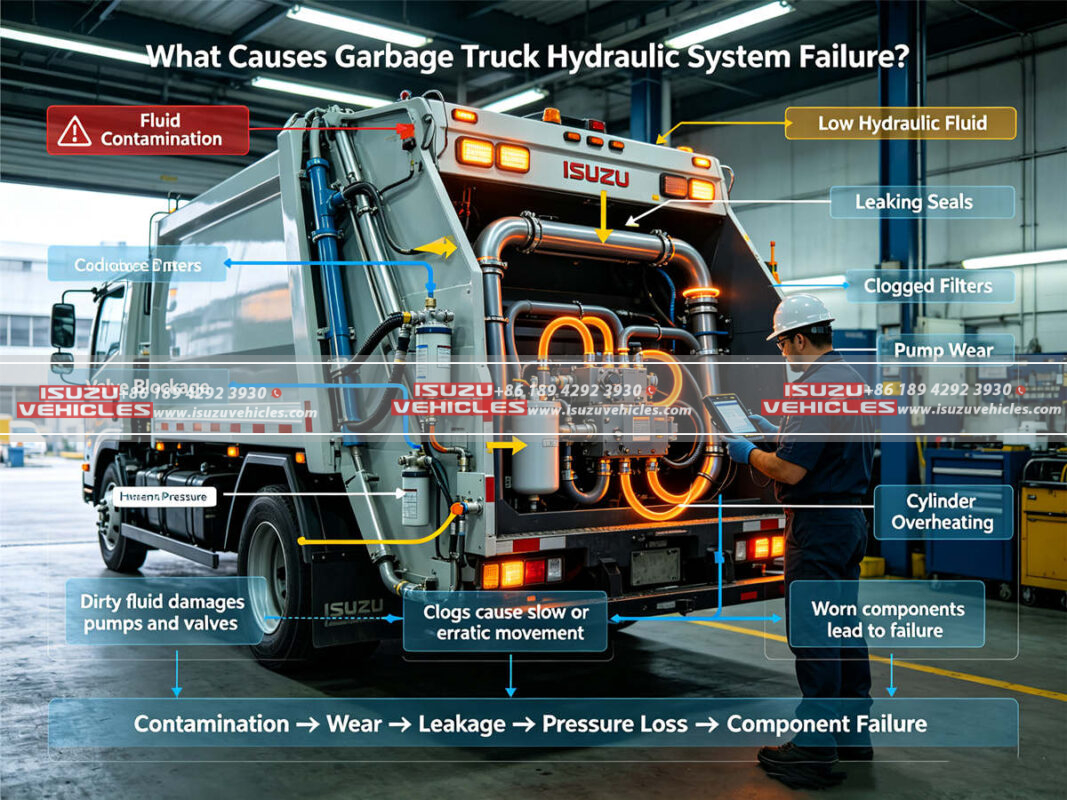
A garbage truck depends on its hydraulic system to perform some of its most important operations, including lifting waste containers, compressing refuse, opening and closing the rear door, and unloading collected garbage. Unlike ordinary commercial vehicles, which mainly rely on their engines and transmissions to move goods from one location to another, garbage trucks must repeatedly perform demanding mechanical tasks throughout the working day, often under heavy loads, in dusty environments, and with frequent stop-and-go operation. As a result, the hydraulic system experiences considerable pressure, temperature changes, vibration, and mechanical wear, making it one of the most important systems to maintain properly.
When a hydraulic system begins to fail, the consequences can extend far beyond a slow-moving lifting mechanism. A minor oil leak or clogged filter may gradually develop into insufficient lifting force, unstable compaction, overheating, or even complete equipment shutdown. For municipal sanitation departments and waste management companies, unexpected hydraulic failures can interrupt collection schedules, increase maintenance expenses, and reduce the overall efficiency of their fleets.
Understanding what causes garbage truck hydraulic system failure is therefore essential for operators, fleet managers, maintenance technicians, and vehicle buyers. This guide examines the most common causes of hydraulic problems, explains how to recognize early warning signs, and provides practical maintenance recommendations that can help extend equipment service life.
1. Understanding How a Garbage Truck Hydraulic System Works
Before examining the causes of failure, it is useful to understand the basic working principle of a garbage truck hydraulic system. Most modern garbage trucks use hydraulic power to operate their loading, lifting, compacting, and unloading mechanisms. The system converts mechanical power from the engine or power take-off (PTO) into hydraulic energy, which is then transmitted through pressurized hydraulic oil to different cylinders and motors.
The main components generally include a hydraulic pump, hydraulic oil tank, control valves, hydraulic cylinders, pipelines, hoses, filters, and various pressure-regulating devices. Each component performs a specific function, but all of them must work together to ensure stable and reliable operation.
The hydraulic pump draws oil from the reservoir and delivers it under pressure to the control valve assembly. When the operator activates a particular function, the control valves direct the oil toward the appropriate hydraulic cylinder or motor, allowing the lifting arm, loading mechanism, compaction plate, or rear door to move.
For example, in a rear-loading garbage truck, hydraulic cylinders control the movement of the loading mechanism and compaction plate, allowing loose waste to be compressed into the collection compartment. When the truck reaches a disposal facility, another hydraulic mechanism may raise the body or operate the unloading plate to discharge the collected waste.
This working process requires consistent oil pressure, adequate fluid flow, reliable seals, and accurate valve control. If any of these conditions is compromised, the entire hydraulic system may experience reduced performance or mechanical failure.
The same basic principles apply to other specialized municipal vehicles. A vacuum truck uses hydraulic power for certain tank, boom, and auxiliary operations, while a sweeper truck may rely on hydraulic circuits to operate its brushes, lifting mechanisms, and other working equipment. Although their applications differ, these vehicles share similar requirements for hydraulic cleanliness, pressure stability, and preventive maintenance.
2. Common Causes of Garbage Truck Hydraulic System Failure
Hydraulic failures rarely happen without a reason. In many cases, problems develop gradually because of contaminated oil, insufficient maintenance, excessive operating pressure, or damaged components. Identifying the underlying cause is more effective than repeatedly replacing individual parts without addressing the actual problem.
Hydraulic Oil Contamination
Hydraulic oil is responsible for transmitting power, lubricating moving components, reducing friction, and helping control operating temperature. When the oil becomes contaminated with dust, metal particles, water, or other foreign substances, its ability to protect the hydraulic system decreases significantly.
Garbage trucks typically operate in environments where dust, dirt, moisture, and waste residues are common. During daily collection operations, contaminants may enter the hydraulic reservoir through damaged seals, poorly maintained filling equipment, loose connections, or inadequate filtration.
Once contamination enters the system, small particles can circulate through the pump, valves, and cylinders, gradually damaging precision-machined surfaces. Contaminated oil may also cause control valves to stick, resulting in slow movements, inconsistent pressure, or difficulty controlling the loading and unloading mechanisms.
Water contamination presents another problem because it can promote corrosion, reduce lubrication performance, and affect the characteristics of hydraulic fluid. In severe cases, contaminated oil can cause premature pump wear and expensive repairs.
The best preventive measure is to use hydraulic oil that meets the vehicle manufacturer’s specifications, keep filling equipment clean, inspect the reservoir regularly, and replace filters according to the recommended service schedule.
Insufficient Hydraulic Oil or Oil Leakage
Low hydraulic oil levels are another frequent cause of system failure. When the reservoir does not contain enough oil, the pump may draw in air instead of maintaining a continuous supply of hydraulic fluid. This condition can lead to cavitation, irregular operation, unusual noise, and reduced lifting capacity.
Oil leakage may occur at hose connections, cylinder seals, valve assemblies, pump housings, or damaged hydraulic pipelines. Because garbage trucks operate under frequent pressure changes and vibration, connections that initially appear secure may gradually loosen, while rubber hoses and seals can deteriorate over time.
An external leak is usually easy to recognize because oil may appear around hydraulic components, underneath the vehicle, or near the rear working mechanism. However, internal leakage can be more difficult to identify. For example, worn cylinder seals may allow hydraulic oil to pass between internal chambers without producing an obvious external leak, causing the lifting mechanism to lose holding force.
Operators should never ignore small oil stains or gradually decreasing reservoir levels. Even a minor leak can eventually cause insufficient pressure, equipment overheating, or serious pump damage if the vehicle continues operating without proper inspection.
Hydraulic Pump Wear or Failure
The hydraulic pump is one of the most important components in the entire system because it supplies the oil flow required to operate the truck’s working equipment. If the pump cannot deliver sufficient flow or pressure, the lifting, loading, and compaction mechanisms may become slow or completely inoperative.
Pump failure can result from prolonged operation with contaminated oil, inadequate lubrication, oil starvation, excessive operating temperatures, or continuous operation beyond the pump’s rated pressure.
Common warning signs include abnormal whining or grinding noises, reduced working speed, excessive vibration, and difficulty lifting heavy waste containers. In some situations, the pump may continue running but fail to provide enough hydraulic flow for the truck to complete its normal operating cycle.
It is important to distinguish between pump problems and other hydraulic faults before replacing the pump. A clogged suction filter, restricted oil inlet, faulty relief valve, or low reservoir level may produce similar symptoms. Professional pressure and flow testing can help determine whether the pump itself has deteriorated.
Excessive Hydraulic Pressure
Every hydraulic component is designed to operate within a specific pressure range. When system pressure exceeds the manufacturer’s recommended limits, hoses, seals, cylinders, valves, and pump components may experience excessive mechanical stress.
Overpressure can result from an incorrectly adjusted relief valve, blocked hydraulic lines, malfunctioning control valves, or improper operation of the equipment. It may also occur when an operator attempts to lift a load beyond the vehicle’s rated capacity.
For example, repeatedly forcing a compaction mechanism to operate when it is obstructed by oversized or improperly positioned waste can place unnecessary stress on the hydraulic circuit. Similarly, attempting to lift an overloaded container may cause pressure to rise beyond the system’s normal operating range.
The pressure relief valve is designed to protect the hydraulic circuit by limiting excessive pressure. However, if the valve becomes stuck, damaged, or incorrectly adjusted, the protection it provides may be reduced.
Regular pressure testing and correct relief valve adjustment are essential for preventing this type of failure. Operators should also follow the truck’s rated loading capacity and avoid forcing hydraulic mechanisms through abnormal resistance.
Worn Hydraulic Seals and Cylinders
Hydraulic cylinders convert pressurized oil into mechanical movement, making them essential for operating lifting arms, compaction plates, rear doors, and unloading mechanisms.
Over time, cylinder seals can deteriorate because of friction, temperature fluctuations, contamination, pressure variations, and normal aging. Once seals become damaged, oil may leak internally or externally, reducing cylinder efficiency.
A common symptom is a lifting mechanism that gradually sinks when it should remain in a fixed position. Another warning sign is uneven or jerky cylinder movement, particularly when the truck is carrying a heavy load.
Cylinder rods can also become scratched, bent, or corroded. A damaged rod surface may quickly wear out replacement seals, meaning that simply installing new seals will not necessarily solve the problem.
During maintenance, technicians should inspect cylinder rods, seal assemblies, mounting points, and hydraulic connections rather than focusing only on visible oil leakage.
3. Operating Conditions That Accelerate Hydraulic System Damage
Apart from component defects and maintenance problems, the working environment and daily operating habits have a significant influence on hydraulic system reliability. Garbage trucks are exposed to demanding conditions that can accelerate wear, particularly when they operate continuously without sufficient cooling periods or are regularly used beyond their intended working capacity.
Continuous Operation and Hydraulic Overheating
Hydraulic systems generate heat during normal operation because of fluid friction, pressure losses, and mechanical energy conversion. Under ordinary working conditions, the cooling system and hydraulic reservoir help maintain an appropriate oil temperature. However, when a garbage truck performs repeated loading and compression cycles throughout the day, the hydraulic oil may become excessively hot if the system cannot release heat efficiently.
High temperatures accelerate oil oxidation, reduce lubricant life, and cause rubber seals to harden or deteriorate. As the oil loses some of its original performance characteristics, internal leakage may increase, resulting in lower hydraulic efficiency and additional heat generation.
Several factors can contribute to overheating, including a blocked oil cooler, insufficient hydraulic oil, continuous operation at excessive pressure, restricted return lines, and an incorrectly adjusted relief valve.
Fleet managers should pay attention to changes in operating temperature, particularly during hot weather or intensive waste collection periods. Allowing the hydraulic system to cool when necessary and keeping cooling components clean can significantly reduce the risk of thermal damage.
Overloading and Improper Operation
Garbage trucks are designed to handle substantial working loads, but this does not mean that operators can continuously exceed the rated capacity without consequences. Overloading places additional stress on hydraulic cylinders, pumps, lifting arms, structural components, and control valves.
When a garbage truck is repeatedly used to lift excessively heavy containers or compress unsuitable materials, the hydraulic system may be forced to operate near or beyond its designed pressure limits. This can accelerate seal deterioration, damage cylinder components, and increase the possibility of hose or fitting failure.
Improper operating habits can also contribute to hydraulic problems. Abruptly changing control directions, repeatedly activating mechanisms before the previous movement is complete, and continuing to operate equipment when abnormal resistance occurs can create unnecessary pressure fluctuations.
Operators should follow the manufacturer’s operating procedures, understand the rated capacity of each mechanism, and stop the equipment when unexpected noises, vibration, or movement abnormalities appear.
Poor Maintenance and Incorrect Hydraulic Oil Selection
Another important cause of hydraulic failure is inadequate maintenance. Some fleet operators only inspect hydraulic components after a problem appears, rather than following a regular preventive maintenance program. Unfortunately, by the time a lifting cylinder stops working or the compaction plate loses its operating force, the original problem may already have damaged several connected components.
Using hydraulic oil with an unsuitable viscosity is another common mistake. Oil that is too thick may make cold starts and fluid circulation more difficult, while oil that is too thin may increase internal leakage and reduce lubrication under high-temperature conditions.
The correct hydraulic fluid should always be selected according to the equipment manufacturer’s recommendations, considering the specified viscosity grade, operating temperature, and system requirements. Mixing different hydraulic oils without confirming their compatibility should also be avoided.
4. Warning Signs That Indicate Hydraulic System Problems
Recognizing early warning signs is one of the most effective ways to prevent expensive hydraulic repairs. Although different failures may produce similar symptoms, changes in equipment movement, hydraulic pressure, operating temperature, and fluid condition can provide valuable clues about the underlying problem.
The following symptoms deserve particular attention during daily garbage truck operation:
- Slow lifting or loading speed: When hydraulic cylinders move more slowly than usual, the cause may involve insufficient oil flow, a worn pump, restricted filters, or internal leakage.
- Weak compaction performance: If the compaction plate cannot compress waste effectively, the system may have insufficient pressure, damaged seals, or a malfunctioning control valve.
- Unusual hydraulic noise: Whining, knocking, or grinding sounds may indicate air entering the system, pump cavitation, insufficient oil supply, or mechanical wear.
- Jerky or unstable movements: Irregular cylinder movement may result from air contamination, inconsistent hydraulic pressure, sticking valves, or damaged cylinder components.
- Excessive oil temperature: Oil that becomes unusually hot may indicate continuous pressure losses, inadequate cooling, excessive operating loads, or an internal system malfunction.
- Visible hydraulic oil leakage: Oil around hoses, cylinders, pump connections, and valve assemblies indicates that seals, fittings, or pipelines require inspection.
- Equipment drifting after operation: When a lifting arm, rear door, or other hydraulic mechanism gradually moves after the controls have been released, internal leakage or a faulty holding valve may be responsible.
A useful maintenance practice is to record these symptoms whenever they appear, together with the operating conditions, working temperature, and recent maintenance history. Such records help technicians identify recurring problems and avoid unnecessary replacement of expensive hydraulic components.
5. How to Prevent Garbage Truck Hydraulic System Failure
Preventive maintenance is generally less expensive and more effective than repairing a hydraulic system after a major breakdown. A well-planned maintenance program should combine regular inspections, proper hydraulic fluid management, professional testing, and appropriate operating procedures.
Inspect Hydraulic Oil and Replace Filters Regularly
Hydraulic oil should be checked at the intervals specified by the vehicle manufacturer, with particular attention to oil level, color, unusual odors, and visible contamination. If the oil appears milky, unusually dark, or contains visible particles, technicians should investigate the cause rather than simply adding fresh fluid.
Hydraulic filters are equally important because they prevent contaminants from circulating through sensitive components. A clogged filter can restrict oil flow, increase pressure losses, and contribute to pump damage. Replacing filters according to the recommended service schedule helps maintain stable hydraulic performance.
For garbage trucks operating in dusty environments or under particularly intensive working conditions, more frequent inspections may be appropriate.
Check Hoses, Connections, and Cylinder Seals
Hydraulic hoses are exposed to vibration, pressure fluctuations, temperature changes, and repeated movement. Over time, their outer surfaces may crack, fittings may loosen, and internal hose layers may deteriorate.
Technicians should inspect hoses for abrasion, swelling, deformation, corrosion around connections, and visible leakage. Cylinder rods should also be checked for scratches, rust, and other surface damage that could affect seal performance.
Damaged hoses and seals should be replaced with components that meet the required pressure and compatibility specifications. Never attempt to locate a high-pressure hydraulic leak with bare hands, because escaping hydraulic fluid can penetrate the skin and cause a serious injection injury. Before maintenance, the equipment must be properly shut down, depressurized, and secured against unexpected movement.
Monitor Hydraulic Pressure and Operating Temperature
Pressure testing can help identify problems that are difficult to detect through visual inspection alone. Technicians can use suitable pressure gauges and diagnostic equipment to evaluate pump output, relief valve operation, and pressure stability across different hydraulic circuits.
If the pressure is lower than expected, the problem may involve pump wear, internal leakage, a faulty relief valve, or a restricted oil supply. Excessive pressure, on the other hand, may indicate incorrect valve adjustment, blocked pipelines, or abnormal mechanical resistance.
Temperature monitoring is equally valuable because excessive heat often develops before more serious hydraulic failures become apparent. Keeping oil coolers clean, ensuring adequate airflow, and avoiding unnecessary continuous operation can help maintain reliable performance.
Train Operators to Use Hydraulic Equipment Correctly
Even a well-designed hydraulic system can experience premature failure when operated incorrectly. Drivers and sanitation workers should understand the operating sequence, loading limitations, emergency stop procedures, and basic warning signs associated with hydraulic problems.
Operators should avoid forcing mechanisms through obstructions, exceeding rated lifting capacities, or continuing work when the equipment behaves abnormally. A short inspection before each working shift can also help identify loose connections, oil leakage, and other visible problems before the truck enters service.
For fleet operators, consistent training is particularly important because different drivers may have different levels of experience with compactor trucks, hook loaders, skip loaders, and other specialized waste collection equipment.
6. Choosing Reliable Garbage Trucks and Maintaining Long-Term Performance
Hydraulic reliability does not depend exclusively on maintenance; vehicle design, component quality, manufacturing standards, and the suitability of the truck configuration for its intended application are equally important.
When purchasing a garbage truck, buyers should pay attention to the hydraulic pump, cylinder specifications, control valve arrangement, oil reservoir capacity, pressure protection devices, and accessibility of components during routine servicing. A hydraulic system should be properly matched to the vehicle’s intended payload and working cycle rather than selected only according to its maximum pressure rating.
For example, a rear-loading compactor garbage truck requires a dependable hydraulic system to operate its loading hopper and compression mechanism repeatedly throughout the collection route. A hooklift garbage truck, meanwhile, requires sufficient hydraulic lifting capacity and stable cylinder operation when loading, unloading, and transporting detachable containers.
ISUZU Vehicles offers different specialized municipal vehicles designed for various waste collection and environmental sanitation applications. Buyers can explore the ISUZU garbage truck range to compare rear-loading compactors, hooklift trucks, skip loaders, and other refuse collection configurations.
For municipal departments managing multiple sanitation responsibilities, hydraulic maintenance knowledge can also be applied to other specialized vehicles. The ISUZU vacuum truck range includes equipment for sewage collection, sludge removal, and sewer cleaning, while the ISUZU sweeper truck range provides road cleaning solutions with hydraulic-driven working mechanisms on selected configurations.
These vehicles perform different tasks, but their long-term operating efficiency depends on selecting appropriate equipment, following manufacturer maintenance recommendations, and ensuring that operators understand the systems they use.
Before purchasing a vehicle, fleet managers should also ask about hydraulic component brands, maintenance intervals, available technical documentation, replacement component availability, and after-sales support. These details can have a substantial influence on total operating costs, especially for fleets that work long hours every day.
7. Practical Maintenance Checklist for Fleet Managers
A structured inspection schedule makes hydraulic maintenance easier to organize and helps prevent small problems from developing into major equipment failures. Although the exact service intervals depend on the truck model, hydraulic configuration, and working conditions, the following checklist provides a useful starting point for fleet management.
| Inspection Frequency | Maintenance Item | Purpose |
|---|---|---|
| Before each shift | Check hydraulic oil level | Prevent oil starvation and pump damage |
| Before each shift | Inspect hoses and connections | Identify leakage and visible damage |
| Before each shift | Check lifting and compaction movements | Detect abnormal operating behavior |
| Weekly | Inspect cylinder rods and seals | Identify wear and oil leakage |
| Weekly | Check hydraulic reservoir and fittings | Prevent contamination and fluid loss |
| Monthly | Inspect filters and cooling components | Maintain oil cleanliness and temperature control |
| Periodically | Test hydraulic pressure | Verify pump and valve performance |
| According to manufacturer schedule | Replace hydraulic oil and filters | Maintain proper lubrication and system cleanliness |
| When abnormal symptoms appear | Perform professional hydraulic diagnosis | Identify faults before further damage occurs |
The checklist should be adjusted to the actual maintenance requirements provided by the truck manufacturer. Vehicles working in high-temperature regions, dusty industrial environments, or demanding municipal collection routes may require more frequent inspections.
It is also advisable to maintain a separate service record for each truck, documenting oil changes, filter replacements, hydraulic repairs, component inspections, and recurring performance problems. This information allows fleet managers to identify patterns, plan maintenance budgets, and determine whether a particular component is experiencing premature wear.
For companies operating several garbage trucks, a preventive maintenance system can help reduce unexpected downtime and make vehicle replacement decisions more predictable.
A reliable hydraulic system is essential for keeping garbage trucks productive, safe, and ready for daily waste collection. Most hydraulic failures can be traced to a combination of contamination, insufficient oil, leakage, excessive pressure, overheating, component wear, and improper operation, which means that regular inspections and correct working practices can make a substantial difference to equipment service life. By understanding these common causes, responding promptly to early warning signs, and choosing properly configured vehicles from dependable manufacturers, waste management companies can improve collection efficiency while controlling long-term operating and maintenance costs. ISUZU Vehicles remains committed to providing practical commercial vehicle solutions for municipal sanitation, waste collection, and environmental maintenance operations.