
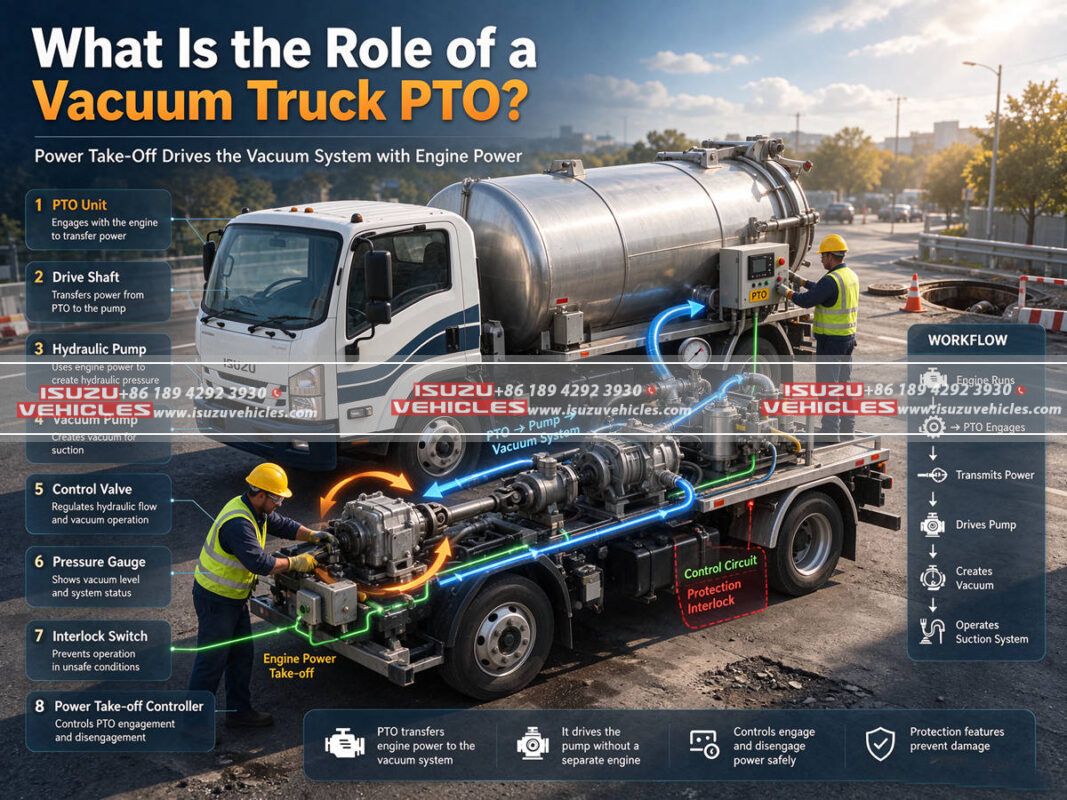
A vacuum truck is a specialized vehicle designed to collect, transport, and discharge liquid waste, sewage, sludge, mud, and other materials that cannot be handled efficiently by conventional garbage collection equipment. Whether it is being used for municipal sewer maintenance, industrial wastewater management, septic tank cleaning, or emergency drainage operations, its working capability depends on several interconnected mechanical and hydraulic systems. Among these components, the Power Take-Off (PTO) plays an especially important role because it transfers mechanical power from the truck’s engine or transmission to the auxiliary equipment responsible for generating the suction force required for cleaning operations.
Although the PTO is often a relatively small component compared with the vacuum pump or waste collection tank, it is essential to the overall operation of a vacuum truck. Without a properly configured PTO system, the engine’s power cannot be effectively delivered to the vacuum pump, making it difficult or impossible for the vehicle to perform its primary cleaning functions. Understanding how the PTO works, how it interacts with the vacuum pump, and how it should be maintained is therefore important for vehicle operators, fleet managers, equipment purchasers, and sanitation contractors.
In this article, we will explain the function of a vacuum truck PTO, examine its operating principles, discuss common PTO configurations, and explore the relationship between the PTO, vacuum pump, hydraulic system, and other municipal cleaning vehicles. We will also look at practical maintenance considerations that help ensure reliable performance throughout the vehicle’s service life.
1. What Is a PTO on a Vacuum Truck?
PTO stands for Power Take-Off, a mechanical power-transmission device that allows a commercial vehicle to use engine power to operate auxiliary equipment beyond the normal driving system. On a vacuum truck, the PTO is generally connected to the vehicle’s transmission or another designated power output point, allowing engine power to be transferred to the vacuum pump or other specialized equipment.
In an ordinary cargo truck, the engine primarily supplies power to the transmission, driveshaft, and wheels, enabling the vehicle to travel on public roads. However, a specialized vacuum truck needs additional power to perform stationary or low-speed working operations, such as extracting wastewater from underground pipelines, removing sludge from septic tanks, and collecting liquid waste from industrial storage facilities. The PTO provides a practical way to operate this auxiliary equipment without installing a completely independent engine for every working component.
Depending on the vehicle design, the PTO may drive the vacuum pump directly or provide power to a hydraulic pump that subsequently operates the vacuum system. The specific arrangement depends on the vacuum pump type, required operating speed, vehicle transmission, and overall equipment configuration.
A typical vacuum truck PTO system includes several related components:
- PTO assembly: The mechanical unit that transfers engine or transmission power to the auxiliary equipment.
- Power transmission shaft: The component that carries rotational power from the PTO to the driven equipment when a remote connection is required.
- Vacuum pump: The main working device that creates negative pressure inside the tank and suction pipeline.
- Hydraulic pump: Used in configurations where hydraulic power is required to operate auxiliary equipment, lifting mechanisms, or hydraulic-driven vacuum pumps.
- Engagement control: The pneumatic, hydraulic, or mechanical control mechanism that allows the operator to engage and disengage the PTO.
- Protection and monitoring devices: Components such as pressure indicators, temperature monitoring devices, and safety controls that help maintain stable operation.
It is important to understand that the PTO itself does not create vacuum pressure. Instead, it supplies the mechanical energy needed to drive the vacuum pump, which generates the negative pressure used to collect waste materials. This distinction helps explain why the PTO and vacuum pump must be correctly matched to achieve reliable working performance.
2. What Is the Main Role of a Vacuum Truck PTO?
The primary role of a vacuum truck PTO is to transfer power from the vehicle’s engine to the auxiliary working equipment, allowing the truck to perform specialized cleaning and waste collection operations. However, its practical contribution involves several important functions that directly influence the vehicle’s operating efficiency and working reliability.
Providing Power to the Vacuum Pump
The most important responsibility of the PTO is supplying rotational power to the vacuum pump. During operation, the vacuum pump removes air from the collection tank or associated suction system, creating a pressure difference between the inside of the tank and the surrounding atmosphere. This pressure difference allows liquid waste, sludge, sewage, and other suitable materials to travel through the suction hose and enter the tank.
For example, when a vacuum truck is cleaning a septic tank, the operator first positions the suction hose inside the waste container and activates the vacuum system. The PTO transfers engine power to the pump, the pump generates negative pressure, and atmospheric pressure helps push the waste through the hose into the collection tank. The entire process depends on a stable power supply and an appropriately configured vacuum system.
Different vacuum pumps require different operating speeds and power levels, which means the PTO must be selected according to the manufacturer’s specifications rather than simply choosing a unit based on physical compatibility.
Supporting Continuous Working Operations
Vacuum trucks frequently perform operations that require the pump to run continuously for extended periods, particularly when removing large quantities of sewage, wastewater, or industrial sludge. The PTO makes it possible to operate the vacuum equipment while the vehicle remains stationary, allowing the truck engine to supply the required power without engaging the normal driving system.
This arrangement is particularly useful for municipal sanitation departments and industrial cleaning contractors because waste collection often takes place at fixed locations, including sewer access points, septic tanks, wastewater treatment facilities, and industrial storage areas. A dependable PTO system helps maintain consistent pump operation throughout the collection process.
Reducing the Need for an Independent Power Unit
Another important advantage is that the PTO allows the vehicle’s existing engine to power auxiliary equipment, reducing the need for a separate engine dedicated exclusively to the vacuum pump. This can simplify the vehicle’s overall structure, reduce the number of independent power units requiring maintenance, and make more efficient use of the available chassis space.
For commercial vehicle manufacturers, integrating the PTO with the transmission and working equipment provides a practical solution for developing specialized trucks that can perform both transportation and industrial cleaning functions.
Enabling Coordinated Auxiliary Functions
On some vacuum trucks, the PTO also supplies power to hydraulic systems that control auxiliary equipment, such as tank lifting mechanisms, rear doors, hose handling devices, or other specialized attachments. These functions depend on the vehicle’s particular configuration, and not every vacuum truck uses the same power transmission arrangement.
By providing a centralized source of mechanical power, the PTO helps coordinate the operation of several working systems while keeping the vehicle’s design relatively compact and manageable.
3. How Does a Vacuum Truck PTO Work?
The working principle of a PTO system is based on mechanical power transmission. When the truck engine is running, it generates rotational energy that can be used not only to move the vehicle but also to operate specialized equipment through an auxiliary power connection. The PTO provides this connection, allowing the vacuum pump to receive the power necessary for its operation.
Step 1: Starting the Truck Engine
The process begins when the operator starts the truck engine and allows it to reach an appropriate operating condition. The engine supplies power to the transmission, and the PTO is connected to a designated output mechanism within the drivetrain. At this stage, the vacuum pump is generally not operating until the operator activates the auxiliary power system according to the manufacturer’s instructions.
Step 2: Engaging the PTO
Once the vehicle is correctly positioned at the cleaning site, the operator follows the prescribed procedure to engage the PTO. Depending on the truck’s transmission and PTO design, engagement may be controlled through a pneumatic switch, an electrical control, or a mechanical mechanism. When engagement is completed, the PTO connects the engine’s available mechanical power to the auxiliary drive system.
For a direct-drive configuration, rotational power is transmitted through a connecting shaft to the vacuum pump. In a hydraulic configuration, the PTO drives a hydraulic pump, which supplies pressurized oil to a hydraulic motor connected to the vacuum pump. Both arrangements can provide the power needed for vacuum generation, although their installation requirements and maintenance procedures are different.
Step 3: Driving the Vacuum Pump
After the PTO is engaged, the vacuum pump begins rotating and removes air from the sealed collection tank or vacuum circuit. As air is continuously discharged from the system, the pressure inside the tank decreases below atmospheric pressure. The resulting pressure difference creates the conditions required for waste collection.
The pump must operate within its recommended speed range to maintain the appropriate balance between suction capacity, mechanical efficiency, temperature, and component durability. Running the pump too slowly may reduce working efficiency, while operating it beyond its permitted speed can increase heat generation and accelerate mechanical wear.
Step 4: Collecting Waste Materials
When the required vacuum condition has been established, the operator can position the suction hose and open the appropriate collection valve. Atmospheric pressure acting on the waste surface pushes compatible liquid and semi-liquid materials through the hose and into the collection tank. Throughout this process, the vacuum pump continues operating to remove air entering the system and maintain the required pressure difference.
Depending on the material being collected, the operator may need to adjust the suction arrangement, hose position, or working speed. Thick sludge, for example, may require more careful handling than ordinary wastewater because its viscosity and solid content can influence the speed and stability of the suction process.
Step 5: Disengaging the PTO After Operation
When collection is complete, the operator should follow the manufacturer’s procedure to stop suction, isolate the relevant valves, release vacuum pressure safely where required, and disengage the PTO. The engine should not be shut down or the auxiliary drive disconnected without considering the operating condition of the pump and related equipment.
This sequence is important because sudden or incorrect disengagement can place unnecessary stress on mechanical components and may create unsafe pressure conditions. Proper operating procedures help protect the PTO, transmission, vacuum pump, and other connected equipment.
4. Different PTO Drive Configurations Used on Vacuum Trucks
Although the basic function of a PTO remains the same, vacuum trucks can use different drive configurations according to their chassis, transmission, vacuum pump, and intended working applications. Choosing the appropriate arrangement is important because the power transmission system must match the pump’s operating requirements while remaining compatible with the vehicle’s drivetrain.
Transmission-Mounted PTO
A transmission-mounted PTO is one of the common arrangements used on commercial sanitation trucks. It is installed on a designated opening in the transmission housing and transfers mechanical power from the transmission to the auxiliary equipment. This configuration is practical for many medium-duty and heavy-duty vacuum trucks because it makes use of the existing drivetrain and can provide a relatively direct power transmission path.
Depending on the transmission design, the PTO can be configured with different gear ratios and output directions to accommodate the requirements of the vacuum pump. Before selecting this type of PTO, engineers need to verify the available mounting position, allowable torque, rotational speed, and compatibility with the transmission model.
Direct Mechanical PTO Drive
In a direct mechanical drive arrangement, the PTO transfers rotational power through a connecting shaft to the vacuum pump. This design can offer an efficient power transmission path when the PTO output and pump input are correctly aligned and matched.
However, shaft installation requires careful attention to alignment, mounting strength, rotation direction, and vibration control. Incorrect shaft angles or unsuitable couplings can cause excessive vibration, bearing wear, and premature damage to the connected equipment. For this reason, the complete drive arrangement should follow the recommendations of the vehicle and pump manufacturers.
Hydraulic PTO Drive
Another common solution uses the PTO to drive a hydraulic pump, which generates pressurized hydraulic oil for operating a hydraulic motor or other auxiliary equipment. In this arrangement, the PTO supplies the mechanical input, while hydraulic components distribute power to the working devices.
Hydraulic drive systems provide considerable flexibility because they can be used to operate different components through control valves and hydraulic circuits. Depending on the vehicle configuration, the same general system may support vacuum pump operation, tank lifting, rear-door opening, or other auxiliary functions, although the available hydraulic capacity must be calculated carefully.
Hydraulic systems also require regular attention to oil quality, operating temperature, filtration, hose condition, and pressure settings. A hydraulic pump or motor that is incorrectly sized can reduce efficiency and create excessive heat, potentially affecting the reliability of the entire working system.
When comparing these configurations, buyers should avoid assuming that one PTO arrangement is automatically better than another. The correct choice depends on the vacuum pump’s power demand, vehicle transmission design, expected operating duration, maintenance capabilities, and the specific requirements of the intended sanitation work.
5. How Does the PTO Work with Other Vacuum Truck Components?
The PTO cannot perform vacuum cleaning independently because its main responsibility is power transmission rather than waste collection. To understand its importance, it is necessary to examine how it works with the other components that make up the complete vacuum truck system.
PTO and Vacuum Pump
The vacuum pump is the primary working device connected to the PTO, and the performance of these two components must be properly matched. The PTO provides rotational power, while the pump converts that power into the airflow and pressure conditions required for waste extraction.
For instance, the ISUZU 8 CBM Vacuum Sewer Truck uses a PTO-driven rotary-vane vacuum pump, demonstrating how the engine and transmission can supply power to a dedicated suction system. The pump operating speed, vacuum capability, and suction performance must be considered together when selecting a suitable vehicle for municipal or industrial applications.
PTO and Vacuum Tank
The vacuum tank provides sealed storage for the materials collected through the suction hose. While the PTO and vacuum pump establish the negative-pressure conditions required for collection, the tank must be sufficiently strong and properly sealed to withstand the intended operating pressure and safely transport the collected waste.
Tank capacity is another important consideration because it influences how much material can be collected during each working cycle. A larger tank may reduce the frequency of trips to disposal facilities, but it also increases the vehicle’s weight and places greater demands on the chassis, axle capacity, and braking system.
For example, the ISUZU 6 CBM Sewage Vacuum Cleaner Truck is designed for sewage collection and wastewater transportation in urban and industrial environments where maneuverability and practical storage capacity are important considerations.
PTO and Hydraulic Discharge System
After the collection tank reaches its permitted loading level, the collected waste must be discharged at an appropriate disposal or treatment facility. Many vacuum trucks use hydraulic mechanisms to operate the rear tank door, lift the tank body, or control other discharge-related functions.
On vehicles equipped with PTO-powered hydraulic systems, the engine can supply the mechanical energy needed to operate these mechanisms through the hydraulic pump. However, the exact arrangement varies by vehicle, and some configurations use separate hydraulic circuits or additional power connections for different functions.
Operators should always ensure that the tank has been depressurized according to the manufacturer’s instructions before opening the rear cover or performing unloading operations. The hydraulic discharge system and vacuum system serve different purposes, and their controls must be operated in the correct sequence.
PTO and Safety Monitoring Equipment
Reliable vacuum truck operation also depends on appropriate monitoring and protection devices. Pressure gauges allow operators to observe the vacuum condition, while temperature indicators and other monitoring devices can help identify abnormal working conditions before they cause serious equipment damage.
Some vehicles also incorporate safety valves, overflow protection, oil separators, and other devices to protect the pump and prevent collected materials from entering components that are not designed to handle them. These systems are particularly important when vacuum trucks are used for demanding sewage and industrial sludge applications.
For additional information about different vehicle capacities and specialized configurations, the ISUZU vacuum truck product range provides examples of equipment designed for municipal sanitation, septic tank cleaning, sewage collection, and industrial waste management.
6. Common Vacuum Truck PTO Problems and Maintenance Tips
Because the PTO operates under mechanical loads and often works for extended periods during sanitation operations, regular inspection and maintenance are essential for maintaining reliable performance. A PTO problem can interrupt the operation of the vacuum pump even when the truck engine and other vehicle systems are functioning normally. For fleet operators, identifying early warning signs can help prevent expensive repairs and unnecessary vehicle downtime.
PTO Fails to Engage
One common problem is that the PTO does not engage when the operator activates the control switch. Possible causes include insufficient pneumatic pressure, electrical connection problems, damaged engagement mechanisms, incorrect operating conditions, or internal gear damage. The first step should be to check the relevant control circuits and follow the vehicle manufacturer’s troubleshooting procedure rather than repeatedly attempting to engage the system.
Abnormal Noise and Excessive Vibration
Unusual noises during PTO operation may indicate worn gears, damaged bearings, loose mounting bolts, poor shaft alignment, or problems with the connecting coupling. Excessive vibration should never be ignored because it can gradually damage the PTO housing, transmission mounting points, and connected vacuum pump. Regular inspection of the mounting structure and drive shaft can help identify these problems before they become serious.
Oil Leakage and Lubrication Problems
Some PTO assemblies require dedicated lubrication, while hydraulic PTO configurations also depend on the condition of hydraulic oil and related components. Oil leakage around seals, connections, or housings can reduce lubrication effectiveness and eventually lead to excessive friction and component damage. Operators should inspect the system regularly, use the correct lubricants, and replace damaged seals according to the manufacturer’s maintenance schedule.
Insufficient Vacuum Pump Performance
If the vacuum pump operates but cannot generate the expected suction performance, the cause may not necessarily be the PTO itself. Problems such as incorrect pump speed, worn pump components, air leakage in the pipeline, blocked filters, damaged valves, or an improperly sealed tank can all affect the vacuum system.
For this reason, technicians should inspect the complete power transmission and suction system instead of immediately replacing the PTO whenever vacuum performance decreases. Checking the actual pump rotation speed, drive connections, pressure readings, and pipeline condition can help identify the source of the problem more accurately.
Recommended Maintenance Schedule
Although the exact maintenance intervals depend on the PTO model and vehicle manufacturer’s recommendations, the following inspection practices provide a useful starting point for vacuum truck fleet management:
- Check the PTO housing and mounting bolts for looseness, cracks, and visible damage.
- Inspect connecting shafts, couplings, and joints for excessive wear or vibration.
- Check lubrication levels and replace lubricants according to the specified service intervals.
- Inspect hydraulic hoses, fittings, and seals for leakage in hydraulic drive configurations.
- Verify that the PTO engagement and disengagement mechanisms operate correctly.
- Monitor abnormal noises, overheating, and changes in vacuum pump performance.
- Ensure that the PTO output speed and torque remain within the equipment manufacturer’s permitted range.
- Arrange professional inspection whenever internal gear damage or other serious mechanical faults are suspected.
One important maintenance principle is that the PTO should not be forced to operate beyond its rated capacity. Selecting the correct power output and following the recommended operating procedures are often more effective than attempting to improve performance through excessive engine speed or unsuitable modifications.
7. The Role of PTO Systems in Other Municipal Cleaning Trucks
Although the PTO is especially important for vacuum trucks, it is also widely used in other specialized commercial vehicles. Many municipal cleaning and environmental maintenance trucks require auxiliary power to operate pumps, hydraulic mechanisms, compressors, and other working equipment. The PTO provides a convenient connection between the vehicle’s engine and these auxiliary systems, allowing one truck to perform transportation and specialized working functions.
PTO Applications in Sprinkler Trucks
A sprinkler truck uses a water pump to transfer water from its storage tank through pipelines and spray nozzles. In many conventional configurations, the PTO drives the water pump, allowing the vehicle to distribute water for road washing, dust suppression, construction-site watering, and landscape irrigation.
The operating principle is similar to that of a vacuum truck in terms of power transmission, but the working equipment performs a completely different task. A vacuum truck uses its PTO to drive a vacuum pump that removes air and creates negative pressure, whereas a sprinkler truck commonly uses its PTO to drive a water pump that generates the flow and pressure required for water distribution.
Municipal departments can therefore benefit from understanding the PTO requirements of both vehicle types when planning their sanitation fleets. You can explore the ISUZU sprinkler truck range for different water transportation and road maintenance configurations.
PTO Applications in Sweeper Trucks
A modern sweeper truck combines mechanical brushes, suction equipment, water spray systems, and a debris collection tank to remove dust, leaves, sand, and other materials from road surfaces. Depending on its design, the vehicle may use a PTO-driven hydraulic pump to provide power to the sweeping brushes, lifting cylinders, and other hydraulic equipment.
Some sweeping vehicles also use dedicated PTO-driven systems for their water pumps or other auxiliary components. These arrangements allow the truck to perform road cleaning operations without requiring separate engines for every working function.
The coordination between the PTO, hydraulic system, brushes, and suction equipment is particularly important because the vehicle needs to maintain consistent cleaning performance while operating at relatively low driving speeds. For more information about different road-cleaning configurations, visit the ISUZU sweeper truck category.
One Power Transmission Principle, Different Working Applications
From vacuum pumps and water pumps to hydraulic lifting mechanisms, the PTO provides a flexible way to transfer engine power to specialized commercial vehicle equipment. However, the PTO specifications for different applications are not necessarily interchangeable. A vacuum pump may require a particular rotational speed and torque, while a sprinkler truck’s water pump or a sweeper truck’s hydraulic system may have different power requirements.
For fleet owners considering several types of municipal vehicles, it is important to evaluate the PTO as part of the complete equipment configuration rather than treating it as a standard component that can be selected independently of the working machinery.
8. How to Choose the Right PTO for a Vacuum Truck?
Selecting the appropriate PTO is an important part of vacuum truck configuration because the power transmission system must match the requirements of the vacuum pump and the vehicle’s drivetrain. A PTO that is mechanically compatible but cannot supply sufficient torque or the correct rotational speed may result in inefficient operation, excessive component wear, or even serious mechanical damage.
Before purchasing a vacuum truck or specifying a customized vehicle, buyers and equipment manufacturers should consider several technical and operational factors.
Match the PTO with the Vacuum Pump
The vacuum pump’s rated power, operating speed, torque requirements, and rotation direction should be confirmed before selecting the PTO. Different vacuum pumps have different operating characteristics, and the transmission ratio must provide the required pump speed without exceeding the manufacturer’s limits.
It is also important to consider the pump’s expected operating duration. A truck intended for frequent industrial sludge removal may have different continuous-duty requirements from a smaller vehicle used for occasional septic tank cleaning.
Check Transmission Compatibility
The PTO must be compatible with the vehicle’s transmission model, mounting interface, gear arrangement, and available power output. Not every transmission supports the same PTO configuration, and the installation position can influence the design of the connecting shaft and surrounding components.
For this reason, buyers should provide the chassis and transmission specifications to the vehicle manufacturer when requesting a vacuum truck quotation or customized configuration.
Consider the Actual Working Environment
Operating conditions also influence the choice of PTO and vacuum pump. Vehicles used for residential septic tank cleaning may spend much of their working time at relatively stable engine speeds, whereas industrial vacuum trucks may face longer working cycles and more demanding suction requirements.
Other considerations include ambient temperature, working frequency, suction hose length, expected material viscosity, and the distance between the collection point and the truck. These factors help determine the appropriate power requirements and overall equipment arrangement.
Evaluate Maintenance and After-Sales Support
Even a technically advanced PTO system requires regular servicing, and the availability of replacement components can have a significant influence on the long-term operating cost of a commercial vehicle. Buyers should consider the accessibility of maintenance points, the availability of qualified technicians, and the manufacturer’s recommendations for servicing the PTO and connected equipment.
ISUZU Vehicles offers specialized vacuum trucks in different chassis classes and tank capacities, providing solutions for municipal sanitation departments, sewage treatment contractors, industrial facilities, and private waste management businesses. When selecting a vehicle, customers should communicate their intended applications, required tank capacity, preferred vacuum pump, and operating conditions so that the PTO and other auxiliary systems can be configured appropriately.
Ultimately, the PTO is a small but essential part of a vacuum truck’s power transmission system. It connects the vehicle’s engine to the equipment that makes specialized waste collection possible, allowing the vacuum pump and other auxiliary mechanisms to operate efficiently. When correctly selected, installed, operated, and maintained, a dependable PTO system contributes to stable suction performance, reduced downtime, and a longer service life for the entire vehicle. For anyone purchasing or operating a professional vacuum truck, understanding the role of the PTO is an important step toward making better equipment decisions and achieving more reliable sanitation operations.