
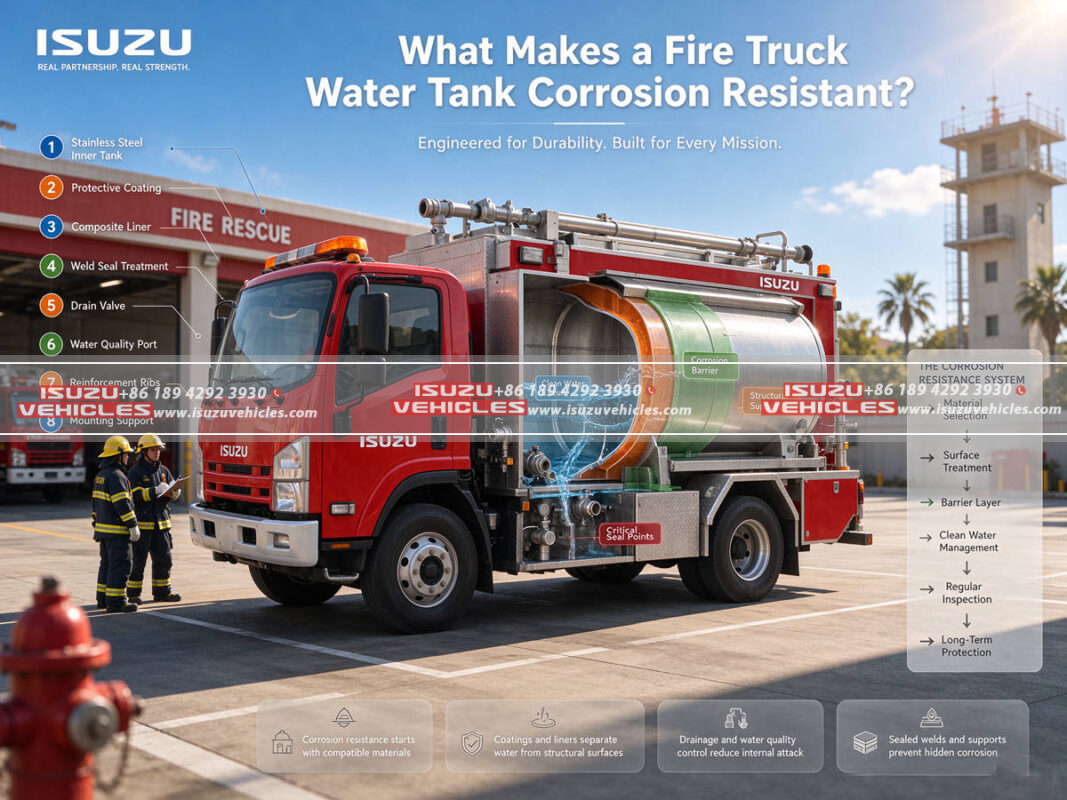
A fire truck water tank is one of the most important components of a firefighting vehicle because it provides the water supply needed to control fires, protect property, and support emergency rescue operations. Unlike ordinary water storage tanks, fire truck tanks operate under demanding conditions, including frequent filling and emptying, constant road vibration, temperature changes, exposure to moisture, and long periods of contact with stored water. These conditions place considerable demands on the tank material and protective structure, making corrosion resistance an essential consideration when designing and manufacturing a professional fire truck.
Corrosion may initially appear as a small surface problem, but if it develops inside a water tank and remains untreated, it can gradually reduce material thickness, damage welded connections, contaminate stored water, and eventually affect the structural integrity of the entire tank. For a firefighting vehicle that may be required to operate immediately during an emergency, such problems can create unnecessary maintenance expenses and potentially compromise operational reliability.
So, what makes a fire truck water tank corrosion-resistant? The answer involves several factors working together, including the selection of suitable construction materials, professional welding techniques, internal anti-corrosion coatings, effective drainage arrangements, proper water management, and regular inspection. Modern manufacturers also consider the vehicle’s operating environment and intended firefighting application when selecting the most appropriate tank structure.
In this article, we will examine the materials and manufacturing technologies that help protect fire truck water tanks against corrosion, explain how protective coatings work, discuss common causes of tank deterioration, and introduce several practical maintenance methods. Whether you are purchasing a municipal fire engine, an industrial firefighting vehicle, or a large-capacity water tank truck, understanding these details can help you make a more informed equipment decision.
1. Why Is Corrosion Resistance Important for a Fire Truck Water Tank?
Corrosion is the gradual deterioration of metal caused by chemical or electrochemical reactions with its surrounding environment. In a fire truck water tank, this process can occur when the metal surface remains in contact with water, oxygen, dissolved minerals, and other substances that encourage oxidation or chemical attack. Although the exact corrosion rate depends on the tank material, water quality, temperature, and protective treatment, even relatively small areas of surface damage can become the starting point for more serious deterioration.
Fire trucks frequently operate under conditions that make corrosion protection particularly important. After firefighting operations, water may remain inside the tank, while moisture can also accumulate around the tank’s external structure, supporting brackets, pipelines, and welded joints. Vehicles working in coastal regions may additionally face salt-laden air, while industrial firefighting vehicles can encounter environments containing chemicals, airborne contaminants, and other potentially aggressive substances.
Protecting Structural Strength and Tank Safety
The first reason corrosion resistance matters is that the tank must maintain its structural strength throughout its service life. A fire truck water tank carries a considerable quantity of water, and the combined weight of the liquid, tank structure, firefighting equipment, and vehicle body creates substantial demands on the chassis and supporting framework.
If corrosion gradually reduces the thickness of the tank walls or damages welded connections, the tank may become more vulnerable to leakage, cracking, and structural failure. This is particularly concerning for heavy-duty firefighting vehicles carrying several thousand liters of water, because their tanks experience continuous movement and vibration while traveling between emergency locations.
Maintaining Water Quality
Another important consideration is water quality. When the internal metal surface deteriorates, rust particles and other corrosion products may enter the stored water. Although ordinary firefighting water does not need to meet drinking-water standards, excessive contamination can create problems for pumps, valves, filters, pipelines, and firefighting monitors.
Corrosion products may accumulate inside narrow water passages, restrict flow, or interfere with the reliable operation of firefighting equipment. Maintaining a clean and properly protected tank interior therefore helps support the overall performance of the water delivery system.
Reducing Maintenance Costs and Vehicle Downtime
Fire departments and industrial emergency response teams depend on their vehicles being available whenever an incident occurs. A tank that develops repeated leaks or extensive internal corrosion may require professional cleaning, coating repairs, welding, or even complete replacement.
These repairs can be expensive, particularly when the vehicle must be removed from emergency service for an extended period. Investing in an appropriate corrosion-resistant tank structure during the initial manufacturing process can help reduce long-term maintenance requirements and improve the economic value of the firefighting vehicle.
2. What Materials Make a Fire Truck Water Tank Corrosion Resistant?
Material selection is one of the most important decisions in fire truck tank manufacturing because different metals offer different combinations of corrosion resistance, mechanical strength, weight, cost, and fabrication flexibility. There is no single material that is automatically suitable for every firefighting application. Instead, manufacturers evaluate the intended water capacity, vehicle weight limitations, operating environment, budget, and expected service conditions before choosing a suitable construction material.
Stainless Steel: Excellent Resistance to Corrosion
Stainless steel is widely recognized for its corrosion resistance and is frequently used in applications where metal surfaces are regularly exposed to water or moisture. Its protective properties come from the chromium contained in the alloy, which forms a thin passive oxide film on the surface and helps prevent further oxidation under suitable environmental conditions.
For fire truck manufacturing, grades such as 304 stainless steel may be considered for water or foam storage systems, depending on the specific application and chemical exposure. Stainless steel offers several practical advantages, including good durability, relatively easy cleaning, and resistance to many forms of ordinary water-related corrosion.
However, stainless steel is not completely immune to corrosion. Certain water conditions, particularly those involving high chloride concentrations, may cause localized pitting or crevice corrosion. Therefore, the correct stainless steel grade, welding procedure, surface finish, and maintenance approach should be selected according to the actual operating environment.
Stainless steel is also generally more expensive than ordinary carbon steel, which may influence its use in large-capacity firefighting tanks. For this reason, some manufacturers use stainless steel for foam tanks or selected internal sections while choosing protected carbon steel for the main water tank.
Carbon Steel with Anti-Corrosion Treatment
Carbon steel remains a practical and widely used material for fire truck water tanks because it provides good mechanical strength, convenient fabrication, and relatively economical manufacturing costs. It can be formed into different tank shapes and welded into reinforced structures suitable for medium-duty and heavy-duty firefighting vehicles.
However, untreated carbon steel is vulnerable to rust when exposed to water and oxygen. To address this weakness, manufacturers apply protective treatments to the internal and external surfaces, creating a barrier between the steel and the surrounding environment.
Depending on the tank design, protective systems may include epoxy coatings, polyurethane coatings, specialized industrial primers, or other compatible anti-corrosion treatments. When properly applied and maintained, these coatings can significantly improve the service life of carbon steel tanks.
For example, the ISUZU 6000L Water Tank Fire Truck features a corrosion-protected carbon steel water tank, with stainless steel available as an optional material. This configuration gives buyers flexibility when balancing tank durability, vehicle weight, manufacturing cost, and operating requirements.
Aluminum Alloy: Lightweight and Naturally Protective
Aluminum alloy is another material used in specialized emergency vehicle construction. It naturally forms a thin oxide layer when exposed to air, which helps protect the underlying metal from further oxidation. Its relatively low density also makes it attractive for vehicle manufacturers seeking to reduce overall body weight while maintaining adequate structural performance.
Although aluminum alloy is not necessarily the standard choice for every fire truck water tank, it can be used in specialized structures and vehicle body components where weight reduction and corrosion resistance are important. Its suitability for direct water storage depends on the particular alloy, water chemistry, fabrication quality, and protective requirements.
When selecting aluminum components, manufacturers must also consider galvanic corrosion, which can occur when aluminum comes into electrical contact with dissimilar metals in the presence of an electrolyte. Proper material isolation and suitable joining techniques help reduce this risk.
Ultimately, the best tank material is the one that matches the intended firefighting application and offers an appropriate balance of durability, weight, cost, and maintenance requirements.
3. How Do Anti-Corrosion Coatings Protect Fire Truck Water Tanks?
Even when a manufacturer selects a suitable metal, the tank surface may still require additional protection to achieve reliable long-term performance. This is particularly true for carbon steel tanks, where a properly designed coating system provides an essential barrier against water, oxygen, and other corrosive substances.
An anti-corrosion coating works by separating the metal surface from its surrounding environment. When the coating remains continuous, properly bonded, and compatible with the stored liquid, it helps prevent corrosive substances from reaching the underlying steel.
Internal Epoxy Coating
Epoxy coatings are commonly used in industrial tank protection because they can provide strong adhesion, good chemical resistance, and a relatively durable protective film. Once correctly applied and fully cured, an appropriate epoxy system can help prevent direct contact between stored water and the carbon steel surface.
Before application, the internal steel surface generally requires thorough preparation to remove rust, mill scale, oil, dust, and other contaminants. Depending on the coating manufacturer’s requirements, abrasive blasting may be used to achieve the specified surface cleanliness and roughness.
The coating is then applied at the recommended thickness and allowed to cure under controlled conditions. Proper curing is essential because an inadequately cured coating may have reduced adhesion, chemical resistance, or mechanical durability.
For fire truck tanks, it is important to choose a coating specifically suitable for the intended water and firefighting applications rather than assuming that every industrial epoxy product can be used interchangeably.
Polyurethane Protective Coatings
Polyurethane coatings can provide another layer of protection, particularly where resistance to moisture, weather exposure, and environmental wear is required. Depending on the formulation, polyurethane systems may offer good flexibility and resistance to abrasion, making them useful for selected internal or external tank protection applications.
When used on the exterior of a fire truck tank, suitable polyurethane topcoats can also help protect the underlying coating system from sunlight, rain, and other environmental influences. The final coating arrangement should be selected according to the manufacturer’s specifications and compatibility requirements.
Multi-Layer Coating Systems
In many professional manufacturing processes, corrosion protection involves more than one coating layer. A typical system may include a surface preparation stage, a corrosion-resistant primer, an intermediate protective coating, and a suitable finishing layer.
Each layer serves a particular purpose. The primer helps establish adhesion and protect the metal, the intermediate layer provides additional barrier thickness, and the topcoat helps resist environmental exposure and surface damage.
However, simply adding more coating layers does not automatically guarantee better performance. The coating materials must be chemically compatible, applied within the specified conditions, and cured correctly. Poor surface preparation or inadequate application can lead to peeling, blistering, cracking, or premature coating failure.
Protecting Welded Joints and Difficult Areas
Welded joints, internal corners, drain openings, manholes, and pipeline connections deserve particular attention because these areas can be more difficult to coat uniformly. Small gaps, sharp edges, welding residues, and inaccessible spaces may create locations where moisture can accumulate or protective coatings become thinner than intended.
Professional manufacturers therefore pay special attention to weld finishing, edge preparation, coating coverage, and inspection of difficult-to-reach areas. Properly treated connections help prevent localized corrosion from developing at locations that are essential to the tank’s structural integrity.
4. What Structural Design Features Help Prevent Tank Corrosion?
Corrosion resistance is not determined by material and coating alone. The physical design of the tank also influences how water moves, where moisture accumulates, and how easily internal surfaces can be inspected and maintained. A well-designed fire truck water tank should therefore combine suitable materials with practical structural features that reduce unnecessary corrosion risks.
Proper Drainage and Low-Point Drain Valves
One important design consideration is the ability to drain water effectively after cleaning, maintenance, or prolonged storage. If water remains trapped inside low points, corners, or poorly designed pipeline connections, it may create conditions that encourage localized corrosion, particularly when the protective coating has been damaged.
A properly positioned drainage valve at the tank’s lowest practical point allows accumulated water and sediment to be removed more effectively. This is particularly useful when the vehicle needs to undergo periodic internal inspection or when water must be removed before extended storage in cold conditions.
Internal Baffles and Reinforced Structures
Fire truck water tanks commonly incorporate internal anti-surge baffles that help control liquid movement when the vehicle accelerates, brakes, or changes direction. These structures improve vehicle stability by reducing the movement of large volumes of water inside the tank.
Although baffles are primarily designed for safety and structural performance rather than corrosion prevention, their design must also consider drainage, cleaning accessibility, and coating coverage. Poorly designed internal connections can create difficult-to-clean areas where sediment and moisture accumulate.
Well-Designed Manholes and Inspection Openings
Inspection manholes provide access to the tank interior for cleaning, maintenance, and visual examination. They allow technicians to inspect internal coatings, welded connections, baffles, and other structural components without dismantling the entire tank.
The manhole cover and sealing arrangement should be designed to prevent unwanted water ingress and maintain the tank’s intended operating conditions. Adequate access also makes it easier to remove accumulated sediment and identify coating damage before it becomes more extensive.
High-Quality Welding and Surface Finishing
Welding quality is another important factor because poorly executed joints can become potential leakage points or locations for corrosion development. Incomplete welds, excessive spatter, sharp edges, and surface irregularities can make protective coating application more difficult.
Professional tank fabrication therefore requires suitable welding procedures, qualified personnel, appropriate inspection, and careful surface finishing. After welding, the relevant areas should be cleaned and prepared according to the selected coating system’s requirements.
For larger firefighting vehicles, these design considerations become particularly important because the tank must withstand not only the weight of the stored water but also repeated road vibration and the mechanical stresses associated with emergency driving.
5. Common Causes of Corrosion in Fire Truck Water Tanks
Even a professionally manufactured fire truck water tank can develop corrosion if it is exposed to unsuitable operating conditions or receives insufficient maintenance. Understanding the most common causes of corrosion helps operators take preventive measures before surface deterioration becomes a serious structural problem.
Poor Water Quality
The quality of the water stored inside a fire truck tank can influence its corrosion behavior. Water containing high concentrations of dissolved salts, chlorides, or other aggressive substances may accelerate corrosion in certain metals and coating systems.
For example, vehicles operating in coastal regions or industrial environments may use water sources with different chemical characteristics from those found in ordinary municipal supply systems. When water quality is a concern, operators should evaluate the compatibility of the tank material and protective coating with the intended water source.
Long-Term Water Storage
Leaving water inside a tank for extended periods without inspection or appropriate maintenance may encourage sediment accumulation, microbial growth, and deterioration of damaged protective coatings. Although standing water does not automatically cause serious corrosion in every tank, prolonged exposure can increase the importance of monitoring internal surface conditions.
Regular water replacement, appropriate cleaning, and inspection procedures help reduce these risks, especially when the vehicle is not used frequently.
Coating Damage During Operation
Protective coatings may become damaged during manufacturing, transportation, maintenance, or repeated operation. Mechanical impacts, abrasive cleaning tools, unsuitable chemicals, and improper repair techniques can expose the underlying metal to water and oxygen.
Once the protective layer is broken, corrosion may develop locally and gradually spread beneath the surrounding coating if the damage is not repaired correctly. This is why periodic internal inspections are important even when the tank does not show visible external signs of deterioration.
External Environmental Exposure
The external surface of a fire truck tank is exposed to rain, road spray, humidity, temperature fluctuations, and airborne contaminants. In coastal regions, salt deposits may accumulate on exposed metal surfaces, while industrial areas can introduce additional chemical contaminants.
Corrosion may also develop around mounting brackets, supporting frames, fasteners, and other areas where moisture remains trapped. Regular washing and inspection of these locations can help reduce the likelihood of external corrosion.
Inadequate Maintenance
One of the most avoidable causes of tank deterioration is the failure to inspect and maintain protective systems. Small coating defects, damaged seals, blocked drains, and early signs of rust can remain unnoticed until they require more extensive repairs.
For fire departments and private emergency response organizations, establishing a consistent maintenance schedule is therefore just as important as selecting a corrosion-resistant tank during the purchasing process.
6. How to Maintain a Corrosion-Resistant Fire Truck Water Tank
Proper maintenance is essential for preserving the corrosion protection originally provided during manufacturing. Even high-quality stainless steel and professionally coated carbon steel require suitable inspection and cleaning procedures to maintain their performance over time.
Clean the Tank Interior Regularly
Operators should follow an appropriate cleaning schedule based on the vehicle’s operating frequency, water quality, and manufacturer’s recommendations. Removing accumulated sediment and other contaminants helps maintain a cleaner internal environment and makes it easier to identify early signs of corrosion.
Cleaning procedures should use compatible tools and materials. Aggressive chemicals or abrasive equipment that damage the internal protective coating should be avoided unless specifically approved by the coating manufacturer.
Inspect Internal Coatings and Welded Connections
Periodic internal inspections should focus on coating continuity, welded joints, corners, baffle connections, drain openings, and other locations where corrosion may develop. Any blistering, peeling, cracking, rust staining, or exposed metal should be evaluated by qualified maintenance personnel.
Where necessary, damaged coatings should be repaired using a compatible system and the correct surface preparation procedure. Simply applying a new layer over loose or deteriorated coating is unlikely to provide reliable long-term protection.
Maintain Drainage and Ventilation Systems
Drain valves, overflow devices, vents, and other openings should be inspected to ensure that they remain functional and free from obstruction. Proper drainage helps remove unwanted water and sediment, while suitable ventilation arrangements support the tank’s intended operating and maintenance procedures.
During cold-weather operations, special attention should be given to residual water in exposed pipes and fittings because freezing can damage valves, seals, and connected components.
Protect the Exterior Surface
External tank surfaces should be washed periodically to remove road salt, mud, dust, and other contaminants. Particular attention should be paid to the underside of the tank, mounting brackets, frame connections, and areas that are difficult to access during ordinary vehicle washing.
Any damaged exterior paint or protective coating should be repaired promptly to prevent corrosion from developing underneath the exposed surface.
Use Professional Inspection and Testing
Professional inspection becomes especially important when a vehicle has been operating for many years or has experienced repeated exposure to aggressive environments. Depending on the tank design and applicable requirements, inspections may include coating thickness measurements, visual examination, weld inspection, wall-thickness assessment, and appropriate leak or pressure testing.
These procedures help technicians evaluate the tank’s actual condition rather than relying only on its external appearance. Any pressure or leak testing should be conducted using the procedures and limits specified by the manufacturer and relevant safety requirements.
7. How to Choose a Fire Truck with a Reliable Corrosion-Resistant Water Tank
When purchasing a fire truck, buyers should evaluate the tank as part of the complete firefighting system rather than focusing exclusively on its storage capacity. A large water tank may provide an impressive water supply, but its practical value also depends on construction quality, corrosion protection, pumping performance, vehicle stability, and long-term maintenance requirements.
Several factors deserve attention during the purchasing process.
- Tank material: Confirm whether the tank uses stainless steel, carbon steel with protective treatment, or another suitable material, and request information about the specific grade or material specification.
- Internal coating: Ask about the coating type, application procedure, recommended thickness, curing requirements, and suitability for the intended water or foam application.
- Welding quality: Check whether the manufacturer follows appropriate welding procedures and conducts inspections of important structural connections.
- Tank capacity: Select a suitable water capacity according to the fire department’s operational requirements, available water sources, vehicle payload, and expected response conditions.
- Drainage and inspection: Confirm that the tank includes practical drain valves, inspection manholes, level indicators, and other necessary maintenance features.
- Internal structure: Check the arrangement of anti-surge baffles, reinforcement members, and internal connections to ensure that they support safe operation and practical maintenance.
- After-sales support: Consider whether the manufacturer can provide technical documentation, replacement components, coating repair guidance, and professional maintenance assistance.
Consider the Complete Firefighting Vehicle Configuration
A fire truck water tank does not work independently. It must be integrated with the fire pump, water pipelines, valves, monitors, and other firefighting equipment. The tank outlet and piping arrangement should provide the required water supply without unnecessary restrictions, while the chassis must safely support the combined weight of the tank, water, crew, and equipment.
For departments responsible for high-rise firefighting, an aerial truck may also be required as part of the wider emergency response fleet. Unlike a conventional water fire truck, an aerial vehicle is designed to provide elevated access for rescue and firefighting operations, using specialized ladders or platforms. Its water supply arrangements, where equipped, must also be designed to accommodate the vehicle’s particular working configuration.
Likewise, a conventional tank truck and a fire truck water tanker should not be treated as interchangeable vehicles. Although both may carry substantial quantities of liquid, a firefighting vehicle incorporates dedicated pumps, monitors, valves, hoses, and emergency equipment to support active fire suppression. The tank must therefore meet the operational requirements of the complete firefighting system.
Explore ISUZU Fire Truck Configurations
ISUZU Vehicles provides different firefighting vehicle configurations designed for municipal departments, industrial facilities, commercial properties, and specialized emergency response organizations. Depending on the selected chassis and application, buyers can consider different tank capacities, materials, pump arrangements, foam systems, and auxiliary equipment.
For example, the ISUZU Rescue Fire Water and Foam Truck features a 4,000-liter corrosion-protected carbon steel water tank and a 2,000-liter stainless steel foam tank. Its compartmentalized tank arrangement incorporates anti-surge baffles and level indicators, while the firefighting system uses a PTO-driven centrifugal pump to deliver water during emergency operations.
For departments requiring larger water supplies, the ISUZU Water Tank and Rescue Service Fire Fighting Truck offers a heavy-duty 6×4 chassis configuration with a 12 CBM carbon steel water tank and a separate foam storage arrangement. This type of vehicle can be considered for industrial firefighting, municipal emergency response, and locations where a larger onboard water supply is necessary.
Buyers can also explore the complete ISUZU fire truck range to compare water fire trucks, water-foam fire trucks, rescue vehicles, and aerial firefighting configurations.
Ultimately, a corrosion-resistant fire truck water tank is the result of several carefully coordinated engineering decisions rather than a single material or coating treatment. Suitable metal selection, reliable welding, effective surface preparation, compatible anti-corrosion coatings, practical drainage, and regular inspection all contribute to long-term tank durability. When these elements are properly integrated into the vehicle design, the water tank can provide dependable service, support the performance of the firefighting equipment, and help emergency response teams maintain operational readiness when every minute matters.