
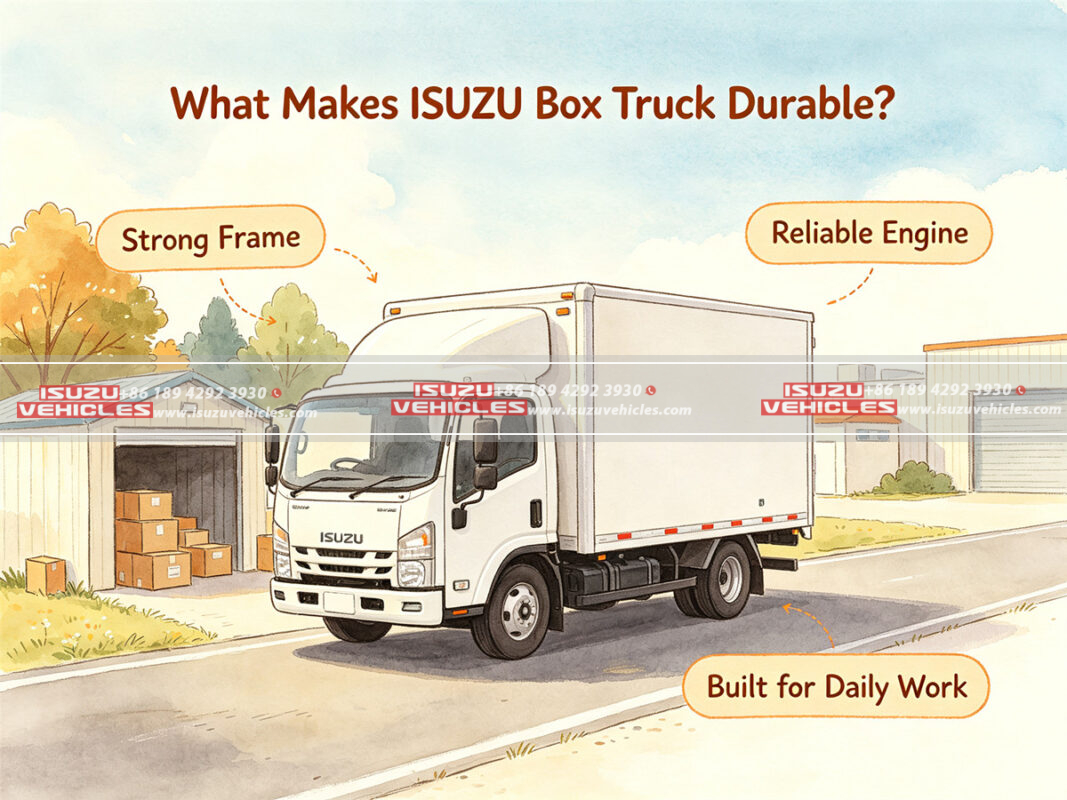
Foundations of Durability in ISUZU Box Trucks
When discussing commercial transport reliability, the ISUZU Box Truck consistently stands out as one of the most dependable choices in the global logistics industry, largely due to its carefully engineered balance of structural strength, mechanical efficiency, and long-term operational stability. Durability in this context is not a single feature but rather a combination of interconnected systems that work together to ensure the vehicle can withstand continuous use under varying road, weather, and load conditions.
Manufactured on the proven platform of ISUZU, these trucks are designed with a strong emphasis on real-world performance rather than theoretical capability, meaning every component is tested and optimized for commercial workloads that often involve daily operation, heavy cargo, and long-distance travel. Unlike standard light-duty vehicles, a box truck is expected to maintain consistent performance over years of repetitive loading cycles, and ISUZU addresses this requirement through reinforced chassis construction, advanced drivetrain systems, and carefully selected materials that resist fatigue and environmental wear.
The concept of durability in ISUZU box trucks also extends beyond physical strength; it includes operational reliability, ease of maintenance, and adaptability to different industries such as retail distribution, logistics networks, and temperature-sensitive transport services. This holistic approach is what allows these vehicles to remain competitive in both developed and emerging markets where infrastructure conditions can vary significantly.
Chassis Engineering and Structural Reinforcement
At the core of every durable ISUZU Box Truck lies its chassis system, which serves as the backbone of the entire vehicle and determines how effectively it can handle load stress, road vibration, and long-term mechanical fatigue.
High-Strength Frame Design for Load Endurance
The chassis of ISUZU box trucks is built using high-tensile steel that provides superior resistance to bending and twisting forces, especially when the vehicle is fully loaded. This is particularly important in logistics operations where cargo weight distribution may not always be perfectly balanced. The reinforced ladder-frame structure helps distribute stress evenly across the entire vehicle body, reducing the likelihood of structural deformation over time.
Additionally, cross-member reinforcements enhance rigidity while maintaining flexibility where needed, allowing the truck to absorb road shocks without compromising structural integrity. This balance between strength and controlled flexibility is one of the key reasons ISUZU vehicles maintain long service lives even in demanding environments.
Suspension Systems Designed for Continuous Operation
Durability is also closely tied to suspension performance, as it directly affects how the vehicle handles uneven terrain, potholes, and frequent stop-and-go driving conditions. ISUZU box trucks typically feature heavy-duty suspension systems that are tuned for commercial use, ensuring that both the chassis and cargo compartment remain stable during transit.
This reduces vibration impact on both mechanical components and transported goods, which not only improves durability but also enhances cargo safety, particularly for fragile or high-value shipments.
Powertrain Reliability and Engine Longevity
Another critical factor contributing to the durability of ISUZU box trucks is the reliability of their engine and transmission systems, which are designed to deliver consistent performance over extended operational cycles without excessive wear or degradation.
Engine Efficiency Under Heavy Load Conditions
ISUZU engines are known for their ability to maintain stable torque output even under full load conditions, which is essential for box trucks that frequently operate at or near maximum capacity. This consistent power delivery reduces strain on internal engine components, thereby extending service life and minimizing breakdown risks.
Efficient combustion systems also contribute to reduced carbon buildup and improved fuel economy, which indirectly supports durability by reducing thermal stress and mechanical wear over time.
Transmission Systems Built for Urban and Highway Use
The transmission systems used in ISUZU box trucks are engineered to handle frequent gear changes in urban environments while still maintaining efficiency during long-distance highway travel. Smooth gear transitions reduce mechanical shock to the drivetrain, which helps preserve clutch and gearbox components.
This adaptability allows ISUZU box trucks to operate effectively in mixed-use scenarios, from city delivery routes to intercity logistics operations, without compromising mechanical reliability.
Cargo Protection Design and Body Strength
While the chassis and engine form the mechanical foundation, the durability of a box truck also depends heavily on the strength and design of its cargo compartment, which must protect goods while withstanding external environmental pressures.
Enclosed Body Construction for Maximum Protection
The enclosed structure of ISUZU box trucks provides a controlled environment that shields cargo from rain, dust, sunlight, and external impact. The body panels are typically constructed from reinforced aluminum or composite materials that offer both strength and corrosion resistance.
This makes them particularly suitable for industries that require high levels of cargo protection, such as electronics distribution, retail logistics, and pharmaceutical transport.
Flooring and Load Distribution Systems
Inside the cargo compartment, reinforced flooring systems are designed to support heavy loads while preventing structural sagging over time. Tie-down points and load-securing systems are strategically positioned to ensure cargo remains stable during transit, reducing the risk of internal damage and improving overall vehicle longevity.
Maintenance Efficiency and Long-Term Operational Stability
Durability is not only determined by how well a vehicle is built but also by how easily it can be maintained and repaired throughout its lifecycle, and ISUZU box trucks are specifically designed with this principle in mind.
Simplified Component Accessibility
One of the key advantages of ISUZU engineering is the accessibility of critical components such as filters, engine parts, and braking systems. This design approach reduces maintenance time and allows fleet operators to perform routine servicing more efficiently, minimizing vehicle downtime.
In commercial logistics, where time is directly linked to revenue, this ease of maintenance significantly enhances overall operational efficiency and long-term durability.
Standardized Parts and Service Network Support
ISUZU’s global presence ensures that replacement parts are widely available, which reduces delays in repairs and ensures consistent maintenance standards across different regions. Standardized components also simplify fleet management for companies operating multiple vehicles across various locations.
This level of support infrastructure plays a major role in extending the practical lifespan of box trucks, making them a cost-effective choice for long-term fleet investment.
Real-World Applications and Multi-Industry Durability Performance
The true measure of durability becomes evident when ISUZU Box Trucks are deployed in real-world logistics environments, where they consistently demonstrate resilience across a wide range of industries and operating conditions.
Urban Delivery and High-Frequency Operation
In urban logistics networks, box trucks are subjected to frequent stopping, tight maneuvering, and constant loading and unloading cycles. ISUZU vehicles perform well under these conditions due to their balanced chassis design and responsive braking systems, which help reduce wear and maintain operational stability.
Long-Distance Freight and Regional Distribution
For intercity transportation, durability is tested through prolonged engine operation, highway speeds, and varying road conditions. ISUZU box trucks maintain consistent performance across these scenarios, ensuring that goods arrive safely and on schedule even over long distances.
Adaptability Across Specialized Transport Needs
Beyond standard cargo applications, ISUZU platforms are also widely used in specialized industries that require modified body configurations, including insulated transport and temperature-controlled logistics. In such cases, vehicles like the Refrigerated truck play an important role in maintaining product integrity for perishable goods.
Similarly, in broader logistics ecosystems where flexibility is essential, the integration of cargo truck variants allows operators to handle diverse freight requirements efficiently, from bulk materials to packaged goods. Within this interconnected system, ISUZU Vehicles continue to serve as a reliable foundation for global transport operations, combining durability, adaptability, and long-term performance across multiple industry applications.