
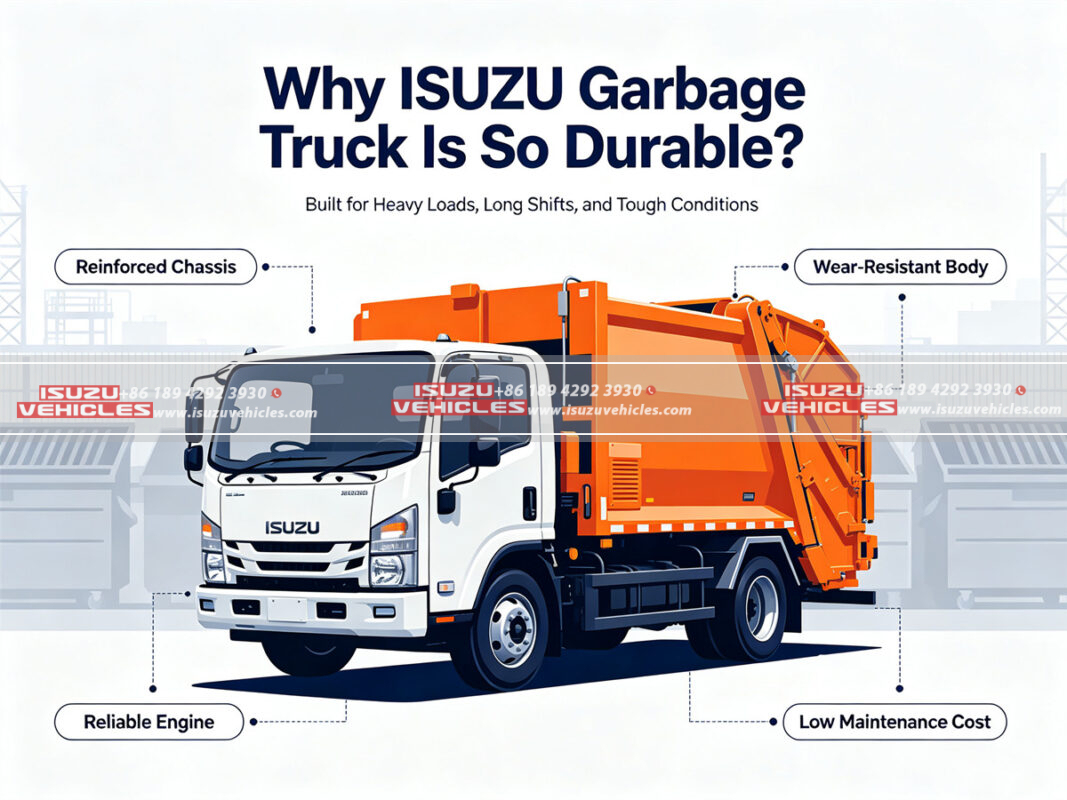
1. Engineering Philosophy Behind ISUZU Garbage Truck Durability
The long-standing reputation of ISUZU garbage trucks is not accidental, but rather the result of a deliberate engineering philosophy that prioritizes endurance, mechanical stability, and long service life under extreme working conditions. Unlike many light- and medium-duty commercial vehicles that are optimized mainly for cost efficiency, ISUZU designs its refuse collection platforms with a clear focus on continuous urban operation, frequent stop-and-go cycles, and heavy payload stress.
Structural Design for Continuous Load Stress
One of the core strengths lies in the chassis architecture, which is built using reinforced high-tensile steel frames designed to resist torsional flexing. Garbage collection routes often involve uneven roads, sharp turns, and repeated braking, and this constant mechanical stress can quickly fatigue weaker frames. ISUZU addresses this by reinforcing key stress points such as the rear axle mounting area and compactor integration zones, ensuring that the vehicle maintains structural integrity even after years of service.
Optimized Powertrain Integration
Another defining factor is how the engine, transmission, and axle systems are engineered to operate in harmony under heavy-duty conditions. The drivetrain is not simply powerful—it is tuned for torque consistency at low speeds, which is essential for compacting and lifting operations. This reduces unnecessary strain on components, significantly extending operational lifespan compared to conventional truck platforms.
2. High-Performance Engines Built for Long-Term Endurance
At the heart of every ISUZU garbage truck is a diesel engine designed for sustained torque output rather than short bursts of speed, making it ideal for municipal waste collection cycles that involve constant acceleration and deceleration.
Low-RPM Torque Optimization
ISUZU engines are widely recognized for their ability to deliver stable torque at relatively low RPMs, which reduces internal wear and improves fuel efficiency during stop-start operations. This characteristic is particularly important in urban sanitation routes where trucks may stop hundreds of times per day.
Thermal Management and Engine Longevity
Advanced cooling systems ensure that engine temperature remains stable even under high load conditions, such as operating hydraulic compactors or climbing steep urban gradients. By maintaining optimal combustion temperature, ISUZU minimizes thermal fatigue, one of the most common causes of diesel engine degradation over time.
Fuel Efficiency with Durability Balance
Rather than sacrificing durability for performance gains, ISUZU engines are calibrated to achieve a balanced combustion process that reduces carbon buildup, thereby prolonging injector life and reducing maintenance frequency.
3. Reinforced Chassis and Body Structure for Heavy-Duty Use
The durability of a garbage truck is heavily dependent on its ability to withstand continuous vibration, high payload loads, and corrosive waste materials. ISUZU has engineered its chassis and upper structure with this exact challenge in mind.
Heavy-Duty Frame Reinforcement
The chassis beams are manufactured using reinforced steel with optimized cross-member spacing to distribute weight evenly. This prevents localized stress damage, which is a common failure point in lower-grade refuse trucks.
Corrosion-Resistant Body Construction
Garbage environments are highly corrosive due to organic waste, liquids, and chemical residues. ISUZU garbage truck bodies often incorporate anti-corrosion coatings and high-strength steel liners that protect internal compactor surfaces from rust and abrasion.
Compactor System Strengthening
The compactor mechanism itself is designed with reinforced hydraulic arms and wear-resistant steel plates, ensuring consistent compression performance even after prolonged use in high-density waste environments.
4. Hydraulic System Reliability Under Continuous Operation
Hydraulic systems are the operational core of any garbage truck, controlling lifting, compressing, and unloading functions. ISUZU integrates industrial-grade hydraulic components that are designed to perform reliably under continuous cycling conditions.
Stable Pressure Distribution Design
The hydraulic circuits are engineered to maintain stable pressure distribution across all working components, reducing the risk of sudden pressure spikes that could damage seals or cylinders.
Wear-Resistant Hydraulic Components
High-quality seals, reinforced cylinders, and precision-machined valves contribute to reduced leakage risk and extended maintenance intervals, ensuring that trucks remain operational even under demanding municipal schedules.
Efficient Energy Transfer
By optimizing hydraulic flow efficiency, ISUZU systems reduce unnecessary engine load, which indirectly contributes to improved vehicle longevity and reduced fuel consumption.
5. Suspension, Axles, and Brake Systems Designed for Heavy Cycles
Durability is not only about the engine and chassis but also about how the vehicle handles load distribution, braking stress, and road irregularities over time.
Heavy-Duty Suspension Systems
ISUZU garbage trucks are typically equipped with multi-leaf spring suspensions that provide superior load-bearing capacity while absorbing road shocks effectively. This reduces frame fatigue and improves overall ride stability.
Reinforced Axle Engineering
The axles are built to support high payload conditions while maintaining alignment integrity under uneven loading. This is critical in garbage operations where weight distribution changes constantly during compaction cycles.
Reliable Brake Performance
Brake systems are designed for repetitive use under heavy loads, incorporating air brake systems with enhanced thermal resistance to prevent fade during long operational hours.
6. Operational Longevity Through Maintenance Efficiency and Smart Design
A major reason behind the long service life of ISUZU garbage trucks is not only their mechanical strength but also their intelligent design that simplifies maintenance and reduces downtime.
Simplified Maintenance Architecture
Key components are positioned for easy access, allowing technicians to perform inspections and repairs without excessive disassembly. This reduces service time and keeps vehicles in active duty for longer periods.
Modular Component Design
Many systems, including hydraulic assemblies and electrical modules, are designed in a modular format, allowing quick replacement rather than full system overhauls.
Reduced Downtime Strategy
Fleet operators benefit from predictable maintenance schedules and lower unexpected breakdown rates, which significantly improves operational efficiency in municipal waste management systems.
In real-world applications such as sewer truck operations, sweeper truck fleet services, and urban sanitation programs relying on ISUZU Vehicles, this reliability translates into consistent performance, lower lifecycle cost, and extended operational readiness across demanding environments.