
Understanding Agricultural Irrigation Demands and Mobile Water Solutions
Modern agriculture operates within an increasingly complex environment shaped by unpredictable rainfall patterns, water allocation restrictions, rising fuel costs, and the need for greater operational efficiency across large and often geographically dispersed farmland. While fixed irrigation systems such as center pivots and drip lines dominate large-scale farming, there are many situations in which mobile water delivery becomes not only practical but essential. In this context, the question arises: are ISUZU water trucks suitable and effective for farm irrigation applications?
To answer this properly, one must first understand that farm irrigation is not a uniform process. Different crops, soil types, climate zones, and farm sizes create varying water distribution needs. In some cases, water trucks are used as supplemental irrigation during drought periods; in others, they serve as primary delivery systems in remote plots lacking permanent infrastructure. The suitability of a water truck for agricultural use therefore depends on tank capacity, pump performance, chassis durability, terrain capability, and long-term operating cost considerations.
ISUZU water trucks, built on commercial-grade chassis platforms with configurable tank systems, are frequently used in construction dust suppression, mining operations, and municipal service. However, when adapted for agricultural use, their structural reliability and flexibility make them viable candidates for specific irrigation tasks, particularly in environments where flexibility and mobility are critical.
Tank Capacity and Water Delivery Capabilities
The effectiveness of any water truck in farm irrigation hinges primarily on its storage capacity and discharge performance. Unlike fixed irrigation systems that rely on continuous water flow from centralized sources, a water truck must transport, distribute, and return for refilling within a time-efficient cycle.
Tank Size and Operational Efficiency
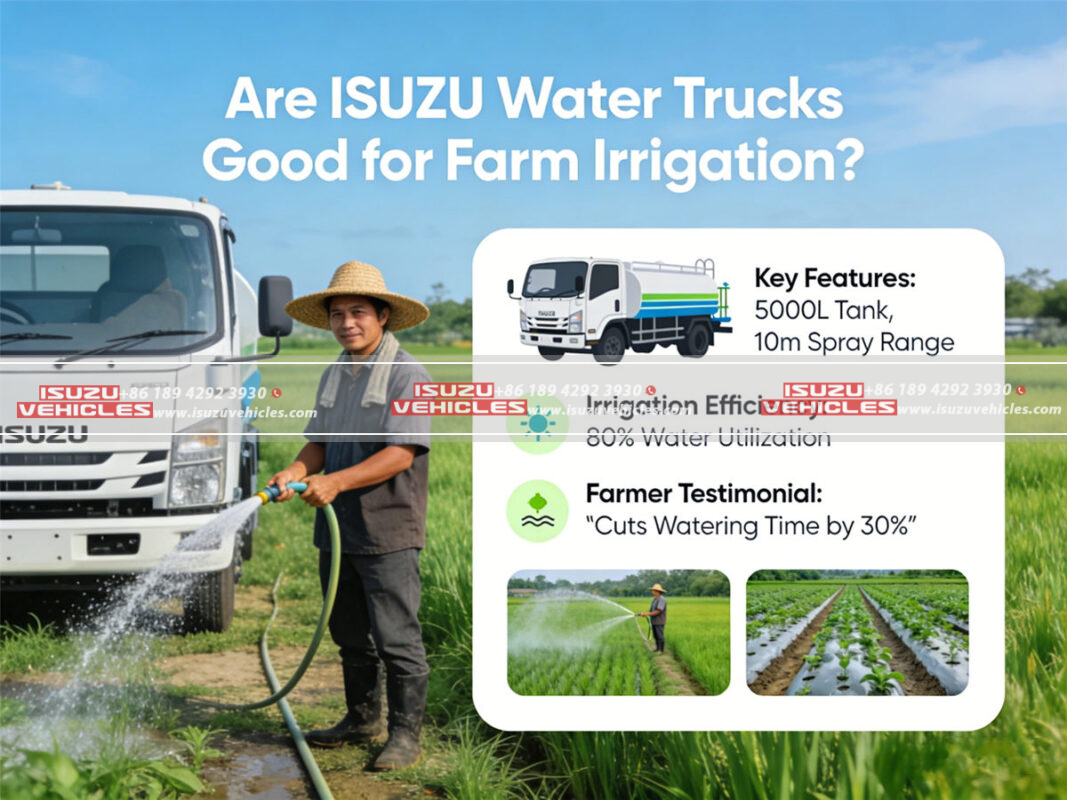
ISUZU water trucks can be configured with tank capacities ranging from approximately 3,000 liters to over 15,000 liters, depending on the selected chassis and axle configuration. For small- to medium-scale farms, a mid-range tank with a capacity of 5,000 to 10,000 liters often strikes a balanced compromise between payload capacity and maneuverability.
A larger tank reduces the number of refill trips required during irrigation cycles, which is particularly important in:
- Remote agricultural fields
- Orchards without permanent water lines
- Livestock watering applications
- Seasonal crop support during drought conditions
However, tank size must be carefully aligned with terrain and road load limits, as excessive weight can reduce mobility in soft or muddy soil conditions.
Pump and Spray System Flexibility
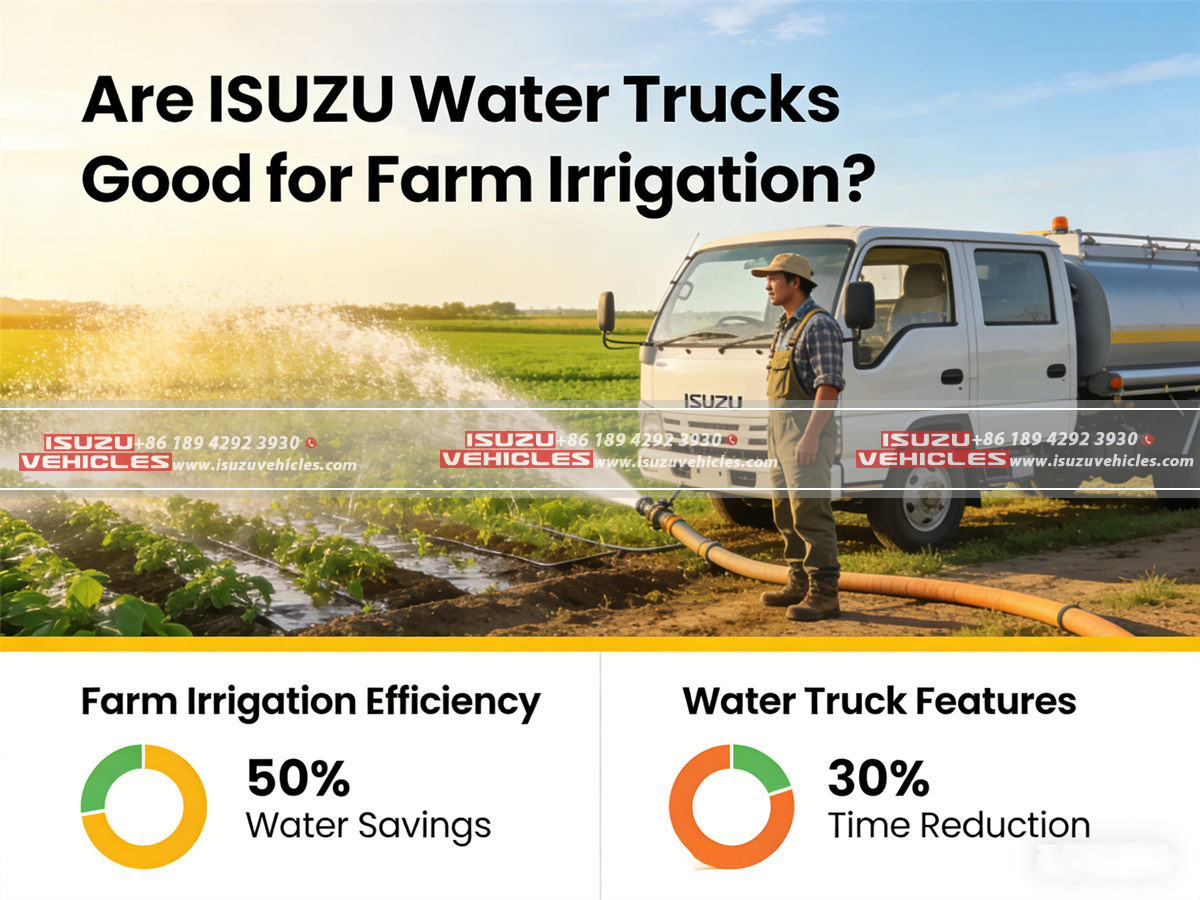
Irrigation use requires adaptable discharge systems. ISUZU water trucks can be equipped with adjustable spray bars, rear sprinklers, side nozzles, and high-pressure cannons. This flexibility allows farmers to apply water in different patterns depending on crop requirements.
For example, wide spray bars can be effective for dust suppression on farm roads, while controlled side sprays may assist in targeted watering along crop rows. In certain agricultural operations, controlled flow rate settings help prevent soil erosion and overwatering, which can damage root systems.
Terrain Performance and Chassis Durability
Farms rarely offer the smooth pavement conditions found in urban environments. Fields may include uneven surfaces, soft soil, inclines, and unpaved access roads. Therefore, chassis durability and traction performance become central to determining suitability.
Frame Strength and Suspension Design
ISUZU commercial chassis platforms are designed to handle demanding payload applications in construction and industrial settings. Reinforced frame rails and robust suspension systems allow water truck configurations to maintain structural integrity under the substantial weight of a full tank.
When deployed in agricultural settings, these structural attributes provide resilience against:
- Repeated loading and unloading cycles
- Vibrations from rough terrain
- Extended operational hours during peak seasons
Farm managers must also consider whether a 4×2 or 4×4 drivetrain configuration is appropriate, particularly in regions with frequent rainfall or irrigation runoff that softens field access routes.
Turning Radius and Maneuverability
In orchards, vineyards, or smaller crop plots, maneuverability becomes critical. A shorter wheelbase ISUZU water truck offers improved turning performance, reducing crop damage and allowing operators to navigate between planted rows more safely.
Cost Efficiency and Operational Sustainability
From a business perspective, the decision to deploy a water truck for irrigation must be evaluated through the lens of total cost of ownership, which includes acquisition cost, fuel consumption, maintenance requirements, and service life.
Fuel Consumption Considerations
Agricultural irrigation often involves repetitive routes across large properties. Fuel-efficient engines are therefore essential in minimizing operating expenses. ISUZU engines are recognized for delivering balanced fuel performance in medium-duty commercial applications, which translates well into farm use where stop-and-go driving and moderate speeds are common.
Reducing fuel costs per irrigation cycle can significantly impact seasonal profitability, especially during prolonged dry periods when water application frequency increases.
Maintenance and Longevity
Water trucks used in agricultural environments are exposed to dust, debris, and moisture, all of which can affect mechanical systems over time. Routine maintenance schedules must account for:
- Pump inspections
- Tank cleaning
- Suspension checks
- Brake system servicing
ISUZU’s widespread parts availability and service support infrastructure can reduce downtime and improve long-term asset reliability, an important consideration during critical growing seasons.
When Water Trucks Are Most Effective for Farms
While ISUZU water trucks offer substantial benefits, they are not a universal replacement for permanent irrigation systems. Instead, they excel in specific agricultural scenarios.
Supplemental Irrigation During Drought
In regions experiencing water scarcity or temporary irrigation restrictions, a water truck can provide targeted relief to high-value crops. This flexibility allows farmers to prioritize specific fields without investing in extensive infrastructure upgrades.
New Land Development
For newly cultivated plots that lack permanent irrigation systems, a water truck provides immediate functionality while long-term solutions are planned or constructed.
Livestock and Remote Areas
Water trucks are also valuable for transporting potable water to remote livestock enclosures or pasture areas, ensuring consistent hydration without the expense of installing underground pipelines.
Strategic Integration Within Agricultural Fleets
Farm operations often rely on a diverse fleet of specialized vehicles designed for distinct tasks, ranging from tractors and harvesters to transport vehicles and maintenance units. Within this broader operational ecosystem, a water truck serves as a flexible support asset rather than a singular solution.
It is important to recognize that while a water truck supports irrigation and dust control, it may coexist alongside other specialized vehicles such as a fire truck configured for rural emergency response or a sweeper truck used for maintaining farm roads and processing facilities. By incorporating reliable and adaptable platforms from ISUZU Vehicles, agricultural businesses can develop resilient fleet strategies that balance mobility, durability, and operational efficiency across irrigation, safety, and infrastructure maintenance functions, ensuring that water delivery capabilities align with both immediate crop needs and long-term farm sustainability objectives.