
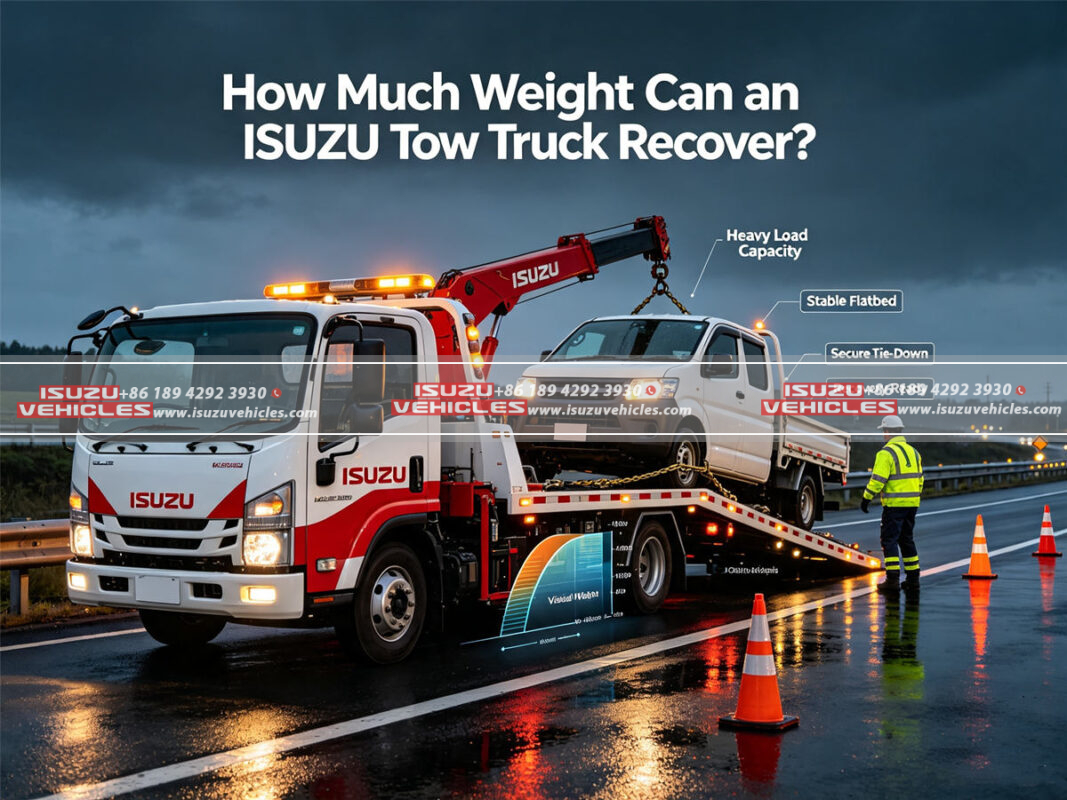
When people compare recovery vehicles, one of the first questions they ask is, “How much weight can the tow truck actually recover?” It sounds like a simple specification, but in reality, recovery capacity is influenced by much more than a single number. The design of the chassis, the towing equipment, the type of recovery system, the road conditions, and even the position of the disabled vehicle all determine how much weight can be handled safely.
An ISUZU tow truck has earned a solid reputation in the recovery industry because it combines a dependable commercial chassis with professionally engineered recovery equipment. Whether the task involves removing a stranded passenger car from a busy highway, transporting a light commercial vehicle after an accident, or recovering equipment from a construction site, ISUZU tow trucks are designed to deliver stable and reliable performance.
Rather than focusing only on maximum towing figures, fleet managers usually evaluate how a tow truck performs in real working conditions. Consistent recovery capability, operational safety, low maintenance costs, and versatility are often far more valuable than the highest advertised lifting capacity.
Recovery Capacity Depends on the Type of Tow Truck
One common misunderstanding is that every tow truck is designed to recover the same type of vehicle. In reality, different recovery bodies are built for different jobs, and each configuration has its own practical working range.
An ISUZU tow truck can be equipped with several recovery systems, each offering different weight capacities and operating advantages.
Wheel-Lift Tow Trucks
Wheel-lift systems are commonly used for roadside assistance and urban towing.
They are typically designed for:
- Passenger cars
- SUVs
- Pickup trucks
- Small delivery vans
Depending on the chassis and recovery equipment, wheel-lift systems often recover vehicles weighing between 2 and 5 tons safely and efficiently.
Because they are compact and easy to maneuver, these trucks are widely used in cities where traffic conditions require quick response times.
Flatbed Recovery Trucks
Flatbed tow trucks transport the entire disabled vehicle on the loading platform rather than towing it with two wheels on the ground.
Typical recovery capacity ranges from 3 to 8 tons, depending on the truck model and body design.
Flatbeds are particularly suitable for:
- Luxury vehicles
- Electric vehicles
- Four-wheel-drive vehicles
- Accident-damaged cars
- Long-distance transport
Keeping all four wheels off the road reduces wear on the recovered vehicle and provides greater transportation stability.
Integrated Heavy Recovery Trucks
Larger ISUZU recovery platforms equipped with heavy-duty booms and powerful hydraulic winches can recover much heavier commercial vehicles.
Applications include:
- Medium-duty trucks
- Buses
- Construction equipment
- Municipal vehicles
- Loaded commercial vans
Actual recovery capacity varies according to the equipment manufacturer and the specific configuration selected.
More Than Vehicle Weight: Understanding Recovery Ratings
When manufacturers describe recovery capacity, they are not referring only to the total weight of the disabled vehicle.
Several technical ratings work together during every recovery operation.
Winch Pulling Capacity
The hydraulic winch is responsible for pulling disabled vehicles into position.
Modern ISUZU tow trucks may be equipped with winches rated from several thousand kilograms up to 10 tons or more, depending on the application.
However, maximum winch capacity is generally achieved under ideal operating conditions with proper cable layering and equipment setup.
Boom Lifting Capacity
The recovery boom lifts part of the disabled vehicle during towing.
Its lifting capacity depends on:
- Boom design
- Hydraulic pressure
- Vehicle stability
- Outrigger positioning
- Lifting angle
A boom may safely lift only a portion of a vehicle’s weight rather than its total mass.
Wheel-Lift Capacity
Wheel-lift ratings refer specifically to the amount of weight supported by the lifting forks.
Since only one axle is raised during towing, the supported weight is much lower than the total vehicle weight.
Understanding these differences helps buyers avoid comparing recovery equipment using only a single specification.
Factors That Affect Real Recovery Performance
Two tow trucks with identical published ratings may perform differently once they reach an actual recovery scene. This is because real-world recovery depends on far more than equipment specifications.
Road Conditions
A disabled vehicle located on flat pavement is considerably easier to recover than one positioned:
- On steep slopes
- In roadside ditches
- On muddy construction sites
- On uneven gravel
- After serious collisions
Difficult terrain increases resistance and often requires more powerful recovery equipment.
Vehicle Position
The condition of the disabled vehicle also matters.
Recovering a vehicle with locked wheels, damaged suspension, or severe collision damage requires additional force compared with towing a mechanically disabled vehicle.
Recovery operators often use multiple winching stages to safely reposition heavily damaged vehicles before towing begins.
Weight Distribution
A fully loaded commercial truck places different demands on recovery equipment than an empty vehicle of the same model.
Cargo distribution affects:
- Lifting stability
- Axle loading
- Hydraulic performance
- Overall recovery strategy
Professional operators evaluate these conditions before selecting the safest recovery method.
Why Chassis Strength Is Just as Important as Recovery Equipment
The towing body often attracts the most attention, but the performance of an ISUZU tow truck begins with its chassis. Every recovery operation transfers significant forces through the frame, suspension, and drivetrain, making structural integrity essential for both safety and long-term durability.
ISUZU commercial chassis are engineered to withstand demanding operating conditions while supporting heavy recovery equipment. Reinforced ladder frames help distribute loads evenly during lifting and towing, reducing stress on critical components. Stable suspension systems improve vehicle control when carrying recovery bodies, while dependable diesel engines provide the low-end torque needed to move heavy loads from difficult positions.
Equally important is the truck’s braking system and overall balance. Recovery vehicles often travel with uneven weight distribution because only part of the disabled vehicle may be supported by the tow truck. A stable chassis contributes to better handling, shorter stopping distances, and improved driver confidence during transportation.
These engineering advantages allow ISUZU tow trucks to deliver consistent performance day after day, even in demanding commercial recovery environments.
Choosing the Right Recovery Capacity for Your Business
The ideal recovery capacity depends entirely on the vehicles your business services. A company specializing in passenger vehicle roadside assistance rarely needs the same equipment as a contractor recovering buses or medium-duty commercial trucks.
Fleet managers should begin by reviewing their average service calls rather than selecting the largest available tow truck. An oversized recovery vehicle may increase acquisition costs, fuel consumption, and maintenance expenses without providing additional operational benefits. On the other hand, a truck with insufficient capacity can limit the range of jobs your company is able to accept.
It is also wise to consider future business growth. Many towing companies gradually expand from passenger vehicle recovery into commercial fleet support, municipal contracts, or equipment transportation. Selecting a versatile ISUZU chassis that can accommodate upgraded recovery equipment later can provide greater flexibility while protecting the long-term value of the investment.
Instead of asking only, “How much weight can this tow truck recover?” experienced buyers often ask a broader question: “How reliably can it perform every recovery we encounter?” That perspective usually leads to a more practical purchasing decision.
Whether recovering passenger cars on city streets or assisting commercial fleets on highways, a properly configured ISUZU tow truck delivers dependable performance through a combination of durable engineering, efficient hydraulic systems, and well-balanced chassis design. For companies operating diverse commercial fleets, these recovery vehicles work naturally alongside specialized equipment such as a bucket truck for utility maintenance and a crane truck for lifting operations. Together with dependable ISUZU Vehicles, they provide practical, long-lasting solutions that support transportation, construction, municipal services, and emergency response across a wide variety of industries.