
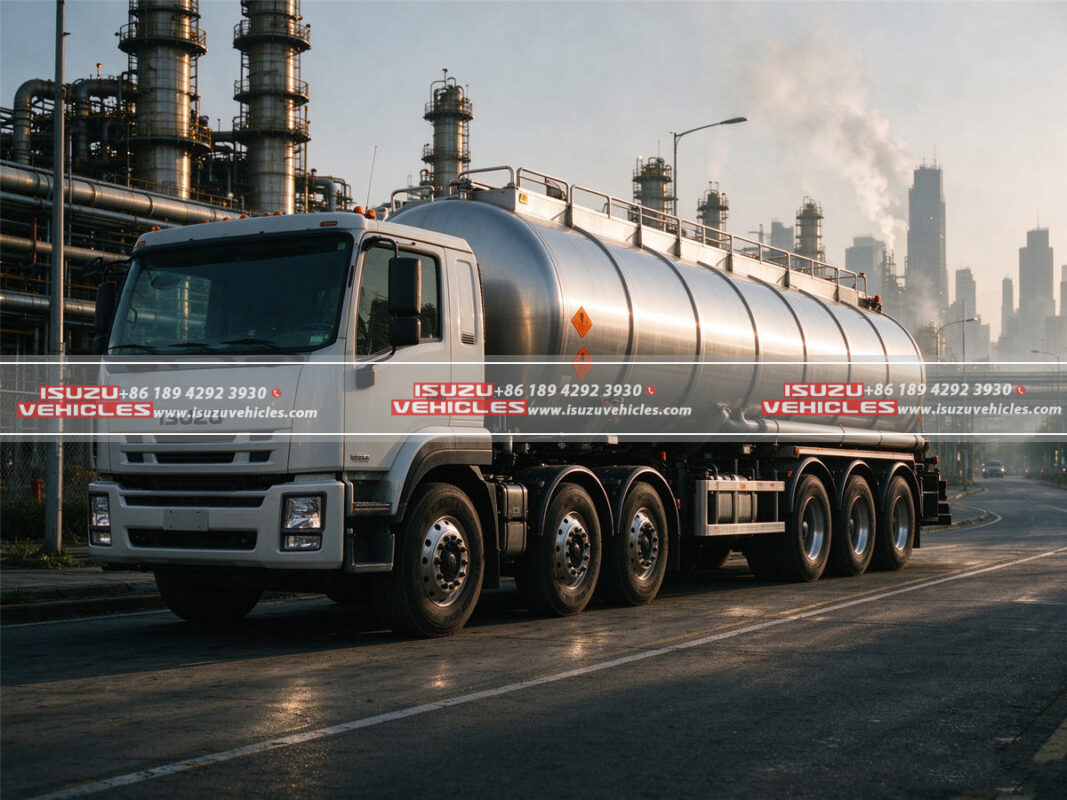
When businesses, municipalities, contractors, fuel distributors, and agricultural operators need to move large quantities of liquid efficiently, the capacity of the tanker is one of the first specifications they consider. An ISUZU tanker truck can be configured with very different tank volumes depending on the chassis, liquid being transported, road conditions, and intended application, so there is no single capacity that applies to every model. Current configurations from ISUZU Vehicles include compact tankers around 5,000 to 6,000 liters, medium-capacity vehicles around 10,000 to 12,000 liters, and much larger heavy-duty tankers reaching 16,000, 20,000 liters or more, while specialized vehicles such as aircraft refuelers can provide even greater capacity. The important point is that the largest possible tank is not always the most practical choice, because the useful capacity must be matched with the truck’s gross vehicle weight, payload, axle loading, operating environment, and the density of the liquid being carried.
For this reason, understanding tanker capacity requires more than simply looking at the number of liters printed in a product specification. A 10,000-liter water tanker, for example, behaves differently from a 10,000-liter fuel tanker because water and petroleum products have different densities, while a tanker designed for municipal spraying may require a different internal arrangement and discharge system from one designed for long-distance fuel transportation. This article explains the typical liquid capacities available on ISUZU tanker trucks, what those capacities mean in practical operation, and how buyers can select a suitable configuration for their actual transportation requirements.
What Are the Typical Capacities of ISUZU Tanker Trucks?
ISUZU tanker trucks cover a broad capacity range because they are built for several different industries rather than one specific type of liquid transportation. Looking at the current tanker range offered by ISUZU Vehicles, buyers can find models such as 5,000-liter oil tank trucks, 6 CBM fuel tank trucks, 10 CBM water tankers, 12 CBM fuel tank trucks, 16 CBM fuel tankers, 20,000-liter aircraft refuelers, and even 25 CBM stainless-steel water sprinkler tankers. This makes it possible to select a vehicle according to the actual working requirement instead of forcing every operation into the same standard tank size.
For general municipal and construction applications, 10,000 liters is a practical capacity because it provides a useful balance between transportation volume, vehicle size, maneuverability, and operating cost. One current 10 CBM water tanker, for example, uses a 4×2 configuration with a 10,000-liter tank and an 18-ton GVW, making it suitable for municipal water distribution, road maintenance, landscaping irrigation, construction-site dust suppression, and similar applications.
Medium and heavy-duty applications can move considerably more liquid in one trip. A 12 CBM tanker can carry approximately 12,000 liters when filled with a liquid having a density close to that of water, while a 16 CBM fuel tanker provides approximately 16,000 liters of nominal tank volume. Larger specialized configurations can reach 20,000 liters or beyond, particularly when the chassis and axle configuration are designed to handle the additional payload.
| Typical Tank Capacity | Approximate Liquid Volume | Common Applications |
|---|---|---|
| 5–6 CBM | 5,000–6,000 liters | Urban fuel distribution, small water supply, compact municipal work |
| 10 CBM | 10,000 liters | Water delivery, irrigation, road maintenance, dust suppression |
| 12 CBM | 12,000 liters | Fuel transportation, water distribution, municipal services |
| 16 CBM | 16,000 liters | Heavy-duty fuel and liquid transportation |
| 20 CBM | 20,000 liters | Aircraft refueling and specialized high-volume applications |
| 25 CBM | 25,000 liters | Large-scale water distribution and sprinkler operations |
These figures describe nominal tank volume rather than an instruction to fill every tank to the absolute maximum under every operating condition. The legal payload, liquid density, tank design, axle limitations, and local transportation regulations must always be considered before determining the actual filling level.
Does Tank Volume Equal Payload Capacity?
One of the most common misunderstandings when buying a tanker truck is assuming that a 10,000-liter tank automatically means the truck can carry 10,000 kilograms of any liquid. The relationship between volume and payload is more complicated because the weight of the liquid depends on its density. Water has a density close to 1 kilogram per liter, which means 10,000 liters of water weighs approximately 10,000 kilograms before considering the weight of the tank, chassis, equipment, driver, fuel, and other accessories. A fuel such as diesel generally weighs less per liter than water, so the same 10,000-liter volume will have a lower liquid mass, although fuel transportation introduces additional requirements concerning tank construction, compartments, grounding, valves, and safety equipment.
This distinction becomes particularly important when choosing a large-capacity tanker. Suppose a truck is equipped with a tank having a nominal volume of 16,000 liters. If the transported liquid has a density of approximately 1 kg/L, the liquid itself could weigh around 16 tonnes. The vehicle therefore needs a chassis and axle configuration with enough legal payload capacity to carry that mass while also supporting the tank body and associated equipment. Simply installing a large tank on a smaller chassis could result in an impractical or legally overloaded vehicle.
Volume, Density, and Gross Vehicle Weight
The basic calculation is straightforward: liquid weight = liquid volume × liquid density. For water, a 10,000-liter tank corresponds to approximately 10 tonnes of liquid under normal conditions. For a liquid with a density of 0.8 kg/L, the same tank would contain approximately 8 tonnes of liquid when completely filled. This is why professional tanker specifications must be considered as a complete package rather than by tank volume alone.
The GVW is another critical factor. A truck with an 18-ton GVW cannot simply be loaded with 18 tonnes of liquid because the empty truck itself already consumes part of that allowable weight. The curb weight, tank body, pump, piping, tools, fuel, passengers, and other equipment must all be included when calculating the permissible liquid payload. This is also why larger tankers normally use heavier chassis configurations, additional axles, and stronger suspension systems.
How Much Water Can an ISUZU Water Tanker Carry?
Water tankers are among the most common ISUZU liquid transportation vehicles, and their applications range from municipal water delivery to road washing, agricultural irrigation, landscaping, construction-site dust suppression, and emergency water supply. The capacity can be selected according to the distance between the water source and the working area, the available road infrastructure, and how frequently the truck needs to return for refilling.
A 10 CBM water tanker is a useful example of a medium-capacity configuration. The current model listed by ISUZU Vehicles has a 10 CBM, or 10,000-liter, carbon-steel tank mounted on a 4×2 chassis, with a 4,600 mm wheelbase and an 18-ton GVW. Such a configuration is well suited to routine municipal water transportation because it provides substantial volume while remaining more maneuverable than a very large multi-axle tanker.
For operations requiring greater productivity, larger tanks can reduce the number of trips required during a working day. A 12,000-liter or 16,000-liter vehicle may be preferable when water sources are far away, while a 25 CBM configuration can be particularly useful for large-scale water distribution or sprinkler work where road conditions and payload regulations allow such a vehicle. The current ISUZU tanker category includes a 25 CBM stainless-steel water sprinkler tanker alongside smaller water and fuel models.
However, capacity should always be matched to the job. A very large tanker may reduce refill frequency, but it can also require more road space, have a larger turning radius, increase operating weight, and be less convenient in narrow urban streets. For city landscaping, for example, a smaller tanker may complete the work more efficiently because it can reach locations that a larger vehicle cannot easily access.
How Much Liquid Can a Fuel or Specialized Tanker Carry?
Fuel transportation requires a different approach from ordinary water transportation because the liquid is often transported over longer distances and may include diesel, gasoline, fuel oil, or other petroleum products with specific safety requirements. Current ISUZU tanker configurations include 5,000-liter oil tank trucks, 6 CBM fuel tank trucks, 12 CBM fuel tank trucks, and 16 CBM fuel tankers, while specialized aircraft refueling vehicles can reach 12,000 and 20,000 liters.
For fuel distribution, tank volume is only one part of the specification. Internal compartments can divide the tank into separate sections, allowing different products or quantities to be carried while helping manage the liquid movement inside the tank. The truck may also require a fuel pump, meter, hose reel, delivery nozzle, grounding system, emergency shutoff equipment, and appropriate valves depending on the application and local regulations.
The physical behavior of the liquid also matters. When a partially filled tank accelerates, brakes, or changes direction, the liquid can move inside the tank and create a shifting load. Proper internal tank design, including suitable anti-wave or baffle structures, helps control this movement and contributes to better vehicle stability. The 10 CBM water tanker listed by ISUZU Vehicles, for example, uses a square-round tank with an anti-wave board and a 5 mm Q235 carbon-steel tank structure.
Water, Fuel, and Firefighting Applications
Not every liquid-carrying truck is technically used as a conventional tanker. A fire truck, for example, carries water and sometimes foam concentrate as part of an integrated firefighting system, meaning its tank capacity must be considered together with the pump, monitor, hose system, and firefighting equipment. ISUZU Vehicles currently offers fire trucks ranging from compact 3,000-liter configurations to larger 16,000-liter water fire trucks and specialized water-and-foam configurations.
One heavy-duty ISUZU water-and-rescue fire fighting truck, for instance, is specified with a 12 CBM water tank and a 4 CBM foam tank, giving it a combined liquid capacity of 16 CBM, while its 6×4 chassis and 26,800 kg GVW provide the structural capacity required for the complete firefighting system. This illustrates why the answer to “how much liquid can the truck carry?” can vary significantly even within the same general vehicle family.
What Determines the Right Tank Capacity for Your Operation?
Selecting the right tanker capacity should begin with the actual transportation cycle rather than simply choosing the largest available tank. Buyers should first determine what liquid will be transported, how many liters are required per working cycle, how far the truck must travel between loading and unloading points, what road conditions it will encounter, and what maximum GVW and axle loads are permitted in the operating country.
For short-distance municipal work, a 5,000–10,000-liter tanker can often provide an excellent combination of maneuverability and productivity. For regional water distribution or fuel delivery, a 10,000–16,000-liter configuration may reduce the number of trips without making the vehicle excessively large. Heavy-duty industrial transportation may justify 20,000 liters or more, but the supporting chassis, axle configuration, braking system, suspension, tank construction, and road regulations must all be appropriate for the additional load.
The nature of the work should also influence the body design. A water tanker used for irrigation may need a rear sprinkler bar, side spraying system, water cannon, or pump, while a fuel tanker may require compartments, metering equipment, delivery hoses, and additional safety systems. A vehicle serving as a mobile emergency water source may prioritize rapid filling and high-flow discharge, whereas a tanker supplying construction sites may prioritize long-distance transportation and simple discharge operation.
Even specialized trucks outside the traditional tanker category demonstrate the importance of choosing a chassis around the working application. For example, an bucket truck is designed around elevated access equipment rather than liquid transportation, and its payload, stability, and chassis requirements are determined by the aerial platform and working height. The same principle applies to tanker trucks: the chassis and body must be engineered as one working system rather than treating the tank as an independent container.
Why Choosing the Correct Capacity Matters
The correct tanker capacity can have a direct effect on transportation efficiency, fuel consumption, maintenance costs, safety, and overall fleet productivity. If the tank is too small for the daily workload, the truck may spend too much time returning to the filling station, increasing mileage and reducing the number of deliveries that can be completed. On the other hand, an unnecessarily large tank can increase the vehicle’s purchase price, operating weight, maneuvering requirements, and fuel consumption, particularly when the vehicle frequently operates below its potential capacity.
There is also a practical difference between nominal capacity and useful working capacity. Operators may not always fill a tank completely because of liquid characteristics, road conditions, temperature changes, loading procedures, legal weight limits, or the requirements of the specific transportation system. For fuel and other regulated liquids, additional restrictions may apply, and the tank must be designed and certified for the intended product and operating environment.
For international buyers, this is particularly important because a tanker designed for one country may need modifications before it can be legally operated in another market. Chassis configuration, emission standard, steering position, tank material, pump system, safety equipment, dimensions, axle loads, and local certification requirements can all affect the final vehicle specification. Working with an experienced manufacturer such as ISUZU Vehicles allows buyers to define the tank volume together with the chassis and specialized equipment instead of selecting capacity in isolation.
Ultimately, the answer to “how much liquid can an ISUZU tanker truck carry?” ranges from several thousand liters to more than 20,000 liters depending on the model and application, with common configurations including 5 CBM, 6 CBM, 10 CBM, 12 CBM, 16 CBM, 20 CBM, and 25 CBM. The best choice is not necessarily the tanker with the biggest tank, but the vehicle that provides the right balance between liquid capacity, payload, chassis strength, road conditions, operating range, safety, and application requirements. Whether the job involves water delivery, fuel transportation, municipal spraying, industrial liquid handling, or emergency support alongside a fire truck fleet, a properly matched tanker can significantly improve daily transportation efficiency. By selecting the capacity according to the real working cycle and combining it with the correct chassis and equipment, ISUZU Vehicles can provide a practical liquid transportation solution for different markets, while related commercial vehicles such as a fire truck, bucket truck, and other specialized trucks can be integrated into a broader professional fleet.