
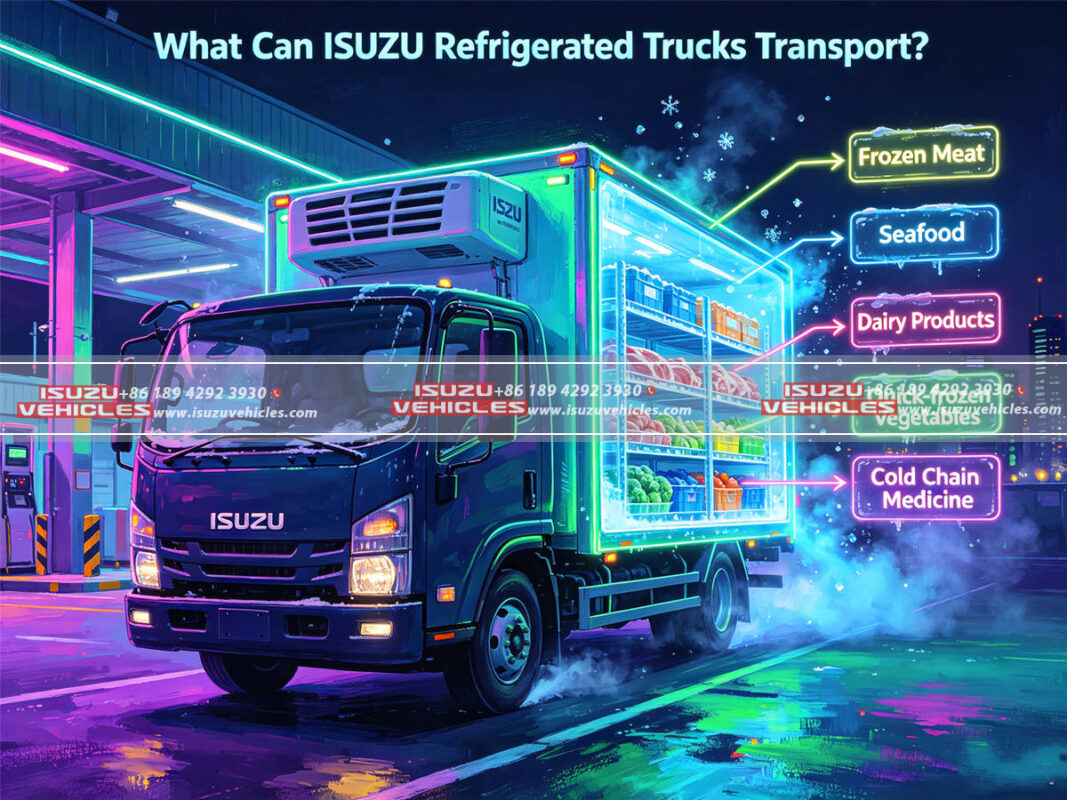
An ISUZU refrigerated truck is designed for transporting goods that need a controlled temperature environment throughout the journey, making it an important part of modern cold-chain logistics rather than simply a truck with an insulated cargo box. From fresh vegetables and fruit to frozen meat, seafood, dairy products, ice cream, pharmaceuticals, and other temperature-sensitive goods, the vehicle helps protect cargo from temperature fluctuations that can reduce quality, shorten shelf life, or cause spoilage. The current refrigerated truck range includes compact refrigerated vans, medium-duty models, freezer box trucks, and larger refrigerated box trucks, so different businesses can select a configuration according to cargo volume, delivery distance, road conditions, and required temperature range.
1. What Types of Food Can ISUZU Refrigerated Trucks Transport?
Food transportation is one of the most common applications for refrigerated trucks because many food products deteriorate quickly when exposed to uncontrolled temperatures. A standard enclosed cargo vehicle can protect products from rain, dust, and direct sunlight, but it cannot actively remove heat from the cargo compartment, which becomes a serious limitation when the vehicle is operating in a hot climate or when the delivery route takes several hours. A refrigerated truck solves this problem by combining an insulated cargo body with a refrigeration unit that continuously removes heat and maintains the desired internal temperature.
Fresh meat, seafood, dairy products, vegetables, fruits, beverages, frozen foods, prepared meals, and other perishable products can all be transported in appropriate refrigerated configurations, although the exact temperature requirement depends on the product. The current ISUZU range includes models specifically described for fresh vegetables and meat transportation, as well as freezer box trucks and larger refrigerated box bodies for higher-volume distribution.
Fresh Meat and Seafood
Fresh meat and seafood require careful temperature management because quality can deteriorate rapidly when products remain in an unsuitable environment for an extended period. A refrigerated body provides a controlled space that can be maintained at a chilled temperature rather than allowing the cargo compartment to follow the outside ambient temperature. This makes refrigerated trucks particularly useful for transporting meat from processing facilities to wholesalers, supermarkets, restaurants, and distribution centers, while seafood distributors can use the same principle for fish, shellfish, and other fresh aquatic products.
When transporting fresh products, the refrigeration system is only one part of the process. The cargo should normally be loaded at an appropriate temperature, the doors should remain closed as much as practical, and the internal airflow should not be blocked by poor cargo arrangement. These operating practices help the refrigeration unit maintain a more stable environment and reduce unnecessary heat gain during delivery.
Dairy Products and Beverages
Milk, yogurt, cheese, cream, and other dairy products are also common refrigerated cargo because they require controlled temperatures during distribution. Refrigerated trucks are widely suited to moving these products from production facilities to supermarkets, convenience stores, restaurants, hotels, and regional distribution centers, particularly when the vehicle needs to make several deliveries during the same working day.
Some beverages and specialty food products may also require temperature-controlled transportation even when they do not need to be frozen. This illustrates an important point about refrigerated transportation: the objective is not simply to make the cargo compartment as cold as possible, but to maintain the temperature range appropriate for the product being carried.
2. Can ISUZU Refrigerated Trucks Transport Frozen Food?
Yes, appropriately configured ISUZU freezer trucks can transport frozen food, and this is one of the most demanding applications for temperature-controlled transportation because frozen products generally require significantly lower temperatures than ordinary chilled goods. Frozen meat, frozen seafood, ice cream, frozen vegetables, frozen fruit, frozen prepared meals, and other frozen products can require the cargo compartment to remain around -18°C or below, depending on the product and transportation requirements.
The current ISUZU refrigerated truck range includes dedicated freezer box configurations as well as larger refrigerator-freezer box trucks, giving operators choices for both smaller urban deliveries and higher-volume regional distribution. The refrigeration unit must have sufficient cooling capacity for the cargo volume and operating conditions, while the insulated body must minimize heat transfer from the outside environment.
Frozen Meat, Seafood, and Vegetables
Frozen meat and seafood are frequently transported over considerable distances between processing plants, cold-storage warehouses, wholesale markets, and retail outlets. Maintaining a stable frozen environment helps prevent unwanted thawing and refreezing, which can affect product quality and appearance. Frozen vegetables and prepared foods similarly benefit from reliable temperature control because they may spend many hours inside the vehicle during loading, transit, and multiple delivery stops.
Ice cream is another particularly temperature-sensitive product because its quality can be affected quickly by temperature increases. For this type of cargo, the refrigeration system, insulation, door sealing, and loading practices all need to work together. A powerful refrigeration unit alone cannot compensate indefinitely for an open door or a poorly insulated cargo body.
3. Can ISUZU Refrigerated Trucks Transport Fruits and Vegetables?
Fresh fruits and vegetables are another major application, although transporting produce requires a different approach from transporting frozen products. Many fruits and vegetables should remain cool without being frozen, and different types of produce can have different ideal storage and transportation conditions. For this reason, the operator needs to select a suitable temperature setting and avoid assuming that colder is always better.
Fresh produce can lose moisture, quality, texture, and appearance when exposed to excessive heat or unsuitable environmental conditions. A refrigerated truck provides a more stable environment than an ordinary cargo truck, particularly during long regional distribution routes where outside temperatures can change significantly between the departure and destination points.
The current ISUZU range includes a fresh produce refrigerated truck designed for applications such as vegetable and meat transportation. Smaller refrigerated vehicles are also available for urban food distribution, where frequent stops and relatively limited cargo volumes make maneuverability just as important as overall capacity.
Why Cargo Arrangement Matters
Refrigerated transportation works most effectively when cold air can circulate around the cargo. If products are packed too tightly against the walls or loaded directly in front of the evaporator outlet, airflow can become restricted and temperature distribution inside the body may become less uniform. Proper loading therefore involves leaving appropriate circulation space and avoiding unnecessary obstruction of the refrigeration system.
For businesses delivering fresh produce to multiple customers, this becomes especially important because doors may be opened repeatedly throughout the route. Every door opening allows warmer outside air to enter the cargo compartment, so efficient delivery planning and minimizing unnecessary door-open time can help reduce the cooling load.
4. Can Refrigerated Trucks Transport Pharmaceuticals and Medical Products?
Temperature-controlled transportation is also important in the pharmaceutical and healthcare industries, where some products require stable environmental conditions throughout the distribution process. Vaccines, certain medicines, laboratory materials, biological products, and other temperature-sensitive medical supplies may require controlled transportation rather than ordinary cargo handling.
Pharmaceutical transportation is different from ordinary food distribution because the acceptable temperature range may be relatively narrow and documentation can be an important part of the logistics process. Many products are transported within chilled ranges such as +2°C to +8°C, while other products may require different conditions according to their specific handling requirements. The vehicle therefore needs to be selected and configured according to the actual product specification rather than relying on a generic refrigerated setting.
Temperature Monitoring Is Important
A refrigeration unit maintains the environment, but temperature monitoring provides visibility into what actually happened during transportation. Digital temperature displays, sensors, data logging, and alarm systems can help operators identify abnormal temperature changes and respond before cargo quality is compromised.
For pharmaceutical logistics, the complete cold-chain process matters, including pre-cooling, loading, door management, temperature monitoring, route planning, and unloading. A refrigerated truck is an important part of that system, but it cannot replace proper handling procedures at warehouses and delivery locations.
5. What Other Temperature-Sensitive Products Can ISUZU Refrigerated Trucks Carry?
The application of refrigerated transportation extends beyond conventional food and pharmaceutical products. Depending on the configuration and temperature requirements, refrigerated trucks can also be used for flowers, specialty agricultural products, confectionery, chocolate, certain processed foods, laboratory materials, and other products whose quality depends on controlled environmental conditions.
Cut flowers, for example, can be sensitive to heat and dehydration during transportation. A controlled environment can help protect their freshness when they are moved from growers to wholesalers, flower markets, supermarkets, event suppliers, and retailers. Similarly, chocolate and certain confectionery products can soften or lose their desired appearance when exposed to high temperatures, making temperature-controlled delivery useful for particular distribution routes.
Specialty food manufacturers can also benefit from refrigerated transportation when products contain ingredients that require controlled temperatures. Prepared meals, fresh sauces, premium dairy products, seafood products, and other chilled foods may need to travel from central production kitchens or factories to restaurants, hotels, supermarkets, and catering operations.
However, businesses should always verify the transportation requirements of the specific product before selecting a temperature setting. A refrigerated truck is a flexible platform, but different products can have very different requirements concerning temperature, humidity, ventilation, packaging, and maximum transportation time.
6. How Does the Refrigerated Body Protect Different Cargo?
The refrigeration unit is only one component of an effective cold-chain vehicle because maintaining cargo temperature depends on the complete refrigerated body. Insulation forms the thermal barrier between the inside and outside of the vehicle, while the refrigeration system removes heat that enters the cargo compartment through the walls, roof, floor, doors, and during loading and unloading.
High-quality insulation is particularly important in hot climates because the refrigeration system has to work harder when the difference between outside and inside temperatures becomes greater. The body construction, insulation thickness, door seals, floor structure, and condition of the panels all affect the vehicle’s ability to maintain the desired internal environment.
Different Body Sizes for Different Distribution Tasks
ISUZU refrigerated trucks are available in a broad range of body sizes, from compact vehicles intended for urban distribution to larger models designed for regional and high-volume transportation. The current product category includes a 4-meter refrigerated van truck, 3-ton refrigerated van truck, 6-ton refrigerated cooling box truck, 16 CBM refrigerator-freezer box truck, 28 CBM refrigerated box truck, 30 CBM refrigerated box truck, and 36 CBM refrigerated box truck.
This variety allows businesses to match the truck to their actual distribution pattern. A restaurant supplier making deliveries through crowded city streets may prefer a compact vehicle that can enter narrow roads and make frequent stops, while a food distributor moving large quantities between warehouses may benefit from a much larger refrigerated box. Choosing an appropriately sized vehicle can also prevent businesses from carrying unnecessary body weight or paying for more capacity than their daily operation requires.
7. How Should Businesses Choose the Right Refrigerated Truck?
The best refrigerated truck for a particular business depends on the type of cargo, required temperature, cargo volume, route distance, number of daily stops, loading method, road conditions, and local climate. Businesses should first identify the products they transport and the temperature range they actually require, then consider how much cargo needs to be moved on a normal day and whether the truck will mainly operate in urban areas or on longer regional routes.
For small urban deliveries, a compact refrigerated van can provide a practical balance between cargo capacity and maneuverability. The current 4-meter refrigerated truck, for example, has a 4,495 kg gross vehicle weight and a rated payload of 1.11 tonnes, making it a compact option for urban cold-chain logistics. Its electric configuration also demonstrates how refrigerated distribution is beginning to include lower-emission vehicle options for city operations.
For larger distribution requirements, medium- and heavy-duty refrigerated trucks can provide substantially greater cargo volume and payload capacity. The current product range includes 16 CBM, 28 CBM, 30 CBM, and 36 CBM refrigerated configurations, which can be more appropriate for supermarket distribution, food wholesalers, regional logistics providers, and other businesses moving larger quantities of temperature-sensitive products.
Refrigeration Capacity Should Match the Cargo
Choosing a refrigeration unit should not be based only on the lowest temperature it can theoretically reach. Cooling capacity, ambient temperature, cargo temperature at loading, body volume, insulation quality, door-opening frequency, and journey duration all influence real-world performance. A truck that regularly operates in a hot region with frequent deliveries may need a different refrigeration configuration from one carrying pre-chilled cargo on a short highway route.
Businesses should also consider serviceability because refrigeration equipment is essential to the value of the entire vehicle. Regular inspection of the compressor, condenser, evaporator, electrical connections, temperature sensors, door seals, and insulated body can help maintain consistent performance and reduce unexpected downtime.
8. How Does a Refrigerated Truck Compare With an Ordinary Cargo Vehicle?
The main difference is that a refrigerated truck actively controls the cargo environment, while an ordinary cargo vehicle primarily provides physical transportation and weather protection. A conventional cargo truck is an excellent solution for dry goods such as machinery, packaged products, building materials, furniture, and many other items that do not require controlled temperatures. However, it cannot provide the same protection for products that deteriorate when exposed to heat.
A van truck can provide an enclosed cargo environment and is particularly useful for general urban distribution, but an ordinary van body does not actively maintain chilled or frozen temperatures. This distinction becomes important when businesses move products through hot weather, over long distances, or through multiple delivery stops, because the outside temperature can quickly affect an ordinary enclosed cargo compartment.
Refrigerated transportation therefore becomes particularly valuable when the cargo itself has a temperature requirement. Fresh food distributors, supermarkets, restaurants, pharmaceutical suppliers, seafood wholesalers, agricultural producers, catering companies, and cold-chain logistics providers can all benefit from a properly configured refrigerated vehicle because the truck becomes part of the product-protection system rather than merely a means of moving boxes.
Ultimately, an ISUZU refrigerated truck can transport a wide range of temperature-sensitive products, including fresh meat, seafood, dairy products, fruits, vegetables, frozen food, ice cream, prepared meals, pharmaceuticals, flowers, and other specialized cargo, provided that the vehicle configuration and temperature setting match the requirements of the individual product. From compact urban refrigerated vans to large 36 CBM refrigerated box trucks, the available configurations allow operators to build transportation solutions around different cargo volumes and distribution routes. When a fleet also includes a cargo truck for dry goods and a van truck for general enclosed deliveries, each vehicle can be assigned to the type of freight it is designed to protect and transport efficiently. For businesses building a dependable cold-chain logistics system, ISUZU Vehicles offers refrigerated truck solutions that combine commercial vehicle practicality with controlled-temperature cargo transportation.