
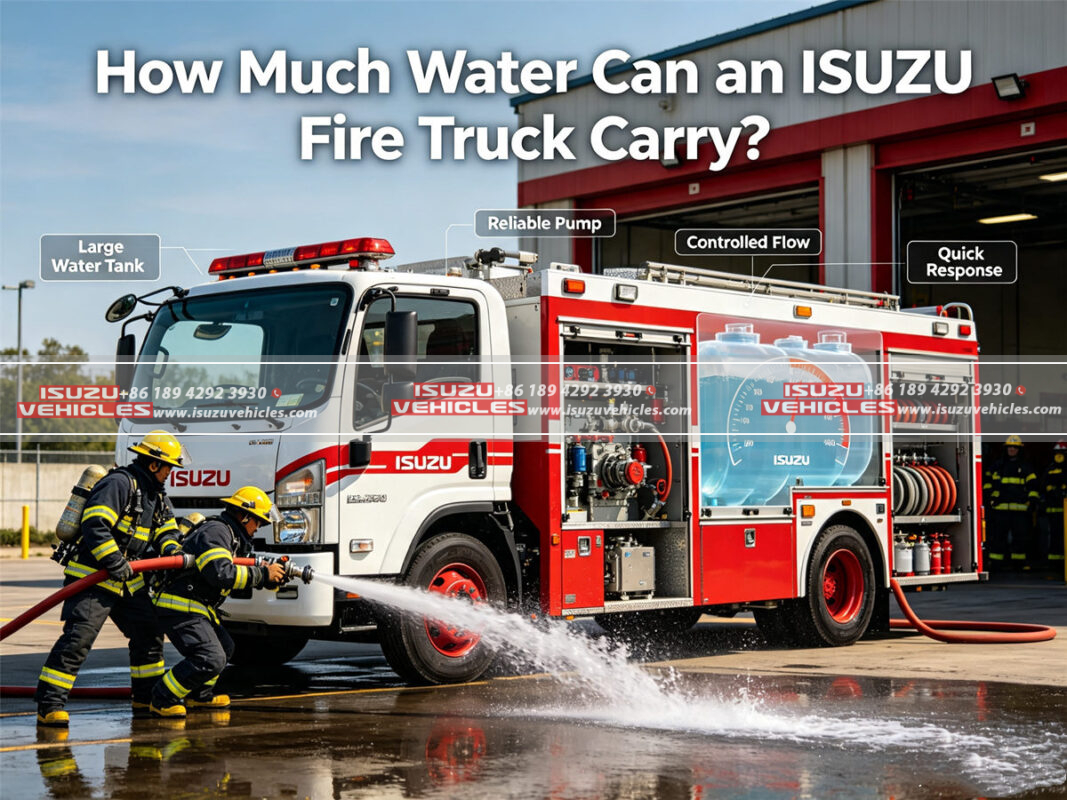
Firefighting operations depend on speed, reliability, and having the right equipment available at the exact moment it is needed. While firefighters use many tools and systems to control emergencies, one of the most important resources during a fire response is a dependable water supply. In areas where hydrants are limited, water sources are far away, or large volumes of water are required quickly, the onboard water capacity of a fire truck becomes a critical factor.
A common question from fire departments and emergency service organizations is, “How much water can an ISUZU fire truck carry?” The answer depends on the truck model, chassis configuration, firefighting purpose, and customer requirements. Different applications require different tank sizes, from compact urban response vehicles designed for fast arrival to larger firefighting units built for extended operations.
An ISUZU fire truck is engineered to balance water capacity, vehicle mobility, pump performance, and operational reliability. Rather than simply carrying the largest possible tank, professional firefighting vehicles are designed to provide the right combination of water supply and rapid response capability.
Understanding how water capacity is determined helps emergency organizations select the right fire truck for their specific firefighting needs.
Different ISUZU Fire Truck Models Have Different Water Capacities
The water capacity of an ISUZU fire truck varies depending on its intended role. Fire departments often operate multiple types of firefighting vehicles because different emergencies require different levels of water supply and mobility.
Typical water capacities include:
- 1,000–3,000 liters for compact urban fire response vehicles
- 3,000–6,000 liters for standard firefighting applications
- 8,000–12,000 liters for larger water tender configurations
- 15,000 liters or more for specialized firefighting support vehicles
The ideal capacity depends on the operating environment.
For example:
- City fire trucks may prioritize maneuverability and quick response.
- Rural firefighting vehicles may require larger tanks because hydrants are less available.
- Industrial firefighting units may need higher water capacity for large-scale emergencies.
A smaller tank does not necessarily mean lower performance because many fire trucks rely on external water sources after arriving at the scene.
Balancing Water Capacity and Vehicle Mobility
Water is heavy, with each liter weighing approximately one kilogram. A 5,000-liter water tank adds around five tons of weight before considering the chassis, equipment, firefighters, and fuel.
Because of this, manufacturers must carefully balance:
- Tank volume
- Vehicle weight
- Axle capacity
- Driving stability
- Road regulations
An oversized tank may reduce maneuverability, while a properly designed vehicle provides better overall firefighting efficiency.
How Water Storage Supports Firefighting Operations
The onboard water tank provides immediate firefighting capability before external water sources are connected.
When arriving at an emergency scene, firefighters can quickly activate the pump system and begin spraying water through:
- Fire hoses
- Roof monitors
- Side outlets
- Foam systems
- High-pressure nozzles
This initial water supply is especially important during the first minutes of a fire when rapid action can prevent the situation from becoming more severe.
Fast Response Without Immediate Hydrant Access
In many locations, firefighters cannot rely on nearby hydrants.
Challenges may include:
- Rural areas
- Construction zones
- Industrial sites
- Remote communities
- Disaster areas
A properly equipped ISUZU fire truck provides an independent water source, allowing firefighting operations to begin immediately after arrival.
This capability improves emergency response efficiency and gives firefighters more time to establish a continuous water supply.
Factors That Determine the Right Fire Truck Water Capacity
Choosing the correct water capacity requires considering the environment where the vehicle will operate.
Urban Firefighting Requirements
Urban areas usually have dense networks of fire hydrants, meaning fire trucks do not always need extremely large tanks.
Urban fire trucks often prioritize:
- Compact dimensions
- Fast acceleration
- Easy navigation through traffic
- Quick deployment
For these applications, a medium-capacity tank may provide the ideal balance between water supply and maneuverability.
Rural and Industrial Applications
Rural areas often require larger water tanks because external water sources may be limited.
Industrial facilities may also require greater capacity because fires involving:
- Warehouses
- Manufacturing plants
- Fuel storage areas
- Chemical facilities
can require large amounts of water or firefighting foam over longer periods.
In these situations, a high-capacity ISUZU fire truck provides additional operational flexibility.
Advanced Pump and Tank Systems Improve Firefighting Efficiency
Water capacity is only one part of a successful firefighting system. The ability to deliver water quickly and effectively is equally important.
An ISUZU fire truck typically combines the water tank with a high-performance pump system that converts stored water into effective firefighting pressure.
Important components include:
- Centrifugal fire pumps
- Water outlets
- Pressure control systems
- Foam mixing equipment
- Spray monitors
These systems allow firefighters to adjust water flow according to different emergency conditions.
Tank Construction and Safety Features
Fire truck water tanks must withstand constant operational demands.
Quality tank designs include:
- Corrosion-resistant materials
- Reinforced structures
- Internal anti-surge systems
- Secure mounting systems
Anti-surge designs are especially important because water movement inside the tank can affect vehicle stability during acceleration, braking, and cornering.
A well-designed tank improves both safety and driving performance.
Why Choosing the Right Water Capacity Matters
Selecting the correct water capacity is not simply about maximizing volume. Fire departments must consider their actual emergency conditions, available infrastructure, and operational strategies.
A fire truck with excessive capacity may become heavier and less agile, while a vehicle with insufficient water may require frequent refilling during critical operations.
The right choice considers:
- Local fire risks
- Average response distances
- Water availability
- Road conditions
- Emergency service requirements
Professional fire departments often combine different vehicle types to create a complete emergency response system. A fast-response truck may carry a smaller water tank, while a dedicated water supply vehicle provides additional capacity for longer incidents.
This approach allows emergency teams to maintain both speed and firefighting endurance.
A Reliable Water Supply Solution for Fire Protection
The ISUZU fire truck can carry different water capacities depending on its design, with common configurations ranging from approximately 1,000 liters to more than 15,000 liters for specialized applications. The best capacity depends on whether the vehicle is intended for urban response, rural firefighting, industrial protection, or emergency water supply support.
Beyond tank volume, a successful firefighting vehicle requires reliable pumping systems, durable construction, stable handling, and the ability to perform under stressful conditions. ISUZU fire trucks are designed to provide these qualities through dependable chassis engineering, practical firefighting equipment integration, and flexible configurations for different markets.
For organizations developing complete emergency response fleets, an ISUZU fire truck can work together with a water tank truck for large-volume water transportation and a bucket truck for elevated rescue and maintenance operations. Combined with dependable ISUZU Vehicles, these specialized solutions provide the reliability, versatility, and professional performance required to support firefighters and emergency teams during critical situations worldwide.