
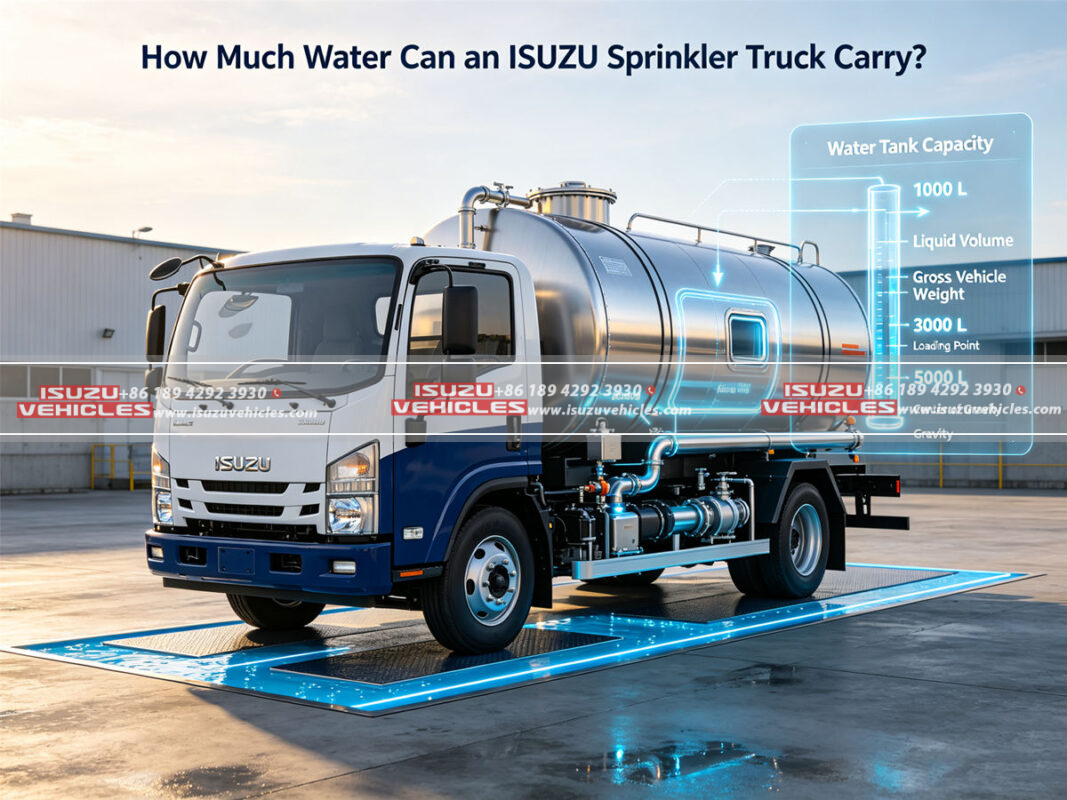
An ISUZU sprinkler truck can carry different amounts of water depending on its chassis, tank design, payload rating, and intended municipal application, with current models including compact 5,000-liter configurations and larger 8,000-liter water sprinkler trucks. The most important point for buyers is that tank capacity is not determined simply by how large the tank looks, because the truck must maintain an appropriate balance between water volume, chassis payload, axle loading, road performance, and equipment weight. For customers looking for a practical municipal vehicle, the sprinkler truck range currently includes 5,000-liter and 8,000-liter models as well as smaller configurations, allowing the water capacity to be matched with the actual requirements of road cleaning, dust suppression, landscaping, irrigation, and other water-distribution work.
In simple terms, a 5,000-liter truck carries approximately 5 cubic meters of water, while an 8,000-liter truck carries approximately 8 cubic meters when filled to its designed capacity. The difference of 3,000 liters may appear straightforward, but in daily operation it can have a noticeable effect on how often the truck needs to refill, how much road can be treated during one working cycle, and what type of chassis is required to safely transport the water. Water is heavy, with one liter weighing approximately one kilogram under ordinary conditions, so a full 8,000-liter tank represents roughly 8 metric tons of water alone before the weight of the tank, pump, pipes, spray equipment, chassis, fuel, passengers, and other equipment is considered.
What Water Capacities Are Available?
The current ISUZU sprinkler truck range demonstrates that water capacity can vary according to the truck’s size and intended application rather than following one standard tank volume. The available range includes mini water sprayers, small water sprinkler trucks, 5,000-liter models, and an 8,000-liter model, giving municipal departments and contractors several capacity levels from which to choose. This variety is useful because a compact city street-cleaning operation does not necessarily require the same water volume as a large road-maintenance project operating across industrial zones, highways, or construction areas.
5,000-Liter Sprinkler Trucks
A 5,000-liter water tank is one of the practical capacities for urban road maintenance because it provides a useful combination of water volume and vehicle maneuverability. One current 5,000-liter model is built on an ISUZU 600P 4×2 chassis and has a 5,000-liter stainless steel water tank with a 6 mm tank body thickness. Its listed gross vehicle weight is 7,300 kg, while the curb weight is 4,800 kg, showing how the complete vehicle’s weight must be considered alongside the water itself. The model is designed for road cleaning, dust suppression, irrigation, and auxiliary firefighting, making this capacity suitable for a broad range of municipal operations.
Another current 5,000-liter configuration uses an ISUZU ELF 4×2 chassis and has a 5,000-liter stainless steel tank reinforced with internal anti-wave plates. Its compact dimensions of approximately 5,995 × 1,980 × 2,450 mm make it suitable for urban environments where streets can be narrow and frequent maneuvering is required. The same vehicle has a listed rated payload of 3,000 kg, illustrating why the actual permissible water load must always be checked against the complete vehicle’s rated specifications rather than assuming that a nominal tank volume automatically represents the legal payload.
8,000-Liter Sprinkler Trucks
For customers who need longer operating cycles and greater water coverage, an 8,000-liter sprinkler truck provides a substantial increase in water-carrying capacity. The current 8,000-liter model uses an ISUZU F Series 4×2 chassis and has a gross vehicle weight of 16,000 kg, a curb weight of 7,200 kg, and a rated payload of 8,600 kg. Its 8,000-liter tank is constructed from 4 mm carbon steel and includes internal anti-wave plates, an epoxy anti-corrosion coating, a top manhole, and an external water-level indicator.
The additional water capacity can be particularly valuable when the truck operates far from refill points or needs to cover a large area before returning to a water source. However, the larger tank also means that the vehicle is physically larger and heavier, so route conditions, road width, turning space, bridge restrictions, and operating environment need to be considered before selecting the larger configuration.
How Much Does the Water Itself Weigh?
Understanding the weight of water is essential when discussing sprinkler truck capacity because the tank volume and the truck’s payload are closely connected. One cubic meter of fresh water weighs approximately 1,000 kilograms, so a 5,000-liter tank contains roughly 5,000 kilograms of water when completely filled, while an 8,000-liter tank contains approximately 8,000 kilograms. These figures do not include the tank itself or any of the other equipment mounted on the chassis.
This is why a 5,000-liter tank does not mean that every 5,000-liter truck can legally carry 5,000 kilograms of water under every operating condition. The manufacturer must account for the tank structure, pump, piping, spray nozzles, valves, chassis, fuel, passengers, tools, and other equipment when determining the vehicle’s rated payload and gross vehicle weight. A buyer should therefore compare the tank capacity with the vehicle’s complete weight specifications rather than selecting a truck based only on the number printed in its product name.
Tank Capacity vs. Payload
Tank capacity describes the physical volume of water the tank is designed to hold, while payload describes how much total additional weight the vehicle is rated to carry. These two figures are related but are not identical. If a truck has a 5,000-liter tank, the water can weigh approximately 5 tons when full, but the complete vehicle also has to carry the tank and spraying equipment, which means the chassis must have sufficient capacity for the complete operating load.
The current 8,000-liter ISUZU model illustrates this relationship clearly. Its 8,000-liter tank holds approximately 8 tons of water, while the truck has a listed 8,600 kg rated payload. That leaves only a relatively limited margin for additional operating weight once the water is fully loaded, so the complete manufacturer’s specification must be followed when determining how the vehicle should be loaded and operated.
How Far Can an ISUZU Sprinkler Truck Travel on One Tank?
There is no single distance that can be assigned to a full tank because actual water consumption depends heavily on how the truck is being used. A vehicle traveling between job sites without spraying consumes little or no water, while a truck continuously washing a road at a high flow rate can use thousands of liters during a single route. The spray width, nozzle configuration, water pressure, vehicle speed, road condition, weather, and selected operating mode all influence how long a tank will last.
For example, the current 5,000-liter model is specified with a spraying width of at least 14 meters, a water cannon range of at least 35 meters, and a pump flow rate of 60 m³/h. These specifications show that the truck can distribute water rapidly when maximum pumping performance is required, but it also means that a full tank could theoretically be discharged in a relatively short period under continuous high-flow operation. In normal municipal work, operators do not necessarily use the maximum pump output continuously, so actual operating duration can be substantially longer.
Water Consumption During Road Spraying
The relationship between tank capacity and operating duration can be understood through a simple example. If a truck carries 5,000 liters and an operation uses 500 liters per kilometer, the available water would theoretically cover approximately 10 kilometers before the tank is empty, assuming continuous spraying and ignoring other variables. If consumption is reduced to 250 liters per kilometer, the same tank could theoretically cover approximately 20 kilometers. These figures are examples rather than fixed performance ratings, because actual consumption varies with the selected spray system and operating conditions.
This is why municipal operators usually plan routes according to both water capacity and refill availability. A larger tank can reduce the frequency of refill stops, but if the route has convenient water sources, a smaller and more maneuverable vehicle may still be a practical choice. The right capacity depends on the working pattern rather than simply selecting the largest available tank.
Spray Width and Water Efficiency
Spray width also influences how efficiently a sprinkler truck can cover a road. A truck that distributes water across a wide area can treat more pavement during each pass, while narrower spraying may provide greater concentration for specific cleaning tasks. The current 8,000-liter ISUZU sprinkler truck has a listed spray width of 14 to 18 meters, while its front and rear spraying systems are designed for road washing, dust suppression, and landscaping irrigation.
Operators can therefore adjust the water-distribution method according to the work rather than treating every road in exactly the same way. A wide spray can be useful for general dust suppression, while front flushing can provide more concentrated water application when the road surface requires additional cleaning.
What Determines the Right Water Capacity?
The best tank size depends on several practical factors, including the size of the service area, distance between refill points, road conditions, vehicle access, daily operating hours, required spray volume, and available budget. A city department working primarily on narrow residential streets may find a 5,000-liter truck more convenient because its compact dimensions make it easier to maneuver around parked vehicles and intersections. A contractor working on large industrial roads or construction areas may place greater value on the extended operating time provided by an 8,000-liter tank.
Urban Road Cleaning
For urban road cleaning, a 5,000-liter configuration can provide a useful balance between capacity and maneuverability. The truck can carry a substantial volume of water while remaining relatively compact, allowing it to enter streets and municipal areas where a larger vehicle might have difficulty turning or parking. This makes smaller sprinkler trucks particularly suitable for routine dust suppression, street washing, roadside irrigation, and community-level maintenance.
When road cleaning involves substantial amounts of solid debris, however, water alone is not the complete solution. A sweeper truck can use rotating brushes and collection equipment to remove sand, leaves, stones, and other solid material, while the sprinkler truck can wet the surface and suppress airborne dust before or during sweeping operations.
Large-Area Dust Suppression
For construction sites, industrial areas, large roads, and other locations where water must be distributed over a broad area, an 8,000-liter truck can reduce the number of refill cycles required during a working shift. Its larger tank and 14-to-18-meter listed spray width can make it useful for treating extensive surfaces, while the 35-meter-plus water cannon provides a separate option for targeted water application.
The larger capacity does not automatically mean higher productivity in every situation, however, because productivity also depends on road access, water-source availability, traffic restrictions, and the amount of water actually required per square meter. A larger truck that spends considerable time navigating narrow streets may be less efficient than a smaller vehicle that can move quickly between locations.
How Does the Tank Design Affect Water Capacity?
Tank design is about much more than simply creating a container large enough to hold the required amount of water. Because water moves inside the tank while the truck accelerates, brakes, turns, and travels over uneven surfaces, professional sprinkler tanks are commonly equipped with internal anti-wave plates or similar structures that help reduce excessive water movement. This is particularly important for large tanks because the greater the water volume, the greater the potential effect of liquid movement on vehicle behavior.
The current 8,000-liter model uses an elliptical tank with internal anti-wave plates, while its 5,000-liter ELF configuration also uses reinforced internal anti-wave plates. These structural features help control water movement during transportation and contribute to more predictable vehicle handling. The tank material also matters because municipal vehicles may operate frequently in environments where corrosion resistance and long-term durability are important.
The 5,000-liter model with a stainless steel 304 tank uses a 6 mm tank body, while the current 8,000-liter model uses a 4 mm carbon-steel tank with internal epoxy anti-corrosion treatment. These different approaches demonstrate that tank construction can be adapted to the intended application, operating environment, and vehicle configuration.
How Do Pump Performance and Water Capacity Work Together?
A large tank is only useful if the water can be delivered efficiently, which is why pump performance is another important part of sprinkler truck specifications. The pump draws water from the tank and sends it through the pipelines toward the selected spray outlets, and its flow rate determines how quickly water can be delivered. The pump lift or pressure capability also affects how the vehicle can draw water from external sources and how far or forcefully it can distribute water.
The current 5,000-liter model uses a stainless steel self-priming sprinkler pump with a listed flow rate of 60 m³/h and a lift height of 90 meters, while the 8,000-liter model uses an 80QZB-60/90 self-priming centrifugal pump with a rated flow of 60 m³/h and a maximum lift of 90 meters. Both examples show that tank capacity and pump capacity are separate specifications: a larger tank provides greater water storage, while the pump determines how quickly and effectively that water can be delivered to the road or another working area.
A self-priming system can also increase operational flexibility because the truck can draw water from suitable external sources such as reservoirs, rivers, or other approved supply points, subject to local conditions and water-quality requirements. The current 8,000-liter model has a listed suction height of approximately 6 to 7 meters, while the 5,000-liter model specifies a suction height above 7 meters.
Which Capacity Is Suitable for Different Municipal Jobs?
For routine city road cleaning, dust suppression, and landscaping, a 5,000-liter truck can provide a practical combination of capacity and maneuverability. For larger road networks, industrial sites, construction projects, and areas where refill points are far apart, an 8,000-liter truck can reduce the number of water stops and provide longer continuous operating periods. Smaller sprinkler trucks can also make sense where road access is restricted or where water consumption is relatively low.
The important point is that buyers should consider the complete operating cycle rather than tank capacity alone. If a municipal truck has access to a convenient hydrant or water source every few kilometers, a smaller tank may be sufficient, whereas a remote construction project may benefit significantly from carrying more water per trip. Similarly, a vehicle that performs frequent road washing may consume water much faster than one primarily used for occasional roadside irrigation.
When the work involves wastewater, blocked drains, or sludge rather than clean-water distribution, a sewer truck is more appropriate because its vacuum equipment is designed for liquid waste and sewage handling rather than simply spraying clean water. Using specialized vehicles according to their intended functions helps municipal operators avoid trying to make one vehicle perform every type of sanitation task.
Ultimately, an ISUZU sprinkler truck can carry approximately 5,000 liters or 8,000 liters in the current configurations discussed above, while smaller models provide additional options for operators with more specialized capacity and maneuverability requirements. The most suitable choice depends on the working route, refill infrastructure, road conditions, water consumption, payload requirements, and type of municipal service. When these factors are evaluated together, ISUZU Vehicles can provide a practical range of water-carrying solutions, while a sewer truck can handle wastewater-related operations and a sweeper truck can collect solid road debris, allowing different municipal vehicles to work together as part of a complete and efficient road-maintenance fleet.