
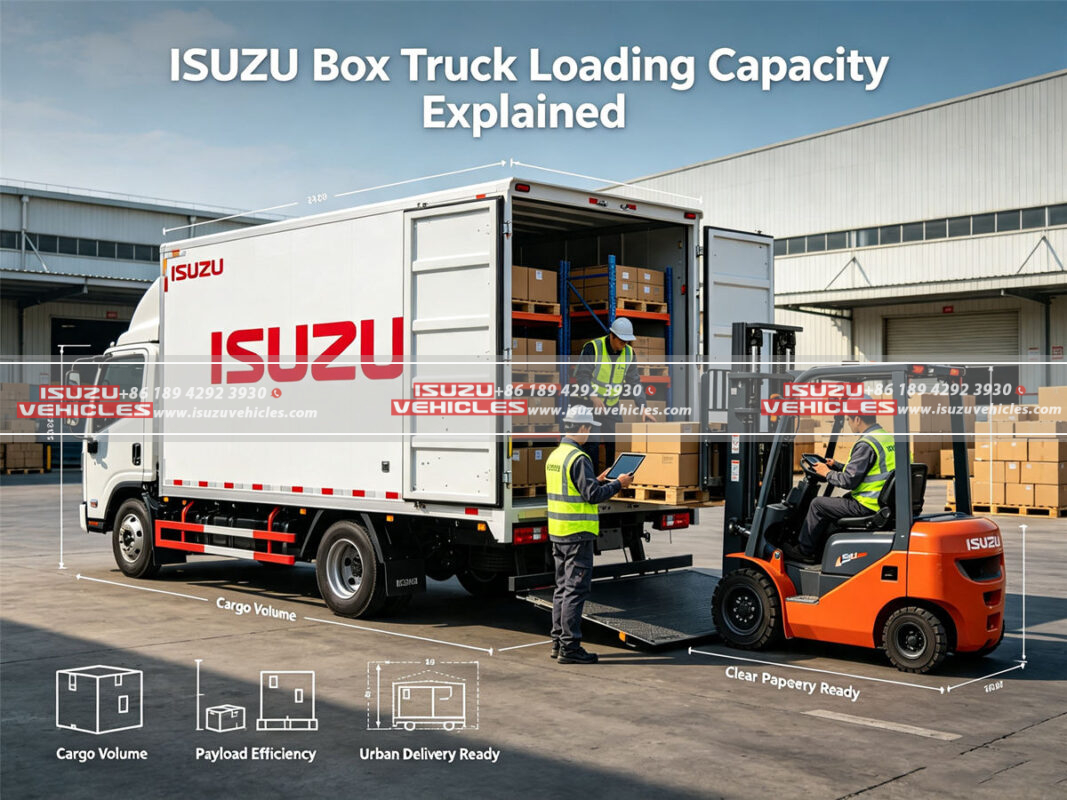
ISUZU Box Truck Loading Capacity Explained: How Much Cargo Can It Carry?
For businesses involved in logistics, distribution, retail delivery, manufacturing, and transportation services, selecting the right truck size is one of the most important decisions affecting daily operating efficiency. A vehicle that is too small may require additional trips, increasing fuel consumption and labor costs, while a truck that is too large may create unnecessary investment and reduce operational flexibility. Among various commercial transportation solutions, ISUZU box trucks are widely recognized for their balance of durability, fuel efficiency, maneuverability, and practical cargo capacity.
However, many customers often ask a simple but important question: How much cargo can an ISUZU box truck carry? The answer depends on several factors, including chassis model, gross vehicle weight rating, cargo box dimensions, engine capacity, axle configuration, and local transportation regulations.
Understanding these factors helps fleet operators choose the right vehicle configuration for their business instead of focusing only on external dimensions. Whether used for urban delivery, long-distance transportation, refrigerated logistics, or commercial distribution, an appropriately configured ISUZU box truck can provide excellent performance and long-term value.
Understanding the Main Factors That Determine ISUZU Box Truck Capacity
The loading capacity of a box truck is not determined only by the size of the cargo compartment. The actual carrying ability depends on the relationship between the truck’s chassis design, total weight limits, and the type of goods being transported.
Gross Vehicle Weight Rating and Payload Capacity
The most important specification when evaluating an ISUZU box truck is the Gross Vehicle Weight Rating (GVWR). This refers to the maximum total weight allowed when the truck is fully loaded, including:
- Vehicle chassis weight
- Cargo body weight
- Driver and passengers
- Fuel
- Tools and additional equipment
- Cargo
The payload capacity is calculated by subtracting the empty vehicle weight from the GVWR.
For example, if an ISUZU light-duty box truck has:
- GVWR: 7,000 kg
- Curb weight: 3,500 kg
The approximate payload capacity would be:
- 3,500 kg of cargo
However, the actual usable payload may vary depending on the cargo box structure, optional equipment, and regional regulations.
Cargo Box Volume vs. Weight Capacity
Another important point is that cargo volume and cargo weight are not the same.
A large cargo box may provide plenty of space but still have a limited weight capacity. This difference becomes especially important when transporting lightweight but bulky products such as:
- Furniture
- Packaging materials
- Electronics
- Clothing
- Household goods
On the other hand, heavy products such as:
- Machinery components
- Construction materials
- Metal products
may reach the truck’s weight limit before the cargo area is completely filled.
Therefore, professional operators consider both payload capacity and cargo volume when selecting an ISUZU truck.
Different ISUZU Box Truck Sizes and Their Typical Loading Capacities
ISUZU offers a wide range of commercial truck platforms, allowing customers to choose different sizes according to transportation requirements. From compact urban delivery vehicles to medium-duty logistics trucks, each model is designed for specific applications.
Light-Duty ISUZU Box Trucks
Light-duty models are commonly used for city distribution, supermarket delivery, courier transportation, and small business operations.
Typical specifications include:
- 4×2 drive configuration
- Compact chassis design
- Excellent urban maneuverability
- Lower fuel consumption
Depending on the chassis model, these trucks generally offer payload capacities ranging from approximately:
1.5 tons to 5 tons
Their smaller dimensions allow them to operate efficiently in crowded urban environments where larger trucks may have difficulty accessing narrow streets or restricted delivery zones.
These vehicles are especially popular among businesses requiring frequent short-distance deliveries with flexible scheduling.
Medium-Duty ISUZU Box Trucks
Medium-duty models provide increased cargo capacity while maintaining good operational efficiency.
Typical applications include:
- Regional distribution
- Industrial transportation
- Food delivery
- Manufacturing supply chains
Depending on configuration, medium-duty ISUZU box trucks commonly provide:
5 tons to 10 tons of payload capacity
These trucks often feature stronger chassis frames, larger engines, and bigger cargo compartments compared with light-duty versions, making them suitable for companies that require higher transportation efficiency.
Heavy-Duty ISUZU Box Trucks
For large-scale logistics operations, heavy-duty box trucks provide greater loading capability and longer-distance transportation performance.
These models are designed for:
- Highway transportation
- Large warehouse distribution
- Industrial cargo movement
- Commercial freight operations
Depending on the chassis configuration and regulations, heavy-duty ISUZU box trucks can offer payload capacities exceeding:
10 tons
Their larger engines, stronger suspension systems, and reinforced chassis structures allow them to handle demanding transportation tasks while maintaining reliability over extended service periods.
How Cargo Box Design Influences Loading Efficiency
The cargo body itself plays a major role in determining how effectively an ISUZU box truck can be used. A well-designed box body does not only provide storage space but also improves loading efficiency, cargo protection, and operational convenience.
Cargo Box Dimensions and Interior Layout
The internal dimensions of the box determine how many goods can be loaded and how efficiently space can be organized.
Important measurements include:
- Length
- Width
- Height
- Door opening size
- Floor strength
For example, a longer cargo box may allow more pallets to be loaded, while a taller box provides additional vertical storage space for lightweight goods.
Many businesses choose customized box dimensions according to their products. A logistics company transporting standard pallets may require different dimensions compared with a company delivering appliances or furniture.
Protection and Specialized Applications
One of the biggest advantages of a box truck compared with an open cargo vehicle is protection from external conditions.
The enclosed cargo structure protects goods from:
- Rain
- Dust
- Sun exposure
- Road debris
- Unauthorized access
For businesses transporting temperature-sensitive products, an ISUZU chassis can also be equipped with specialized bodies such as refrigerated compartments, creating a professional solution for cold-chain logistics.
This makes the platform suitable for applications beyond ordinary transportation, including food distribution and pharmaceutical delivery.
Why ISUZU Box Trucks Are Popular for Commercial Transportation
The popularity of ISUZU box trucks comes from more than just their loading capacity. Many fleet operators choose ISUZU because the vehicles combine practical cargo capability with long-term reliability and economical operation.
Durable Chassis and Efficient Engines
ISUZU commercial chassis are known for strong structural design and dependable diesel engines. These characteristics are especially valuable for businesses where trucks operate every day under demanding conditions.
A reliable engine reduces unexpected downtime, while efficient fuel consumption helps control operating expenses over thousands of kilometers of transportation.
Easy Maintenance and Global Parts Support
Another advantage of ISUZU trucks is their wide international service network. Since ISUZU commercial vehicles are used in many countries, replacement parts and maintenance knowledge are generally accessible.
For logistics companies, this means:
- Faster repairs
- Lower maintenance risks
- Longer vehicle service life
A truck that remains operational consistently can provide significantly better economic value than a vehicle with higher downtime, even if the initial purchase price is lower.
Choosing the Right ISUZU Box Truck for Your Business Needs
Selecting the correct loading capacity requires understanding the relationship between cargo type, transportation distance, road conditions, and operating frequency. A small urban delivery company may benefit from a compact ISUZU box truck with excellent maneuverability, while a regional logistics operator may require a larger model with increased payload capacity and cargo volume. The best choice is not always the largest truck available, but the vehicle that matches the actual transportation requirements with the highest efficiency. Whether customers need a dependable cargo truck for general distribution, a professional dry van truck for protected freight transportation, or customized commercial solutions from experienced suppliers, ISUZU Vehicles provide a strong foundation with reliable chassis performance, flexible configurations, and proven durability for businesses around the world.