
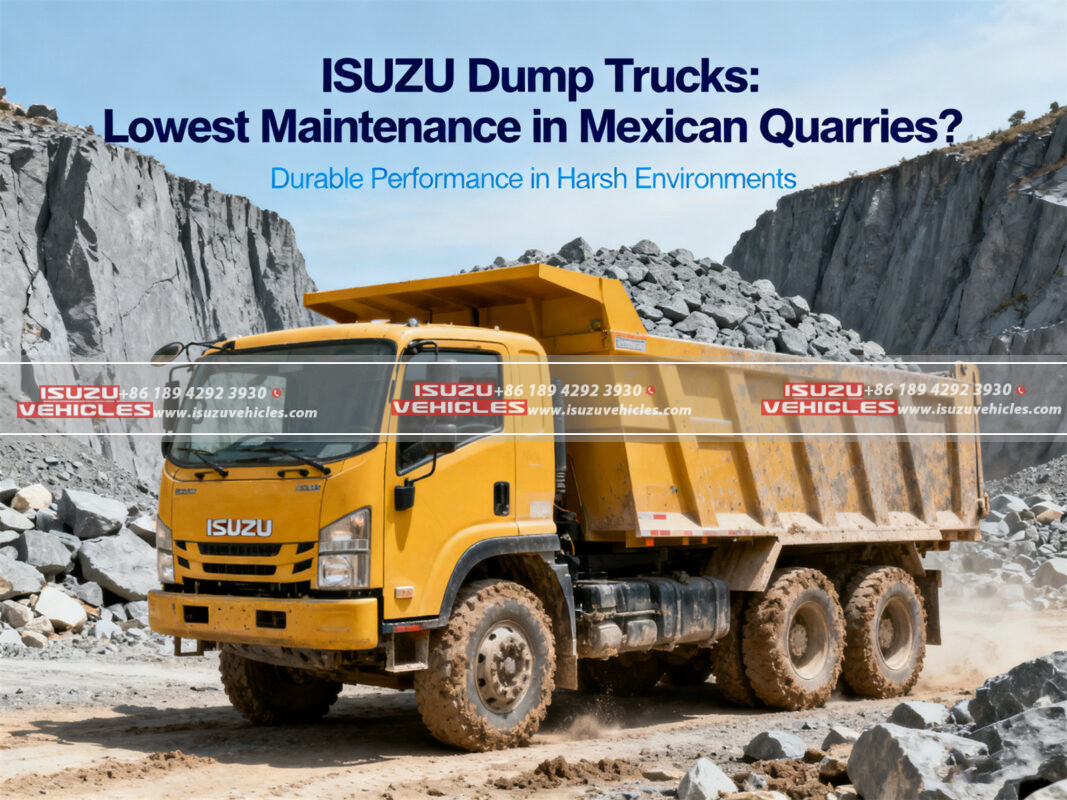
Across the rugged heart of Mexico’s mining regions — from Sonora’s copper-rich plateaus to the limestone quarries near Puebla — one name keeps reappearing among fleet managers and site operators who measure productivity not in numbers on paper but in the days their machines stay running: ISUZU dump trucks. They’ve become an almost standard presence on quarry roads, moving stone, sand, and aggregate under punishing conditions that test the endurance of every mechanical part and every design assumption.
The reputation these trucks have built over the years is not a product of marketing but of evidence. Operators who maintain dozens of units across multiple sites often say the same thing in different words: “They just don’t stop.” But what makes them so reliable in Mexico’s demanding quarry environments, where dust, vibration, and heat routinely destroy vehicles designed for gentler service? To answer that question, one must look closely at ISUZU’s engineering philosophy, its integration of mechanical simplicity and smart electronics, and the balance it strikes between operational cost and uptime.
1. The Harsh Reality of Mexican Quarry Operations
Before discussing why ISUZU’s dump trucks have earned their reputation for low maintenance, it’s important to understand the context in which they work. Mexican quarries are among the most mechanically abusive environments for trucks.
Most extraction sites operate on uneven terrain, often unpaved and ungraded, with abrasive dust that infiltrates every mechanical crevice. Ambient temperatures fluctuate dramatically — cool mornings, scorching afternoons, and sudden rainfall — creating thermal cycles that expand and contract metal structures thousands of times a week. Diesel engines inhale dust-filled air; transmissions endure shock loads from uneven rock surfaces; and brake systems face long descents under full loads.
These conditions quickly reveal weaknesses in any vehicle’s design. Trucks with complicated electronics, underdimensioned drivetrains, or high-maintenance suspension systems quickly accumulate downtime. In contrast, ISUZU’s dump trucks have found a niche precisely because their architecture minimizes these vulnerabilities, combining mechanical durability, modular components, and efficient cooling systems that extend service intervals far beyond industry averages.
2. Simplicity as a Design Strength
Mechanical Reliability Through Minimalism
One of ISUZU’s defining traits in its heavy-duty truck lineup has been its deliberate avoidance of unnecessary complexity. While modern trucks across the world increasingly depend on layers of software to regulate everything from transmission timing to fuel injection, ISUZU has adopted a philosophy of controlled modernization — introducing technology where it improves reliability rather than complicating service.
In the context of Mexican quarries, where access to advanced diagnostic tools can be limited and field mechanics rely on practical experience more than specialized computers, this philosophy pays dividends. The powertrains in ISUZU dump trucks are designed for ease of maintenance — filters, pumps, and belts are positioned for quick access, while hydraulic and pneumatic systems are color-coded and clearly routed. Every hour saved in maintenance is an hour gained in hauling, and over the course of a year, this translates into significant cost advantages.
Durability Under Stress
The chassis of ISUZU dump trucks employs reinforced ladder-frame steel with anti-corrosive coatings, capable of withstanding repetitive torsional stress from uneven quarry roads. The suspension systems are calibrated for high payload vibration absorption without frequent bushing or shock replacement. This combination of heavy-duty structure and tuned elasticity reduces the mechanical fatigue that typically forces other trucks into early repair cycles.
These are not theoretical benefits — maintenance records from operators in Querétaro and Guanajuato show intervals between major overhauls that are 20–30% longer than industry averages, largely due to fewer failures in the cooling, suspension, and driveline systems.
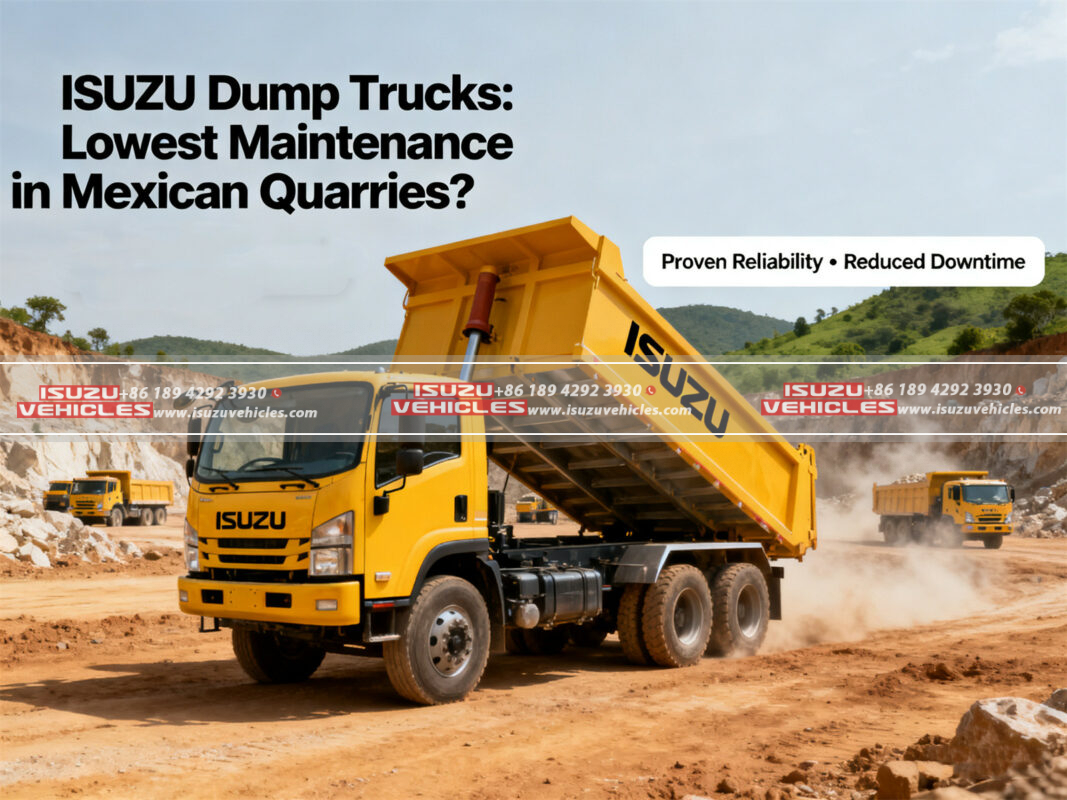
3. Efficient Powertrains Designed for Endurance
Engine Performance and Fuel Tolerance
ISUZU’s diesel engines are known for their balance of torque delivery and fuel efficiency, but in quarry environments, another trait becomes equally important: fuel tolerance. In many remote locations, diesel quality fluctuates, containing higher sulfur or water content that can cause injector wear and clogging in high-precision systems. ISUZU engines are built with injection systems designed to handle this variability, featuring filtration redundancies and simplified fuel mapping to prevent failure even under suboptimal fuel conditions.
Cooling systems, a critical factor in hot and dusty operations, are built with high-capacity radiators and thermostatically controlled fans that respond to real load temperature, not just ambient readings. This ensures that overheating — a common cause of engine wear in quarry trucks — remains rare. Combined with robust oil circulation and filtration, these measures enable longer oil-change intervals and reduce the risk of catastrophic engine wear from debris infiltration.
Transmission and Differential Engineering
A dump truck’s lifespan in a quarry is often limited by its driveline, not its engine. ISUZU’s transmission systems are purpose-built for low-speed torque delivery and frequent load cycling. Reinforced gearsets, improved lubrication channels, and temperature-resistant seals allow continuous operation under heavy loads with minimal slippage.
Differentials feature heavy-duty bearings and optimized tooth geometry, reducing heat generation during prolonged uphill hauling. Because each quarry presents a different topography, these design considerations give ISUZU a practical advantage — they minimize overheating and metal fatigue in the very components that determine service frequency.

4. Operator Safety and Cabin Integrity
Ergonomic Design Meets Long-Hour Endurance
Maintenance efficiency is not only mechanical but human. Fatigue-induced mishandling leads to premature wear or accidents, which is why ISUZU has invested heavily in operator ergonomics even in its most rugged models. The cabin design balances visibility, comfort, and vibration control — three elements that directly influence driver alertness and precision.
Seats are suspended to absorb vertical shocks from uneven terrain, while control levers and switches are placed within natural reach zones to prevent overextension during repeated maneuvers. The dashboard layout uses analog clarity combined with essential digital monitoring, displaying only the parameters that matter: oil temperature, air pressure, and load weight. By reducing unnecessary distractions, ISUZU ensures that operators can concentrate fully on terrain and payload — a subtle but decisive factor in avoiding operational stress on mechanical parts.
Safety Systems and Structural Reinforcement
In quarry conditions, safety overlaps with structural preservation. Cab reinforcements protect both driver and vehicle from rollover or falling debris incidents. Braking systems employ anti-lock modulation suitable for low-traction surfaces, while the air braking circuits are partitioned to ensure redundancy in case of line damage. These measures prevent not only accidents but also the downtime that inevitably follows them, reinforcing ISUZU’s reputation for consistent availability.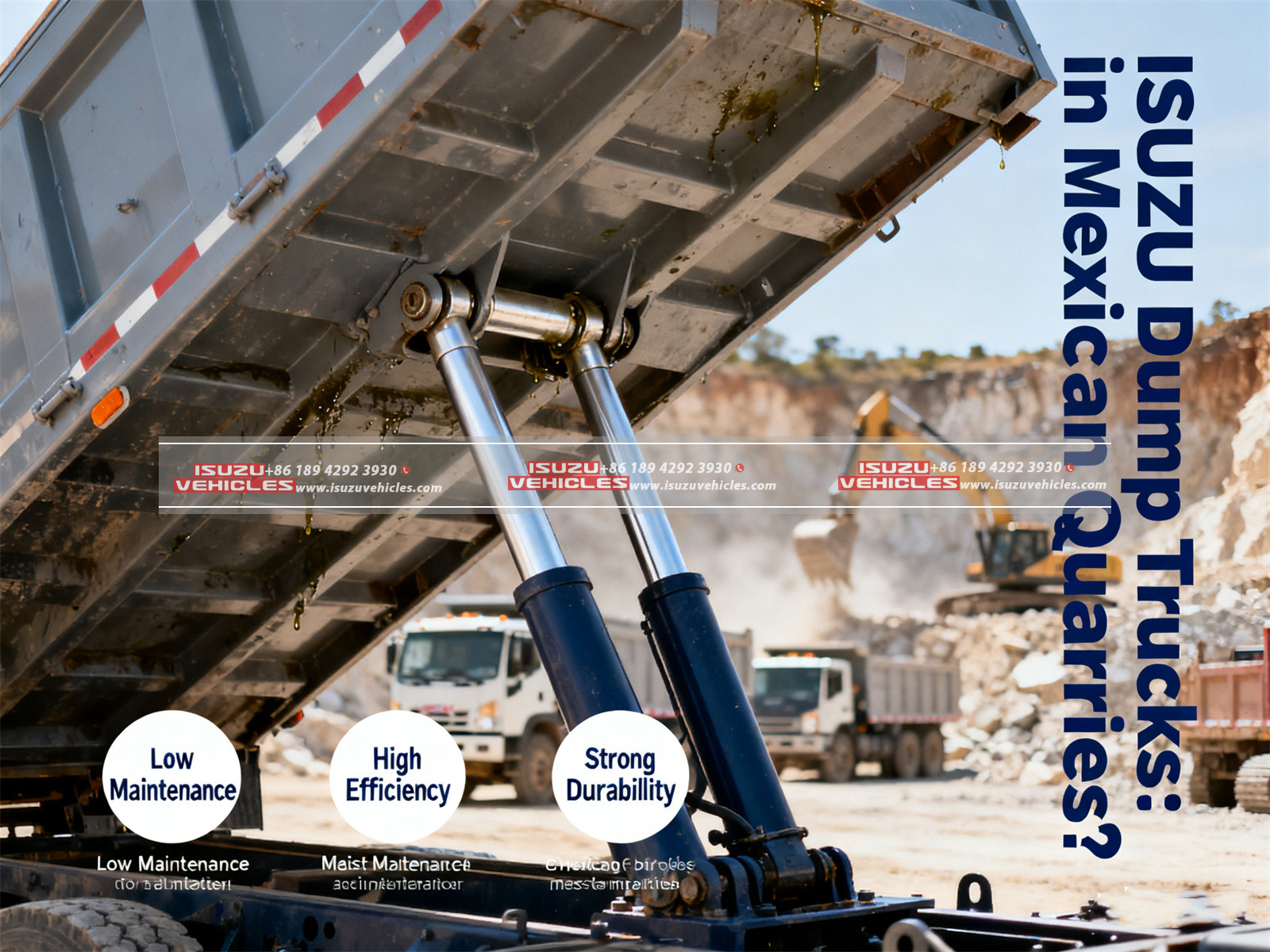
5. Maintenance Economics and Lifecycle Value
Extended Service Intervals
What distinguishes ISUZU dump trucks in Mexican quarries is not just that they require fewer repairs but that they stretch out the time between each service cycle. Their consumable components — filters, belts, seals — are built for extended life, and their diagnostic simplicity enables mechanics to perform quick, accurate inspections without prolonged disassembly.
This efficiency shows up clearly in operational economics: lower parts consumption, reduced labor time, and fewer unplanned halts. Over a five-year operating window, quarry operators often find total cost per ton hauled significantly lower than with competitive models. The maintenance predictability also simplifies budgeting and inventory management, ensuring parts availability aligns with real service demand rather than overstocking “just in case.”
Fleet Management Integration
Modern ISUZU models are compatible with telematics systems that log engine performance, load cycles, and idle times. These data-driven insights allow quarry managers to detect patterns that precede maintenance needs, such as rising coolant temperatures or abnormal vibration signals. Preventive scheduling becomes easier, transforming maintenance from reactive to predictive — a key factor in sustaining profitability when margins depend on daily output consistency.
6. A Broader Vision: ISUZU’s Role in Industrial Reliability Across Mexico
It’s no coincidence that ISUZU dump trucks have become integral to Mexico’s quarrying and construction ecosystems. Their success stems from a design culture that treats simplicity, durability, and adaptability not as opposites of innovation but as its most practical form. Every welded joint, every sensor, and every fluid channel is engineered with the expectation that it will face dust, heat, impact, and fatigue as part of its daily routine — and still deliver measurable performance after thousands of hours in operation.
Fleet owners who operate across both extraction and infrastructure sectors have begun to expand their ISUZU fleets beyond dump trucks. The same engineering logic — the balance between strength, efficiency, and ease of service — can be found in related platforms such as the ISUZU bucket truck, used for utility maintenance in remote industrial areas, and the ISUZU truck with crane, essential for material handling where precision lifting complements heavy haulage. Together, these models illustrate a consistent engineering identity: vehicles built to sustain productivity under punishing conditions, requiring less attention and providing more output.
In the end, the phrase “lowest maintenance” doesn’t merely describe an economic benefit — it expresses a broader relationship between machine and environment, one that ISUZU has managed to refine into a quiet but unmistakable form of industrial reliability that keeps Mexico’s quarries moving, shift after shift, year after year.