
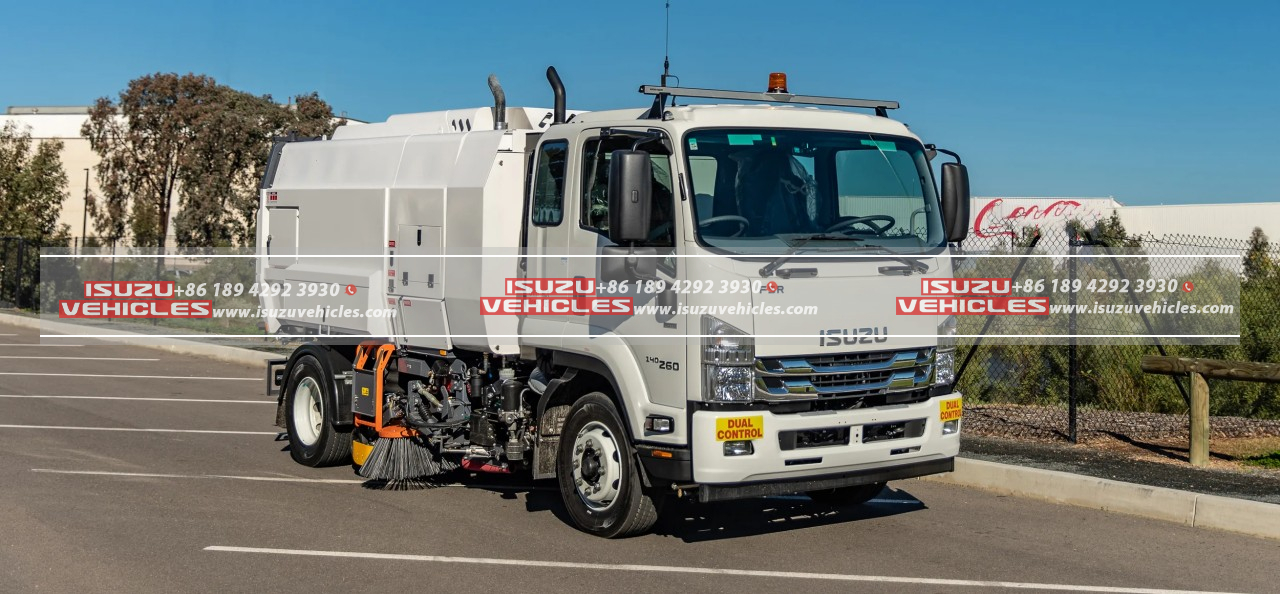
The arrival of cutting-edge ISUZU Sweeper Trucks in Panama heralds a quantum leap in the nation’s urban environmental management, deploying AI-driven cleaning systems across Panama City’s financial district, Colón’s Free Trade Zone corridors, and UNESCO-protected heritage sites in Casco Viejo where microplastic pollution, construction debris, and tropical storm runoff compromise public health and tourism revenue. Engineered explicitly for Central America’s climatic extremes—from torrential downpours to Saharan dust incursions—these vehicles integrate regenerative air-filtration technology capturing 99.3% of PM10 particulates while recycling 85% of water via closed-loop purification, enabling municipalities to reduce street maintenance costs by 40% while achieving UN-Habitat urban livability standards; this strategic deployment accelerates Panama’s “Green City Accord,” mitigating dengue outbreaks linked to clogged drains, enhancing cruise tourism appeal, and establishing the nation as Latin America’s pioneer in intelligent municipal stewardship.
Revolutionary Sweeping Engineering for Tropical Metropolises
Redefining urban hygiene through Japanese durability and digital innovation, the ISUZU FVR Eco-Sweepers combine military-grade chassis with ecological intelligence, featuring multi-stage cyclone separators that extract everything from volcanic ash to tire fragments below 5 microns, while adaptive brush torque systems auto-adjust pressure across surfaces from colonial cobblestones to modern expressways.
Intelligent Debris Processing Architecture
Patented vortex-enhanced suction tunnels generate 28kPa vacuum force to dislodge sediment from porous surfaces without damage, paired with AI-optimized debris recognition cameras identifying hazardous waste like syringes or battery cells, triggering sealed containment protocols; the rainwater-harvesting add-ons capture and filter 5,000 liters daily—a game-changer during Panama’s October monsoons.
Extreme-Weather Resilience Systems
Fortified by tropicalized corrosion-resistant alloys resisting salt erosion in coastal provinces, and typhoon-rated stability controls maintaining operation in 100km/h winds, these trucks ensure 97% uptime during extreme weather; critically, hybrid-electric auxiliary drives enable zero-emission cleaning in pedestrian zones, aligning with Panama City’s Carbon Neutrality 2050 mandate.
Digital Urban Ecosystem Integration
The fleet functions as networked environmental sentinels, with embedded IoT telematics mapping pollution sources and transmitting real-time data to the National Municipal Command Center.
Predictive Urban Analytics Framework
Machine learning algorithms forecast debris accumulation near ports before cruise ship arrivals, pre-deploying sweepers to high-impact zones, while traffic-adaptive routing software cuts fuel consumption by 30% through dynamic congestion avoidance; concurrently, drainage capacity monitors predict flood risks 72 hours in advance, transforming reactive cleaning into climate-resilient governance.
Citizen-Centric Service Platforms
Integrated blockchain reporting portals allow residents to verify neighborhood cleaning compliance, while municipal transparency dashboards publish real-time PM2.5 reduction metrics—fostering unprecedented public trust in environmental investments.
Strategic Alliance: Building Panama’s Green Tech Sovereignty
This milestone springs from a visionary partnership between ISUZU Vehicles and Panama’s infrastructure leader, Panama Limpia Group, establishing a co-innovation ecosystem that transfers manufacturing capabilities, technical expertise, and circular economy models to Central America.
End-to-End Industrial Enablement
The collaboration launches Central America’s first Smart Sweeper Academy in David City, certifying 300+ Panamanian engineers in AI maintenance and hybrid powertrains, while Panama Pacifico assembly facilities initiate localized production of filtration matrices and sensor suites—slashing import costs by 55% through ISUZU-authenticated quality regimes. Parallel waste-to-resource initiatives will convert collected biomass into biochar for urban landscaping, creating self-funding sanitation loops.
Socioindustrial Transformation Engine
Beyond technical transfer, the venture ignites Panama’s high-tech manufacturing via domestic production of suction turbines and control modules, generating 180+ skilled jobs and stimulating local composites and electronics sectors—with 45% local content integration targeted by 2030. Panama Limpia now emerges as Latin America’s hub for self-sustaining urban environmental solutions.
Multidimensional Socioeconomic Impact
The ISUZU-Panama Limpia initiative delivers cascading co-benefits: Hospitalization reductions from particulate-related diseases save public health systems $15M annually, while enhanced cruise tourism aesthetics boost port city revenues by 12%. Informal waste workers transition into certified equipment technicians with 400% income gains, embodying Panama’s commitment to equitable ecological modernization where environmental excellence and social inclusion converge.
Catalyzing Panama’s Circular Urban Future
The partnership lays groundwork for the region’s most advanced Integrated Municipal Services Network, with imminent phase-two expansions featuring ISUZU vacuum trucks for canal-zone drain maintenance and ISUZU garbage trucks equipped with AI-driven compaction intelligence for synchronized waste logistics. This fleet-level integration enables seamless material management—from street to recycling hub—positioning Panama as a laboratory for regenerative urbanism. By transforming organic sweepings into biogas for public transit and repurposing recovered plastics for waterfront boardwalks, Panama pioneers a Zero-Waste Tropical Metropolis, offering scalable templates for coastal nations confronting climate-amplified pollution through technological transcendence.