
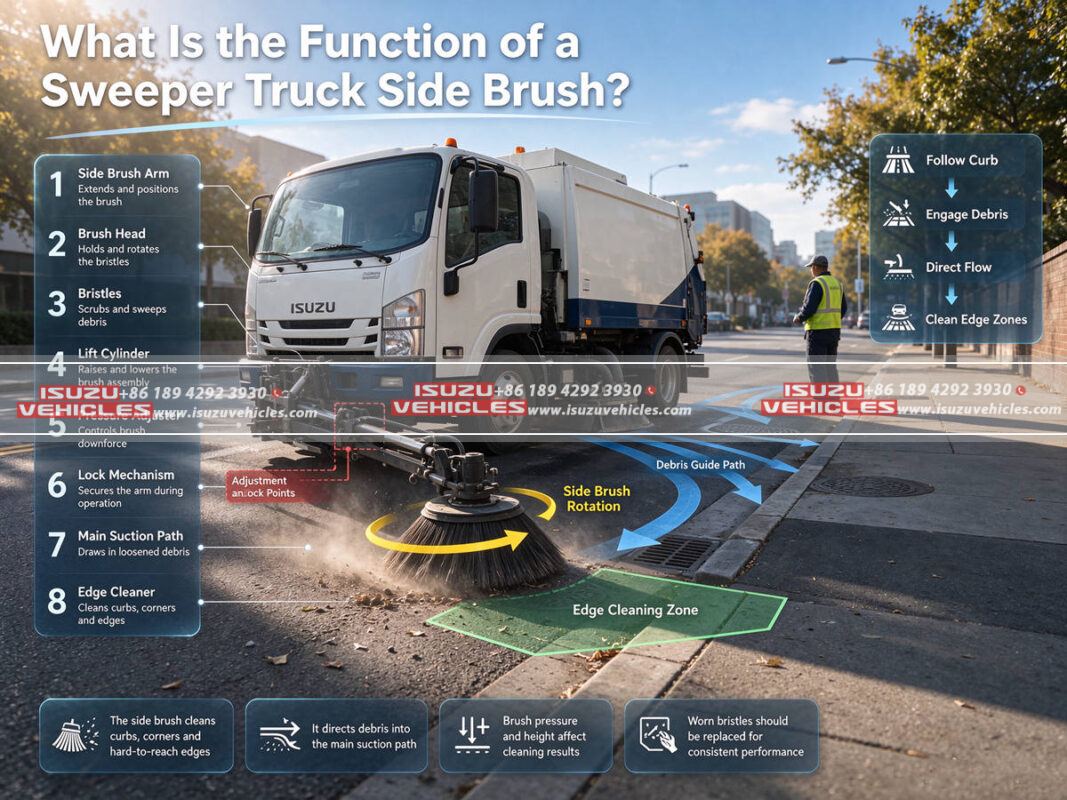
When it comes to maintaining clean roads, removing accumulated dust, and keeping urban environments in good condition, a modern road sweeper truck relies on several coordinated cleaning components to achieve effective results. Among these components, the side brush plays an especially important role because it reaches areas that the main sweeping mechanism cannot easily clean, including roadside edges, gutters, corners, parking spaces, and areas close to curbs. Although it may appear to be a relatively simple rotating component, its design, positioning, rotation speed, and hydraulic control directly influence the overall cleaning performance of the vehicle.
So, what exactly is the function of a sweeper truck side brush, and why is it so important for professional road-cleaning operations? In simple terms, the side brush loosens, gathers, and directs dust, sand, leaves, stones, and other accumulated debris from the edges of the road toward the central suction area or collection mechanism, allowing the vehicle to remove waste more efficiently during a single cleaning pass. Without properly functioning side brushes, a sweeper truck could leave considerable amounts of debris along curbs and roadside areas, even if its central suction system performs exceptionally well.
For municipalities, sanitation departments, industrial cleaning contractors, and commercial property managers, understanding how this component works can help improve equipment selection, daily operating efficiency, and long-term maintenance planning. This article explores the main functions of side brushes, their operating principles, various brush configurations, maintenance requirements, and their relationship to other road-cleaning systems offered by ISUZU Vehicles.
1. What Is a Sweeper Truck Side Brush?
A sweeper truck side brush is a rotating mechanical cleaning component installed near the lower front or side section of a road sweeper, usually positioned close to the front wheels. Depending on the vehicle configuration, a sweeper truck may have one or two side brushes, while some larger professional cleaning vehicles use four-disc brush arrangements to provide wider cleaning coverage and more comprehensive debris collection.
Unlike the main suction nozzle, which primarily collects loosened debris through airflow, the side brush makes direct contact with the road surface and physically moves accumulated materials. Its circular brush head rotates at a controlled speed, allowing the bristles to sweep debris away from roadside edges and guide it toward the central collection area. This mechanical action is particularly useful for cleaning locations where dirt tends to accumulate over time, such as drainage channels, curb lines, road intersections, and the spaces between parked vehicles.
The brush assembly generally consists of several important components:
- Brush disc: The circular supporting structure that holds the sweeping bristles in position and rotates during operation.
- Brush bristles: The working elements that contact the road surface and remove dust, sand, leaves, and other debris.
- Hydraulic motor: The power unit responsible for driving the brush rotation on many professional sweeper trucks.
- Supporting arm: The mechanical structure that connects the brush assembly to the vehicle and allows it to extend or retract.
- Hydraulic lifting mechanism: The system that raises or lowers the brush according to operating requirements.
- Control system: The controls that allow the operator to manage brush rotation, working position, and other operating functions from the driver’s cab.
The materials used for the bristles vary according to the intended application. Steel-wire bristles are commonly selected for demanding industrial environments and stubborn accumulated dirt, while polypropylene or other synthetic bristles are suitable for lighter cleaning applications and surfaces where a less aggressive brushing action is preferred. Some brush designs combine different bristle materials to balance cleaning strength, flexibility, and service life.
For example, an urban road sweeper may require a different brush configuration from a vehicle regularly cleaning construction sites or industrial parks. Selecting the appropriate brush material and operating arrangement helps ensure that the vehicle can maintain effective cleaning performance without causing unnecessary wear to the road surface or sweeping equipment.
2. What Are the Main Functions of a Sweeper Truck Side Brush?
The side brush performs several essential tasks that contribute directly to the cleaning efficiency of a road sweeper. Although its primary responsibility is moving debris toward the collection system, its practical functions extend beyond simply rotating against the pavement.
Cleaning Road Edges and Curbs
One of the most important functions of a side brush is cleaning areas along the edges of roads, particularly locations where dust, leaves, sand, and other materials accumulate naturally. Road curbs often create narrow spaces that are difficult to reach with the central suction nozzle or the main cleaning mechanism, especially when the vehicle is operating on narrow urban streets.
As the truck moves forward, the side brush extends toward the roadside and rotates against the pavement, loosening accumulated dirt and sweeping it inward. This allows the debris to move away from the curb and into the working area of the suction nozzle, where it can be collected and transferred into the garbage tank.
This function is especially valuable in residential neighborhoods, commercial districts, industrial facilities, and urban streets with frequent roadside parking, where conventional cleaning methods may leave visible dirt along the pavement edges.
Gathering and Directing Road Debris
Another major function is collecting scattered materials and guiding them toward the central suction system. A road surface may contain a mixture of fine dust, dry leaves, gravel, cigarette packaging, paper fragments, and other solid waste, and these materials are often distributed across different areas rather than concentrated in one location.
The rotating side brush creates a controlled sweeping movement that pushes scattered debris inward. When the brush is correctly positioned and its rotation direction is properly configured, the materials can be gathered into a relatively concentrated path, making it easier for the suction nozzle to capture them.
This coordinated operation reduces the likelihood of leaving debris behind and helps the vehicle achieve more consistent cleaning results. It also improves the efficiency of the collection process because the suction system does not need to locate and collect every scattered particle independently.
Removing Dust and Fine Particles
Fine dust is one of the most common challenges in municipal road maintenance, particularly in dry climates, construction areas, mining environments, and locations with heavy vehicle traffic. As vehicles pass over accumulated road dust, some of these particles can become airborne, affecting visibility and reducing local air quality.
The side brush helps loosen fine particles that have settled on the pavement, allowing them to be collected by the vehicle’s suction system. Many modern road sweepers also use water spray nozzles around the brush assembly to control dust during operation. The water slightly moistens the working area, reducing the amount of dust released into the air as the bristles rotate.
However, the side brush should not be expected to control dust independently. Its effectiveness depends on the combined performance of the water-spraying arrangement, suction fan, filtration system, and debris collection equipment.
Improving Overall Cleaning Coverage
A sweeper truck without side brushes would have difficulty cleaning roadside areas and other locations outside the effective working range of its central collection system. Side brushes extend the cleaning width of the vehicle, allowing it to cover a larger area during each pass and reduce the need for repeated cleaning operations.
For example, some professional road sweepers use two front side brushes to clean both sides of the working area, while four-brush configurations can provide additional flexibility and wider sweeping coverage. The exact cleaning width depends on the brush diameter, extension distance, vehicle arrangement, and operating conditions.
By increasing the effective cleaning area, side brushes help municipal cleaning teams complete larger routes with fewer passes, improving daily productivity and making better use of available equipment and labor.
3. How Does a Sweeper Truck Side Brush Work?
The operating principle of a side brush is relatively straightforward, but its performance depends on the coordination of mechanical, hydraulic, and electrical systems. In most modern road sweeper trucks, the brush is driven by a hydraulic motor, while hydraulic cylinders control its lifting and extension movements.
When the operator activates the sweeping function from the cab, the control system sends the appropriate signals to the hydraulic circuit. Hydraulic oil flows through the system and powers the brush motor, causing the circular brush head to rotate at the required speed. At the same time, the supporting arm positions the brush at the appropriate working height and angle.
Once the truck begins moving forward, the rotating bristles make contact with the pavement and sweep accumulated debris toward the central collection area. The suction nozzle then draws the loosened materials into the collection tank through a powerful airflow system.
The complete working process generally follows these steps:
- Brush deployment: The operator lowers the side brush and moves it into the required working position.
- Hydraulic activation: The hydraulic motor drives the brush disc at the selected operating speed.
- Surface contact: The bristles contact the road surface and loosen accumulated dirt and debris.
- Debris movement: The rotating brush guides the materials inward toward the suction nozzle.
- Vacuum collection: The suction fan creates negative pressure, drawing the debris through the suction opening and into the collection tank.
- Filtration: The filtration system separates dust and particles from the airflow to reduce secondary dust emissions.
The relationship between brush rotation speed and vehicle driving speed is particularly important. If the brush rotates too slowly, it may fail to remove stubborn debris or move materials effectively toward the suction area. If it rotates excessively fast, the bristles may scatter dust and small particles, increase wear, or produce unnecessary splashing when water is being sprayed.
For this reason, professional operators should adjust the brush speed, working angle, and contact pressure according to the road conditions, debris type, and vehicle configuration rather than relying on one fixed operating setting for every cleaning situation.
4. Different Types of Side Brushes and Their Applications
Not all side brushes are designed for the same working conditions. Different road surfaces, cleaning requirements, and vehicle configurations influence the selection of brush materials, diameters, and operating arrangements. Understanding these differences helps fleet managers choose a suitable sweeping system for their daily operations.
Single Side Brush Configuration
A single side brush is commonly used on compact road sweepers and smaller municipal cleaning vehicles. Its relatively simple arrangement makes it suitable for narrow roads, residential streets, small industrial facilities, and commercial parking areas where maneuverability is more important than maximum cleaning width.
This configuration can effectively clean one roadside area while guiding debris toward the central suction opening. It also offers a practical solution for operators who require a compact vehicle with straightforward maintenance requirements and a relatively economical cleaning system.
Dual Side Brush Configuration
A dual-brush arrangement is widely used on medium-duty and heavy-duty road sweepers because it provides more comprehensive cleaning coverage. With brushes positioned on both sides of the front working area, the vehicle can sweep a wider section of pavement and handle roadside debris more effectively.
Many professional configurations allow the left and right brushes to operate independently, giving the operator greater flexibility when cleaning narrow streets, intersections, and areas with different roadside obstacles. Depending on the vehicle design, the brushes can also be raised, lowered, or adjusted to accommodate changing working conditions.
Four-Disc Hydraulic Brush Configuration
Some large-capacity road sweepers adopt four-disc hydraulic sweeping systems to achieve wider coverage and more intensive cleaning performance. These systems are particularly useful for urban arterial roads, industrial parks, large commercial facilities, and other locations where substantial cleaning capacity is required.
For example, the ISUZU 12 CBM Road Sweeper Truck features a four-disc hydraulic sweeping brush arrangement, with a stated sweeping width of approximately 2.6–3.2 meters and brush diameters of 850 mm. Its hydraulic brush drive and adjustable rotation speed allow operators to adapt the sweeping system to different road conditions and cleaning requirements.
The configuration demonstrates how brush arrangement can influence the overall working capability of a professional sweeper truck, particularly when the mechanical sweeping system is integrated with a powerful suction nozzle and water-flushing equipment.
For additional information about different vehicle configurations and cleaning applications, explore the road sweeper truck range available from ISUZU Vehicles.
5. Why Is the Side Brush Important for Overall Sweeper Truck Performance?
The side brush is not simply an auxiliary attachment; it is an important part of the complete cleaning system, and its performance directly influences how effectively the vehicle removes debris from different sections of the road. Even a powerful suction fan cannot deliver satisfactory results if accumulated dirt remains outside the suction nozzle’s effective collection area.
By loosening debris and directing it toward the collection opening, the side brush allows the suction system to work more efficiently. This coordinated process is especially important when dealing with roadside sand, dry leaves, small stones, and other materials that may become trapped near curbs or uneven pavement surfaces.
Higher Cleaning Efficiency
Effective side brushes allow the vehicle to clean a wider area in a single pass, reducing the time required to complete municipal cleaning routes. For contractors responsible for large road networks, this improvement can translate into better vehicle utilization, lower labor requirements, and more predictable daily operating schedules.
Better Cleaning Results in Difficult Areas
Road edges, drainage channels, parking areas, and street corners frequently collect materials that ordinary vehicle traffic cannot remove. The ability of side brushes to extend beyond the main body of the truck makes them particularly useful for cleaning these difficult locations, helping operators maintain a more consistent standard across the entire road surface.
Reduced Manual Cleaning Requirements
When the side brush and suction system work properly together, the truck can collect a greater proportion of accumulated debris mechanically, reducing the amount of manual sweeping required after vehicle operations. Although certain narrow spaces and heavily obstructed locations may still require additional attention, a properly configured sweeper can significantly reduce routine manual cleaning workloads.
More Effective Dust Management
When combined with water-spraying equipment and an efficient vacuum filtration system, side brushes help manage the dust generated during mechanical sweeping. This is particularly valuable in densely populated urban areas, industrial facilities, and locations where environmental cleanliness is an important operational requirement.
For these reasons, the side brush should be evaluated as part of the entire cleaning system rather than as an independent component. Brush quality, hydraulic performance, suction capacity, filtration efficiency, and water distribution all contribute to the final cleaning result.
6. Common Side Brush Problems and Maintenance Tips
Like other working components exposed to continuous contact with road surfaces, side brushes experience mechanical wear and require regular inspection. Their bristles gradually become shorter, uneven, or damaged, while hydraulic components may develop leaks or reduced operating performance after extended service.
Without appropriate maintenance, these problems can reduce cleaning efficiency, increase operating costs, and place additional pressure on other parts of the sweeping system. Fortunately, many common problems can be prevented through routine inspection and proper operating procedures.
Excessive Brush Wear
Worn bristles are one of the most common maintenance issues. When the brush material becomes too short or uneven, the side brush may no longer maintain consistent contact with the road surface, resulting in incomplete debris removal.
Operators should regularly inspect the bristle length, overall brush shape, and mounting condition. Brushes should be replaced when their cleaning performance deteriorates beyond acceptable operating limits or when visible damage affects their ability to maintain consistent surface contact.
Hydraulic Motor Problems
If a hydraulic motor develops a fault, the side brush may rotate slowly, operate irregularly, or stop completely. Possible causes include insufficient hydraulic pressure, contaminated hydraulic oil, damaged hoses, restricted filters, or internal motor wear.
Regular hydraulic system inspections, correct oil selection, and timely replacement of filters help maintain stable operation. Any unusual noise, excessive vibration, or oil leakage should be investigated before the vehicle returns to demanding cleaning work.
Incorrect Brush Height or Working Angle
A brush that is positioned too high may fail to contact the road surface effectively, while a brush that is positioned too low can experience excessive resistance and unnecessary wear. Incorrect working angles may also cause debris to scatter rather than move toward the suction nozzle.
Operators should follow the manufacturer’s adjustment recommendations and check the brush position regularly, especially after replacing the brush assembly or performing hydraulic maintenance.
Blocked or Damaged Spray Nozzles
Water spray nozzles installed near the side brushes help suppress dust during sweeping operations. If these nozzles become blocked by dirt or mineral deposits, water distribution may become uneven, reducing dust-control performance.
Cleaning the nozzles, checking water filters, and inspecting the spray lines can help maintain consistent water delivery. Operators should also ensure that the water supply is adequate before beginning extended cleaning operations.
A practical maintenance routine should include the following checks:
- Inspect the brush bristles for excessive wear, missing sections, and deformation.
- Check the hydraulic motor, cylinders, hoses, and connections for leaks or abnormal operation.
- Verify that the brush can extend, retract, raise, and lower smoothly.
- Check the brush rotation speed and confirm that the working direction is correct.
- Clean the water spray nozzles and inspect the related filters and pipelines.
- Remove accumulated debris from the brush assembly and supporting structures.
- Inspect mounting bolts and mechanical connections for looseness or damage.
Consistent maintenance not only extends the service life of the side brush but also helps protect the hydraulic and suction systems from unnecessary operating stress.
7. How Does the Side Brush Work with Other Municipal Cleaning Equipment?
Although the side brush is a fundamental component of a road sweeper, effective municipal sanitation usually requires several types of specialized vehicles working together. Different vehicles perform different cleaning functions, and understanding their respective roles helps municipalities and contractors develop a more efficient fleet.
Side Brush and Vacuum Suction System
The relationship between the side brush and the vacuum suction system is central to the operation of a modern vacuum sweeper. The brush loosens and directs debris toward the suction opening, while the fan generates the airflow needed to transport the collected materials into the garbage tank.
These two systems complement each other because mechanical brushing alone may scatter fine dust or leave debris in the working area, whereas vacuum suction alone may struggle to collect materials located near curbs or outside the effective reach of the suction nozzle.
By combining mechanical sweeping and vacuum collection, modern road sweepers can remove a wider variety of materials and achieve more consistent cleaning results. Businesses interested in vehicles designed for specialized liquid waste and sewer maintenance can also explore the vacuum truck solutions offered by ISUZU Vehicles.
Side Brush and Sprinkler Truck
Water is another important part of road-cleaning operations because dry sweeping can generate airborne dust, especially when the pavement contains large quantities of fine sand or accumulated dirt. A sweeper truck therefore often uses a dedicated water tank and spray nozzles to moisten the working area during brush operation.
For larger-scale road washing, dust suppression, and water distribution requirements, a sprinkler truck can provide additional support. Rather than mechanically collecting solid waste, a sprinkler truck distributes water over road surfaces and other designated areas, helping loosen dirt and control dust before or after sweeping operations.
In some municipal cleaning programs, a sprinkler truck first washes or moistens the road, after which a sweeper truck collects the loosened materials. This coordinated approach is particularly useful for heavily contaminated roads, construction areas, and industrial environments where water-based cleaning and mechanical debris removal are both necessary.
Building a Complete Municipal Sanitation Fleet
For municipalities responsible for maintaining large urban areas, relying on one type of vehicle is rarely sufficient to address every sanitation requirement. A well-planned fleet may include road sweepers for solid debris collection, vacuum trucks for sewage and sludge removal, sprinkler trucks for road washing and dust suppression, and garbage trucks for general waste collection.
Each vehicle performs a specific task, and their combined capabilities allow sanitation departments to manage different environmental maintenance challenges more systematically. ISUZU Vehicles provides a range of specialized commercial vehicles that can support these applications, giving municipal departments and private contractors more flexibility when selecting equipment for their operational requirements.
8. How to Choose the Right Side Brush for a Sweeper Truck?
Selecting an appropriate side brush requires consideration of more than its diameter or appearance. The correct configuration should match the vehicle’s cleaning system, intended working environment, expected debris types, and daily operating requirements. A brush that performs well on smooth urban roads may not deliver the same results on rough industrial surfaces or heavily contaminated construction roads.
Before purchasing a sweeper truck or replacing its brush assembly, fleet managers should evaluate several important factors.
- Road conditions: Consider whether the vehicle will operate mainly on smooth asphalt, concrete roads, uneven pavement, or industrial surfaces.
- Debris characteristics: Determine whether the primary cleaning materials consist of fine dust, sand, leaves, gravel, or heavier accumulated waste.
- Brush material: Choose between steel-wire, synthetic, or mixed-bristle designs according to the required cleaning strength and surface conditions.
- Brush diameter: Ensure that the brush size is compatible with the vehicle’s supporting arm, cleaning width, and suction nozzle arrangement.
- Hydraulic capacity: Confirm that the hydraulic system can provide the pressure and flow required for stable brush operation.
- Adjustment flexibility: Consider whether the brush can be independently controlled, extended, retracted, and adjusted to accommodate different roadside conditions.
- Replacement availability: Check the availability of replacement brushes and other maintenance components to reduce potential downtime.
It is also important to consider the overall vehicle configuration rather than selecting a brush independently. A high-quality brush cannot compensate for inadequate suction capacity, poor hydraulic performance, or an incorrectly designed debris collection system. The best results come from matching the brush assembly with the vehicle’s complete cleaning equipment.
For operators considering a new road-cleaning vehicle, the ISUZU sweeper range offers different configurations for municipal road maintenance, industrial cleaning, and urban sanitation. The appropriate selection depends on the required cleaning width, garbage tank capacity, water supply, chassis specifications, and expected daily workload.
Ultimately, the side brush performs a simple but essential job: it reaches the areas that other cleaning components cannot easily handle, loosens accumulated dirt, and directs debris toward the collection system. When properly designed, adjusted, and maintained, it helps a sweeper truck achieve wider cleaning coverage, better debris collection, and more reliable daily performance. For municipalities and professional cleaning contractors, understanding this component is an important step toward choosing and operating a more effective road sanitation vehicle.