
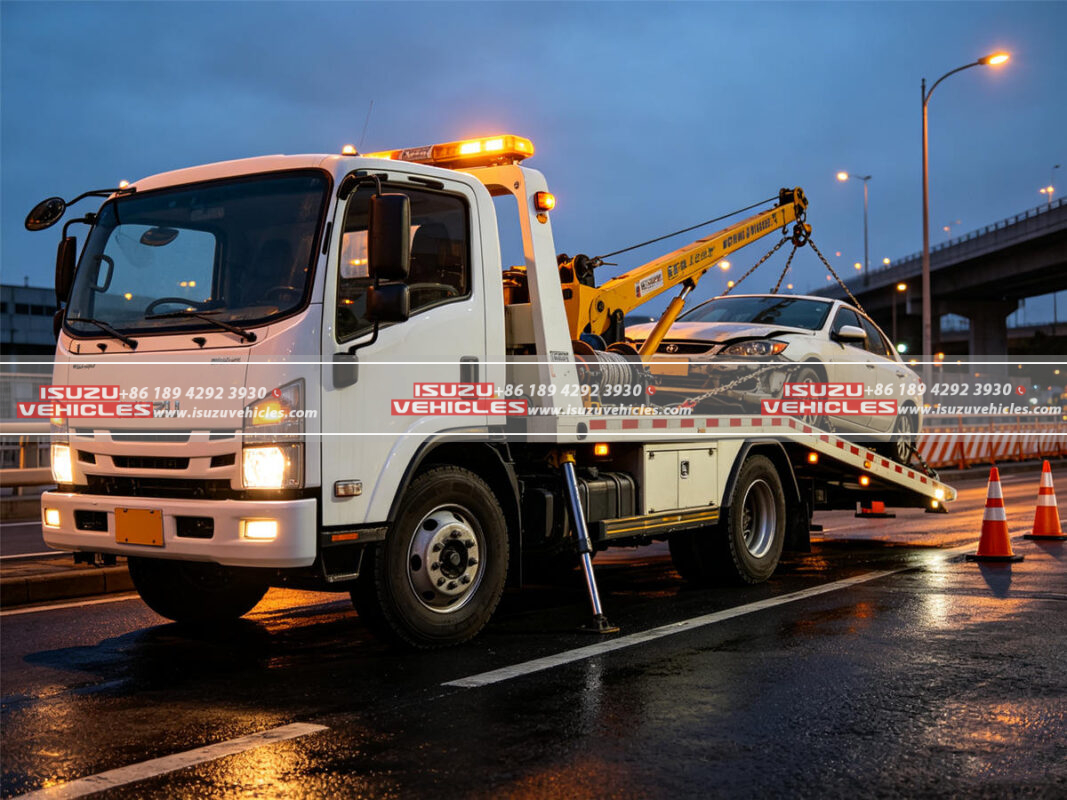
Vehicle breakdowns rarely happen at convenient times, and when a car, bus, commercial vehicle, or heavy truck becomes disabled on a busy road, the recovery company needs equipment that can perform immediately rather than a truck that only looks capable in a showroom. This is one of the main reasons the ISUZU tow truck has become a practical choice for roadside recovery companies, fleet operators, workshops, municipalities, and professional towing businesses. Reliability in this industry is not simply about engine durability; it involves the strength of the chassis, stability during towing, hydraulic performance, winch capacity, braking control, ease of maintenance, and the ability to keep working repeatedly under demanding operating conditions.
An ISUZU recovery truck combines a proven commercial vehicle platform with specialized towing equipment, allowing the truck to perform both transportation and recovery duties in one coordinated system. Depending on the model and application, the range includes flatbed wreckers, rollback tow trucks, integrated wreckers, recovery trucks with cranes, and heavier GIGA-based towing configurations. The current ISUZU tow-truck range includes 3-ton, 5-ton, 6-ton, 20-ton and other configurations designed for different recovery requirements.
So, what makes these trucks reliable in actual working conditions? The answer comes from several engineering factors working together rather than from one individual component.
1. A Strong Commercial Chassis Provides the Foundation for Reliability
Every recovery vehicle begins with its chassis, because the towing body, hydraulic equipment, winch, lifting mechanism, recovered vehicle, tools, and other equipment all place additional loads on the truck. If the chassis cannot handle these loads consistently, even the most advanced towing equipment will struggle to deliver dependable performance.
ISUZU tow trucks benefit from commercial truck chassis platforms developed for regular road transportation, giving them a strong foundation for specialized recovery applications. Depending on the required capacity, operators can choose from compact platforms such as ELF and 600P-based configurations or move toward larger F-Series, FTR, and GIGA platforms for heavier recovery work. The current ISUZU tow category specifically highlights chassis strength, stability, durability, and different chassis options as important advantages of its recovery trucks.
Designed for Real Road Conditions
Recovery trucks do not spend their entire working life on perfectly maintained highways. They may need to enter construction areas, parking facilities, narrow urban streets, industrial yards, rural roads, or roadside locations where the pavement is uneven and access is limited. A robust chassis and appropriately selected suspension system help the vehicle maintain stability when approaching a disabled vehicle, positioning the recovery equipment, or transporting a recovered vehicle back to a workshop.
For example, the published ISUZU 3 Ton Wrecker Tow Truck uses a 3,815 mm wheelbase, 4×2 drive configuration, reinforced chassis structure, and spring suspension with auxiliary springs, providing a balance between load support, stability, and maneuverability.
This balance is especially valuable for urban recovery companies because a tow truck must be strong enough for recovery work without becoming unnecessarily large and difficult to maneuver through congested streets.
2. Reliable Powertrains Deliver Consistent Towing Performance
A tow truck needs more than enough horsepower to move itself from one location to another. During recovery operations, the engine and transmission must provide controlled torque while the truck is carrying or towing another vehicle, climbing an incline, maneuvering at low speed, or positioning itself precisely beside a damaged vehicle.
ISUZU’s commercial vehicle powertrains are well suited to this type of work because they are designed around durability and repeated daily operation. A good recovery truck needs predictable throttle response and sufficient low-speed pulling capability rather than simply a high maximum horsepower figure, because much of the difficult work happens at relatively low speeds.
Power Should Be Matched to the Recovery Application
The correct engine depends on the recovery class of the vehicle. A compact 3-ton wrecker intended for passenger cars and light commercial vehicles does not require the same powertrain as a heavy-duty GIGA recovery truck. Matching engine output, transmission, axle capacity, and towing equipment to the intended workload prevents unnecessary mechanical stress and helps maintain long-term operating reliability.
The ISUZU 3 Ton Wrecker Tow Truck, for instance, uses a 2.999-liter four-cylinder diesel engine producing 130 horsepower and is paired with a six-speed manual transmission. Its published specification gives a gross vehicle weight of 7.3 tons and a towing/lifting capacity of up to 3,190 kg, making the configuration appropriate for light- and medium-duty recovery applications.
For fleet operators, this type of application-based matching is important because reliability is partly determined by whether the vehicle is being used within the capacity range for which its chassis and recovery equipment were designed.
3. The Towing and Hydraulic Systems Are Built for Controlled Recovery
The most obvious difference between a normal cargo truck and a wrecker truck is the specialized recovery equipment mounted behind the cab. A tow truck must not only move a load; it must lift, pull, secure, position, and sometimes partially carry a disabled vehicle. These operations require controlled hydraulic movement and dependable mechanical components.
ISUZU recovery configurations can incorporate flatbed platforms, hydraulic lifting mechanisms, recovery booms, winches, underlift systems, and other equipment according to the intended application. The equipment must work smoothly because sudden movement during vehicle recovery can damage both the recovered vehicle and the recovery truck, while poor stability can create unnecessary safety risks.
Hydraulic Control Supports Precision
During a recovery operation, the operator may need to extend a boom, lower a platform, pull a vehicle with a winch, lift one axle, adjust the vehicle position, and secure the recovered vehicle before beginning transportation. These steps require gradual and predictable hydraulic movement rather than uncontrolled speed.
A professional recovery system therefore needs properly matched hydraulic pumps, cylinders, control valves, hoses, and structural components. Regular inspection of hydraulic oil, hoses, fittings, cylinders, and connection points is also essential because even a highly reliable system can become unsafe if maintenance is neglected.
Winch Performance Matters in Difficult Recoveries
The winch is particularly important when a disabled vehicle cannot be driven onto the recovery platform under its own power. Depending on the truck configuration, the winch pulls the vehicle toward the platform or assists with vehicle positioning during recovery.
One current ISUZU 3 Ton Wrecker Road Recovery Truck, for example, is equipped with a recovery boom rated at 3,000 kg and a winch with a listed pulling force of 40 kN and 25 meters of cable. These specifications illustrate why recovery equipment must be considered as a complete working system, with the boom, winch, chassis, platform, and hydraulic system all selected to operate within their intended limits.
4. Stability and Vehicle Control Improve Recovery Safety
Reliability is closely connected to stability because a recovery truck must remain predictable while another vehicle is being lifted or towed. The weight distribution changes significantly when a disabled vehicle is loaded onto a flatbed or supported by a recovery boom, so chassis dimensions, axle ratings, suspension design, tires, braking equipment, and recovery-body geometry all matter.
A well-designed ISUZU tow truck provides the operator with a stable working platform before, during, and after recovery. This is particularly important when the truck is positioned on the roadside, where traffic conditions, road gradients, limited space, and uneven surfaces can make an otherwise straightforward recovery more complicated.
Compact Dimensions Can Be a Reliability Advantage
It may seem that a larger recovery truck is always better, but that is not necessarily true. In crowded cities, narrow streets, underground parking areas, workshops, and roadside locations, excessive vehicle dimensions can make positioning difficult. A compact recovery truck can often reach the disabled vehicle more easily and establish a better recovery angle.
The ISUZU 3 Ton Wrecker Tow Truck has an overall length of approximately 5.9 meters and a width of 1.99 meters, while its 3,815 mm wheelbase provides a practical compromise between stability and maneuverability. Its published maximum speed is 110 km/h, which also gives the vehicle suitable road mobility when traveling between recovery calls.
For larger vehicles and heavier recovery work, however, a bigger platform becomes necessary. This is why the ISUZU range includes substantially heavier tow-truck configurations, allowing fleets to select equipment according to the vehicles they normally recover rather than trying to use one truck for every possible task.
5. Easy Maintenance Helps Keep an ISUZU Tow Truck Working
For a professional towing company, a truck that spends excessive time in a workshop can become more expensive than a truck with a higher initial purchase price but better availability. Recovery companies often operate on urgent schedules, and customers expect the towing vehicle to arrive quickly when their vehicle breaks down. Therefore, maintainability is an important part of overall reliability.
ISUZU commercial trucks are widely designed around practical service requirements, with established engine, transmission, chassis, and braking systems that can be inspected and maintained as part of a regular fleet-management program. A recovery truck should receive scheduled inspections of the engine and transmission as well as the specialized recovery equipment.
Regular Inspection of the Recovery Equipment
Maintenance should include checking the winch cable for wear or deformation, inspecting hydraulic hoses for leaks or damage, examining lifting cylinders and pins, checking platform locking mechanisms, inspecting towing chains and hooks, and confirming that all safety devices function correctly. The chassis and suspension should also be checked regularly because recovery work places different stresses on the vehicle compared with ordinary cargo transportation.
Preventive maintenance is especially valuable because towing equipment is often exposed to sudden loads. Detecting a worn hydraulic hose, damaged cable, loose connection, or fatigued component before a recovery operation is far safer than discovering the problem while a disabled vehicle is suspended or being pulled onto the platform.
In other words, the reliability of an ISUZU wrecker is not simply a factory characteristic; it is also the result of choosing the correct configuration and following a disciplined maintenance schedule throughout the truck’s service life.
6. ISUZU Tow Trucks Offer Different Configurations for Different Recovery Jobs
One reason the ISUZU platform is practical for professional recovery fleets is that towing requirements vary considerably. A roadside assistance company that mainly handles passenger cars needs a different vehicle from a fleet contractor responsible for buses, construction equipment, or heavy commercial trucks.
The current ISUZU tow-truck category includes 3-ton flatbed wreckers, 5-ton flatbed recovery trucks, 5-ton carrier towing trucks, rollback breakdown recovery trucks, flatbed tow trucks with cranes, 20-ton GIGA flatbed tow trucks, and other specialized configurations. This range allows operators to choose a recovery solution based on vehicle weight, towing frequency, operating environment, and expected workload.
Flatbed Tow Trucks for Versatile Roadside Recovery
Flatbed and rollback configurations are particularly useful because the entire disabled vehicle can be positioned on the recovery platform rather than being towed with all four wheels on the road. This can be advantageous when the recovered vehicle has steering, transmission, wheel, or drivetrain damage and should be transported securely to a workshop.
For companies that need additional lifting capability, a flatbed tow truck with a crane can provide greater flexibility by combining vehicle recovery with equipment-handling functions. This can be particularly useful for workshops, fleet operators, construction contractors, and roadside service providers that regularly encounter vehicles carrying additional equipment or requiring assistance beyond simple towing.
Heavier Recovery Requires the Right Platform
For buses, heavy trucks, and large commercial vehicles, the recovery equipment must be selected according to actual weight and dimensions. Heavy-duty integrated wreckers and GIGA-based recovery trucks provide greater capacity for these applications, while compact ISUZU tow trucks remain more efficient for everyday passenger-car and light-commercial recovery.
This application-based approach is one of the strongest arguments for choosing a dedicated recovery platform rather than trying to convert an ordinary cargo vehicle into a towing truck. The chassis, hydraulic system, recovery body, winch, axle loads, and braking system should all work together as one engineered package.
For businesses building a broader specialized-vehicle fleet, the same principle applies to other applications. A bucket truck is designed for elevated utility and maintenance operations, while a dedicated wrecker truck is engineered around vehicle recovery, lifting, towing, and transportation. Keeping each vehicle matched to its intended application improves productivity and reduces unnecessary equipment stress.
Ultimately, the reliability of an ISUZU tow truck comes from the combination of a durable commercial chassis, appropriately matched powertrain, dependable towing equipment, stable vehicle dynamics, practical maintenance requirements, and a wide range of configurations for different recovery jobs. When properly specified and maintained, the truck can provide consistent support for roadside assistance companies, repair workshops, fleet operators, municipalities, and professional recovery businesses. Whether a fleet needs a compact recovery vehicle for city streets or a heavy-duty platform for larger commercial vehicles, ISUZU Vehicles provides a practical specialized-truck foundation, while operators can select a bucket truck for elevated maintenance work and a dedicated wrecker truck for dependable vehicle recovery operations.