
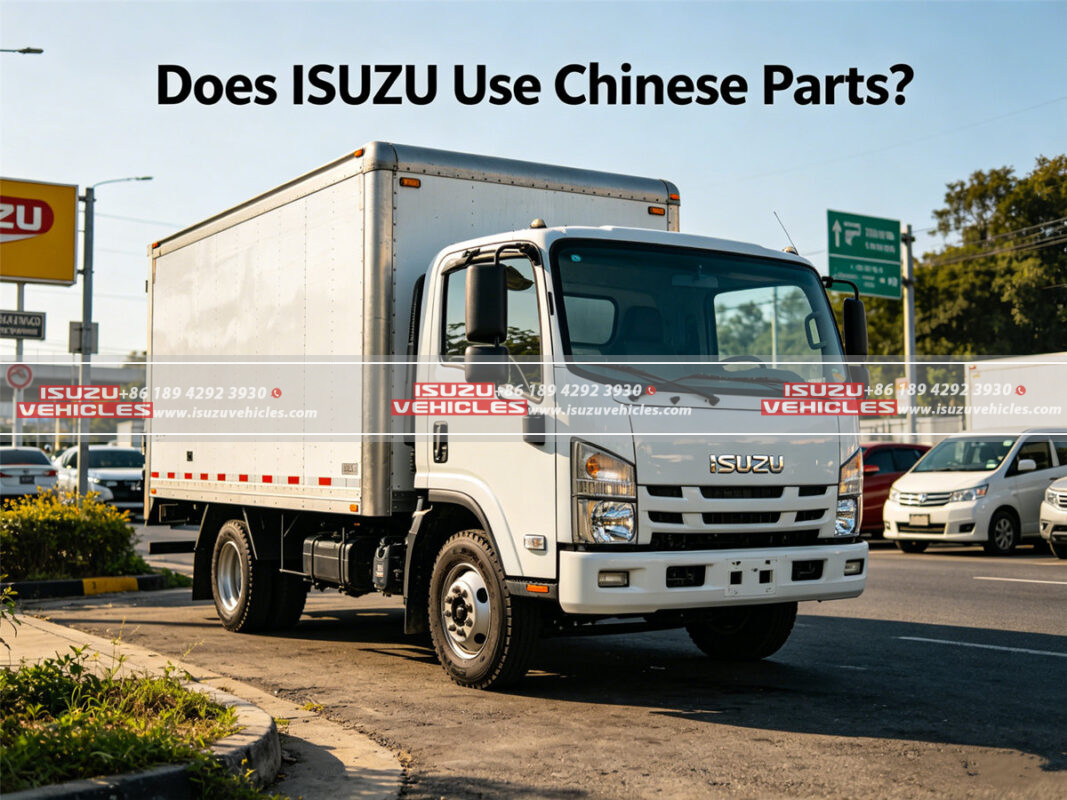
Understanding ISUZU’s Global Supply Chain and Manufacturing Strategy
In today’s global automotive industry, very few vehicle manufacturers rely entirely on parts sourced from a single country, and this is especially true in the commercial truck sector where supply chains stretch across multiple continents. One question that frequently appears among fleet buyers and truck enthusiasts is: Does ISUZU use Chinese parts? The answer is yes, to a certain extent, but the full explanation is far more complex and important than a simple yes-or-no response.
ISUZU is a Japanese brand, and its engineering heritage, product development philosophy, and corporate headquarters remain firmly rooted in Japan. However, like nearly every major global commercial vehicle manufacturer, ISUZU operates an international manufacturing and procurement network that includes suppliers and factories in China. Among these operations, the company’s massive manufacturing presence in Chongqing, China, plays a particularly significant role in production and regional distribution.
To understand why ISUZU uses some Chinese-made components while still maintaining its Japanese identity and quality standards, it is necessary to explore how modern truck manufacturing actually works, how international supply chains function, and how quality control systems are maintained across global operations.
1. ISUZU Is a Japanese Brand With Global Manufacturing Operations
The first and most important point to understand is that ISUZU Motors Limited is a Japanese company. Founded in Japan and headquartered there to this day, ISUZU has built its international reputation through decades of expertise in diesel engines, commercial trucks, and industrial vehicle engineering.
For many buyers, Japanese automotive brands are associated with durability, reliability, fuel efficiency, and disciplined manufacturing processes, and ISUZU has long been recognized globally for these strengths. The company’s engineering philosophy continues to be heavily influenced by Japanese industrial standards, particularly in relation to:
- Diesel engine performance
- Chassis durability
- Long-term operating reliability
- Fuel economy optimization
- Fleet maintenance efficiency
Even as ISUZU expanded internationally, these core engineering principles remained unchanged.
1.1 Why Global Manufacturing Became Necessary
As international demand for commercial vehicles increased, ISUZU expanded production outside Japan in order to:
- Lower manufacturing costs
- Improve regional distribution efficiency
- Reduce shipping times
- Support overseas markets more effectively
- Remain competitive in developing economies
This international strategy eventually included major manufacturing operations in China, Thailand, Indonesia, and several other countries.
2. Does ISUZU Actually Use Chinese Parts?
The practical answer is yes. Many ISUZU vehicles include components sourced from Chinese suppliers or manufactured within China-based production facilities. However, this should not be misunderstood as meaning the trucks are no longer Japanese in design or engineering philosophy.
The modern automotive industry operates through highly integrated global supply chains. Even premium automotive brands from Japan, Europe, and the United States use internationally sourced components.
2.1 Common Chinese-Sourced Components
Depending on the vehicle model and production location, Chinese-made components may include:
- Steel structural parts
- Wiring harnesses
- Plastic interior panels
- Lighting assemblies
- Glass components
- Electronic modules
- Fasteners and brackets
- Air-conditioning systems
In some cases, larger assemblies may also be produced within China-based factories operating under ISUZU supervision or joint venture arrangements.
2.2 Why Manufacturers Source Parts Internationally
Automakers source components globally because modern manufacturing requires enormous supplier networks capable of supporting large production volumes at competitive costs. China has become one of the world’s largest automotive component manufacturing centers due to:
- Mature industrial infrastructure
- Extensive supplier ecosystems
- Advanced metal processing capabilities
- High-volume production capacity
- Competitive manufacturing economics
As a result, many global truck brands utilize Chinese-made components in one form or another.
3. The Huge ISUZU Factory Presence in Chongqing, China
One of the main reasons people associate ISUZU with China is the company’s major manufacturing footprint in Chongqing. This city has become one of China’s most important automotive production centers and plays a critical role in ISUZU’s international strategy.
3.1 Why Chongqing Matters
Chongqing offers several strategic advantages for large-scale vehicle production, including:
- Advanced manufacturing infrastructure
- Strong logistics networks
- Access to component suppliers
- Skilled industrial labor
- Export-friendly transportation systems
For ISUZU, operating in Chongqing allows the company to efficiently serve both domestic Chinese demand and international export markets.
3.2 Joint Ventures and Local Production
ISUZU has partnered with Chinese manufacturers through joint ventures and cooperative production arrangements. These partnerships help expand manufacturing scale while adapting products to regional market requirements.
Vehicles assembled in Chongqing may include:
- Locally sourced structural parts
- Chinese-manufactured accessories
- Regional electrical systems
- Market-specific configurations
However, the engineering platforms, powertrain concepts, and technical standards are still heavily influenced by ISUZU’s Japanese design systems.
3.3 Quality Control Inside Chinese Facilities
One important point often overlooked is that manufacturing location does not automatically determine product quality. What matters more is the quality management system used inside the factory.
ISUZU’s Chongqing operations typically incorporate:
- Japanese-style production management
- Detailed assembly inspection processes
- Supplier qualification systems
- Precision tolerance standards
- Engine testing procedures
- Component traceability tracking
This allows ISUZU to maintain consistency even when parts or assembly processes occur outside Japan.
4. Which ISUZU Components Usually Remain Japanese?
Although many supporting components may be sourced internationally, certain key systems often remain closely tied to Japanese engineering and manufacturing oversight.
4.1 Diesel Engine Technology
ISUZU is globally respected for its diesel engine expertise, and many of its engines are developed using Japanese engineering research and design standards. Even when engines are assembled in overseas factories, the technical architecture often originates from Japan.
These engines are known for:
- Strong low-end torque
- Long operational lifespan
- Fuel efficiency
- Reliable cold-weather starting
- Reduced maintenance demands
Because the engine is considered the heart of a commercial vehicle, ISUZU places significant emphasis on maintaining strict technical standards.
4.2 Chassis Engineering
The structural design of ISUZU truck chassis also reflects Japanese commercial vehicle engineering philosophy. Lightweight durability, balanced load distribution, and long-term fatigue resistance are key design priorities.
4.3 Transmission and Drivetrain Systems
Some drivetrain systems and critical mechanical components may still be produced under tighter Japanese technical oversight or sourced from internationally recognized suppliers that meet ISUZU’s standards.
5. Why Using Chinese Parts Does Not Automatically Mean Lower Quality
One of the biggest misconceptions in the truck industry is the assumption that any Chinese-made component is automatically inferior. In reality, component quality depends far more on engineering standards, supplier management, and manufacturing supervision than on geography alone.
5.1 Different Quality Levels Exist in Every Country
China manufactures products across an enormous quality spectrum, ranging from low-cost consumer goods to highly advanced industrial equipment and aerospace components. The same country can produce both budget-level products and premium-grade automotive systems depending on the specifications required by the manufacturer.
ISUZU typically works with suppliers capable of meeting commercial vehicle durability standards rather than simply choosing the cheapest available parts.
5.2 Japanese Oversight Makes a Difference
Japanese automotive companies are known for maintaining extremely strict quality assurance systems, even when production occurs overseas. This often includes:
- Supplier audits
- Statistical quality monitoring
- Production process verification
- Continuous improvement systems
- Material performance testing
Because of these controls, many globally sold ISUZU trucks maintain strong reliability records regardless of where certain components originate.
5.3 Customer Priorities Have Changed
Today’s fleet operators care more about uptime, durability, fuel efficiency, and operating cost than the country origin of every individual bolt or bracket. As long as the vehicle performs reliably and spare parts remain accessible, global sourcing is generally accepted throughout the industry.
6. ISUZU’s Future as a Japanese Brand With International Manufacturing Strength
The future of commercial vehicle manufacturing will almost certainly involve even more international collaboration, and ISUZU is already deeply integrated into this global system. While the company remains unmistakably Japanese in heritage, engineering philosophy, and corporate identity, its manufacturing strategy reflects the realities of modern industrial production.
The massive Chongqing factory presence demonstrates how ISUZU combines Japanese engineering with Chinese manufacturing scale to serve international transportation markets more efficiently. This approach allows the company to maintain competitive pricing while supporting growing demand for commercial vehicles across Asia, Africa, the Middle East, and Latin America.
For truck buyers, the key distinction is understanding that using some Chinese-made parts does not change the fact that ISUZU is fundamentally a Japanese brand. Instead, it reflects how modern vehicle manufacturers operate within interconnected global supply chains while maintaining engineering oversight and quality control standards.
Whether customers are purchasing a heavy-duty cargo truck, a durable box truck, versatile pickups, or other professional ISUZU Vehicles, they are ultimately buying products shaped by Japanese commercial vehicle engineering while benefiting from the efficiency and scale of international manufacturing networks, including ISUZU’s enormous production operations in Chongqing, China.