
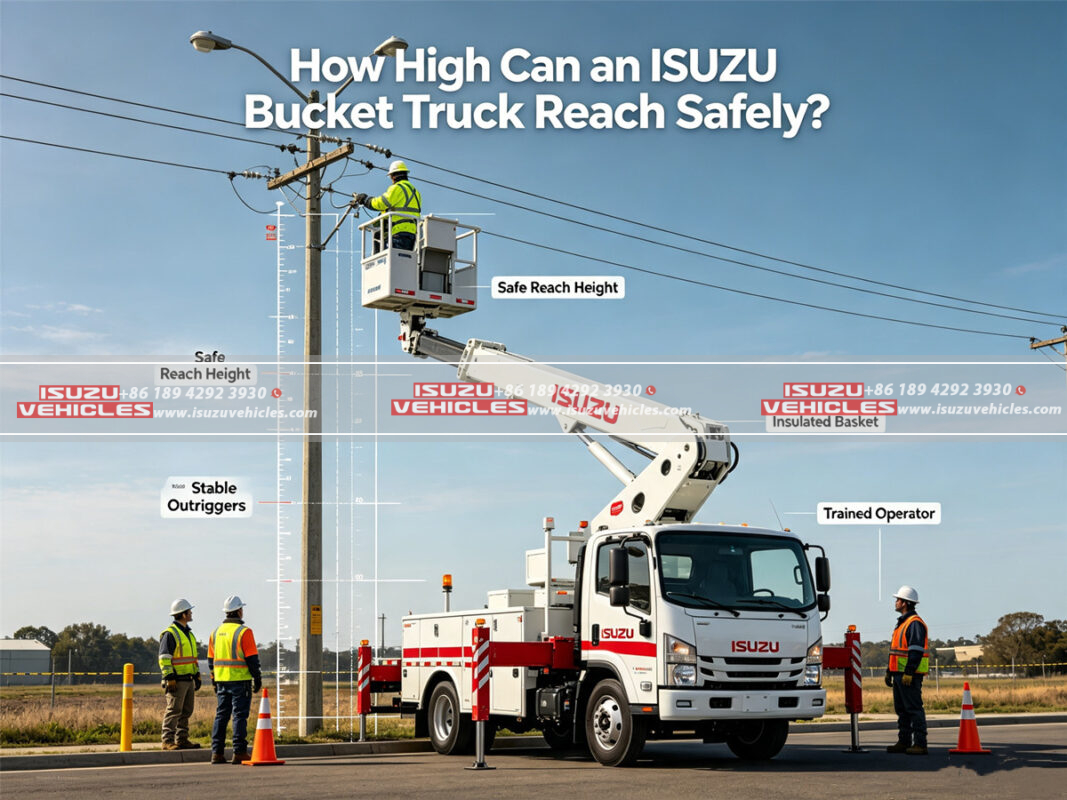
Working at height is an essential part of many industries, including electrical maintenance, telecommunications, street lighting, construction, tree care, and municipal infrastructure services. However, reaching elevated areas safely requires much more than simply having a long boom. The vehicle must provide stable support, accurate positioning, and reliable control to ensure operators can complete their tasks efficiently without compromising safety.
One of the most common questions from utility companies and contractors is: How high can an ISUZU bucket truck reach safely? The answer depends on several factors, including the truck model, boom design, chassis size, working radius, basket capacity, and operating conditions. Modern ISUZU bucket trucks are available in a wide range of configurations, from compact models designed for urban maintenance to larger aerial platforms capable of reaching significant working heights for specialized projects.
Understanding how height capability works helps buyers select the right aerial work vehicle for their specific applications while ensuring safe and productive operations.
Understanding the Working Height of an ISUZU Bucket Truck
The working height of a bucket truck refers to the maximum vertical distance that the operator inside the aerial platform can safely reach. It is important to understand that working height is not the same as boom length.
A bucket truck’s total reach includes:
- Vehicle height
- Boom extension length
- Basket position
- Operator working range
For example, a truck with a 20-meter boom does not always provide exactly 20 meters of working height because the operator’s position inside the basket, ground conditions, and boom angle all influence the final reach.
Depending on the configuration, an ISUZU bucket truck can commonly provide working heights ranging from approximately 10 meters to more than 30 meters.
Typical applications include:
- 10–14 meter models for streetlights and urban maintenance
- 16–22 meter models for electrical and communication work
- 24–30+ meter models for high-voltage lines and large infrastructure projects
The correct height depends on the job requirements rather than simply choosing the tallest available model.
Different Boom Configurations Provide Different Reach Capabilities
The aerial boom design plays a major role in determining how high and how far an ISUZU bucket truck can operate. Different industries require different levels of flexibility, so manufacturers offer several boom configurations.
Telescopic Boom Bucket Trucks
A telescopic boom uses straight sections that extend outward to achieve greater vertical height.
Advantages include:
- Excellent vertical reach
- Simple structural design
- Strong lifting stability
- Suitable for high-level maintenance work
These models are commonly used for:
- Power transmission maintenance
- Communication towers
- Large street lighting systems
- Industrial facilities
Because the boom extends in a straight line, telescopic designs are often preferred when maximum height is the primary requirement.
Articulated Boom Bucket Trucks
Articulated booms use multiple connected sections that can bend and move around obstacles.
Their advantages include:
- Better flexibility
- Easier positioning around structures
- Improved access in crowded areas
- Greater horizontal movement
These trucks are especially useful in cities where operators may need to reach around buildings, trees, or other obstacles.
Telescopic-Articulated Combination Systems
Some advanced ISUZU bucket trucks combine both telescopic extension and articulated movement, providing a balance between height and flexibility.
These systems allow operators to reach elevated work areas while maintaining better positioning control.
Safety Factors That Determine Maximum Working Height
Although a bucket truck may be capable of reaching a certain height, safe operation depends on more than the maximum technical specification. Professional operators must consider several conditions before extending the boom.
Vehicle Stability and Outriggers
The stability system is one of the most important safety elements.
Hydraulic outriggers extend from the truck chassis to create a wider support base, reducing movement during aerial operations.
Before lifting the boom, operators must ensure:
- The truck is positioned on stable ground
- Outriggers are fully deployed
- The vehicle is properly leveled
- The surrounding area is clear
A stable foundation allows the boom system to operate safely at its designed height.
Working Radius and Load Capacity
Height and horizontal reach are closely connected.
When the basket moves farther away from the truck, the load placed on the boom system increases. As a result, the maximum safe height may vary depending on:
- Basket weight
- Number of workers
- Tools and equipment carried
- Boom angle
- Extension distance
Manufacturers provide working charts that specify safe operating limits under different conditions.
Advanced Features That Improve Aerial Work Safety
Modern ISUZU bucket trucks incorporate various technologies designed to help operators work safely at elevated positions.
Hydraulic Control Systems
Smooth hydraulic controls allow operators to adjust boom movement accurately.
Precise control is important when working near:
- Electrical cables
- Communication equipment
- Building structures
- Traffic infrastructure
Controlled movement reduces sudden shifts and improves operator confidence.
Safety Protection Systems
Depending on the configuration, bucket trucks may include:
- Boom interlock systems
- Emergency lowering systems
- Overload protection
- Basket leveling systems
- Warning alarms
- Insulated platforms
These features help prevent unsafe operation and provide additional protection during complex maintenance tasks.
Choosing the Right ISUZU Bucket Truck Height for Your Application
Selecting the correct working height requires careful consideration of the actual jobs a company performs. A taller bucket truck is not automatically the best choice because larger models may require more operating space, higher purchase costs, and additional maintenance.
For example, municipal departments responsible for streetlight maintenance may find a 12–16 meter bucket truck sufficient for daily tasks. Telecommunications companies installing cables on utility poles may require a medium-height model with greater horizontal reach. Power companies maintaining high-voltage infrastructure may need larger aerial platforms exceeding 25 meters.
Other factors should also be considered:
- Road accessibility
- Worksite limitations
- Transportation regulations
- Frequency of high-altitude operations
- Future business expansion
Choosing a properly matched truck improves efficiency while avoiding unnecessary investment in unused capacity.
A well-selected ISUZU bucket truck allows operators to complete more tasks with one vehicle, increasing fleet productivity and reducing operational complexity.
Reliable Height Performance with ISUZU Engineering
The answer to how high an ISUZU bucket truck can safely reach depends on the specific model, boom configuration, and working environment. With available working heights ranging from compact urban models to advanced aerial platforms exceeding 30 meters, ISUZU provides solutions for a wide variety of elevated maintenance requirements.
However, safe aerial operation is not determined only by height. A reliable bucket truck must combine strong chassis construction, stable support systems, accurate hydraulic controls, and professional safety features to ensure dependable performance throughout every working day.
For utility companies, contractors, and municipal operators, investing in the right aerial platform means improving worker safety, increasing productivity, and reducing downtime during essential maintenance projects. ISUZU bucket trucks provide a practical combination of reach, stability, and durability for modern infrastructure needs.
For businesses building a complete specialized vehicle fleet, an ISUZU bucket truck can work together with a crane truck for material lifting operations and a tow truck for vehicle recovery and roadside assistance. Combined with dependable ISUZU Vehicles, these professional solutions offer the versatility, reliability, and engineering quality required for utility services, construction projects, emergency response, and infrastructure maintenance worldwide.