
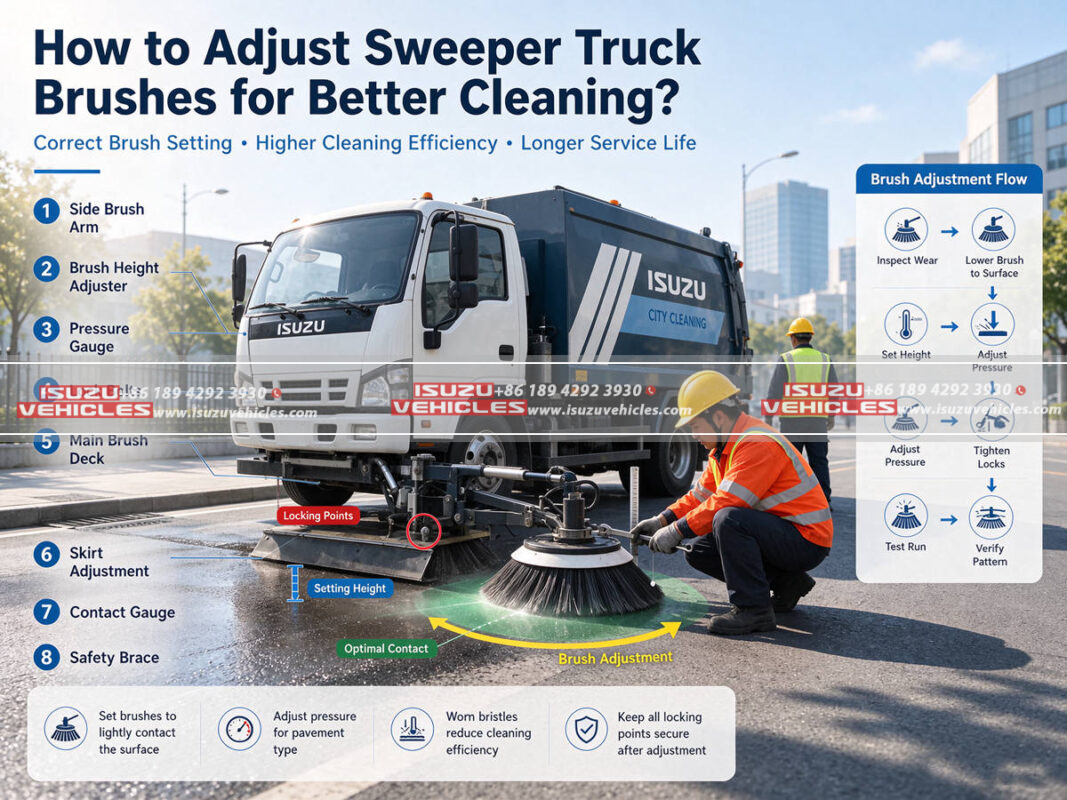
A sweeper truck can be equipped with powerful hydraulic motors, a high-capacity suction system, and an efficient dust-control arrangement, but its actual cleaning performance still depends heavily on how correctly the sweeping brushes contact the road surface. If the brushes are positioned too high, they may rotate without collecting enough dust, sand, leaves, and other debris, while brushes that press too firmly against the pavement can wear out quickly, consume more power, place unnecessary loads on hydraulic components, and create uneven cleaning results. Proper adjustment is therefore not simply a matter of lowering the brushes until they touch the ground; it involves finding a suitable balance between brush height, contact pressure, rotation speed, sweeping angle, vehicle speed, and the characteristics of the surface being cleaned.
For municipal sanitation departments, road maintenance contractors, industrial facilities, and commercial cleaning operators, correctly adjusted brushes can improve daily cleaning efficiency while reducing replacement costs and unnecessary equipment downtime. A well-maintained ISUZU sweeper truck can handle routine road cleaning, roadside debris collection, and industrial yard maintenance more consistently when its brush system is configured according to the working environment rather than operated with one fixed setting for every task.
Brush adjustment is particularly important because road conditions are rarely uniform. Smooth asphalt, rough concrete, paved industrial yards, road shoulders, gutters, and construction access roads all present different cleaning challenges. Fine dust may require a different brush arrangement from wet leaves or accumulated gravel, and operators should understand how to make practical adjustments without exceeding the equipment manufacturer’s recommended operating limits.
2. Understand the Main Parts of a Sweeper Truck Brush System
Before making adjustments, operators should understand the basic construction of the sweeping assembly, because different components influence cleaning performance in different ways. Many mechanical-vacuum road sweepers use one or more rotating disc brushes mounted near the front or sides of the vehicle, while some configurations also use a central cylindrical brush or other specialized cleaning attachments. The disc brushes loosen debris and guide it toward the suction opening or collection area, allowing the vehicle’s airflow system to collect the material rather than simply pushing it along the road.
Disc Brushes and Brush Bristles
Disc brushes are commonly positioned at the sides of the vehicle, where they can reach road edges, gutters, and areas that are difficult for the main suction nozzle to cover directly. Their bristles may be made from steel wire, polypropylene, or a combination of materials, depending on the intended application and the manufacturer’s design. Steel-wire bristles are often selected for demanding work involving compacted dirt and heavier debris, while synthetic bristles can be appropriate for lighter dust and general surface cleaning.
The condition and arrangement of the bristles have a direct influence on the brush’s effective working diameter and contact pattern. As the bristles wear down, the brush may no longer reach the pavement at its original adjustment position, which means that an operator may need to inspect the brush height and follow the manufacturer’s procedure for restoring the specified working position. Replacing badly worn brushes is often more effective than continually lowering them to compensate for excessive bristle wear.
Hydraulic Motors, Arms, and Adjustment Mechanisms
Many commercial sweeper trucks use hydraulic motors to rotate the disc brushes, while hydraulic cylinders or mechanical adjustment arrangements control their lifting, lowering, extension, and working position. The brush arms determine how the brushes are presented to the road surface, and their angle influences the direction in which debris is moved. Hydraulic controls allow the operator to raise the brushes during travel or when passing over obstacles, then lower them into the working position when cleaning begins.
For example, the ISUZU 12 CBM Road Sweeper Truck is listed with four hydraulic sweeping brushes, adjustable rotation speed, and hydraulic brush lifting control. Its configuration illustrates why brush adjustment should be considered as part of an integrated cleaning system rather than as an isolated setting, because brush operation must work together with the suction nozzle, dust suppression equipment, and vehicle operating speed.
Brush Contact and the Suction System
The brushes are only one part of the cleaning process. Their purpose is to loosen and guide debris toward the collection system, where suction airflow carries the material into the hopper or debris container. If the brushes are incorrectly positioned, debris may be scattered beyond the suction path, left behind along the curb, or pushed into areas that the vehicle cannot collect efficiently. This is why brush adjustment should always be evaluated by observing the actual cleaning result, not merely by checking whether the brushes appear to rotate normally.
3. How to Adjust Sweeper Truck Brushes Step by Step
Although the exact adjustment procedure varies between manufacturers and brush assemblies, the following method provides a practical framework for routine inspection and setup. Operators should always consult the vehicle’s operation manual for the correct adjustment points, specified contact pattern, hydraulic settings, and safety requirements before changing any mechanical or hydraulic component.
Step 1: Park the Truck and Prepare the Working Area
Park the sweeper truck on a firm, level surface where the brush assembly can be inspected safely, engage the parking brake, and follow the manufacturer’s procedure for shutting down the sweeping equipment. Keep people away from the brush arms and other moving components, and never place hands, feet, or tools beneath a suspended assembly unless it has been properly supported using the approved safety method. If inspection requires access beneath the vehicle or near hydraulic components, use the designated mechanical supports and isolation procedures rather than relying on hydraulic pressure to hold the equipment in position.
Before beginning, check whether the brushes are excessively worn, damaged, unevenly assembled, or contaminated with wire, rope, plastic film, or other materials. Remove debris only after the equipment has been safely stopped and isolated according to the manufacturer’s instructions. A brush with bent mounting parts or severely damaged bristles should be repaired or replaced before adjustment.
Step 2: Inspect the Existing Brush Position
Lower the brush assembly into its specified inspection or working position using the normal control procedure, making sure that the truck remains stationary and that no one is within the movement area. Examine the brush arrangement from the front and side, paying attention to the bristle contact pattern, the distance between the brush and the road, and whether the brush assembly sits evenly in relation to the vehicle.
Some manufacturers specify a particular bristle deflection or contact pattern rather than a universal ground clearance measurement. This distinction matters because brush diameter, bristle material, arm geometry, and suspension design can vary considerably between models. Operators should therefore avoid copying a measurement from another sweeper truck, even if the two vehicles appear similar, unless the manufacturer confirms that the setting is applicable.
Step 3: Adjust Brush Height and Contact Pressure
If the brush is not reaching the road correctly, use the designated adjustment mechanism to restore the manufacturer’s specified working position. Depending on the design, this may involve an adjustment screw, a mechanical linkage, a support wheel, a suspension arrangement, or a hydraulic control system. Make small, controlled changes and inspect the result after each adjustment rather than making a large change that could cause excessive contact pressure.
The objective is to achieve sufficient bristle contact for effective debris removal without forcing the brush heavily against the pavement. Excessive contact can cause rapid bristle wear, increase the load on the hydraulic drive, produce unnecessary vibration, and make the brush assembly work harder than necessary. Insufficient contact, on the other hand, may allow fine dust and heavier particles to remain on the surface. The correct position is the one that delivers the required cleaning performance while remaining within the manufacturer’s operating specifications.
Step 4: Check the Brush Angle and Sweeping Direction
Brush angle determines how the bristles move debris across the road and toward the suction area. A side brush is normally arranged so that its rotation and working angle guide material inward rather than scattering it away from the collection path. If the angle is incorrect, the brush may push leaves or gravel toward the curb, spread dust into adjacent traffic lanes, or leave a visible line of debris between the brush path and the suction opening.
Make angle adjustments only through the intended adjustment points, and check the left and right brushes independently where the vehicle design allows separate control. Road edges and gutters may require a different working arrangement from open road surfaces, but the adjustment should remain within the permitted range specified by the equipment manufacturer.
Step 5: Test the Brush Rotation and Cleaning Result
After completing the static adjustment, clear the inspection area, restore the equipment to its normal operating condition, and test the brush system at the manufacturer’s recommended operating speed. Observe the brush rotation, contact pattern, hydraulic response, and debris movement from a safe position. Conduct a short cleaning pass over a representative section of pavement and inspect the road after the vehicle has passed.
If debris remains along the curb, check the brush angle and coverage. If dust is scattered widely, inspect the water suppression system and brush rotation settings. If the brush leaves deep marks or shows unusually rapid wear, stop the operation and recheck its contact pressure and working position. Change one setting at a time so that the effect of each adjustment can be identified clearly.
4. Adjust Brush Settings According to Road Conditions
There is no single brush setting that provides the best results on every road, because the type of debris, pavement condition, moisture level, and required cleaning standard can all influence the ideal configuration. Experienced operators learn to recognize these differences and make controlled adjustments while keeping the equipment within its approved operating range.
Smooth Asphalt and Concrete Roads
Smooth asphalt and concrete generally provide a consistent surface for disc brushes, making it easier to maintain an even contact pattern. For routine dust, small stones, and light roadside debris, the operator should begin with the manufacturer’s standard brush setting and adjust only when the cleaning result indicates that a change is necessary. Excessive brush pressure is rarely beneficial on these surfaces, because it can accelerate wear without providing a proportional improvement in debris collection.
Rough Pavement and Road Shoulders
Uneven pavement, damaged road edges, and rough industrial access roads can cause the brush to lose consistent contact with the ground. In these conditions, the operator should pay particular attention to the brush arm’s ability to follow the surface and to the clearance available around the mounting assembly. Slower vehicle movement may help the brush maintain more consistent coverage, while obstacle avoidance features, where fitted, can reduce the risk of damage when the brush encounters raised surfaces or other obstructions.
Wet Leaves, Mud, and Heavy Debris
Wet leaves and compacted mud can be more difficult to remove than dry dust because they may adhere to the pavement or collect in thick layers. Operators should not automatically solve this problem by increasing brush pressure or rotation speed. Instead, they should inspect the bristle condition, brush angle, water application, suction performance, and vehicle speed, then choose a suitable combination of settings according to the manufacturer’s guidance. In some cases, a separate washing or pre-treatment operation may be more effective than relying on the sweeping brushes alone.
Fine Dust and Dry Weather Cleaning
Fine dust can become airborne when the brushes disturb the road surface, reducing visibility and creating an environmental nuisance. A properly functioning dust suppression system helps control this problem by applying water around the brush area or other designated points. A sprinkler truck can support broader road watering and dust-control operations, while a sweeper truck uses its own brush, suction, and water-spray systems to remove debris during cleaning. These vehicles can complement each other in a municipal fleet, but their operating functions are not interchangeable.
5. Common Brush Adjustment Problems and How to Correct Them
When a sweeper truck leaves debris behind or develops unusual brush wear, the problem may be related to adjustment, but operators should avoid assuming that every cleaning issue can be solved by changing brush height. A systematic inspection helps distinguish between brush-related faults and problems involving the hydraulic drive, suction system, water supply, or debris collection equipment.
Brushes Wear Out Too Quickly
Rapid bristle wear may indicate excessive contact pressure, incorrect brush angle, unsuitable brush material, or operation on surfaces that are more abrasive than expected. Check whether the brush is being forced against the road, whether the mounting assembly is correctly positioned, and whether the selected brush type is appropriate for the work. If the bristles have become uneven or damaged, replacement may be necessary before the original cleaning performance can be restored.
Debris Remains Along the Road Edge
Debris left along the curb may result from an incorrect brush angle, insufficient working coverage, worn bristles, or an unsuitable vehicle path. Check that the side brush reaches the intended cleaning area and directs material toward the collection zone. Also inspect whether the suction nozzle is operating correctly, because even a well-positioned brush cannot compensate for a blocked or poorly functioning collection system.
Dust Spreads During Sweeping
Excessive dust may indicate inadequate water delivery, blocked spray nozzles, worn brush components, excessive brush speed, or a cleaning speed that does not suit the road conditions. Inspect the water filters and nozzles, verify that the water supply is operating correctly, and make sure the brush system is not disturbing more material than the suction equipment can collect. Operators should never exceed the manufacturer’s hydraulic or water-system pressure limits in an attempt to solve a dust problem.
Brushes Rotate Unevenly or Respond Slowly
Uneven rotation or delayed movement may point to a hydraulic issue, such as a damaged hose, a restricted filter, a malfunctioning valve, insufficient hydraulic oil, or a worn motor. These conditions require inspection of the hydraulic system rather than repeated changes to the brush’s mechanical position. Hydraulic systems can retain dangerous pressure even after the engine has been switched off, so repairs should be performed by qualified personnel using the manufacturer’s pressure-release and isolation procedures.
When the sweeping system is working normally but liquid waste, sludge, or accumulated wastewater remains in the cleaning area, a vacuum truck may be more suitable for the collection task. Vacuum equipment is designed for suction-based removal of liquid and other compatible waste materials, whereas the sweeper truck’s brushes are intended to loosen and guide surface debris into its collection system.
6. Routine Maintenance for Consistent Brush Performance
Correct adjustment should be supported by regular maintenance, because even a carefully configured brush assembly will gradually lose performance as its bristles wear, hydraulic components age, and working parts become contaminated. A simple inspection routine before and after each shift can help operators identify developing problems before they affect an entire cleaning route.
Inspect Bristles, Mountings, and Brush Arms
Check the brush bristles for uneven wear, missing sections, bending, cracks, and material trapped between the bristles. Inspect mounting bolts, retaining components, brush discs, and support arms for looseness or visible damage. Confirm that adjustment mechanisms move correctly and that the brush can be raised and lowered without abnormal noise or resistance. Any damaged component should be repaired or replaced according to the manufacturer’s service instructions.
Maintain the Hydraulic System
Inspect hydraulic hoses, connectors, cylinders, motors, and visible pipework for leaks, abrasion, deformation, or other signs of damage. Check hydraulic oil level and condition according to the vehicle’s maintenance schedule, and replace filters and oil at the specified intervals. Never search for a high-pressure hydraulic leak with bare hands, because escaping fluid can penetrate the skin and cause a serious injection injury. Suspected leaks should be assessed using safe inspection methods by trained maintenance personnel.
Keep the Water and Suction Systems Clean
Water spray nozzles and filters should be checked regularly because blocked outlets can reduce dust suppression around the brushes. Clean the suction opening, inspect the ducting for accumulated debris, and maintain the filter and fan system according to the prescribed service schedule. If the suction system is restricted, debris loosened by the brushes may remain on the road even when brush contact and rotation are correct.
Record Adjustments and Replacement History
Keeping a maintenance record helps a fleet manager understand how quickly brushes wear under different operating conditions and whether particular routes require more frequent inspection. Useful records include the date of adjustment, brush replacement intervals, road conditions, operating hours, reported cleaning problems, and maintenance actions. Over time, this information can help establish a practical inspection schedule and identify recurring problems with specific brush assemblies or operating environments.
7. Improving Overall Cleaning Efficiency with the Right Equipment and Operating Practices
Better cleaning performance does not come from brush adjustment alone; it results from coordinating the sweeping assembly with the vehicle’s hydraulic system, suction equipment, water supply, operator technique, and maintenance schedule. Operators should select a suitable vehicle configuration for the work area, follow the recommended operating procedures, and evaluate cleaning results regularly instead of relying on maximum brush speed or excessive ground pressure as a shortcut.
For example, the ISUZU 12 CBM road sweeper configuration combines four hydraulic sweeping brushes with adjustable rotation speed, a floating suction nozzle, and a dust suppression system. Such an arrangement demonstrates how mechanical sweeping and suction collection work together: the brushes loosen and direct debris, while the suction system collects the material into the vehicle’s container. Each component must be maintained and adjusted correctly for the complete cleaning process to operate efficiently.
Fleet managers should also consider whether a particular cleaning task requires a different type of vehicle. A sprinkler truck is useful for road watering, dust suppression, and water distribution, while a vacuum truck is designed for suction-based collection of liquid waste, sludge, and compatible debris. A sweeper truck is better suited to routine surface cleaning involving dust, leaves, sand, and road debris. Using the appropriate equipment for each task can prevent unnecessary wear and help sanitation teams complete their work more effectively.
For businesses and municipal departments evaluating equipment for road maintenance, ISUZU Vehicles offers different sweeper truck configurations for a range of cleaning requirements, from compact urban applications to larger road-cleaning operations. Before selecting a vehicle, buyers should compare brush quantity and arrangement, brush material, hydraulic drive design, sweeping width, suction capacity, water tank configuration, and maintenance accessibility. The most suitable model is not necessarily the one with the largest brush assembly, but the one whose working configuration matches the roads, debris types, operating schedule, and service conditions of the fleet.
Ultimately, adjusting sweeper truck brushes correctly is a practical process of inspection, controlled adjustment, testing, and ongoing maintenance. By maintaining the specified brush contact, choosing an appropriate working angle, monitoring rotation, and checking the performance of the suction and water systems, operators can achieve more consistent cleaning while reducing unnecessary brush wear and mechanical stress. A disciplined approach to these details helps keep municipal roads, industrial facilities, and commercial areas cleaner while allowing the sweeper truck to deliver reliable performance throughout its working life.