
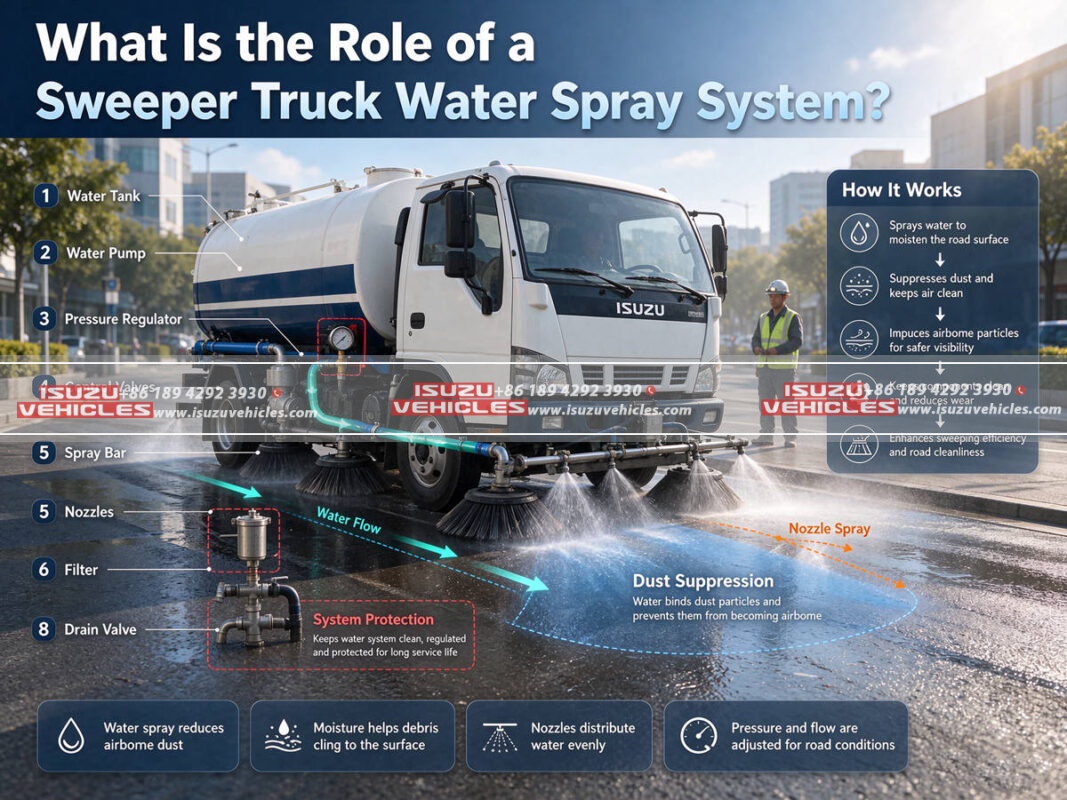
A modern sweeper truck does much more than collect leaves, sand, gravel, and roadside rubbish. During daily operation, rotating brushes disturb accumulated dirt and fine particles, and without proper dust suppression, some of this material can become airborne, reducing visibility, affecting nearby pedestrians, and creating additional environmental problems. This is why the water spray system has become an important part of many road sweeping vehicles, working together with the brushes, suction equipment, and filtration system to improve overall cleaning performance.
The primary purpose of the water spray system is to control dust before and during the sweeping process. By applying a controlled amount of water to the road surface, brush area, or suction inlet, the system increases the moisture content of loose particles and reduces their tendency to become airborne. Fine dust can then be more effectively managed as the brushes loosen road deposits and the suction system collects the material into the debris hopper.
It is important to understand that water spraying does not replace mechanical sweeping or vacuum collection. Water helps suppress dust and may loosen certain surface deposits, but it cannot independently collect accumulated sand, leaves, stones, and other solid waste. The best cleaning results come from coordinating all three functions: water application, mechanical brushing, and debris collection.
For municipal sanitation departments, industrial parks, construction contractors, and road maintenance companies, this integrated approach can make daily cleaning more efficient and reduce the amount of secondary dust generated during operation. Different ISUZU sweeper truck models combine water tanks, spray nozzles, sweeping brushes, and suction systems in configurations suited to different road conditions and cleaning requirements.
2. How Does a Sweeper Truck Water Spray System Work?
The working principle of a sweeper truck water spray system is relatively straightforward, although its actual performance depends on the coordination of several components. Water is stored in a dedicated tank, drawn through a pump, transported through pipelines, regulated by valves, and finally distributed through strategically positioned nozzles. Depending on the vehicle configuration, the system may spray water around the sweeping brushes, near the suction opening, across the front of the truck, or behind the vehicle to provide additional dust suppression and road washing.
Water Tank: Providing a Reliable Water Supply
The water tank stores the clean water required for dust suppression and washing operations. Its capacity influences how long the sweeper truck can work before returning to a filling station, although the actual operating time also depends on spray flow rate, the number of active nozzles, road conditions, and the selected cleaning mode.
Different vehicle sizes require different tank configurations. A compact sweeper may use a relatively small water tank to keep the overall vehicle dimensions manageable, while a larger municipal road sweeper can carry several thousand liters to support longer cleaning routes. For example, the ISUZU 12 CBM Road Sweeper Truck is listed with a 4,000-liter clean-water tank and an integrated high-pressure flushing and spraying arrangement, allowing it to perform dust suppression and more intensive road-cleaning work.
Water Pump: Delivering Flow and Pressure
The water pump moves water from the tank into the spray pipelines and provides the flow and pressure required by the selected nozzles. Depending on the vehicle design, the pump may be driven by an electric motor, hydraulic motor, or another power arrangement. The pump must be matched to the system’s total water demand, because operating several nozzles simultaneously requires sufficient flow to maintain a consistent spray pattern.
Flow rate and pressure are related but different performance characteristics. Flow rate describes how much water the pump delivers over a period of time, commonly expressed in liters per minute, while pressure describes the force available to move the water through the system and discharge it from the nozzles. A pump with an unsuitable flow rate may fail to supply all active outlets adequately, while excessive pressure can damage components if the system is not designed for it. Operators should always follow the manufacturer’s specified operating range rather than attempting to improve cleaning performance by increasing pressure beyond approved limits.
Pipelines, Filters, and Control Valves
After leaving the pump, water travels through pipes or hoses to the different spray outlets. Filters help prevent sediment and foreign particles from entering small nozzle openings, while control valves allow the operator to select which spray sections are active. This arrangement makes it possible to use the brush sprays during ordinary sweeping, activate front flushing for road washing, or operate rear spray outlets when additional surface wetting is required.
Because the pipelines may contain several bends, connections, filters, and valves, pressure at the pump outlet is not necessarily identical to pressure at every nozzle. Friction and restrictions can reduce the pressure available at distant outlets, which is one reason that regular inspection of the entire water distribution system is important.
Spray Nozzles: Distributing Water Where It Is Needed
The nozzle is the final component that transforms the supplied water into a particular spray pattern. Its opening size, internal design, installation angle, and operating pressure influence how water is distributed. Some nozzles produce a relatively broad fan-shaped spray, while others create a narrower stream or a fine mist suitable for localized dust suppression.
Rather than simply producing as much water as possible, a well-designed nozzle arrangement aims to deliver the appropriate amount of water to the working area. Uniform distribution is especially important around the brushes, where excessive water at one point and insufficient water at another can result in inconsistent cleaning performance.
3. Main Functions of the Sweeper Truck Water Spray System
Although water spray systems are often associated mainly with dust suppression, they can perform several supporting functions depending on the equipment installed on the vehicle. Understanding these functions helps operators select the correct working mode and avoid wasting water during routine cleaning operations.
Controlling Dust Around the Sweeping Brushes
One of the most important functions is reducing airborne dust generated when rotating brushes contact a dry road surface. The brushes loosen sand, dirt, and fine particles, but their movement can also disturb lightweight material and send it into the surrounding air. Spray nozzles positioned near the brushes apply a controlled amount of water to the working area, helping bind fine particles together and reducing the amount of dust released during sweeping.
This function is especially useful on dry urban roads, industrial access routes, construction-area streets, and other locations where dust accumulation is frequent. The objective is to dampen the material sufficiently for effective dust control without soaking the road unnecessarily or creating water runoff that could affect traffic safety.
Supporting the Suction and Debris Collection Process
Water spraying also supports the work of the suction system. When fine dust is slightly dampened, it may be less likely to escape into the surrounding air while the brushes move material toward the suction opening. The vacuum fan then creates the airflow required to draw debris through the collection duct and into the hopper, where larger particles and other waste are retained according to the vehicle’s separation and filtration design.
This relationship is particularly important because a sweeper truck must do more than move debris from one part of the road to another. Its purpose is to collect the material effectively. If the brushes disturb more dust than the suction system can capture, the vehicle may leave behind a visible cloud even when the mechanical sweeping components appear to be working normally.
Washing Road Surfaces and Loosening Deposits
Some road sweepers are equipped with stronger flushing systems that can direct water toward the pavement to loosen mud, accumulated dirt, and other deposits. Front flushing nozzles may distribute water across a wide section of road, while side outlets can help clean gutters and roadside areas. This operation is different from ordinary brush dust suppression because it may require higher water flow and a dedicated pump configuration.
For example, the ISUZU road flushing sweeper configuration described by ISUZU Vehicles combines a large water tank with front flushing nozzles and high-pressure washing equipment. Such a setup is intended for more intensive road maintenance, where water application and mechanical collection work together to remove accumulated material more effectively.
Reducing Secondary Pollution During Daily Cleaning
Without suitable dust control, sweeping operations can sometimes redistribute fine particles instead of removing them completely. Controlled water application helps reduce this problem, improving the working environment around the vehicle and limiting the amount of loose dust disturbed during cleaning. This is particularly valuable in residential neighborhoods, commercial districts, public squares, and industrial environments where road maintenance takes place close to people, buildings, and ongoing activities.
4. Different Water Spray Arrangements and Their Applications
Not every sweeper truck uses the same spray arrangement. The number of nozzles, their locations, and their operating functions depend on the vehicle’s size, cleaning mechanism, and intended application. Some compact sweepers have a relatively simple water distribution system, while larger multifunctional models may incorporate several independent spray circuits.
Brush Spray Nozzles
Brush spray nozzles are usually installed close to the rotating side brushes or other sweeping components. Their main purpose is to control dust at the point where the road surface is disturbed. Because the brushes move continuously during operation, the water supply must remain stable enough to provide consistent coverage without using more water than necessary.
Front Flushing Nozzles
Front flushing nozzles are generally designed to distribute water over a wider area ahead of or around the vehicle. They can be useful for loosening surface deposits and washing broad sections of pavement, particularly when the sweeper is equipped with a suitable high-pressure pump. The spray width depends on nozzle design, mounting arrangement, water pressure, and the distance between the outlets.
Rear Spray Bars
Rear spray bars distribute water behind the vehicle and may be used for light surface wetting or additional dust control after the main sweeping operation. Their purpose and water demand vary between models, so operators should consult the vehicle manual to understand which functions are intended for each outlet.
Side Sprays and Specialized Water Outlets
Side spray outlets can help direct water toward road edges, gutters, and other areas that are difficult to reach with the front flushing arrangement. Some specialized configurations also include water cannons or mist-generating equipment for particular industrial or municipal applications. These functions should not be assumed to be standard on every sweeper truck, since they depend on the selected body configuration and optional equipment.
The ISUZU 5 CBM Street Sweeper Truck, for instance, is listed with a 1,000-liter water tank, a high-pressure centrifugal pump, front flushing, rear spraying, and a water cannon. This type of configuration illustrates how a single vehicle can support routine sweeping and additional water-based cleaning tasks when the equipment is designed for those functions.
5. How the Water Spray System Works with Brushes and Vacuum Equipment
The water spray system achieves its best results when it operates as part of a coordinated cleaning process. Each major component has a different responsibility, and the performance of the complete vehicle depends on how effectively these functions work together.
In a typical sweeping operation, the water system first dampens the areas where dust is likely to become airborne. The rotating side brushes then loosen material from the pavement and guide it toward the suction opening or central collection path. The suction fan creates airflow through the ducting, drawing the loosened debris into the hopper, while filters and separators help prevent dust from escaping through the exhaust system.
This process explains why the water spray system should not be operated without considering the condition of the brushes and suction equipment. If the water supply is insufficient, dry dust may spread during brushing. If the brushes are worn or incorrectly positioned, debris may not reach the suction opening. If the suction duct is blocked or the fan is not performing properly, loosened material may remain on the road even when water distribution is correct.
A vacuum truck also uses suction technology, but its working purpose is generally different from that of a road sweeper. A dedicated vacuum truck is commonly designed to collect sludge, wastewater, sewage, and other compatible liquid or semi-liquid materials through a vacuum tank and specialized suction equipment. Some combination jetting and vacuum vehicles use high-pressure water to loosen deposits before collecting them through suction, making them suitable for sewer and drainage maintenance rather than ordinary street sweeping.
A sweeper truck, by comparison, is designed around road-surface cleaning, with brushes, suction openings, debris hoppers, and water-based dust suppression working together. Understanding this difference helps fleet operators select the right vehicle for each cleaning assignment instead of expecting one type of sanitation truck to perform every task.
6. Factors That Affect Water Spray Performance
Even when a sweeper truck is equipped with a properly designed water spray system, its actual performance can vary according to operating conditions. Water consumption, spray coverage, and dust suppression effectiveness are influenced by several factors that operators should monitor during daily work.
Water Flow Rate and Spray Pressure
The flow rate determines how much water reaches the working area over time, while pressure influences how water moves through the system and exits the nozzle. A suitable combination is more important than maximizing either value independently. Too little flow may leave parts of the brush area dry, while excessive flow can waste water, create runoff, or interfere with the collection process. Operators should use the specified settings for the selected cleaning mode and avoid making unauthorized changes to pump or pressure-control components.
Nozzle Condition and Spray Pattern
Blocked, worn, or damaged nozzles can create uneven water distribution. A nozzle with sediment trapped inside may produce a weak or irregular spray, while physical damage can change the direction and shape of the water pattern. Regular inspection and cleaning are therefore essential, especially when the truck operates in areas where the water supply may contain fine particles or sediment.
Road Conditions and Weather
Dry weather and high temperatures can increase the demand for dust suppression, while wet weather may reduce the amount of additional water required. Construction roads with loose soil and fine aggregate often need more careful dust management than clean, paved urban streets. Operators should also consider vehicle speed, because the amount of water applied to each section of road changes with the relationship between spray flow and travel speed.
Water Quality and Tank Cleanliness
Water containing excessive sediment, sand, or other contaminants can gradually block filters and nozzles, reduce pump efficiency, and increase maintenance requirements. The tank should be inspected and cleaned according to the manufacturer’s maintenance schedule, while filters should be checked at suitable intervals and replaced when required. Using an appropriate water source and maintaining clean storage equipment can prevent many avoidable spray-system problems.
7. Maintenance Tips for a Reliable Sweeper Truck Water Spray System
Routine maintenance is essential because the water spray system operates in an environment where dust, vibration, sediment, and frequent changes in operating demand are unavoidable. A small blockage or leaking connection may initially appear insignificant, but it can gradually reduce spray coverage and affect the performance of the entire cleaning operation.
Inspect the Tank, Pump, and Water Lines
Before operation, check the water level and inspect the tank, pump connections, hoses, and pipelines for visible leaks or damage. Confirm that the pump starts normally and that the water supply reaches the intended spray sections. Any unusual vibration, noise, or reduction in flow should be investigated rather than ignored, particularly if the problem appears after the truck has been operating for an extended period.
Clean Filters and Nozzles Regularly
Filters should be inspected and cleaned according to the manufacturer’s instructions, and nozzle openings should be checked for sediment or foreign material. Use suitable cleaning methods that do not enlarge, scratch, or deform the nozzle opening. Sharp metal objects should not be pushed into the orifice because even small changes in nozzle geometry can affect the spray pattern and water distribution.
Check Valves and Control Functions
Test the spray control valves and switches to make sure each outlet can be activated and shut off correctly. If one spray section fails while the others work normally, the cause may be a local blockage, damaged hose, faulty valve, or electrical control issue rather than a problem with the main pump. Checking individual sections systematically can help maintenance personnel locate the fault more efficiently.
Follow the Manufacturer’s Service Schedule
Different sweeper truck models use different pump types, filters, pipe materials, and control arrangements, so maintenance procedures should always follow the relevant technical documentation. Keep records of filter replacement, nozzle cleaning, pump servicing, water leakage, and other repairs. These records help fleet managers identify recurring problems and plan preventive maintenance before a minor issue causes unnecessary vehicle downtime.
For municipalities and contractors evaluating road-cleaning equipment, ISUZU Vehicles offers sweeper truck configurations designed for different operating requirements, including compact urban cleaning vehicles and larger road sweepers with integrated washing and dust suppression equipment. Buyers should compare water tank capacity, pump specifications, nozzle arrangement, brush configuration, suction performance, and maintenance accessibility before selecting a model for their fleet.
A dedicated sprinkler truck can also complement a sweeper fleet when road watering, broad-area dust suppression, or more extensive water distribution is required. The sprinkler truck focuses primarily on distributing water, while the sweeper truck combines water application with mechanical brushing and debris collection. When both vehicles are used according to their intended functions, municipal teams can manage a wider range of road maintenance tasks more effectively.
Ultimately, the water spray system is a supporting but essential part of modern sweeper truck technology. By controlling airborne dust, improving the working conditions around the brushes, and helping the suction system collect loosened material, it contributes directly to the quality and efficiency of road cleaning. Regular maintenance, appropriate water flow, correctly positioned nozzles, and proper coordination with the sweeping and suction systems allow the vehicle to deliver consistent results while making effective use of its water supply.