

An ISUZU garbage truck compresses waste by combining a rear loading hopper, hydraulic cylinders, a packer or scraper mechanism, an internal push plate, and a high-pressure hydraulic system that repeatedly moves household refuse into the storage body while reducing its volume. This process is much more sophisticated than simply pushing rubbish into a metal container, […]

An ISUZU vacuum truck can hold different amounts of liquid waste, sewage, sludge, and other vacuum-collected materials depending on its tank configuration, chassis size, payload rating, and intended application. There is no single standard capacity for every vacuum truck, because the current ISUZU range includes compact 5,000-liter sewer trucks, 6,000-liter vacuum trucks, 8,000-liter combined jetting-vacuum […]

1. How Much Water Can an ISUZU Fire Truck Carry? When choosing a firefighting vehicle, one of the first questions asked by municipal fire departments, industrial facilities, emergency response teams, and fleet managers is how much water the truck can actually carry, because onboard water capacity directly affects how long firefighters can begin suppression before […]

The spray range of an ISUZU sprinkler truck depends on the specific spraying system, pump, nozzle arrangement, water pressure, and water cannon configuration, so there is no single spray distance that applies to every model. In practical road-cleaning and dust-suppression work, the standard spray width is often around 14 to 18 meters, while the rear-mounted […]

1. How Does an ISUZU Mixer Truck Mix Concrete? An ISUZU mixer truck mixes concrete through a continuously rotating drum that uses specially shaped internal mixing blades to lift, tumble, fold, and redistribute the concrete mixture while the vehicle is traveling between the batching plant and construction site. Unlike an ordinary cargo vehicle, a concrete […]
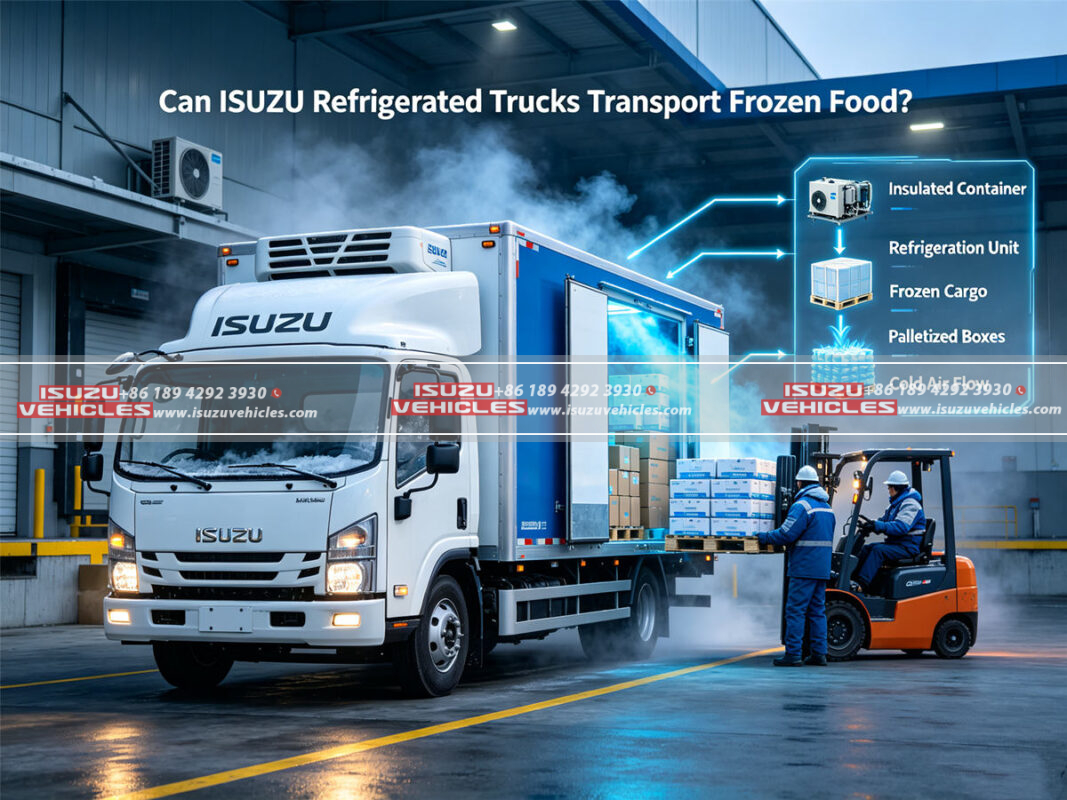
1. Can ISUZU Refrigerated Trucks Transport Frozen Food? Yes, an ISUZU refrigerated truck can be configured to transport frozen food, provided that the vehicle is equipped with an appropriate low-temperature refrigeration unit, properly insulated cargo body, reliable door sealing, and a temperature-control system designed for frozen products. Frozen meat, seafood, poultry, ice cream, frozen vegetables, […]

1. Can ISUZU Fire Trucks Handle Industrial Fires? Yes, an ISUZU fire truck can be configured to handle many industrial firefighting applications, but the key point is that industrial fires are not all the same, so the vehicle must be selected according to the materials present, fire intensity, required water or foam flow, site layout, […]

1. How Does an ISUZU Vacuum Truck Create Suction? An ISUZU vacuum truck creates suction by using a powerful vacuum pump to remove air from a sealed waste tank, producing negative pressure inside the tank and allowing normal atmospheric pressure to push liquid, sludge, sewage, and other materials through the suction hose and into the […]

How long an ISUZU refrigerated truck takes to cool depends on the starting temperature, target temperature, cargo-box size, insulation performance, refrigeration-unit capacity, ambient temperature, and whether the truck is cooling an empty box or trying to remove heat from warm cargo. In practical cold-chain operations, these are two very different situations: an empty refrigerated body […]

An ISUZU sweeper truck can carry different amounts of water depending on its chassis, body size, sweeping system, and intended operating environment, with current configurations ranging from approximately 1.0–1.5 cubic meters on some compact road-cleaning models to 4,000–5,000 liters on larger municipal sweepers. This difference is important because the water tank is not simply an […]