


ISUZU 20M Water Tower Fire Truck
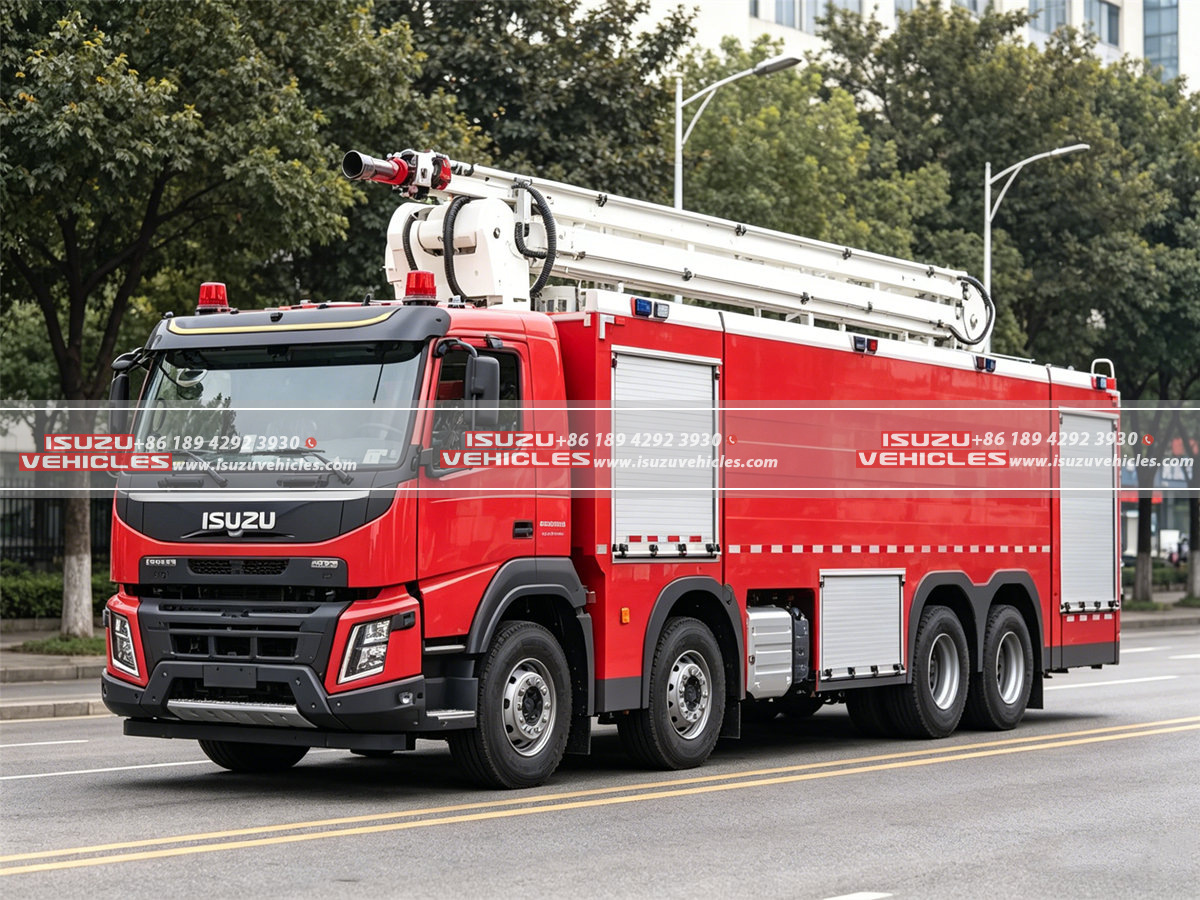
The ISUZU 20M Water Tower Fire Truck represents a pinnacle of modern firefighting technology, combining aerial access capabilities with powerful water delivery systems to address the increasingly complex challenges faced by fire departments responding to mid-rise building fires, industrial emergencies, and large-scale structural conflagrations. Built upon the legendary ISUZU GIGA 8×4 heavy-duty chassis, this aerial firefighting platform delivers exceptional stability, reliability, and operational effectiveness that professional firefighting teams demand when confronting dangerous and time-sensitive emergency situations.
This water tower fire truck integrates a sophisticated 20-meter aerial boom system with a high-capacity water and foam delivery infrastructure, creating a unified firefighting platform capable of delivering substantial water volumes to elevated positions while maintaining the maneuverability and rapid deployment characteristics that emergency response scenarios require. The vehicle’s comprehensive design addresses every aspect of aerial firefighting operations, from initial deployment to sustained suppression activities, providing firefighters with the tools necessary to protect lives and property effectively.
Key Highlights
The 20-meter aerial water tower system enables effective firefighting operations for mid-rise buildings reaching up to approximately seven stories, industrial facilities with elevated equipment and storage configurations, and large open areas where conventional ground-based monitors cannot achieve adequate coverage or reach. The maximum working radius exceeding 16 meters provides flexibility in positioning the vehicle safely away from structural hazards while maintaining effective water delivery to the fire scene, a critical consideration when dealing with buildings that may be structurally compromised or at risk of collapse.
The high-capacity tank system combining 17,000 liters of water and 2,000 liters of foam ensures extended operational duration without the frequent refilling interruptions that would otherwise limit effectiveness during major fire incidents. This substantial capacity enables firefighters to maintain continuous suppression operations while ground crews establish water supply lines or while access constraints prevent immediate relay of additional resources to the scene.
The CB10/170 high-flow fire pump delivering 170 liters per second at 1.3 megapascals pressure works in conjunction with the PLKD10/120-2 fire monitor to provide powerful fire suppression capability with exceptional reach and coverage. The monitor’s 95-meter water range and 90-meter foam range enable firefighters to attack fires from positions that would otherwise be inaccessible or dangerously exposed, while the electric remote control system with manual backup ensures reliable operation even under the most demanding emergency conditions.
Built on the ISUZU GIGA 8×4 heavy-duty chassis, this water tower fire truck offers superior stability derived from its substantial axle load capacity, robust suspension system, and wide-span hydraulic outriggers that create a solid foundation for aerial operations. The double-row crew cab configuration accommodates six firefighters with their equipment, enabling rapid response with full personnel complement while the vehicle proceeds directly to the emergency scene.
Features
Chassis and Structural Configuration
The foundation of this water tower fire truck rests upon the proven ISUZU GIGA double-row crew cab chassis, a platform engineered specifically for the demanding requirements of heavy firefighting apparatus. The 8×4 drive configuration provides exceptional traction and load distribution, ensuring reliable performance across varied terrain and road conditions that fire apparatus may encounter when responding to emergencies throughout municipal response areas.
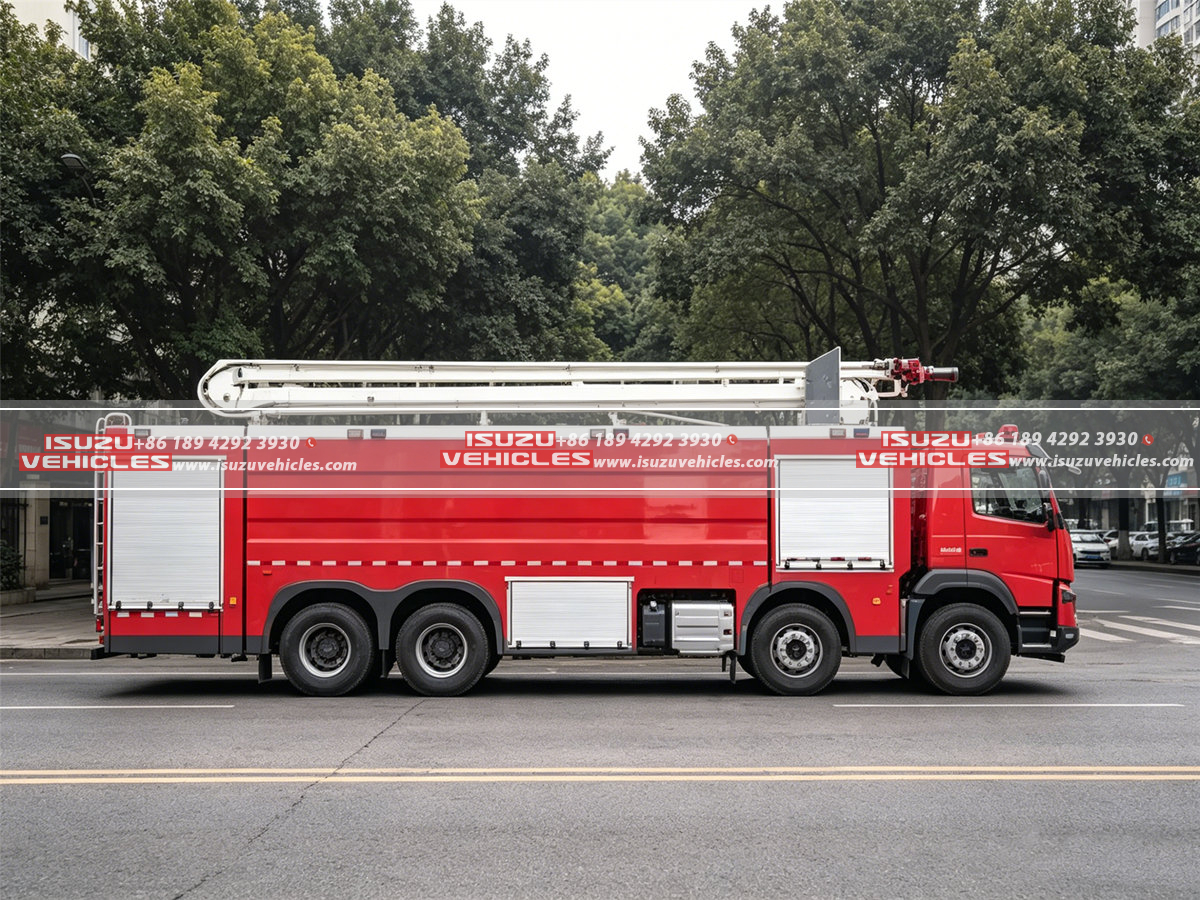
The vehicle’s overall dimensions of approximately 11,900 by 2,540 by 3,980 millimeters represent a substantial footprint that accommodates the aerial system, tankage, and pumping equipment while remaining within legal transport limits for road travel. The sophisticated wheelbase configuration of 1,850 plus 4,600 plus 1,370 millimeters distributes vehicle weight appropriately across all axles, with front axle loads rated at 2 times 7,500 kilograms and rear axle loads rated at 2 times 13,000 kilograms providing the structural capacity necessary for the substantial equipment load and operational stresses encountered during firefighting operations.
The ISUZU GIGA double-row crew cab provides seating for six firefighters in a comfortable and functional arrangement that enables crews to don personal protective equipment during transit and prepare mentally for the operations ahead. The interior layout positions equipment storage conveniently while maintaining clear sightlines and accessibility that experienced firefighters appreciate during high-stress emergency responses.
The FAST 12-speed manual transmission delivers the gear range necessary for both highway response and low-speed maneuvering at fire scenes, while the hydraulic power steering with power assist ensures responsive and precise control during the complex positioning maneuvers that aerial apparatus require. The gross vehicle weight rating of approximately 41,500 kilograms with a curb weight around 24,000 kilograms provides a rated payload capacity suitable for carrying full water and foam loads, equipment, and the full firefighter crew with their personal gear.
Engine Performance and Specifications
The propulsion system centers on the ISUZU 6UZ1-TCG61 inline 6-cylinder turbocharged and intercooled diesel engine, a powerplant that represents ISUZU’s engineering excellence in heavy-duty commercial applications. This six-cylinder configuration delivers an impressive 380 to 420 horsepower output with maximum torque reaching approximately 1,800 to 2,000 Newton-meters, providing substantial power reserves for both vehicle propulsion and the demanding hydraulic requirements of aerial operations and fire pump engagement.
The 9.8-liter displacement provides generous internal dimensions for the engine’s moving components, contributing to long-term durability and the ability to sustain high power output during extended emergency operations. The turbocharging and intercooling systems optimize air delivery to the cylinders, ensuring efficient combustion across the entire operating range and responsive performance when maximum power is required for rapid acceleration or demanding operational situations.
Emission compliance with Euro V or Euro VI standards ensures that the vehicle meets current environmental regulations while positioning it favorably for future requirements that municipalities may encounter as emissions standards continue to evolve. The 400-liter fuel tank capacity provides substantial operational range, enabling extended response capabilities without the need for refueling during major incidents that may require sustained operations over many hours.
Aerial Water Tower System
The 20-meter maximum working height positions the water monitor platform well above typical mid-rise building rooflines, enabling firefighters to direct suppression streams directly onto elevated fire involvement or to reach upper-floor windows where occupant rescue or ventilation operations may be occurring. This elevation capability proves invaluable for addressing fires in buildings ranging from four to seven stories where traditional ladder trucks may lack sufficient reach or where the volume of water delivered by ground-based equipment proves inadequate.
The maximum working radius exceeding 16 meters provides operational flexibility that proves critical when fire conditions require positioning the vehicle at safe distances from burning structures. This radius enables effective water delivery while maintaining clear separation from potential collapse zones, falling debris, or other hazards that may threaten apparatus positioned too close to active structural fires. The combination of height and reach capabilities creates a substantial operational envelope that firefighters can exploit to maximum tactical advantage.
The 360-degree continuous rotation capability of the boom system ensures complete coverage around the vehicle without repositioning, enabling firefighters to address multiple fire involvement areas or to shift suppression focus rapidly as fire conditions evolve. This unrestricted rotation proves particularly valuable at complex incident scenes where fire spread or structural conditions may require frequent adjustment of water application angles and positions.
The multi-section telescopic boom constructed from high-strength alloy steel provides the structural integrity necessary to support the water monitor platform and resist the dynamic loads imposed during water delivery operations. The three to four boom sections extend smoothly through the hydraulic system, with the automatic hydraulic leveling system maintaining platform stability regardless of boom position or vehicle orientation on uneven terrain. This leveling capability ensures safe and effective operation on slopes, uneven surfaces, and the varied terrain that fire apparatus may encounter at incident scenes.
The hydraulic H-type outriggers with spans exceeding 7.5 meters create a stable foundation for aerial operations, distributing vehicle weight across wide support points that resist tipping forces during boom deployment and water delivery. The independent or linked outrigger operation enables precise positioning on constrained sites where full outrigger deployment may not be possible, while the outrigger interlock system prevents aerial operations from initiating until proper outrigger deployment has been confirmed.
Fire Pump System
The CB10/170 fire pump represents the heart of the vehicle’s suppression capability, delivering a rated flow of 170 liters per second at 1.3 megapascals pressure. This substantial flow rate enables continuous water delivery that can overwhelm fire growth and achieve meaningful suppression progress on major structural fires, while the rated pressure ensures sufficient force to project water through the monitor system to achieve the vehicle’s impressive reach specifications.
The vacuum pump priming device achieves pump priming in 50 seconds or less, enabling rapid establishment of water supply from the onboard tanks or external sources. This quick priming capability proves critical during emergency operations where immediate water delivery can prevent fire spread and protect occupant life, and where delays in establishing suppression capability may result in significantly worse outcomes.
The rear-mounted or mid-mounted pump installation positions the fire pump for optimal weight distribution and accessibility, with the chosen configuration depending on specific operational requirements and equipment layout preferences. Both installation options provide adequate clearance for maintenance access while protecting the pump from road debris and environmental exposure during transit operations.
Fire Monitor System
The PLKD10/120-2 fire monitor delivers rated flow of 120 liters per second, providing substantial water delivery capacity through the aerial boom system to the fire scene. The monitor’s design incorporates both electric remote control capability for precise positioning from the platform console or ground control station, and manual backup operation that ensures continued functionality if electronic systems experience failures during critical operations.
The monitor’s rotation angles of 0 to 360 degrees horizontally and -15 to plus 70 degrees vertically enable complete coverage of the operational envelope, allowing firefighters to direct suppression streams at any angle necessary to address fire involvement regardless of building geometry or fire location. This full range of motion proves essential when attacking fires in complex structures or when maintaining suppression on multiple fire areas simultaneously.
The shooting range of 95 meters for water and 90 meters for foam provides exceptional reach that enables effective fire attack from positions far removed from structural hazards. This extended range proves particularly valuable at incidents involving buildings at risk of collapse, where hazardous materials may be present, or where the sheer scale of the fire requires substantial separation between the apparatus and the fire involvement area.
Tank System
The 17,000-liter water tank provides substantial suppression capacity that enables extended continuous operations without the frequent refilling interruptions that would otherwise limit effectiveness during major incidents. This capacity represents enough water to support approximately 100 seconds of continuous monitor operation at full flow, or significantly longer periods when operating at reduced flows or with intermittent application tactics.
The 2,000-liter foam tank provides complementary capacity for Class B fire suppression and enhanced effectiveness on Class A fires through the blanketing and cooling properties of foam application. The separation of water and foam into independent compartments prevents cross-contamination and enables precise foam proportioning regardless of tank levels.
The PP composite tank material offers corrosion resistance and lightweight construction compared to traditional steel tank designs, reducing overall vehicle weight while maintaining long-term durability in demanding fire service applications. The built-in anti-wave baffles prevent excessive water movement during transit, maintaining vehicle stability and ensuring consistent pump supply regardless of road conditions or maneuvering.
Foam Proportioning System
The automatic proportioning system delivers consistent foam concentrate injection at adjustable mixing ratios of 3 percent or 6 percent, accommodating different foam concentrates and fire scenarios with simple adjustment. The plus or minus 1 percent accuracy ensures that foam solution concentration remains within effective parameters throughout operational periods, preventing both the waste associated with excessive foam concentrate use and the reduced effectiveness that insufficient concentration would produce.
Hydraulic System
The hydraulic system operating at 20 to 25 megapascals provides the force necessary for boom extension, elevation, rotation, and outrigger deployment through the electro-hydraulic proportional control system. This advanced control architecture enables precise and responsive operation of all aerial functions, with proportional control providing smooth and predictable movement that operators appreciate during critical positioning tasks.
The hydraulic system independently manages boom extension and elevation, rotation control, and outrigger deployment, enabling coordinated or independent operation of each function based on tactical requirements and operator preferences. The system design incorporates redundancy and fail-safe features that maintain safe operation even if individual components experience malfunctions.
Electrical and Control System
The 24-volt electrical system powers all control, monitoring, and lighting functions throughout the vehicle, with the higher voltage providing adequate power for the substantial electrical demands of aerial operations, fire pump controls, and monitoring systems. The distributed control architecture incorporates in-cab control system, ground control panel, and platform control console that enable operation from multiple positions depending on tactical requirements and operator preferences.
The real-time boom angle and height display provides operators with continuous feedback regarding aerial system position, enabling precise placement of the water monitor at desired locations. The load monitoring system tracks aerial loads and prevents overload conditions that could compromise structural integrity or stability, while the fault diagnosis system identifies electrical or hydraulic issues that may require attention, enabling proactive maintenance and preventing unexpected failures during operations.
Safety Features
The comprehensive safety architecture protects both equipment and personnel through multiple redundant systems designed to prevent dangerous conditions and mitigate consequences if abnormal situations develop. The automatic overload protection prevents aerial operations when loads exceed safe limits, while the emergency stop system enables immediate cessation of all aerial functions if hazardous conditions develop.
The boom limit protection prevents movement beyond structural limits that could damage equipment or create unstable conditions, and the anti-tip protection system monitors vehicle stability throughout aerial operations, preventing boom movement that could compromise the stability margin. The emergency manual lowering device provides a means of recovering the aerial system if primary hydraulic power becomes unavailable, ensuring that the boom can be safely stowed even under failure conditions.
The night operation lighting system illuminates the work area for effective operations during low-light conditions, while the comprehensive lighting package ensures that the vehicle remains visible and identifiable during emergency response and scene operations.
Optional Configurations and Customization
The ISUZU 20M Water Tower Fire Truck offers numerous optional enhancements that allow fire departments to customize the vehicle for specific operational requirements. The thermal imaging camera system enables operators to identify hot spots and fire extension through smoke and darkness, enhancing situational awareness and tactical decision-making during complex fireground operations.
The remote wireless control for monitor provides enhanced flexibility for positioning operations, enabling single-person deployment of the aerial system and water delivery capability. The stainless steel tank upgrade provides enhanced durability for demanding applications or aggressive water chemistry conditions.
The compressed air foam system generates expanded foam with significantly greater volume and longer persistence than conventional foam, enhancing suppression effectiveness and reducing water consumption. The rescue lighting system provides scene illumination for rescue operations and scene management, while additional hose reels and equipment compartments enable the vehicle to support a wider range of operational requirements beyond aerial firefighting.
Performance and Operational Advantages
The 20-meter aerial water tower system enables effective firefighting for mid-rise buildings, industrial facilities, and large storage areas that would overwhelm conventional ground-based suppression capabilities. This elevation capability transforms the vehicle from a simple water delivery platform into a comprehensive aerial firefighting system capable of addressing the vertical dimension of modern building construction.
The combination of high-capacity tanks ensures extended operation without frequent refilling, enabling sustained suppression efforts during major incidents while ground resources establish relay operations or while access constraints prevent immediate reinforcement. This operational endurance proves critical during complex incidents that may require many hours of continuous suppression activity.
The high-flow fire pump and long-range monitor provide powerful fire suppression capability with excellent reach and coverage, enabling effective attack from positions that protect both firefighters and apparatus while maintaining the water delivery necessary to achieve suppression objectives. The comprehensive safety systems ensure that these capabilities can be deployed with confidence, knowing that protective systems will prevent dangerous situations and mitigate consequences if abnormal conditions develop.
Built on the ISUZU GIGA 8×4 heavy-duty chassis, this water tower fire truck offers superior stability, reliability, and adaptability for demanding firefighting missions. The combination of proven ISUZU drivetrain components, sophisticated aerial system, and comprehensive suppression infrastructure creates a vehicle that professional fire departments can depend upon for the most challenging emergency response situations.
Specification
| Item | Details |
|---|---|
| General Vehicle Parameters | |
| Vehicle Type | Water Tower Fire Truck (Aerial Platform with Monitor) |
| Chassis Brand | ISUZU GIGA |
| Drive Type | 8×4 (Left-hand drive) |
| Overall Dimensions (L×W×H) | ≈ 11,900 × 2,540 × 3,980 mm |
| Gross Vehicle Weight (GVW) | ≈ 41,500 kg |
| Curb Weight | ≈ 24,000 kg |
| Max Speed | 95–100 km/h |
| Emission Standard | Euro V / Euro VI |
| Chassis Configuration | |
| Cab Type | ISUZU GIGA double-row crew cab |
| Seating Capacity | 2 + 4 (6 firefighters) |
| Wheelbase | 1,850 + 4,600 + 1,370 mm |
| Axle Load Capacity | Front Axles: 2 × 7,500 kg; Rear Axles: 2 × 13,000 kg |
| Transmission | FAST 12-speed manual gearbox |
| Steering System | Hydraulic power steering with power assist |
| Engine System | |
| Engine Model | ISUZU 6UZ1-TCG61 (or equivalent) |
| Engine Type | Inline 6-cylinder, turbocharged, intercooled diesel |
| Engine Power | 380–420 hp |
| Maximum Torque | ≈ 1,800–2,000 Nm |
| Displacement | 9.8 L |
| Aerial Water Tower System | |
| Max Working Height | 20 m |
| Max Working Radius | ≥ 16 m |
| Rotation Angle | 360° continuous rotation |
| Boom Type | Multi-section telescopic boom (3–4 sections) |
| Material | High-strength alloy steel |
| Platform Type | Water monitor platform (no bucket or optional small platform) |
| Leveling System | Automatic hydraulic leveling |
| Outriggers | Hydraulic H-type, span ≥ 7.5 m, independent or linked operation |
| Fire Pump System | |
| Fire Pump Model | CB10/170-2 |
| Rated Pressure | 1.3 MPa |
| Rated Flow | 170 L/s |
| Priming Device | Vacuum pump, ≤ 50 s priming time |
| Pump Installation | Rear-mounted or mid-mounted |
| Fire Monitor System | |
| Fire Monitor Model | PLKD10/120-Z |
| Rated Flow | 120 L/s |
| Control Mode | Electric remote control; manual backup operation |
| Rotation Angle | Horizontal: 0–360°; Vertical: -15° to +70° |
| Shooting Range | Water: ≥ 95 m; Foam: ≥ 90 m |
| Tank System | |
| Water Tank Capacity | 17,000 L |
| Foam Tank Capacity | 2,000 L |
| Tank Material | PP composite material (corrosion-resistant and lightweight) |
| Tank Structure | Built-in anti-wave baffles; independent water and foam compartments |
| Foam Proportioning System | |
| Mixing Ratio | 3% / 6% adjustable |
| Type | Automatic proportioning system |
| Accuracy | ±1% |
| Hydraulic System | |
| Hydraulic Pressure | 20–25 MPa |
| Control Mode | Electro-hydraulic proportional control |
| Functions | Boom extension and elevation; rotation control; outrigger deployment |
| Electrical & Control System | |
| Operating Voltage | 24V |
| Control Panels | In-cab control system; ground control panel; platform control console |
| Monitoring Features | Real-time boom angle and height display; load monitoring; fault diagnosis |
| Safety Features | Automatic overload protection; emergency stop system; boom limit protection; outrigger interlock; anti-tip protection; emergency manual lowering; night operation lighting |
| Tire & Fuel System | |
| Tire Specification | 12.00R20 or 315/80R22.5 (12+1 spare) |
| Fuel Tank Capacity | ≈ 400 liters |
| Optional Configurations | Thermal imaging camera; remote wireless monitor control; stainless steel tank; CAFS; rescue lighting; additional hose reels & equipment compartments |
| Performance Highlights | 20m aerial tower for mid-rise building, industrial and storage firefighting. 17,000L water + 2,000L foam for long operation. High-flow pump and long-range monitor for strong suppression. ISUZU GIGA 8×4 chassis ensures high stability and reliability for heavy firefighting missions. |




Reviews
There are no reviews yet.