


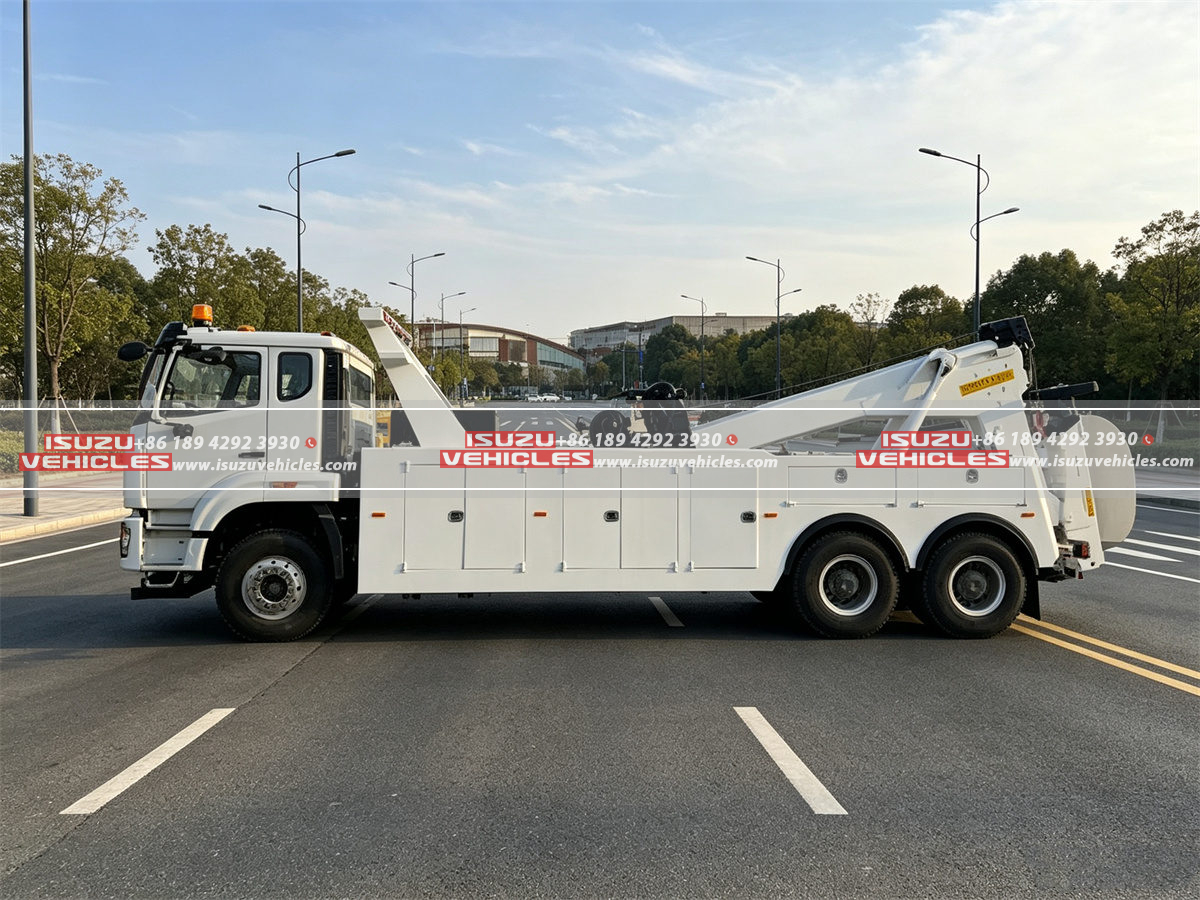
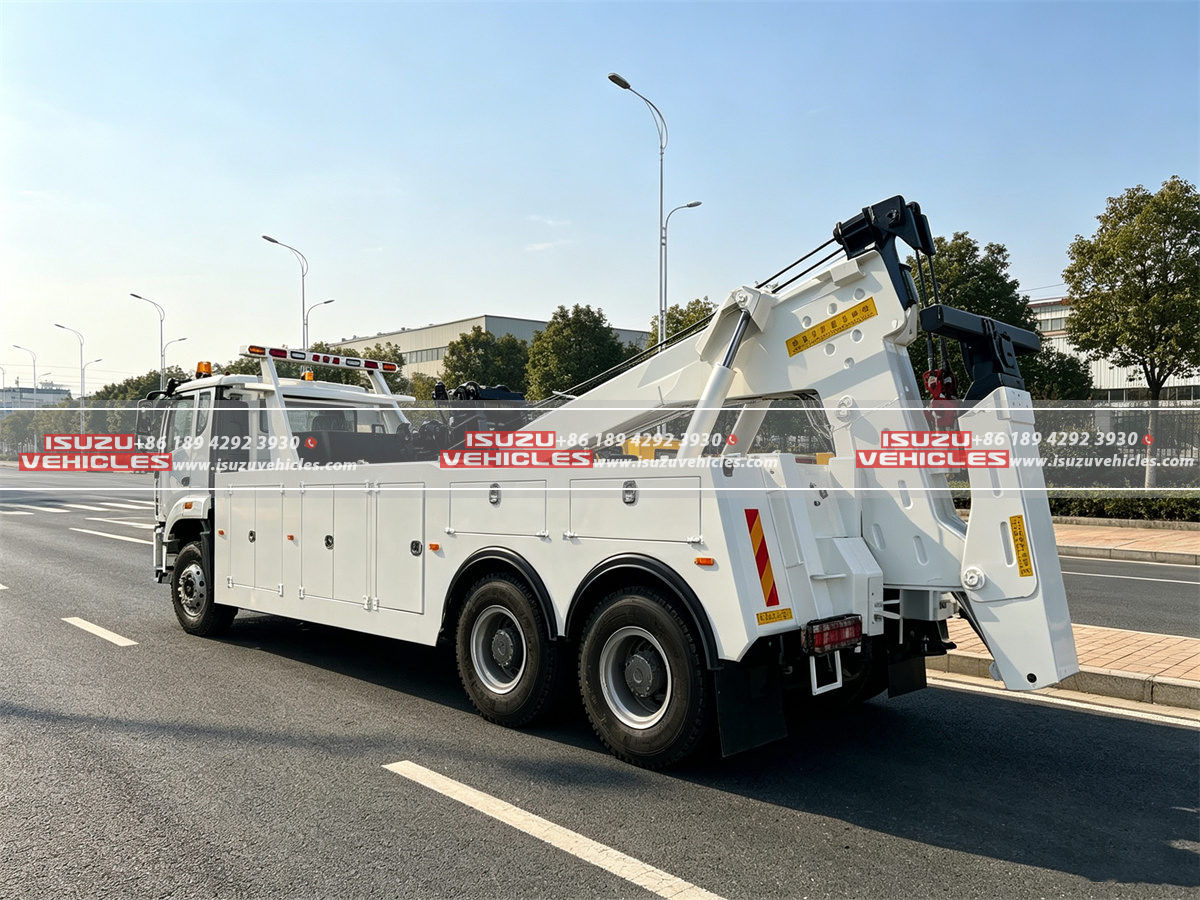
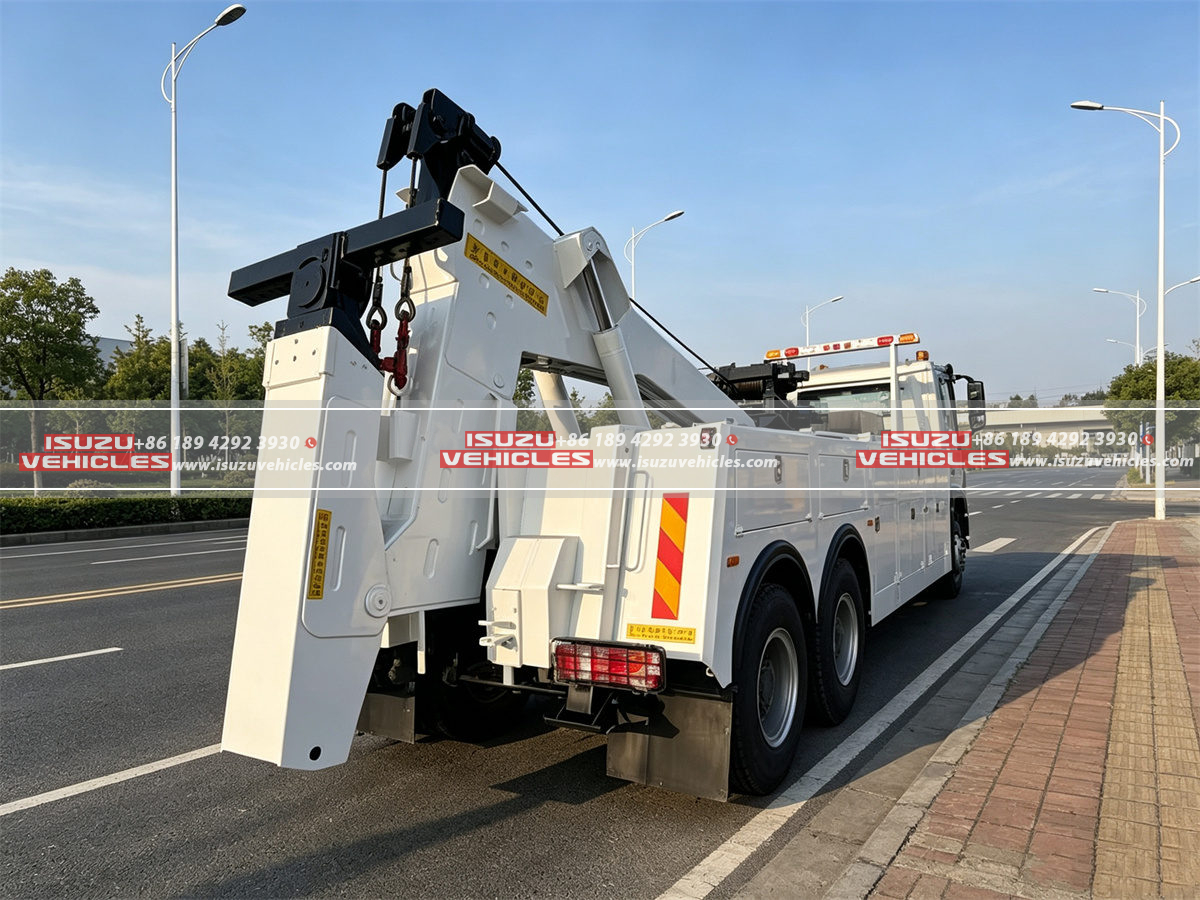


ISUZU 35 Ton Recovery Towing Truck
The ISUZU 35 Ton Recovery Towing Truck is a high-capacity heavy-duty recovery vehicle engineered for demanding towing, lifting, and roadside rescue operations involving large commercial vehicles, buses, construction equipment, and heavily damaged or disabled vehicles. Its professional recovery superstructure combines a 40,000 kg maximum tow rating, a powerful underlift system, a long-reach boomlift structure, dual 10,000 kg hydraulic winches, and two hydraulic support legs, creating a comprehensive recovery platform capable of handling complex situations that require significantly more capability than a conventional tow truck. For businesses looking for different recovery configurations, the current ISUZU Tow Truck range includes flatbed, rollback, integrated, and heavy-duty recovery vehicles for different operating requirements.
40 Ton Maximum Towing Capacity
The vehicle’s 40,000 kg maximum towing rating places it firmly in the heavy-duty recovery category, allowing professional recovery operators to handle large disabled vehicles and substantial commercial equipment that would be beyond the practical range of light- and medium-duty wreckers. This high towing capacity is particularly valuable for highway rescue services, commercial towing companies, fleet operators, industrial recovery contractors, and emergency teams that may encounter heavily loaded trucks or accident-damaged vehicles requiring controlled recovery.
Advanced Underlift Recovery System
The underlift structure provides a static capacity of 28,000 kg, while its fully extended lifting capacity is 12,500 kg, giving the truck a substantial range of recovery capabilities according to the position and extension of the equipment. The underlift has a retracted length of 1,660 mm and can extend to 3,400 mm, with a working angle from -8° to +16° and a folded angle under no load ranging from -7° to +93°.
This adjustable underlift configuration allows operators to position the recovery equipment according to the dimensions, axle arrangement, and recovery position of the disabled vehicle, making it particularly useful when a conventional fixed towing connection is not practical.
50 Ton Boomlift Structure
The boomlift system provides a remarkable 50,000 kg retracted lifting capacity, while the extended lifting capacity is rated at 8,000 kg, giving operators a substantial lifting reserve when working with heavy vehicles and equipment. The boom measures 5,170 mm in its retracted configuration and extends to 8,470 mm, while the maximum lifting height reaches 6,500 mm and the working angle ranges from 5.0° to 33°.
The difference between retracted and extended lifting capacities provides clearly defined operating parameters for different boom positions, allowing the recovery team to select an appropriate configuration according to the required reach, load, and working position during a recovery operation.
Dual 10 Ton Hydraulic Winches
The truck is equipped with two hydraulic winches, each providing a maximum pulling power of 10,000 kg, giving the complete recovery system a combined winching configuration designed for demanding pulling operations. Each winch is fitted with 45 meters of steel cable with an 18 mm cable diameter, while the minimum winch speed is specified at 5 meters per minute, providing controlled cable deployment and recovery during roadside rescue work.
Features of ISUZU 35 Ton Recovery Towing Truck
1. 40 Ton Maximum Tow Rating
The most important capability of the ISUZU 35 Ton Recovery Towing Truck is its 40,000 kg maximum tow rating, which provides the capacity needed for heavy commercial vehicle recovery and specialized towing applications. The system is designed for situations where disabled trucks, buses, heavy equipment, and accident-damaged vehicles must be moved from highways, industrial areas, construction sites, or other difficult locations.
With this level of towing capability, the vehicle can serve as a dedicated recovery asset for professional towing companies, highway emergency services, fleet operators, and specialized rescue organizations that need a high-capacity recovery platform available for demanding incidents.
2. High-Capacity Underlift Structure
The underlift system provides a 28,000 kg static capacity and a fully extended lifting capacity of 12,500 kg, making it suitable for supporting and towing substantial vehicles from their front or rear axle area. The underlift retracts to 1,660 mm and extends to 3,400 mm, allowing the operator to adjust the recovery geometry according to the vehicle being recovered.
Its working angle ranges from -8° to +16°, while the unloaded folded angle ranges from -7° to +93°, providing a broad mechanical range for positioning the underlift during different recovery procedures.
3. Long-Reach 8,470 mm Boom
The boomlift structure uses a 5,170 mm retracted boom that can extend to 8,470 mm, giving the recovery truck a long working reach for complex lifting and vehicle-recovery situations. The maximum lifting height is 6,500 mm, while the working angle ranges from 5.0° to 33°, allowing the operator to select a suitable boom position according to the recovery environment.
The long boom is particularly useful when a disabled vehicle is positioned away from the recovery truck or when direct access is restricted by road barriers, other vehicles, accident debris, or difficult terrain.
4. 50 Ton Retracted Boom Lifting Capacity
The boomlift provides a 50,000 kg retracted lifting capacity, demonstrating the heavy-duty nature of the recovery superstructure. When the boom is fully extended, the specified lifting capacity is 8,000 kg, reflecting the changing mechanical load conditions as the boom reaches farther from the recovery vehicle.
This capacity variation is an important part of professional recovery equipment because the operator must select the correct boom extension and working position according to the actual load and required reach, particularly when recovering large vehicles or heavy equipment from difficult positions.
5. Two 10,000 kg Hydraulic Winches
The recovery system incorporates two 10,000 kg hydraulic winches, each fitted with a 45-meter-long steel cable measuring 18 mm in diameter. The dual-winching arrangement provides greater flexibility when pulling disabled vehicles and allows recovery personnel to configure the pulling operation according to the vehicle’s position and the surrounding working environment.
With a specified minimum line speed of 5 m/min, the winches are configured for controlled pulling rather than simply high-speed cable deployment, which is particularly important when operators need to carefully position a heavy vehicle during accident recovery or roadside rescue operations.
6. Dual Hydraulic Support Legs
Two hydraulic legs are installed as part of the recovery superstructure, providing additional support when the underlift and boom systems are placed under substantial loads. These support legs help establish a more stable working configuration during lifting and recovery operations, particularly when the recovery truck must handle significant forces through its hydraulic equipment.
The combination of the support legs with the underlift and boom systems allows the vehicle to function as a coordinated recovery platform rather than relying on a single towing mechanism.
7. Four Sets of Steel Forks and Recovery Accessories
The truck is equipped with four sets of steel forks, a set of tow-fork sleeves, and a set of steel plate hanging lug forks, providing operators with different connection and lifting options for various recovery situations. The supplied accessories allow the recovery equipment to be adapted to different vehicle structures and lifting requirements instead of relying on a single fixed connection method.
An ABS device, long warning light, auxiliary light set, and auxiliary pipe assembly are also included, helping create a more complete configuration for professional roadside recovery and emergency vehicle rescue operations.
8. Flexible Recovery for Heavy Commercial Vehicles
The combination of the underlift and boomlift structures gives this recovery truck a level of flexibility that is particularly valuable when dealing with heavy commercial vehicles. The underlift can be used for supported towing, while the boom provides the lifting reach required when a vehicle must be raised, repositioned, or recovered from a more complicated location.
This multi-function design can be especially useful for highway recovery teams and professional towing fleets that regularly encounter different types of disabled vehicles and cannot rely on a single standardized recovery method.
9. Professional Configuration for Complex Recovery Operations
The recovery superstructure is designed around multiple coordinated hydraulic functions, including underlift extension, boom extension, boom lifting, winching, and hydraulic support. By combining these functions on a single heavy-duty recovery truck, operators can approach complex rescue situations with more than one method of vehicle engagement and movement.
For comparison, the current ISUZU 30T Rotator Tow Truck provides another heavy-duty recovery configuration, using a 30-ton rotator boom and 16-ton wheel-lift system for demanding recovery operations. This makes it a useful alternative for customers whose work requires rotational recovery capability rather than the specific underlift and boom configuration of this 35-ton model.
10. Built for Heavy-Duty Towing and Rescue
The ISUZU 35 Ton Recovery Towing Truck is designed for demanding professional applications where towing capacity, lifting reach, winching force, and equipment versatility are all essential. Its 40,000 kg tow rating, 28,000 kg underlift static capacity, 50,000 kg retracted boom capacity, 8,470 mm extended boom length, dual 10,000 kg winches, and hydraulic support legs provide a comprehensive set of capabilities for large-scale vehicle recovery.
For customers comparing heavy-duty ISUZU recovery vehicles, the current ISUZU Tow Truck range provides multiple recovery configurations, while the ISUZU GIGA 20 Ton Flatbed Tow Truck offers a heavy-duty flatbed solution for transporting large commercial vehicles and equipment. The current ISUZU range also includes the ISUZU Flatbed Tow Truck with Crane, which combines flatbed recovery with crane lifting capability for customers who need a more versatile loading and transportation configuration.
With its 40-ton towing capability, heavy-duty underlift, long-reach boom, dual hydraulic winches, hydraulic support legs, and comprehensive recovery accessories, this ISUZU recovery towing truck provides a specialized solution for highway rescue departments, professional towing companies, commercial fleet operators, accident recovery teams, construction equipment recovery services, and other organizations that require substantial lifting and towing capability in a single vehicle.
Specifications
| Parameter | Details |
|---|---|
| Superstructure – Underlift structure | |
| Tow rating | 40000 kg |
| Fully extended | 12500 kg |
| Static capacity | 28000 kg |
| Retracted length | 1660 mm |
| Extended length | 3400 mm |
| Working angle | -8 ~ +16 ° |
| Folded angle unload | -7 ~ +93 ° |
| Superstructure – Boomlift structure | |
| Retracted lifting capacity | 50000 kg |
| Extended lifting capacity | 8000 kg |
| Retracted boom length | 5170 mm |
| Extended boom length | 8470 mm |
| Max lifting height | 6500 mm |
| Working angle | 5.0~33 ° |
| Winch | |
| Quantity | 2 |
| Max. pulling power | 10000kg *2 |
| Length of steel cable | 45m *2 |
| Diameter of the cable | 18 |
| Min. speed of winch | 5 m/min |
| Hydraulic Legs | |
| Qty | 2 |
| Equipped | Four sets of steel fork, a set of tow-fork sleeve, a set of steel plate hanging lug fork, a set of ABS device. A long warning light. Auxiliary light set, auxiliary pipe assembly |




Reviews
There are no reviews yet.